Donovan, Laurence
← All authors
Lawrence Louis Donovan (July 1885 – March 11, 1948) was an American pulp fiction writer who wrote nine Doc Savage novels under the pseudonym Kenneth Robeson, published between November 1935 and July 1937. Born in Cincinnati, Ohio in July 1885, he worked as a press feeder in Covington, Kentucky before becoming a newspaperman.
Donovan later became a copyreader and journalist for the San Francisco Call-Bulletin and the Vancouver Sun, as well as city editor for the Spokane Chronicle. During the late 1920s, he began contributing to myriad pulp magazines ranging from the dignified Argosy to the bizarre Zeppelin Stories. Prior to that, he appears to have toiled in Hollywood, and according to family lore, was once considered for the screenplay of the 1925 silent epic Ben-Hur, but lost the opportunity during one of his infamous drinking binges.
Donovan broke into pulps in 1929 via the story "Brick Sacrifices" written for Street & Smith's Sport Story Magazine. By 1933, he was writing for Street & Smith editor John L. Nanovic, contributing short stories to the back pages of The Shadow, Doc Savage, Nick Carter, Pete Rice and others, sometimes under the house name of Walter Wayne. In the pages of Street & Smith's Detective Story Magazine, Clues and Western Story Magazine, he employed the bylines "Patrick Everett" and "Patrick Lawrence"--both cobbled together from the names of his two sons.
In 1936, Street & Smith brought out The Whisperer magazine, with Donovan writing brutal, uncompromising stories in a gritty style particularly suited to the character. Donovan married Ruth Johnson in 1924, and their son Laurence Junior was born in 1927 in Vancouver, British Columbia, followed by another son, Patrick, a year later while the family was living in Spokane, Washington.
Donovan died in seclusion in Manhattan on March 11, 1948. His final known story, "Redheads Kill Easy," was published posthumously in the February 1952 issue of New Detective.
Books (1)
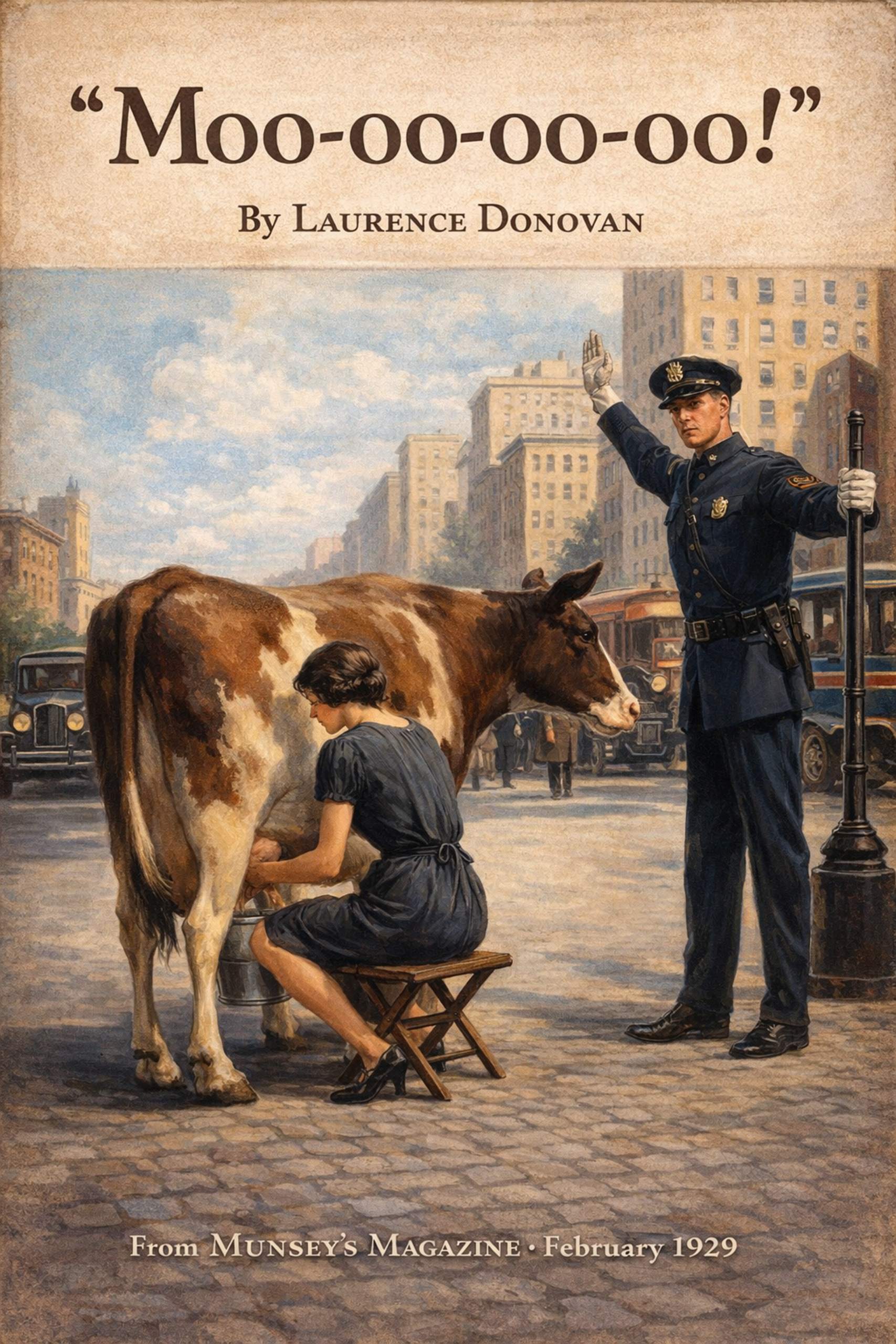
“Moo-oo-oo-oo!”
At a roaring city intersection, an Irish immigrant traffic officer nurtures a quiet, impossible fascination with a refined young woman who passes his post each day in a gleaming roadster. Bound by class, uniform, and self-doubt, he contents himself with fleeting smiles and imagined worlds far beyond his reach. But when an unexpected urban disruption shatters routine, the distance between them narrows in ways neither anticipates. Blending gentle humor with tender social insight, this early twentieth-century tale explores dignity, longing, and the surprising grace found in everyday encounters.
![Book cover]()