A MILITARY INTERLUDE
The hut was both cold and dark. There were no windows to admit the light of the waning day, but through every crack and chink penetrated the sharp, bitter air of January. Alva Jukes, standing in the doorway, saw only white ovals of faces staring upward from the wretched pallets and, though he was a brash, hard-tempered man, oft called upon to witness suffering, the sight of so much unnecessary misery fed the latent rebellion in his Scotch-Irish heart. He struck a posture, put a hand to a hip as if caressing a sword-hilt and mimicked the voice of a colonel well known but not well loved by the brigade—
“And what have you got for supper, my brave fellows?”
The answer came back to him in mock respect from half a dozen throats—
“Fire-cake and water, sir!”
“Ah,” purred Jukes, plucking at an imaginary cloak, “and what have you for breakfast, sons of freedom?”
“Fire-cake and water, sir!”
“And now, my laddies, tell me what you eat for dinner.”
“Fire-cake and water, sir!”
Jukes, grinning dourly through his whiskers, joined them in the chorus—
“God send our commissary of purchases to live on fire-cake and water.”
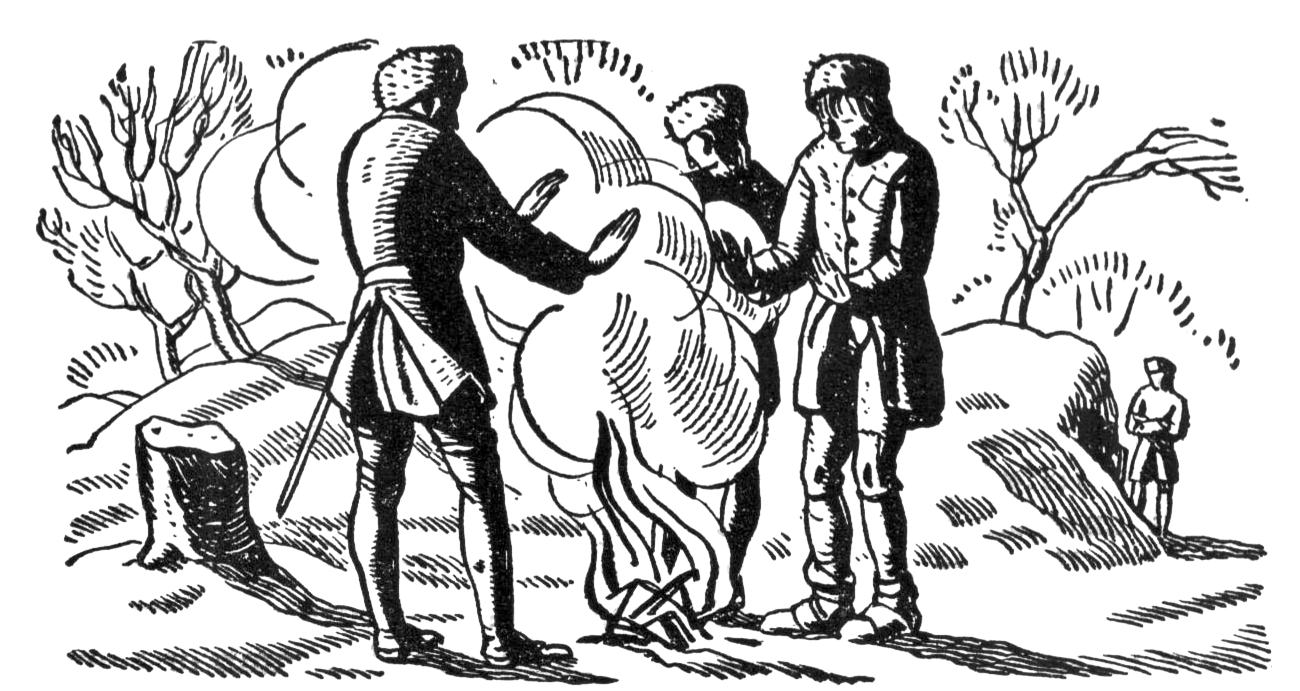
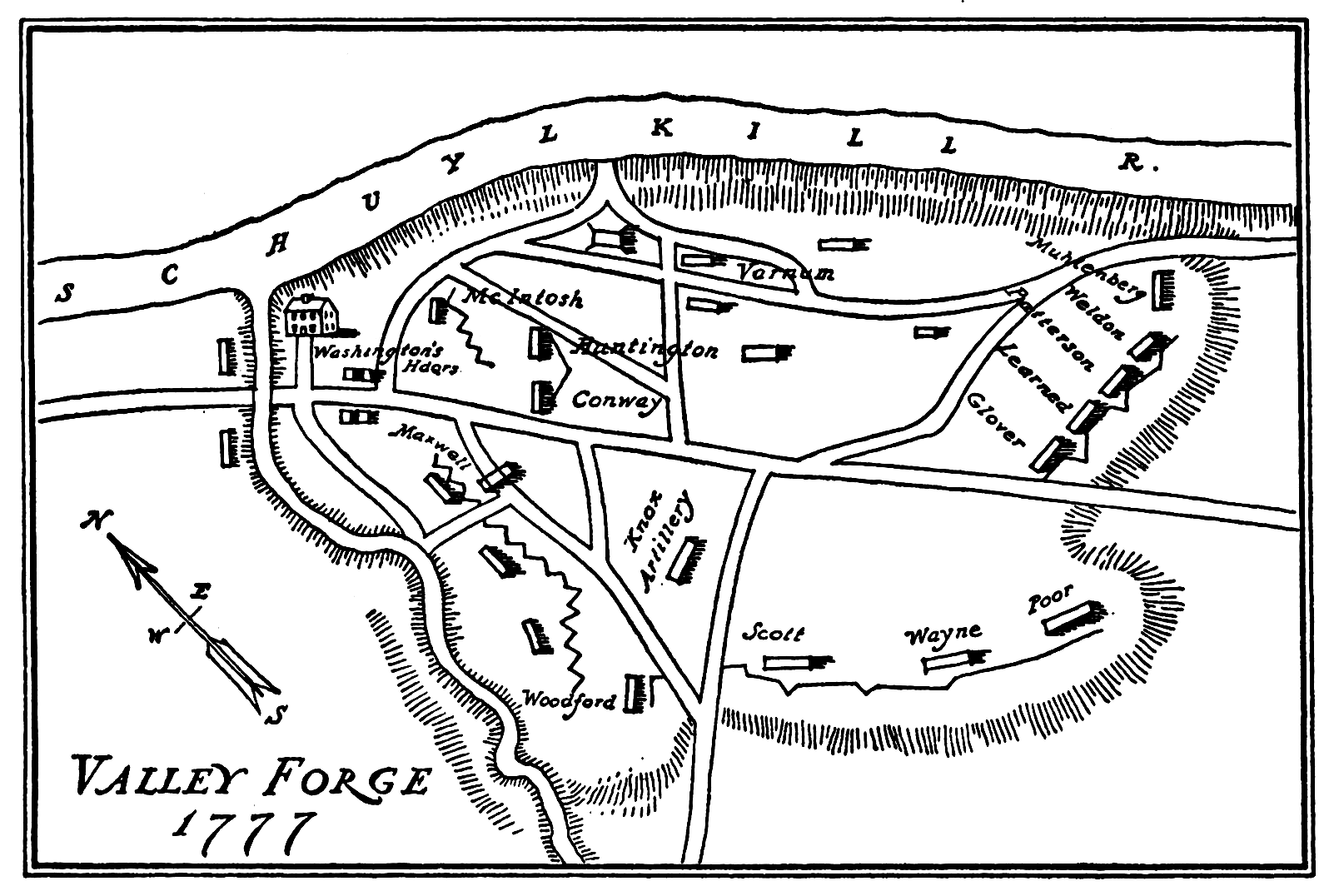
Snow blanketed Valley Forge, dampened the lesser camp sounds and made the crackling-cold air seem doubly severe. A cart, loaded with wood, crept past the hut, drawn by ten or twelve men hitched to a rope; men who moved with dreadful slowness, heads bent, feet slipping on the ground. Here and there fires burned on the brigade street, surrounded by the feeble and the ragged. An officer rode by—a queer sight with a counterpane covering him from head to foot and a shawl, wrapped turban fashion around his head. Alva Jukes stared at these scenes with somber eyes, his hatchet-faced visage growing more and more pointed.
“What’s become o’ the fire I left burnin’?” he asked. “—— of a crew you are to let it die!”
“There ain’t no more wood, Serg’nt,” croaked a remote voice. “I give it the last lick an’ a promise, but it didn’t seem to help. Here’s a letter fer you—come by the courier a small time back.”
“Hey, a letter?” muttered Jukes. “An’ who’d be writin’ to me?”
He crossed the threshold and met a man’s outstretched hand. Retreating to the open, he broke the seal and spread the paper before puzzled eyes. It took some time for him to decipher the illiterate, poorly formed scrawl, for he had no more education than the common run; but at last he mastered the sentences, face settling.
D’r son, you been gone 2 years now, ain’t it time to come hame I ben worrit for y’r helth, the Neely boys went to war for 3 months an come hame braggin fit to kill. Y’ve did your share, pa is doin porely, seems he cant get his wind back after the cold. I never eat but think you must be starvin. Come hame, y’r lovein mother.
He folded the message and tucked it in his pocket. Some one coughed spasmodically, ending with a strangled sigh.
“I don’t figger there’d be room left in the hospital er I’d go. Serg’nt, you better look at Will Cordes; he ain’t answerin’ no questions lately.”
Jukes stepped around a body and knelt in a corner.
“Will, me lad, ’tis a poor time to be sleepin’.” There was no answer and Jukes’ hand, crossing the man’s face, found it stone cold. “Will,” said he, sharply, “you’ll be freezin’ unless you move about. Come now.”
He spoke to unheeding ears. His fingers, resting over the flat chest, found no reassuring movement. He rested on his knees for a long period, while a dismal silence pervaded the hut.
“I reckon,” said a husky voice, “he’s done passed out, eh, Serg’nt?”
Jukes rose.
“I’ll be gettin’ a buryin’ detail. ’Tis the third from this hut in a month. Well, he was a strong lad or he’d gone earlier.”
Another voice broke in:
“Jukes, you heard anything ’bout them clothes supposed to be comin’? Fella told me a ship was in from France with enough to supply the hull army.”
“Huh,” said Jukes, retreating to the doorway. “All I heard was the Congress had sent a committee down here to see why we ain’t satisfied.”
“—— the Congress! What’ve they ever done fer us? Yah, sendin’ a committee! All they do is send committees! Washington could’ve won this war by now if Congress was anything but a pack o’ shilly-shally lawyers! Look at poor Will—the boy’d never died if the cursed Congress had only kep’ us in clo’s an’ vittals. —— the Congress fer a pack o’ spineless, jealous rats! They talk fine but they ain’t got spunk enough to take keer of the army. Better keep their noses outen this camp or they’ll have no army.”
It was a white-hot indictment, spoken in half hysterical tones. All the man’s fears, all his outraged emotions, unleashed by the death of a comrade, went into the diatribe. At the end he was left with his breath coming in gasps while the others of the hut muttered their approval. He had spoken the almost unanimous opinion of the army, an army who daily saw the carts wheeling a dozen bodies like that of the unfortunate Will Cordes through the streets. Jukes, though possessed of tempestuous emotions and a stern sense of justice, bridled his feelings with a sardonic pressure of lips and retreated from the hut.
Turning up the street, he trudged toward the hospital tent, a long, thin figure with the face and eyes of a malcontent. Nature in forming him had done him injustice; for he was not as bad nor as ill-disciplined as the sullenness of mouth and cheek would indicate. The expression was an inheritance from Covenanting ancestors, people who had never found life an easy affair. Nevertheless, men gave him the compliment of legends. His taciturnity in camp and his profane frenzy in battle made him a known figure throughout the brigade.
He reached the hospital hut, left a report of the dead man and retraced his way through the snow, observing here and there footprints edged with crimson. It made him all the more bitter-eyed and his sharp nose sank nearer his chest. He passed several fires and came again to his own cheerless hut. He tarried only long enough to take an ax leaning by the door and went on, aiming for a stand of timber beyond the brigade street.
A certain shapely tree drew him through a deep snowdrift. Getting a position knee deep in the snow, he sank the bitt of the ax into the bark and sent the chips flying.
“Guess paw must be doin’ poorly,” he muttered, between blows. “Else why should maw be spendin’ money on a letter? That cussed Bige done said he’d provide fer ’em while I was gone.”
But then Bige was only a shiftless cousin, too afraid of his own skin to join the army, and perhaps two years’ providing for the family had set him to grumbling. Born grumblers, all the Jukes. He balanced the ax and measured the fall of the tree; he too, he decided, was a grumbler.
His labor was arrested by a sudden disturbance in the street. A lieutenant strode along the line of huts shouting:
“Turn out, men! Turn out for grand parade! Turn out, Pennsylvania!”
Jukes stared at the graying sky and left the bitt of the ax buried in the tree, determining to finish the chore when he had returned from parade. Floundering through the drift, he reached the street, only to be assailed by an entirely new and unexpected commotion. The men were turning out, no doubt, of that; but they were coming not with muskets and belts, nor in the usual lethargic manner. They emerged from the huts bearing pots and pans, beating them together, sending a racket toward the leaden sky and breaking into a chant that, started by one voice, was immediately taken up by others until the camp rang with it.
“No meat, no soldier! No bread, no parade! Poor Dick a-freezin’! No meat, no soldier!”
The officer raised his arms futilely while the ragged soldiers made a ring around him. At every instant fresh voices joined the chorus and more pans swelled the tumult. Jukes, elbowing his way to the fore of the circle, saw angry faces, sick faces, faces that were flushed and faces that were ghastly white.
The whole affair had an undertone of desperation; they were not men revolting from discipline; they were men who had very nearly reached the limit of endurance. Ill, discouraged, and brooding over the obvious injustices done to them, one man’s catch-phrase had set them off. Jukes’ temper flamed in sympathy. He reached the center of the throng in time to hear the lieutenant, an angry and puzzled man, sing out:
“Stop it, men! D’you want to turn this camp upside down? —— of an example we’ll make for other regiments. Stop the infernal racket!”
He was too young to command influence and his words were drowned by the redoubled cry:
“No meat, no soldier! No more fire-cake an’ water!”
One side of the ring parted precipitately and four horsemen, led by a plump brigadier with ruddy cheeks, forced a path to the center. The brigadier leaned over to catch the lieutenant’s words. And then as suddenly as all this racket had begun it subsided, leaving the crowd moving uneasily, some exhausted, others implacably rooted to their places. The brigadier’s face was very solemn, and when he spoke it was not in anger but with compassionate gravity.
“You do yourselves ill, gentlemen,” said he, “to create such a disturbance. Must we win battles from the enemy and lose them among ourselves? Fie that there should be such dissension! Come now, what’s the root of all this?”
The silence was so heavy that the crackling of wood on a near-by fire echoed like gunshots in the frosty air. A voice sang out—
“Jemmy Rice, you speak for us.”
Jukes waited several moments to hear the man’s voice. At last he turned and sought through the crowd until his eyes fell upon Rice—a tumultuous character of his own company who had the readiest tongue for grievances in all the camp. But Jemmy Rice was silent now in face of the brigadier. For this was akin to mutiny and he had no stomach to put himself up as a ringleader to be shot.
Jukes, waiting further, closed his fist and took a pace forward where the brigadier’s searching eyes might find him. The wild rush of feeling that sprang upward, had it been allowed to escape, would have sent a torrent of angry words upon the officer. Jukes checked it, lips turning thin from the effort. His somber face met the brigadier not defiantly but as an equal speaking to an equal.
“A man died in my hut this afternoon fer lack o’ food an’ lack o’ blankets. Died on the ground with nary a straw beneath him. There’s four others in that hut an’ none fit to be abroad. That’s what we raise Cain about.”
The brigadier inclined his head.
“I am aware of the misfortunes of this camp. Every officer worth a grain of salt is aware of them. Don’t you think we spend our days trying to make conditions a little better? But what help d’you expect by this conduct?”
Jukes, looking beyond the brigadier, caught sight of his captain, an angry man indeed that one of his own company should be spokesman of rebellion. He squared his shoulders and proceeded:
“We ain’t doubtin’ your efforts. But it don’t seem in the power o’ officers to help us, so we try raisin’ our own voices. We ain’t had meat fer six days. Last rations o’ bread were plumb moldy. Clothes—well, we don’t expect none, never havin’ had an issue since October. There’s half o’ this company in the hospital an’ more waitin’ to get in when beds are empty. As fer pay, I ain’t seen a scrap o’ money fer fourteen months. Now we hear there’s a committee of the Congress comin’ down to see why we ain’t satisfied. Well, sir, God grant they come to this company fer information!”
The swelling echo behind him told Jukes he had spoken the brigade’s mind. The captain’s face was black as thunder but the brigadier never changed a whit.
“You are mild enough. Were I inclined I could add to that tale of misfortune and make it darker still. Gentlemen, your grievances are my own. But it will never do to break down like this. It only gives our enemies a chance to strengthen their position. Nothing will ever convince me you are the kind to sully your honor by sedition. I want you all to disperse to your huts. Meanwhile I may tell you there is at this moment wagon-trains bound for camp with warm clothes and fresh beef. Now, gentlemen, retire to your quarters.”
The brigadier, looking over their thoughtful countenances, knew he had broken the back of resistance. They had given his words attention and that meant they were still reasonable. Being a kindly man, he clinched his victory with mildness.
“Many of you are very weak. Considering that, we will omit grand parade tonight. The guards will be posted informally.”
The men broke from the ring one by one, slowly returning to their huts. The brigadier and his staff rode away. Jukes, profoundly affected, trudged down the street, breasted the snow bank and caught the handle of his ax. A dozen blows brought the tree down and he set to cutting off branches and sections. Perhaps a half-hour passed at this occupation and the gray dusk fell without warning while he meditated over the plight of his comrades. His recent speech had made him aware of his own personal troubles, too, and as he chopped at the log he thought again of his folks at home.
“That Bige,” he muttered, “allus was a no-’count. As fer them braggin’ Neely boys, they never was worth powder to blow ’em up. Paw must be doin’ poorly.”
He drove the ax into the log and loaded his arms with split wood. Stumbling back to the hut, he began shaving a stick of kindling. He built a teepee of the splinters and went to the adjoining fire for a burning brand to start his own blaze. A flame shot upward and caught the sticks. Some one in the hut called to him:
“That you, Jukes? Didn’t you see the notice?”
Jukes piled more wood on the fire.
“What notice?”
“Fella come down from captain’s quarters with a notice an’ posted it to our hut while you was gone. Better see what it says.”
Jukes took up a flaming branch and carried it to the hut wall. There, stuck to a log where the company orders were usually put, he found the following announcement, written in the clerk’s bold hand:
From this day Jem Rice will be sergeant of the company, taking place of Alva Jukes, returned to the ranks.—Fleming, Captain.
He stood there for a long time, reading the notice thrice over, making sure of its import. The captain’s dark, angry glance had borne fruit and he, Alva Jukes, was to lose the tabard of authority he had won by his own reckless effort. To lose it for speaking nothing but truth; and, what was more unfair, to lose it to a man who had not the courage of his beliefs.
The wild, Scotch-Irish rage gave power to his hand. The burning stick smashed against the notice and sputtered, lighting and consuming the paper.
“Let ’em fight their own war, then!” he cried, ducking into the hut. “I’ve done my share!” He went to his corner of the gloomy place, rolled together his bundle of belongings and took his rifle. Going out, he stopped to add fresh fuel to the fire. “Better come an’ take care o’ this now,” he called back.
Ploughing through the snow, he was swallowed by the night. But he hadn’t gone twenty yards before he stopped, put down his rifle and bundle and went back to the fallen tree. He collected another armful of wood and packed it to the fire, grumbling—
“Ain’t a blessed one o’ them boys able to lift a stick.”
A moment later he had vanished again, turning his course to pass the pickets, bound homeward, a deserter from Valley Forge.
The farther he traveled the more powerfully did the bitter resentment affect him. At last he cried out to the black winter sky.
“May the Lord strike me dead if ever I see the army again. —— the Congress! Let ’em fight fer their own freedom if they’re so sot on it. A pack o’ shilly-shally lawyers an’ argufyers!”
He was a tough, canny fellow, Alva Jukes, and capable of sustaining himself through hard affairs. That night, a great deal later, he turned off the road and slept in a barn. At the first crack of day he was away, bearing in his pouch two ears of dried corn, which was his only food for the next ten hours. His course led him northwesterly along a pike, aiming straight for the backwoods part of the State, toward that land he had left better than two years before.
As he traveled he kept good watch behind for patrols that swept the environs of Valley Forge. He was not of a mind to be taken and marched back before a summary court. And so it was that, when his eyes spied horsemen coming along the road, he dropped into a stand of trees and let them pass. They were a few officers on a reconnoitering party and after they vanished around a bend he came from concealment.
At the joining of highways some distance farther along, he chose the lesser used route and soon was slogging through drifts of snow. The sky was lowering and beyond noon the flakes began to drift slantwise through the air. It was about this time, too, that he considered himself removed sufficiently from the army to abandon his precaution and to give all his attention to the road ahead.
The fact that he had left camp without leave bothered his conscience not at all. He was only doing what hundreds of others had done before him. Indeed, members of that army regarded their enlistment agreements as flexible contracts.
Active campaigning kept them together, but when winter set in and the chance of battle was remote they sat before their fires and listened to the call of the home people who needed their help. Then the brigades dwindled. Jukes, bending against the drifts, defended his course with arguments that seemed to him perfectly valid.
“Two years ’thout a single leave,” said he. “Ain’t that enough fer one man? Let some o’ these proud fire-eaters at home try their luck. I done my share.”
He was shrewd enough to know that there were many thousands of able-bodied citizens who had never answered the call to colors and who were perfectly content to let others do their share of fighting. To men of Jukes’ nature, endowed with a keen sense of justice, this was only an added argument as to the propriety of his act. He had done far more than his share. Now let some other take his place.
Even so, his thoughts turned now and then, as the afternoon advanced and he found himself in strange country, to that dark and miserable hut where his comrades rested, all but helpless.
“I reckon there’ll be grand parade tonight,” he mused. “Well, there won’t be many turnin’ out fer it. No they won’t. An’ I bet they let the fire die again. As fer poor Will Cordes—the cussed Congress c’n take the blame fer that.”
The graying shadows came again, flecked by softly falling snow. Here and there, at wide intervals on the road, he passed farmhouses with lights gleaming through the windows and sparks showering from chimneys. He might have turned in and asked shelter, but a stubborn pride kept him away. He was not a straggler, nor could he stomach the thought of begging at doors. He trudged on, waiting for dark to come that he might crawl into a barn overnight.
His keen ears caught the sound of hoofs and he turned to find a solitary figure riding out of a side road and turning his way. Jukes resumed his march, stolidly indifferent. Nor did he cast another glance behind, although he heard the traveler coming nearer; instead, he took the side of the highway, prepared to let the other pass. The traveler came abreast and reined in, speaking courteously.
“A bad day to be afoot, sir.”
Jukes shifted his gun to the other shoulder and looked up to see a plump, benign face. The man was of a quality, a country squire, well dressed and bearing with him a pride of place. A pair of blue eyes beamed from beneath bushy brows, singularly penetrating eyes. Jukes felt the full weight of their scrutiny and was roused to sudden watchfulness.
“I’ve marched in worse times,” said he, noncommittally, still holding aside to let the man pass.
But the elderly gentleman was of a social nature.
“Doubtless you come from Valley Forge,” he suggested. “Going home, possibly, on leave.”
“Take it that way,” assented Jukes, not entirely pleased at the deception but considering it the better policy.
The elderly gentleman looked at the forbidding sky.
“It will snow heavily all night. You had better take shelter soon. There’s a tavern a mile down the road. You’ll find it agreeable.”
“Tavern,” grunted Jukes. “Where’d you figger I’d get money to spend in a tavern? I ain’t been paid in fourteen months.”
“But you most assuredly can’t sleep in the open,” protested the squire. “It’s devilish cold these nights.”
Jukes looked at the man’s fine clothes with sudden resentment.
“I’ve slept in worse. An’ there’s plenty o’ barns along the way.”
“Nonsense. Let it not be said of Pennsylvania that she neglected her soldiers. We’ll stop at the tavern and I shall have the fellow take care of you overnight. Consider yourself as my guest.”
“And who,” demanded Jukes, “might you be?”
“I, sir, am St. Louis Cotton, of Cotton Hall and member of the Pennsylvania Assembly.”
“A lawyer of the Congress?” demanded Jukes, flinging up his head.
“Not of the Continental Congress. I have not that honor. But of the Pennsylvania Assembly.”
The distinction was not fine enough to check Jukes’ animosity. Here was one of the gentry who debated and dallied and broke their promises and appointed futile committees while the army starved.
“—— your hospitality!” he cried. “I take nothin’ from shilly-shally lawyers. ’Tis your kind that makes misery fer the army. ’Tis you who eat well an’ sleep warm while the rest o’ us go without!”
St. Louis Cotton, esquire, sat bolt upright in the saddle and blew through his nose.
“That is cursed impertinence, sir. I offer you the gratitude of a State and you answer it like a wagon-master. I see you are another of those infested with disrespect for the people’s legislatures. There is some sinister influence at work amongst you.”
“Influence o’ an empty belly,” retorted Jukes. “An’ what do you fine gentlemen accomplish, I’d like to know? When we ask fer vittals an’ food we get smart promises. We starve an’ you tell us we eat too much meat anyway. You’re a pack o’ scoundrels an’ the country’d be better without you! ’Tis no credit due you General Washington wins his battles!”
The squire held his peace and Jukes, looking upward through the fast thickening dusk, could make out the ruddy face screwed to the point of apoplexy.
“Fire away, old man,” he added contemptuously. “Give us some o’ them pretty words you use so nice on committees.”
The squire spoke with a commendable restraint—
“I suppose members of the army could do better, were they elected to serve in the Congress?”
“There’d be no shilly-shally, I tell you.”
“When you grow older,” said the gentleman, “you will know better. If a body of angels came together they would fall to quarreling in these terrible times. It is not human nature to be forever agreeable, no matter how desperate the cause. You soldiers forget, too, that every State has its word in the councils of Congress, and seldom do all States agree. Each has its own interests to watch. Perhaps the Congress makes unfulfilled promises, perhaps it errs in judgment. It is a body without power, my friend. It can ask flour and beef of the States, but only conscience can make those States supply the need. Do you forget that?”
Jukes grunted, disquieted. The old gentleman handled words as he handled a gun. He could not oppose the argument because he had no knowledge. But of what use reason when the misery and misfortune of Valley Forge was there to confound all the fine talk of lawyers. If they wanted a free country why didn’t they find means of helping their soldiers?
“’Tis strange,” said he, “how you gentlemen draw pay an’ wear fine clothes no matter how you disagree. An’ it’s a cussed example you set the country by runnin’ off from Philadelphia every time a British gun sounds within fifty miles. A fine example!”
“I can plainly see,” snorted the old gentleman, “that you are a malcontent. You say you are on leave? Where is your paper to show it?”
“I’ll show no papers,” said Jukes, stoutly.
“Then you are a deserter. ——, sir, I’ve a notion to clap a pistol at your head and turn you around for the provost guards.”
Jukes slipped the musket from his shoulders.
“Mind your business, old fellow, or I’ll knock you off that perch.”
They came to a halt, facing each other as the dusk gave way to darkness and the snow fell about them in redoubled thickness. Jukes laughed grimly.
“Stick to your debatin’, old man. You c’n do better at it. Leave the guns to a fightin’ man. Le’s go, now. I ain’t got time to waste on a fat old turkey-cock like you.”
St. Louis Cotton swore softly, putting his horse in motion.
“You are a renegade—a desperate ruffian, better out of the army than in it.”
“Good enough to kill Englishmen though, ain’t I? Good enough to believe in your fine promises when everything looked mighty black. Now you an’ your blue-blood friends c’n fight fer your own necks. I’m through!”
They turned a curve of the road and had sight of a tavern hidden amongst trees, not a hundred yards away. Jukes bit his words in two and came to a halt. A door of the tavern stood wide open, with the yellow light making a lane in the snow. And up that lane filed a squad of men dressed in the uniform of British dragoons. The door closed behind them, leaving Jukes with dry lips and a question on his tongue.
“There a camp o’ those animals hereabouts, old feller?”
“My eyes, they’re —— poor,” said the squire. “What did you see?”
“British dragoons,” muttered Jukes, peering through the darkness. “Saw six go inside. Wonder—”
The squire was swearing.
“That patrol again! Sweeps this part of the country frequently. No camp this side of Philadelphia. ——, I’d like to put a stop to it! If I had another man or two.”
“Hold on, old feller,” interrupted Jukes, surprized at the former’s warlike speech. “You ain’t the one to do any fightin’. If they’d ketch you usin’ a gun an’ wearin’ civilian clothes they’d hang you.”
“Tut,” said the squire. “I bear a colonel’s commission in the militia.”
“Milisher, huh? Well, anybody could be an officer in the milisher. It’s no-count.”
Jukes was on his knee, head thrust forward, as if trying to penetrate the darkness. The squire dismounted from his horse, muttering.
“If you weren’t such a rascally fellow and we had another one or two—”
“Old man,” broke in Jukes, “I’m goin’ to do a little scoutin’. Stand fast till I come back.”
He slipped his knapsack to the ground and swiftly advanced, the aggressive Scotch-Irish spirit rousing at the proximity of the enemy and a daring plan working through his canny head. Within ten yards of the place he stopped, hearing the champing of a bit. After some moments of intent observation he decided no guard had been left with the animals and moved around the corner of the tavern to a window. The light sparkled through the frosted panes. Jukes removed his hat, raised himself cautiously and commanded a clear view of the interior.
His count had been right. Six of them, headed by a sergeant, were seated around a table; six solid looking fellows with vests loosened to the heat of the room, saber points clanking on the floor. The tavern keeper moved across the boards with steaming cups and disappeared in the kitchen a moment, reappearing with a platter of meat. Jukes located the inner kitchen door and ducked down, grinning dourly.
“They’ll be feedin’ some minutes,” he muttered, working his way back. “Well, we’ll give ’em time to hang themselves.”
He cruised around the yard and reassured himself there was no guard with the horses, going so far as to put his hands upon the hitching rack and take another knot in each of the tied reins. If any of them wished to get away in a hurry they’d find unexpected difficulties. He moved back to the squire’s position.
“Six of ’em,” said Jukes. “Mr. Milisher Colonel, you got any weapons?”
“My pistols. D’you mean you’ve got spirit enough to flush ’em?”
“Well, fightin’s my trade. You talk loud but I ain’t sure you’ll stand fire. Milisher never do. Howsoever, if there’s any gimp in that fat skin o’ yourn come along. I want you to go to the front door an’ wait until you hear me shout. Then you shout—as loud as you can, breakin’ in. I’ll be comin’ through the back way. Le’s go.”
The squire tied his horse to a fence and followed Jukes until they were within a few paces of the tavern.
“Wait until you hear me,” admonished the latter, “then make all the noise you can.”
He turned away. Another furtive glance through the window showed him the dragoons had turned to industrious trenchermen and he skirted the wall of the house until he saw a crack of light coming through a rear door. He tried it gently and found it gave way. At that point he stopped to affix his bayonet, then shoved the door open and let out a cry loud enough to startle every echo in the countryside.
The door slammed against the inner wall and Jukes, musket advanced, careened through a hot kitchen, had a momentary glimpse of a frightened woman shrinking back, and arrived at the front room. He cried again—a high, wailing, half savage yell—and burst upon them at the moment the squire, obeying instructions to the letter, burst through the front way, waving his pistols.
“Surrender, gentlemen, or you die!”
The table went over, sending the dishes to the floor with a crash and clatter. Dragoons flung themselves against the wall, sabers flashing, pistols out.
“Charge ’em!” yelled the sergeant. “Kill the devils!”
Jukes’ musket roared; smoke filled the room and the sergeant’s face sagged. He fell to the floor, knocking aside the weapon of one of his men.
“Come on, Pennsylvania!” shouted Jukes, his face afire.
He was as a man gone stark mad, teeth bared and eyes flashing. The bayonet met a saber and knocked it aside. The room shook with gunshots and he felt the powder burn his cheeks. Through the sudden sweat that dripped over his eyes he saw his bayonet point turn to bright red. The squire’s hoarse voice cried encouragement and summoned aid from the night. His pistols spoke and then he was borne out of sight by a dragoon retreating from the wild man with the face of fury who slashed and struck and parried and lunged with a crimson bayonet.
The room was in semi-darkness, swimming with smoke; the fireplace glowed dully, reflecting on the sergeant’s sightless eyes. The squire, from the outer shadows, sent back a great cry:
“Keep at ’em, my boy! You’ve bagged the birds!”
“Swords down!” shouted a disheveled dragoon, sagging at the knee. “We’re taken. Put up your gun, man!”
There were two of them standing against the wall, one with a streak of blood across his face, the other staring sullenly.
“Gad,” said he, “we’ve been taken by a cursed savage! Quarter!”
Jukes swayed in his tracks, black hair fallen about his face, sweat rolling across his whiskers. At some point in the mêlée the cloth of one sleeve had been ripped by a saber and it hung away from his skinny arm, making him all the more a nondescript figure. The flaming fervor slowly faded from his eyes and he dropped the point of his bayonet, suddenly tired.
They had done well enough. The sergeant and two others were dead on the floor; two were prisoners and one had fled. The tavern keeper thrust his white jowls out of the kitchen door and Jukes barked at him—
“What’s your politics, fat-face?”
“I’m a good patriot. Ye ——, y’ve wrecked my place!”
“Thank your luck I ain’t wrecked you,” growled Jukes. “Pick up that gun and hold these fellers to the corner.”
He slouched toward the door, bent on retrieving the dragoon who had fled. But there was no need of that. For there he lay, in the patch of snow just beyond the doorsill. And beside him, one arm still gripping a pistol, was the squire, St. Louis Cotton, of Cotton Hall and member of the Pennsylvania Assembly. Jukes bent over, moved by a sudden, generous pity. The squire’s plump face was turned upward and his lips twitched.
“My boy,” he whispered, “if you’re a straggler, go back before it’s too late. No matter how you feel—go back. ’Tis not the time to desert the country. The act will haunt you later, and your sons will hate you. Go back.”
“Aye,” muttered Jukes, “it’s somethin’ I’d most made my mind to this minute.”
But St. Louis Cotton never heard that, for he was dead, carrying on his ruddy countenance that same pride of place. Jukes stared somberly. At last he turned back to the room.
“Alva Jukes wa’n’t born to run off,” he muttered. “They’ll be changin’ guards at this minute—and who’s to help those poor devils to keep the fire goin’?” He thought of the old gentleman with admiration. “A plucky old cock. Maybe he’s right.”
The tavern keeper gave up his gun.
“I had better look after the squire.”
“Get help to bury ’em all,” replied Jukes gruffly. “Now, fat-face, bring out somethin’ to eat an’ tally it to the account o’ Pennsylvania.”
A half-hour later he was bound back to Valley Forge with two prisoners and six horses, the saddle of each one bearing the king’s crown. Jukes smiled dourly as he plodded through the dark, swirling night. After all, they could not do much to a straggler who returned in that royal fashion.
Transcriber’s Note: This story appeared in the July 1, 1927 issue of Adventure magazine.