The Lovable Liar
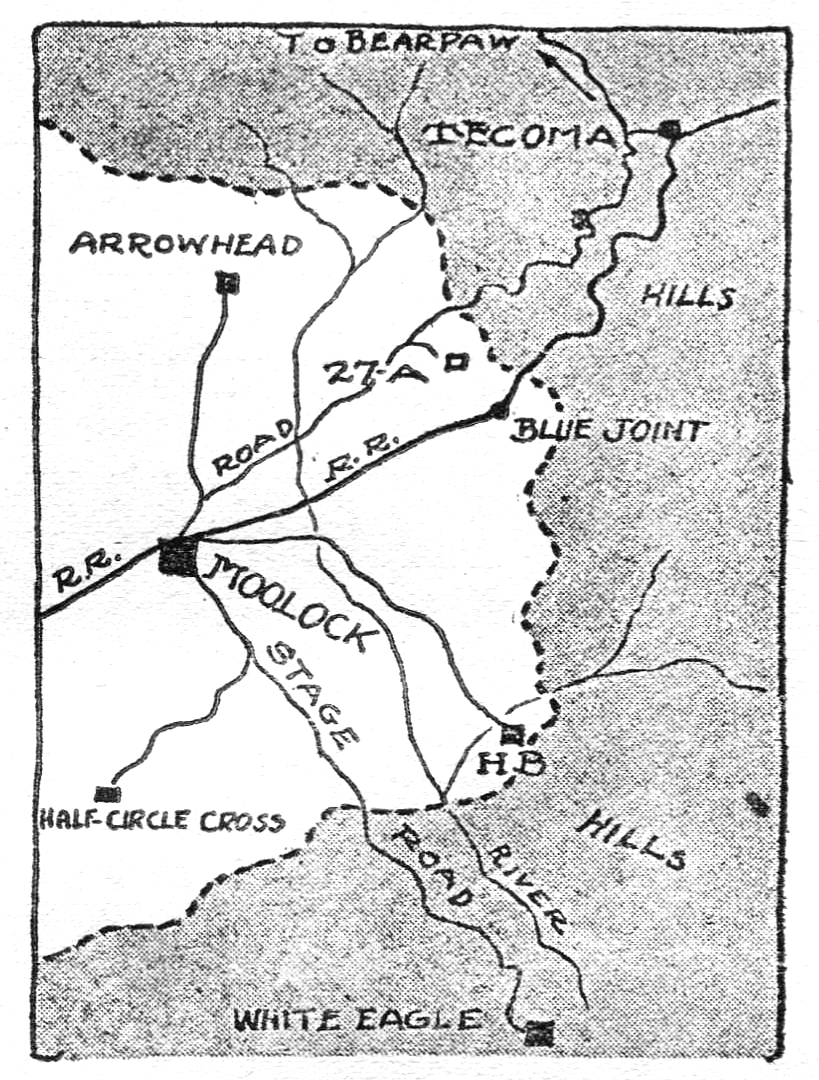
Tecoma consisted of a little depot, a saloon and a restaurant. Inasmuch as the saloon and restaurant were in the same building, it made Tecoma a two-house town. The railroad time table showed that Tecoma had an elevation of five thousand feet, and that certain trains would stop there on a flag.
There was a wagon road of sorts from Tecoma down into the Moolock cattle country, and this alleged road also wound its way from Tecoma back to the mines of the Bearpaw district. The main street of Tecoma was this road, if it might be termed a street. In front of the saloon and restaurant was a long hitch-rack, where a horse might have the privilege of standing at an angle of about forty-five degrees.
Just now it was after dark. The restaurant was closed, as was the depot; but from the open saloon door a shaft of yellow light illuminated part of the rough porch. Inside the saloon, five men sat at a poker table, playing rather indifferently. The stakes were not high enough to make it interesting for a tall, raw-boned cowboy, who yawned wearily and shoved back from the table.
“I wish there was a hotel here,” he said. “Ain’t even a stable where yuh can feed a horse.”
“And that’s whatever,” agreed the proprietor. “Tecoma ain’t no town, pardner. ’F I had a bed I’d offer it to you and your pardner; but all I’ve got is a cot t’ sleep on.”
“It’s about twenty miles to Moolock,” offered the man who owned the restaurant. “The road ain’t none too good, but yuh can get a bed in Moolock.”
The tall cowboy yawned again and squinted at his partner, “Sleepy” Stevens. Sleepy was slightly below the average in height, with broad shoulders, slightly bowed legs and a pair of perfectly innocent blue eyes. His face was angular, almost serious in repose, but at the slightest provocation it would break into a mass of grin-wrinkles, like the ripples from a stone cast into a quiet pool.
“What do yuh think about it, Sleepy?” asked “Hashknife” Hartley, the tall one. “Shall we gird up our broncs and hie away for this Moolock town?”
“Jist so well as not, I reckon,” said Sleepy. “Might as well be ridin’ as settin’ here. I ain’t held better than a pair of jacks since supper.”
“You fellers come in from the Bearpaw?” asked the saloon man.
“Yeah,” said Hashknife. “We came in over the Grayling trail. Some darned liar told us that there was a lot of unlocated land up there—land that was pretty rich; but he lied, as usual. What kind of a country is this Moolock?”
“Cows, mostly. Lot of good outfits. Frank Allenby owns the Half-Circle Cross, the biggest outfit.”
Hashknife looked curiously at Sleepy, who regarded him innocently. They cashed in their few chips, bought a supply of tobacco from the saloon keeper, and went out to the hitch-rack.
As they started to untie their horses, Sleepy grunted wonderingly. He had ridden a roan horse into Tecoma, but the horse he was looking at now was decidedly gray. Its head was hanging low with fatigue and its coat was drying rough with lather.
He called softly to Hashknife, who was doing a little swearing over his own discovery.
“I’ve got a pinto,” grunted Hashknife, as Sleepy blurted out the fact that he had drawn a gray.
There were only two horses at the rack, and only one rack in the town. Sleepy scratched a match and discovered that whoever had made the substitution had changed saddles too.
“We’ve still got our saddles,” he declared. “Now what in —— do yuh know about that?”
Hashknife untied his pinto and led it into the light from the saloon door, where he appraised the animal closely. It was sore-footed and weary. Sleepy walked in beside him, leading the gray, and was about to call to those inside the saloon to come out and help them wonder over it all, when a voice yelled out from the darkness—
“Put up yore hands, doggone yuh!”
A revolver flashed and the bullet bit a splinter out of the sidewalk. With an almost automatic movement, Hashknife drew and fired at the flash; and at the same moment he darted out of the light and flung himself flat on the ground. Sleepy went headlong out of the illumination, rolled down the hill and came to rest behind a big rock.
“Gosh dang yuh, what did yuh do that for, ‘Forty’?” wailed a voice from the gloom. “Who in —— told yuh to shoot, anyway?”
“Don’t walk into that light, ‘Swan River’!” cautioned another voice. “They didn’t go far. I’ve got to fix that gun of mine. It’s too easy on the pull. Don’t git in that light, you darned fool!”
The three men had come to the saloon door, wondering aloud what it was all about. The saloon keeper carried a sawed-off shotgun, and at sight of him, the one called Swan River spoke quickly—
“Hey, Pierson! This is the sheriff.”
“Hello, Swan River,” called the saloon keeper. “What’s all the ruction about?”
“Don’t git in that light!” warned the deputy, “Forty Dollar” Dion, whose gun was easy on the trigger. “I tell yuh they didn’t git far away.”
“Who yuh lookin’ for?” asked one of the men in the saloon doorway.
“The men who own them two horses,” replied Swan River Smith, the sheriff. “They stuck up a train this afternoon, and we’ve been on their trail ever since. That’s their gray and pinto.”
“Hey, sheriff!” called Hashknife.
“Listenin’.”
“Then listen close. Them ain’t our horses. I reckon the three men in the doorway can tell yuh that we rode a roan and a bay into this place late this afternoon, and that we’ve been in there ever since. We jist found that somebody traded horses with us, and was admirin’ ’em in the light.”
“That’s the truth,” said the saloon keeper. “They sure did ride a roan and a bay, sheriff.”
“Well—” the sheriff seemed a bit dubious—“if yuh say so, Pierson, I’ll take yore word. C’mon in, gents.”
Hashknife and Sleepy sauntered back into the light and looked at Swan River Smith and his elongated deputy. Swan River was small, gray as a rabbit, and with a pair of eyes as hard as granite. Forty Dollar Dion was almost as tall as Hashknife, sad of face, and walked with a loose-jointed shamble that would cause one to suspect that he might fall apart at any time.
“I’m the sheriff of this county,” said Swan River, after a close scrutiny of the two cowpunchers. “Name’s Smith.”
Hashknife introduced himself and Sleepy, and they adjourned to the bar.
“You danged near killed me,” declared Forty Dollar mournfully. “My gun went off accidental. I had sense enough to sidestep; and yore bullet poked a hole in the air just after I left. And it ain’t like me to think fast, either.”
“Well,” grinned Hashknife, “yuh can’t blame me, pardner. One of yuh yelled for us to put up our hands and the other one shot at us.”
“Excuse him, if yuh can,” said the sheriff, “I can’t. Here’s happy days and a blanket at night.”
They drank and rattled their glasses on the bar.
“Didja take a good look at them horses, Forty?” asked the sheriff.
“Uh-huh. I was right, Swan.”
The sheriff accepted Hashknife’s tobacco and cigaret papers, which were also passed to Forty Dollar.
“The question is—where did they go from here?” observed the sheriff.
“I’ll betcha forty dollars they headed for Bearpaw,” said Forty Dollar. “They’ve got fresh horses now.”
“And good horses,” added Sleepy mournfully.
“I never heard of a lost horse that wasn’t a good one,” grinned the sheriff. “Nobody ever lost a bad one. Ha, ha, ha! Well, there ain’t no use tryin’ to foller them two fellers now. Our horses are plumb whipped; so we might as well go home, I reckon.”
“How much did they get?” asked Hashknife.
“I dunno. They blew the safe on the express car and took what was in it. Cut the train in two and made their getaway near where they had the horses staked out. But the engineer got a look at the horses they used, and as soon as the train got to Moolock he told me about it. Me and Forty cut straight across the hills and are lucky enough to spot ’em.
“Since then we’ve sure burnt up horseflesh. Comes night and we kinda loses track of ’em; so we heads for here and finds that pinto and gray, standin’ plumb in the light. Yuh can’t blame us for the mistake, can yuh?”
Hashknife laughed and shook his head. It was all clear to him now, and he did not blame the sheriff.
“I reckon we’ll go to Moolock with yuh,” he said. “Mebbe them two horses are as fresh as yours, sheriff.”
“Yeah, sure. Let’s go. It’s a long ride back there; but there ain’t no accommodations in Tecoma. You know anybody down there, Hartley?”
“Nope. Me and my pardner rode into Bearpaw from over the Grayling trail. We kinda had an idea we’d like to do some gold minin’, and we was told that there was plenty of good ground left up there; but there wasn’t an inch. By golly, a moose bird has to keep in the trees to keep from bein’ a trespasser.”
“Pshaw, that’s all been located long ago. Well, let’s have one more drink and pull our freight, gents.”
They told Tecoma good-bye, mounted the jaded horses and headed for Moolock.
“Seems to me that I’ve heard of Moolock,” observed Hashknife, as they jogged along over the dim road through the pines. “The name is kinda familiar. You spoke of a feller named Allenby.”
“Frank Allenby,” said the sheriff. “He’s the biggest man in Moolock county.”
“To hear him tell it,” amended Forty Dollar, “Allenby thinks that his family is responsible for the risin’ and settin’ of the sun. ’S a fact. He tells it when to come up and when to go down.”
“Didn’t Allenby send some young feller to the pen a while ago?”
“Yeah. A young feller by the name of ‘Bud’ Bell. Allenby didn’t exactly send him to the penitentiary; but he was responsible for it. Bud’s out now. I ain’t seen him yet. Mebbe he hates me for what I done, but I had to do it. The Bell family are kinda strong on hate.
“Allenby bought the Half-Circle Cross from Henry Christman about three years ago. Allenby is from Philadelphia. Never seen a cow ranch until he hit this country. Hank Bell nested in on what Christman claimed as his own ranch; but Christman didn’t own it.
“There was bad blood between Christman and old Hank. Christman tried in every way to oust old Hank. Hank’s cows turned up missin’; some of ’em had their throats cut. But old Hank stuck. One day him and Christman met on the street in Moolock and shot it out. Christman got a bullet through one lung and old Hank got his right arm crippled for life.
“It kinda put a crimp into old Hank, as a gunman; so he spent all his time givin’ his son Bud a six-gun education. And Bud was a danged good pupil. Then Christman sold out to Allenby, who tried to oust old Hank, but the old boy had a title to his ranch. It’s a sore spot to Allenby, ’cause Hank’s place has the best spring in the Moolock range.”
“Did they quit killin’ off Hank’s cattle?” asked Hashknife.
Swan River Smith chuckled audibly.
“Yeah, yuh might say they did. The Bible says somethin’ about an eye for an eye and a tooth for a tooth. Anyway, Allenby got the deadwood on Bud Bell and sent him up for five years; but the law let him out in two years and a few days. Now I reckon Allenby is shakin’ in his boots for fear Bud will make him pay for that two years.”
“Allenby is rich, ain’t he?”
“Yeah, I suppose he is pretty well fixed.”
“And I’ll tell yuh why,” said Forty Dollar. “Allenby is so stingy that he wouldn’t pay two bits for a front seat at the Custer battle, if the original actors would come back and play it. It’s an honest fact. To my way of thinkin’, Allenby is a big jughead, with too much money and a soul so danged thin that it squeaks in the wind like a fiddle string. He wants everybody to know that he’s from Philly-del-fee.”
“That ain’t nothin’ agin’ him,” said the sheriff.
“Not that part,” agreed Forty Dollar. “I admire him for gettin’ out that place. I’ve been there——”
“You mean you’ve heard about it,” corrected the sheriff.
Forty Dollar subsided.
“I’ve heard that men don’t value their lives very highly in Moolock,” said Hashknife.
“Thasso?” The sheriff seemed surprised.
“Some as cheap as five thousand dollars.”
“Cheap?” blurted Forty Dollar. “My ——, I could point out a lot that wouldn’t be worth that much per bale. Five thousand! Say, if I was Saint Peter I wouldn’t even accept souls from Moolock, unless they came prepaid.”
“Forty Dollar is a pessimist,” explained the sheriff quickly.
“Yeah and I’m a good democrat. M’ folks was Baptists. Tried to make me one, but the water was too cold that winter; and by spring I was all out of the notion.”
“I think we’ll like Moolock,” said Sleepy.
“Everybody does,” said Forty Dollar. “I know at least a hundred that couldn’t even think of leavin’ there.”
“Love their little city, eh?”
“No—they’re stuck on the little cemetery,” chuckled the deputy. “Ha, ha, ha, ha! I’ll drink with yuh in Moolock.”
They laughed and rode down the last of the steep grades into the valley of the Moolock. The moon had lifted above the timbered slopes of the mountains, bathing the hills and valleys in a blue haze. Far off to the left a light twinkled from a window.
“That’s the 27A ranch,” said the sheriff. “Joe Bass owns it. Joe’s part Nez Percé; quarter-breed, I reckon. Minds his own business. Been here a long time. Ships quite a lot of stock.”
“Moolock is the shippin’ center, ain’t it?” asked Hashknife.
“Most of it goes from there. It’s kinda in the center of the valley; so mostly everybody trades there. I was just wonderin’ what you meant about human life bein’ cheap in Moolock.”
“Nothin’ much,” laughed Hashknife. “I heard that a man—a certain man—only put that much value on his life.”
“Well, I dunno,” said the sheriff thoughtfully. “I s’pose that some folks feel thataway about money. I’d hate to sell mine for that.”
“And yet yuh take a chance every day for so much per month.”
“Yeah, that’s a fact. You fellers aim to get jobs over here?”
“Mebbe. Feller’s got to eat.”
“They sure do. Yuh might see Allenby. Jim Merton might need a man. He runs the Arrowhead brand, and his iron is on lots a cows. Them two are the biggest outfits. You’d like Jim. He’s young and full of ambition.”
“Do yuh think we’d like Allenby?”
“Mm-m-m, well, yuh might. It takes all kinds of folks to make up a world. What’s meat for one man is poison for another.”
It was about one o’clock in the morning when they rode into the town of Moolock, stabled the horses and got a room at the one little hotel. They were too tired to investigate the town, and even the hard mattress of their bed felt like downy feathers.
“It’s funny how things work out,” observed Hashknife, as they stretched out in bed. “We never had any idea of runnin’ into this place.”
“It’s the same Allenby, ain’t it?” asked Sleepy.
“Sure. Bob Freeman said in his letter that it was Allenby of Moolock; so it must be the same feller. He spoke about the feller that Allenby sent to the penitentiary; and about the old man.”
“They are the ones that are stealin’ Allenby’s cows, eh?” Thus Sleepy, with interest.
“The ones he said he’d pay us five thousand for, if we could convict ’em. If we could.” Hashknife laughed. “Allenby wants his detective work done on commission, Sleepy. He’s afraid of his life, that’s what’s the matter with him. And he values it at five thousand.”
“Prob’ly all it’s worth,” laughed Sleepy.
In a different environment Hashknife Hartley might have been a famous detective. His mind was quick to grasp the important points of a case, and that, combined with what a gambler would call a “hunch,” had enabled him to solve some of the mysteries of cowland, which had baffled even the best operatives of the Cattle Associations.
Both he and Sleepy Stevens were top-hand cowboys; but fate had always thrown them into troubled ranges where their detective ability was of more demand than their ability to handle cattle. It was a hazardous calling, and of little remuneration.
Their fame had spread from range to range; and the repeated telling in cowtown, bunkhouse and around the camp-fires had exaggerated their ability until they became a bugaboo to those outside the law on the ranges. But there was nothing superhuman about either of them. There was nothing marvelous about their gun-play; neither could they whip their weight in wild-cats. Yet they had left behind them a trail of righted wrongs, and a memory of two big-hearted cowpunchers, who fought with a grin, asking no favors of anyone; riding away ahead of thanks or remuneration, if possible.
There were homes on the ranges where these two men were mentioned in the evening prayer, and there were places where their names brought forth a curse and the hope that they would never come back. Still they rode on with a grin on their lips, knowing that fate had marked them for certain duties. And they were both confirmed fatalists—facing death with a grin, because they felt that they would never die until the moving finger on the big book wrote Finis after their names.
It was just breaking day the following morning, when “Chet” Hoban, foreman of the Half-Circle Cross, and “Omaha” Olsen, one of the Half-Circle Cross cowboys, rode through the main street of Moolock, which was the only street in the town.
It was a crooked street as well as a narrow one, bordered with false-fronted buildings, of which the livery stable was the most pretentious. The next building in size was the Elk saloon and gambling house, with its spacious hitch-rack crowding close to the narrow sidewalk.
Next to the Elk saloon was the Blue Front Café, with only the name to indicate that at some remote time it might have been painted. Adjoining this building was the White Horse saloon. Across the street from the Elk saloon was the sheriff’s office. On this side of the street were more saloons, a general merchandise store, post-office, stage station and other small business necessary to the comfort of rangeland humanity.
The Moolock hotel was neither of great size nor elegant in appointment, but it served. Its sign read—
FROSTY WELCOME PROP.
Which, as a cowboy had said, “If yuh don’t git treated well, you’ve been warned ahead of time.”
But “Frosty” Welcome was only frosty by nickname and not by nature.
The two cowboys rode through town and cut across a flat toward the big loading corrals near the depot. A string of cattle cars were being shunted onto a spur track by a freight engine, as they rode up to the corral fence and tied their horses.
Chet Hoban was a thin-faced, raw-boned man, whose hair was plentifully dusted with gray, and whose humped shoulders and bowed legs gave him the appearance of one who bears a mighty burden on his back. His boot heels were run-over on the outer side, which caused him to walk jerkily lest he sprain his ankles.
Omaha Olsen was taller than Hoban, and even leaner of frame. His eyes were sad; in fact his whole mien bespoke a great sadness, and his long nose, slightly twisted at the bridge, showed blue veins, as though it might be perpetually damp and cold.
The engine uncoupled and went puffing back toward the depot, while Hoban and Olsen crossed the track, circled the corral and stopped. For a space of several moments they surveyed the empty corral and then, as if by mutual consent, they climbed to the wide plank of the top and gazed across the different pens, their faces filled with an expression of wonderment.
Then Hoban circled to the main gate, where he sat down and looked at the broken padlock, which dangled from a twisted staple. Omaha Olsen came up and peered down at it. Then he produced his tobacco and papers and began calmly rolling a cigaret, while Hoban turned and gazed off across the rolling hills.
“They done busted the lock,” said Omaha. Hoban squinted at him, but did not reply. The busted lock needed no explanation.
“Three hundred of ’em, too,” observed Omaha.
“You keep on and there won’t be nothin’ to tell about,” said Hoban a trifle sarcastically.
“And Allenby will jist about bust a gizzard.” Thus Omaha, ignoring Hoban. “I c’n see him commencin’ to git red and swell up like a carbuncle. My ——, this’ll sure ache him all over.”
“You’d ache if somebody stole three hundred two-year-old Herefords from yuh,” retorted Hoban.
“——, I’d ache if I ever had that many. Now what in —— will we do with these cars?”
Hoban got to his feet, shaking his head.
“Let Clayton worry about that. C’mon.”
They climbed down and went to their horses, which they mounted and rode back into town. The sheriff was still asleep, but Hoban hammered on the office door and woke him up.
“Last night we had three hundred two-year-old Herefords in the loadin’ corrals, sheriff. They were to be loaded this mornin’. Somebody smashed the padlock on the main gate and swiped the whole herd.”
Swan River scratched his head thoughtfully.
“Well,” he said slowly, “that was worth takin’. Smashed the padlock, eh? That’s a penitentiary offense. Took three hundred Half-Circle Cross Herefords, eh? Gosh! Somebody held up the train yesterday, too, Chet. Danged country is goin’ to the dogs. Allenby know?”
“Not yet. We just found it out.”
“We better find Clayton,” said Omaha. “He’ll likely want to see about them cars.”
“I’ll git on some clothes right away and see what I can find out,” offered the sheriff, turning back into the office.
Hoban and Omaha walked up to the hotel, where they found Ed Clayton, the cattle-buyer, just ready to leave for the loading pens. Clayton was a big man, without an ounce of fat on his huge frame. He was not unhandsome, dressed well, and was not over thirty-five years of age. Clayton was an inveterate gambler, a plunger; and his eyes were still heavy from a long session of poker at the Elk.
In a few short words Hoban told him what had happened.
“Sounds like a —— fairy story,” said Clayton, but quickly corrected himself with, “You know what I mean, Hoban; it don’t seem possible.”
Hoban relaxed and nodded shortly. He and Clayton had never been very friendly.
“Mebbe it don’t sound possible,” said Hoban slowly, “but they’re gone. What about your cars?”
“And nothing to put in ’em,” muttered Clayton. “Well, I’ll have to see what can be done. Want to walk up to the depot?”
“All right. Allenby will be here pretty soon.”
The freight was still at the depot and Clayton immediately explained the situation to the agent.
“I’ll tell yuh what we can do,” suggested the agent, “We can send ’em up to Bluejoint. Old Sam Bass has been yelling for cars for three days. He’s got some stock to ship. Shall I take that chance?”
“Go ahead,” urged Clayton. “I don’t want the darned things. If Bass can use ’em, he’s sure welcome.”
Bluejoint was merely a siding and a loading corral about ten miles from Moolock. It was sometimes used by the ranchers of that side of the valley in making small shipments, and was located about two miles from the 27A ranch.
The train crew grumbled audibly, but added the cattle cars to the train, took their orders and steamed away across the valley, while Clayton, Hoban and Omaha went back to wait for Allenby, who rode into town in a buckboard drawn by a pair of cream-colored horses.
Frank Allenby was about fifty years of age, portly and important. When Forty Dollar Dion had declared that Allenby thought the sun arose and set because of the Allenby family, he was not so far wrong. Allenby had a square, protruding jaw, which accentuated the flatness of his cheek-bones, and beneath a slightly hooked nose he wore an aggressive, brush-like, gray mustache.
His suit was of black broadcloth, his boots of finest leather, and his hats were made to order. But he wore an old-fashioned, stiff bosomed shirt, sans collar, but with a huge onyx button; while his cuffs were fastened together with big cameo cuff-buttons. He wore no vest. From a suspender stay dangled a solid gold watch chain, each link at least an inch long.
Hoban met him at the hitch-rack and tied the team, while Allenby got ponderously from the buckboard, the springs of which seemed to sigh with relief. He looked questioningly at Hoban, as though wondering why he was not busy at the loading pens. He could also see Omaha Olsen and Ed Clayton, standing in front of the Elk saloon.
It did not take Hoban long to inform Allenby of his loss, and the big man stiffened, as though to withstand a physical blow. His face paled with anger and then he hunched forward, as if to grapple with his foreman.
“Gone?” he muttered thickly. “You mean that some one stole them?”
“Yuh might say they have,” said Hoban slowly. “The padlock on the big gate has been smashed. I told the sheriff about it.”
Allenby shook his head like a wounded bull. The pocket-book was Frank Allenby’s vital spot, and it nauseated him to think of losing those Herefords. Then he shut his teeth with an audible snap and surged ahead toward the Elk saloon, where he stopped in front of Omaha and the cattle buyer.
“I know about it,” said Clayton sympathetically.
“By ——, I know about it, too!” roared Allenby. He was almost crying with anger. “I know who stole those Herefords. By ——, I know! I’ll——”
“Go ahead and tell me who stole ’em.”
Swan River Smith had crossed the street unnoticed and had heard Allenby’s statement. Allenby turned his head and glared at the sheriff. But Allenby’s glare did not affect Swan River in the least. The big cattle man’s dominating personality meant nothing to the little sheriff.
“Go ahead,” urged Swan River. “I’d shore like to hear his name.”
“That’s my business!” snapped Allenby.
“And mine,” added the sheriff. “If you know who stole yore cows tell me his name. If you don’t know, Allenby, if yore only makin’ a wild guess—keep it to yourself.”
“I’ll do as I —— please!”
“Yeah?” Swan River looked him over coldly. “All right. Free speech is yore right, Allenby. But if you ain’t got evidence enough to back up the name you mention—the law ain’t backin’ you.”
“I don’t need the law. I’ll be my own law, by ——!”
“Huh!” Thus the sheriff softly, as he turned and walked back toward his office. Allenby glared after him. Omaha and Clayton smiled; but Hoban’s face did not change a line.
“Little pup!” sneered Allenby, half under his breath; but the sheriff was too far away to hear it.
“He isn’t much,” agreed Clayton. Hoban looked sharply at the cattle-buyer. Hoban knew that Swan River Smith was a thoroughly capable officer, with a fine record behind him.
“Do yuh know who stole ’em?” asked Omaha innocently.
“Do I know who stole ’em?” parroted Allenby. “I do know.”
“Well, let’s go and get ’em back.”
“Fool!” snorted Allenby. “Do you suppose they’d leave ’em where we could find ’em?” He spat viciously and turned to Clayton.
“When will your man be here, Ed?”
“He’s due any time now. You just keep calm and let Jim Seeley work on this case. He’ll put a stop to it.”
“That’s the detective?” asked Omaha.
“Sh-h-h-h!” cautioned Clayton. “Don’t tell everybody about it.”
“I hope he can handle it,” said Allenby wearily. “I can’t stand losing any more stock. Freeman, the secretary of the association, promised to furnish me with a couple of men, who, he said, are the best in the world on this kind of a case. But they refused to take it. I offered them five thousand dollars for a conviction, but they refused.
“I know who is doing the dirty work, Clayton. I know it just as well as if I had a confession from them; but I need evidence. Nobody else is losing stock. It’s spite work, that’s all it is. For over two years I’ve been losing cattle. I sent one man to the penitentiary, and next time I’ll send two. If I don’t stop ’em, I’ll be broke. I’m going home now.”
“You heard about the train robbery, didn’t you?” asked Clayton.
“Yes. The sheriff chased them to Tecoma, but they got away into the Bearpaw country.”
“Suppose there’s any connection between the train robbery and the rustlers?”
“No. Too far apart. Are you coming out to the ranch today?”
“I may be out later.”
Hoban untied the team and watched Allenby ride back toward the ranch, before joining Omaha and Clayton at the Elk bar.
Hashknife and Sleepy had finished their breakfast in time to see Allenby ride away. The sheriff was standing in the doorway of his office when they arrived, and told them that the big man was Frank Allenby.
“Allenby ain’t no woolly little sheep when he’s contented,” explained Swan River, “so right now he’s a ragin’ wolf with nothin’ in sight to bite into. Somebody busted into the loadin’ pens last night and lifted three hundred Hereford cows that were due to take a railroad ride this mornin’.”
“Lifted ’em out of a loadin’ pen, eh?” grinned Hashknife. “I’ll tell a man that’s the real handy way to get ’em. Sheriff, I’m of the opinion that this county ain’t so law-abidin’ that it aches.”
“Naw, she ain’t,” agreed Forty Dollar, trying to get a number nine foot into a number seven boot. “’F you was a deputy sheriff here for a while you’d find out. This here ain’t no office—it’s a job, y’betcha.”
“Any clues left by the light-fingered gents?” asked Sleepy.
Swan River shook his head.
“Not a clue. There’s so darned many cow tracks in this country, and no rain for two months, that yuh never could trail ’em.”
“Just have to trust to luck, eh?” Thus Hashknife, interested.
“Yeah—luck.”
“Have much rustlin’ to contend with?”
“Mm-m-m, not so much. It’s a queer thing about the rustlin’. Somebody has been stealin’ cows from Allenby for over two years. I’ve tried every scheme I could think of to nail the guilty party or parties; but they’re too slick for me.”
“Only from Allenby?” queried Hashknife.
“He’s the only one that reports a loss.”
“Uh-huh,” Hashknife squinted thoughtfully. “Kinda looks like somebody had a grudge against Mr. Allenby, don’t it?”
“Do yuh think so?”
“Well, what do you think, sheriff?”
Swan River Smith rubbed his chin thoughtfully. He knew who Allenby suspected. There was a dead weight of evidence against that party right now; but Swan River wanted to be fair. He did not know who Hashknife and Sleepy were, except their names, and he did not want to make any mistakes.
“We don’t want to horn into yore business,” said Hashknife, reading the sheriff’s hesitancy. “It ain’t nothin’ to us, yuh see. We’d kinda like to get our broncs back though. Them was sure two goshawful good horses.”
Swan River looked up grinning.
“I’ll betcha they were,” he said. “I’d just like to help yuh get ’em back, to see how good they are. C’mon out to the stable.”
They went out through the rear door, with Forty Dollar bringing up the rear, stamping his feet to try and stretch his boots. If facial expression means anything he was accomplishing little.
“These are m’ dude boots,” he explained to Sleepy. “When I dress—I dress to kill.”
“Yourself?” asked Sleepy innocently.
Forty Dollar grinned painfully and rested on his high-heels, bracing one hand against the stable door, while the others went inside.
“I want yuh to take a look at the gray and the pinto,” said Swan River, pointing out the two horses in adjoining stalls. Hashknife looked them both over carefully and came back beside the sheriff.
“Notice the brands?” asked the sheriff.
“Both HB animals,” said Hashknife. “No other brands.”
The sheriff squinted at the rumps of the two horses, chewing reflectively on a straw.
“I didn’t need to look at the brands,” he said slowly. “I knew the two horses we were chasin’ yesterday. Yuh couldn’t mistake that pinto. That black head shows it up a mile away. And there ain’t many gray horses bein’ rode around here.”
“Kinda looks like Hank Bell’s goose was about cooked,” observed Forty Dollar, limping in from the doorway.
“That’ll be about all from you,” said the sheriff. “Yo’re just pessimistic from tight boots.”
They went back to the office, where Forty Dollar managed to take off the offending, if gaudy, footwear and put on his old boots.
“Them that wants to be dudes can be dudes,” he declared. “’F I can find the drummer what sold me that pair of boots, I’ll kick him seven times with each one. I want food, by golly. You fellers had breakfast yet? Yeah? Well, I reckon I can eat by my lonesome.”
Forty Dollar grabbed his hat and crossed the street to the Blue Front restaurant, while the other three men lounged in the doorway of the office, smoking thoughtfully. A man rode in past them and dismounted at the Elk saloon. He was not many years past his majority; a thin-faced youth and rather frail of physique.
“That’s Allenby’s son,” said the sheriff. “Harry Allenby. The old man thinks that Harry is the finest piece of man-flesh that ever was whelped. I dunno what in —— he’s ever goin’ to make out of the kid. Allenby is so ——ed stingy that he wouldn’t let the kid go to college; yet he expects him to be President of the United States, I reckon.”
“Kinda figures to have him be a self-made man, eh?” smiled Hashknife.
“Somethin’ like that. I like Mrs. Allenby. She’s sure a nice little woman—too ——ed nice for Allenby. And June is a dinger. June is the daughter. She’s about a year younger than Harry, and I reckon he’s about twenty-four now.”
While they were discussing the Allenbys’ affairs two more riders came into the far end of the street and rode toward them. Swan River squinted thoughtfully, watching them ride to the Elk saloon rack.
“There’s Bud Bell and ‘Sticky’ Clay,” said Swan River. “Bud is the one on this side—the feller that Allenby sent to the penitentiary. Clay rides for the HB outfit, and he’s a gunman if there ever was one. Oh, oh! C’mon.”
The two men had tied their horses and were going toward the saloon door. Swan River stepped off the sidewalk and hurried toward the saloon. After a moment of hesitation, Hashknife and Sleepy hurried after him.
“There’s three men from Allenby’s in there,” explained Swan River, as they reached the sidewalk. “Mebbe it won’t mean anythin’, but yuh never can tell.”
As they went inside Clayton was just buying some chips in a poker game, while Omaha and Hoban were deep in the mysteries of trying to play pool on an uneven table, on which the cushions were as “dead” as strips of mattress. Harry Allenby was at the bar, with a bottle at his elbow, squinting sidewise at Bud Bell and Sticky Clay, who were also at the bar, being served by “Snowy” Barnette, the proprietor.
As far as outward appearances went there was no cause for the sheriff to feel any uneasiness. Bud turned his head and looked at Swan River Smith. It was their first meeting since Bud had come back from the penitentiary. But if Bud felt any malice toward the sheriff, his gray eyes did not show it.
“Hello, Bud,” said the sheriff softly. “Goin’ to shake hands with me?”
A slight smile flashed across the young man’s thin lips and he nodded quickly, as he held out his hand.
“Why shouldn’t I, Swan River?” he asked. “You wasn’t to blame.”
They shook hands solemnly. Omaha and Hoban stopped playing long enough to observe this meeting, and those in the poker game were silent until it was over. Harry Allenby took a lonesome drink and braced his elbows on the bar, hooked one heel over the bar-rail and studied the poker players.
“Howdy, Clay,” said the sheriff.
Sticky Clay grinned, showing two rows of bad teeth, and motioned for the sheriff to join them in their drink. Clay was wry-necked, sallow complexioned and almost bald. He seemed to be in bad health, but those who had had trouble with him declared that there was nothing sickly about him.
“Invite yore friends,” said Sticky, noticing that Hashknife and Sleepy were with Swan River.
“I’ll take a cigar,” said Hashknife. “Little too soon after breakfast to drink.”
“Thasall right,” grinned Clay. “I don’t diagnose no man’s inside workin’s. ’S everybody set? Here’s hopin’ yuh never get caught.”
“Here’s hopin’ I don’t have to catch yuh,” smiled the sheriff.
Harry Allenby laughed harshly. The saloon went silent. Swan River had spoken loud enough for every one to hear.
“You won’t have to,” said Harry meaningly. “A sheriff can do as he —— pleases.”
Swan River’s eyes narrowed, but he turned away, ignoring the implied insult. He knew that Harry had been drinking more than was good for him, and was willing to excuse him for his words. Bud was only a few feet away from Harry, with no one between them.
“You’re drunk, Harry,” said Clayton, shoving back from the table. “Better go out and get some fresh air.”
Hoban and Omaha carefully placed their billiard cues on the table and moved slowly toward the bar. Harry looked at them and laughed.
“I don’t need any help,” he assured them, waving them away with a slight gesture of his left hand. “I can take care of myself, y’betcha. Maybe it’s none of my business, but when the sheriff comes in and tries to put himself in right with a —— jail-bird of a horse-thief, I’m ——ed if I——”
His right hand jerked to his gun and he swayed from the bar, but his defense was too slow. Before he had finished speaking, Bud Bell had flung himself forward, and Harry Allenby went down from a smash full in the face that flattened his nose and loosened his front teeth.
He fell at the feet of Omaha and Hoban, who made no move to assist him, as they were looking at Sticky Clay, who had stepped into the center of the room, six-shooter swinging at his thigh, a grin on his lips. Harry got slowly to his feet, spitting gore; but the fight had all been taken out of him. His gun was still in its holster, but he had enough for one day.
“Yuh can put up yore gun, Clay,” said Hoban. “The kid’s been drinkin’ too much, thasall.”
Sticky Clay grinned and snapped the gun back into the holster. Bud Bell’s face was still white with anger, but he turned his back on the blubbering young cowboy, who was being led back to a bucket of water by Omaha Olsen. Clayton looked up at Swan River and said:
“Overlook that, will you, sheriff? Harry is just a fool kid, and he had too much liquor.”
“I’ll do the best I can,” said Swan River seriously. “I hope this will be a lesson to him. Somebody’ll kill him for talkin’ too much one of these days, Clayton.”
“I suppose they will,” agreed Clayton, and resumed playing.
Bud and Sticky left the place and crossed to a general merchandise store. In a few minutes Swan River, Hashknife and Sleepy went outside, where they met Forty Dollar. He wailed mightily when Swan River told him what had happened.
“Jist my darned luck!” he exclaimed. “Seems like I’m always eatin’ when anythin’ good is pulled off. ’F I ever want to see anythin’ of the world, I’ll have to starve, I reckon. Betcha forty dollars this won’t be the end of it.”
“I hope you lose that forty dollars sometime,” grunted the sheriff. “You’ve been offerin’ that bet ever since I’ve knowed yuh.”
“Nobody ever takes me up, Swan River. I’m game.”
“Oh, ——, you never had that much money. I reckon I better go up to the depot and collect a lot of telegrams from the express company. They’ll swamp me with ’em for a while, even if there wasn’t a two bit piece in that safe.”
“How much did they lose?” asked Hashknife.
“I dunno. They prob’ly don’t know yet. Anyway, there ain’t a ghost of a chance to—” Swan River hesitated, cleared his throat harshly and headed for the depot.
“I’d say that he was a square-shooter,” observed Hashknife.
“Swan River?” Forty Dollar grinned softly. “Yeah, he’s all right. He’d play square with a horse-thief. That’s why our jail ain’t hardly ever occupied. But don’tcha ever get the idea that the little feller ain’t a fighter.”
“I wouldn’t choose him,” smiled Hashknife.
They sauntered across the street and met Bud, who was coming out of the store, followed by Sticky Clay.
“Hyah, Bud,” greeted Forty Dollar, holding out his hand.
“Old Forty Dollar Dion, how are yuh?” said Bud softly. “Long time I no see yuh.”
They studied each other for several moments.
“Yuh look all right, Bud,” said Dion.
“Yeah, I’m all right, Forty. It seems good to see yuh again.”
“Thank yuh, Bud. Say, I want you fellers to meet Hashknife Hartley and Sleepy Stevens. Gents, this is Bud Bell and Sticky Clay.”
The four men shook hands. Bud Bell’s eyes never turned from his study of Hashknife, even when he shook hands with Sleepy. It was evident to both Hashknife and Sleepy that Bud Bell had recognized them by name. Sticky’s eyes squinted reflectively, as he seemed to try and place them. Hashknife and Sleepy had never traveled incognito, even when knowingly going into an enemy country. Moolock was a long ways from any place where they had operated, and it was not surprising that more men did not recognize them by name.
There came an awkward pause, broken by Sticky Clay.
“We better be gettin’ back to the ranch with this stuff, Bud.”
“All right,” said Bud. “Pleased to have met yuh, gents.”
They walked across to their horses and rode out of town, while Hashknife, Sleepy and Forty Dollar sauntered down to the office.
“Did you ever know that tall puncher?” asked Clay, as he and Bud rode out of town. “Seems like I’ve heard that name.”
“I don’t know him,” said Bud slowly, thoughtfully, “but I’ve heard about him, Sticky. There was a man in the penitentiary, servin’ time for murder, who told me about him. This convict was part of the Moon River gang. Hartley sent him to the pen.”
“Was he the only one of the gang in the pen?” asked Sticky.
“Yeah—the rest died with their boots on.”
“Oh, yeah,” muttered Sticky. “What do yuh reckon he’s doin’ around here, Bud?”
Bud shook his head slowly.
“I dunno. Mebbe Allenby has hired him.”
“Well, mebbe,” said Sticky dubiously. “Yuh never can tell. Still, when you knocked Harry Allenby down, and Hoban and Omaha were comin’ from the pool table, I seen this tall puncher’s hand swing back toward his gun, and he kinda humped a little. I seen all this out of the corner of my eye. Mebbe he’s hired by Allenby, but I’m wonderin’ what would ’a’ happened if Allenby’s gang had started anythin’.”
Bud shook his head and examined his skinned knuckles, which had come in contact with Harry Allenby’s teeth.
“I heard,” said Sticky Clay, “that Clayton, the cattle-buyer, is goin’ to marry June Allenby.”
Bud looked up quickly, but Sticky was looking straight ahead, his sombrero pulled low over his eyes. For several moments they rode silently. Bud’s thin lips twisted painfully, as he said—
“Well, she’d sure make him a good wife.”
“That side of it is all right,” observed Sticky. “She’d make any man a good wife.”
“If he was lucky enough to get her,” said Bud softly.
Sticky squinted sidewise under the protection of his wide hat at Bud, who was gazing unblinkingly at the bobbing ears of his horse.
Frank Allenby fairly boiled with indignation when Chet Hoban told him what had happened in the Elk saloon. Harry had refused to come home with Hoban and Omaha. Hoban told Allenby exactly what had transpired, without excusing Harry in any way.
Allenby did not stop to consider that Harry had been a foolish young man; he only saw the disgrace to the Allenby family in having an ex-convict knock his son down in a saloon brawl.
“Why didn’t you and Omaha defend him?” he demanded hotly.
Hoban shook his head slowly.
“Harry was wrong; and Sticky Clay had every man in the room covered before Harry went down. And Clay will shoot.”
“Well, perhaps,” grudgingly. “And Harry wouldn’t come home, eh?”
“No.”
“He must feel the disgrace keenly.” Allenby turned away and went into the house. Hoban squinted after him and went back toward the bunkhouse, where Omaha was stretched out on a bunk, reading a paper-backed novel.
“How’d he take it?” asked Omaha.
“Rearin’ straight up,” said Hoban humorously. “I told him that Harry wouldn’t come home, and he said that Harry must feel the disgrace keenly.”
“My ——!” grunted Omaha. “‘The disgrace keenly,’ eh? Didja tell him everythin’ that Harry said?”
“Every word, cowboy.”
“He ought to be proud of his offspring.”
“That’s the —— of it, Omaha—he is.”
June Allenby was in the living room of the ranch-house when her father came in after his talk with Chet Hoban, and she could see that he was greatly perturbed. June was a tall, slender girl, with an unruly crown of soft brown hair above a face that the cowboys of the Moolock swore, “has anythin’ beat that ever came over the hills.” But June was not of the clinging-vine type, nor was she ever guilty of parading her own beauty.
Allenby flung himself down in an easy chair that creaked a protest, and stared moodily at the well-worn Navajo rug under his feet.
“What has gone wrong now, Dad?” asked June, closing the book she had been reading.
He lifted his head and stared at her.
“Wrong? Everything is wrong. Bud Bell whipped your brother in the Elk saloon today. Knocked him down like a dog!”
Allenby grasped the arms of the chair, as though trying to tear them from their moorings.
June colored slightly and looked away.
“Why did he do it?” she asked calmly.
“Why?” snorted her father. “Possibly Bud Bell thought it would help to pay me back for sending him to prison.”
“Don’t you know what started it?”
“What difference does that make?”
“Had Harry been drinking?”
“Drinking? He doesn’t——”
“Yes, he does, Dad. Omaha told me——”
“Oh, pshaw! They all drink a little. Harry isn’t a drinker.”
“Perhaps it doesn’t take much liquor to make him drunk.”
Allenby stared at June for several seconds. He chuckled angrily and got to his feet.
“June, are you trying to defend Bud Bell?”
“No, I——”
“You met him at several dances before——”
June sprang to her feet and they looked squarely at each other. Then Allenby laughed harshly, and June whirled on her heel and left the room.
“By ——, that would make the —— laugh,” he told the empty room. “That —— rustler!”
He turned to the front door as a vehicle rattled over the hard ground outside, and he stepped out to see Clayton and a stranger getting out of a buggy. The stranger was of medium size, dark-featured and with a small, black mustache. He was dressed in dark clothes, soft shirt and a stiff-brim Stetson hat.
“Mr. Allenby, meet Mr. Seeley—Jim Seeley.”
They shook hands jerkily. Clayton took a big suit-case from the buggy and placed it on the porch.
“Kind of a pretty place yuh got here, Mr. Allenby,” said Seeley, glancing around. “I never seen a cow-ranch with so much paint before. You believe in dudin’ it up, don’tcha?”
“Just because it is a cattle ranch, there is no need of living like savages,” replied Allenby.
“Mr. Allenby is several jumps ahead of the rest of the country,” declared Clayton. “He’s progressive. His ranch-house is as fine as a home in the city, and I’ll defy you to find a broken board, loose post or a loose wire on the place.”
Seeley laughed.
“I’m not goin’ to look.”
“Well, you couldn’t find it,” declared Allenby proudly. “I’ve seen to it all myself. Do you intend to stay right here?”
“Why not?” asked Seeley. “I’m workin’ for you now.”
“Well, I’m glad to have you,” said Allenby. “And when I hire a man I want him where I can see that he is on the job all the time. Come on in and meet the family.”
Seeley shot a side glance at Clayton, who was trying to suppress a smile, and they followed Allenby into the house.
“Now who do yuh reckon that is?” queried Omaha, who was looking out of the window and saw the three men going into the house.
Hoban joined him and took a look at the stranger.
“That must be the private investigator that Clayton sent for,” said Hoban dryly. “Allenby has had the detective idea for quite a while, it seems. He lost faith in the Cattle Association, and had some words with the secretary, who promised to get him a first-class cow detective; but it seems that Allenby didn’t ante high enough to get this man.”
“He wouldn’t,” agreed Omaha, turning away from the window. “I don’t like to appear disloyal, but personally I think that Allenby is so stingy that he takes out his false teeth at night to save the wear and tear from his snores.”
Omaha went back to his paper-backed novel, while Chet Hoban sat down to play a game of solitaire. About fifteen minutes later Harry Allenby came in. His nose was badly swollen, as was his upper lip; but he was well loaded with liquor, and if he had been disgraced he did not show it.
“Whoozup at th’ house?” he asked thickly, trying to point in the direction of the ranch-house.
“Clayton and a stranger,” grunted Hoban.
“Whooza stranger?”
“I dunno,” Hoban was trying to concentrate on the layout.
“Zasso?” Harry sat down on the bunk and looked owlishly at Omaha, who grinned behind his book.
“He’s a detective, sonny,” said Omaha patiently. “He’s come here to save yore papa’s li’l cowlets.”
“Zasso?” Harry blinked thoughtfully. “Zee a goo’ one?”
“Shore is,” nodded Omaha. “He’s the jigger that found the ‘Lost Chord,’ if yuh know what that is.”
“Yezzir, I dunno. Ol’ man up at the house?”
“Yeah, he’s there. If I was you I’d doctor up that nose and lip, Harry. Yo’re a —— of a lookin’ thing, if yuh ask me.”
“You better crawl into bed and sleep it off,” said Hoban, without looking up. “Don’t let yore dad see yuh drunk.”
“Zasso?” Harry stumbled over to a mirror and looked at himself with one eye shut.
“I’m a sweet lookin’ lily, tha’s a cinch,” he concluded.
He came back to the center of the room, as though the sight of himself had sobered him a little.
“I’m goin’ back to town,” he decided.
“You better stay right here,” advised Hoban. “Shuck off yore clothes and go to bed.”
“Not ’f I can get away without the folks seein’ me.”
He opened the door cautiously, peered out for several moments before going out after his horse. Omaha went to the window and watched Harry make his sneak back toward town.
“Danged fool kid,” opined Hoban.
“Yeah,” nodded Omaha, “he’s a fool all right, I s’pose. Still he’s old enough to know what he wants. I blame Allenby more than I do the kid. He won’t even pay Harry a cowpuncher’s wages.”
Some one was talking just outside the door; so Omaha went to the window and looked out at Swan River Smith and Forty Dollar Dion, who had just ridden up to the bunkhouse.
“The law has found us out, Chet,” he said as he threw the door open.
“Howdy, officers,” he called. “Get down and appear amiable.”
“Hello, Omaha,” grinned Swan River. “Is Allenby at home? I mean ‘Mr.’ Allenby.”
Omaha grinned widely and pointed toward the house, where Allenby, Clayton and Seeley had come out on the porch. Clayton got into the buggy and drove away, and after a few moments of conversation Allenby and Seeley came down to the bunkhouse.
Allenby did not introduce Seeley to any of them, but spoke directly to the sheriff—
“Something you wanted, Mr. Smith?”
“Nothin’ I exactly wanted, Mr. Allenby,” said the sheriff. “It was kinda in regard to yore loss of last night. In reply I can say that I ain’t been able to find any clue—yet. In yore talk of this mornin’ you kinda intimated that you suspected somebody of purloinin’ yore cows, and if you ain’t got nothin’ else to do right now, I’d kinda like to have yuh explain yore suspicions to me. Sincerely yours, Swan River Smith, sheriff of Moolock.”
Swan River had intoned the whole statement, as though dictating a letter, and Allenby’s ears reddened quickly. Omaha smothered a grin; but Forty Dollar Dion laughed outright. Allenby glared angrily at Forty Dollar, but that worthy did not mind.
“Are you trying to be smart, or just funny?” Allenby asked the sheriff.
“It’s all in the point of view,” said Swan River evenly.
“All right,” Allenby spat viciously. “As far as my losses are concerned, you may just forget them. I am not asking any assistance from the sheriff’s office, and I don’t care to have you volunteer any. I hope you understand what I mean.”
“——, you didn’t leave many loopholes for a mistake to crawl through,” grinned Swan River. “But yore likes and dislikes don’t mean nothin’ to me, Allenby. I’m the sheriff of this county, and I want to tell you——”
“Pardon me, but you can’t tell me anything.” Thus Allenby.
“That’s the whole trouble with you,” said Swan River slowly. “You think that yore a tin god around here, Allenby. Another thing yuh might do without any advice from me—and that is to look after that half-baked kid of yours.
“He came danged near gettin’ what was comin’ to him today, when he opened his mouth too wide. You’ve brought him up to think too ——ed much of the name of Allenby. Now I’m tellin’ this to you for yore own good. And yuh might preach it to him and practice a little of it yoreself. When you’ve got some evidence that’ll hold good in court, let me look at it. In the meantime, think what yuh please, but keep yore mouth shut. I hate to conduct coroner’s inquests. Adios.”
The two officers turned their horses and rode away, leaving Allenby gasping with wrath. Omaha stepped back into the bunkhouse, where he could laugh in safety, while Allenby spluttered and told the wide world what he thought of Swan River Smith.
Finally he introduced Seeley to Chet Hoban, but did not tell Hoban what Seeley’s business was. In fact Allenby was too mad to tell anything.
“We’re going to town, Chet,” he said hoarsely. “I’ll hitch up the team myself.”
He and Seeley went toward the stable, and Hoban leaned against the doorway until they drove away. Omaha, his face tear-streaked, came out to watch them depart.
“Prob’ly goin’ down to tell his son that the fatted calf is almost ready for the barbecue,” said Omaha hoarsely.
“More likely goin’ down to save his little lamb from the slaughter,” said Hoban. “Me and you better fix a new lock on this bunkhouse, Omaha. The next thing we know, somebody will steal us.”
For the next two days Moolock was devoid of excitement. Hashknife and Sleepy spent their time loafing around the Elk saloon and the sheriff’s office. They had made the acquaintance of several cowboys, but had not tried to secure work. Hashknife suggested that they move on, but Sleepy demurred.
“Somethin’ tells me that Moolock is a good place for to be, Hashknife,” he stated. “The poker games ain’t too avaricious, they put up good food, and I ain’t found a bug in that hotel. Yuh don’t find many places as good as this, cowboy.”
Swan River and Forty Dollar had scoured the country, trying to see what they could see; but there was no trace of Allenby’s three hundred Herefords. The express company had flooded Swan River with correspondence regarding the robbery but as yet they had offered no reward.
“I marked them off my slate, as soon as they got into the Bearpaws,” stated Swan River. “I’d like to see you fellers get yore broncs back.”
“Me, too,” said Sleepy. “They was the best pair of animals that ever wore a saddle, y’betcha. Whooee, but that roan of mine was a bird.”
“I’ll betcha,” nodded Swan River. “It could run a mile in spite of——.”
“Just about that fast,” agreed Sleepy. “It was one of them famous A-rab steeds, noted for endurance. It was the horse that the old emperor or somethin’ or other meant when he yelled that he’d trade his kingdom for a horse. Yessir, I’m sure pinin’ a lot for that hammer-headed, ring-boned hunk of coyote bait.”
“Speakin’ of horses,” observed Hashknife, “I’d like to play somebody a game of bottle-pool for the championship of Sweden.”
“I’ll poke yuh a game,” offered Forty Dollar quickly.
Swan River and Sleepy agreed to hold stakes and keep the score, but before the quartet reached the Elk saloon, Jack Merton, owner of the Arrowhead outfit, and Pete Sepulveda, one of his cowboys, came riding down the street, leading two horses.
Hashknife and Sleepy looked quickly at each other, as they recognized their horses. There was no mistaking Hashknife’s tall bay and Sleepy’s hammer-headed roan. Merton waved to the sheriff, and he and Sepulveda tied the four horses to the Elk saloon hitch-rack, and the four men waited for the two riders.
“Seen anybody that lost two horses?” asked Merton, a tall well-built cowboy, with a pleasant cast of countenance, indicating the horses. “These two were camped at my stable this mornin’; so I brought ’em in, sheriff. One’s branded with a JK and the other with a Triangle-6. They don’t show in my register book.”
“They belong to us,” grinned Hashknife.
“F’r gosh sake!” exclaimed Swan River.
“Is them the two saddle-racks yuh been wailin’ about? Well, well, well! Huh!”
“What about it?” asked Merton interestedly.
“Well,” Swan River scratched his head thoughtfully, “it ain’t ready for explanation, Jack. You just take my word for it that the horses belongs to these gents, will yuh?”
“Anythin’ you say, Swan River,” Merton grinned and hitched up his chaps.
“That’s fine of yuh,” admitted Swan River, and proceeded to introduce Merton and Sepulveda to Hashknife and Sleepy.
They all adjourned into the saloon, and a few minutes later another rider came into town.
It was not difficult to see that this rider’s veins carried a certain percentage of Indian blood. He was nearly six feet tall, a trifle gaudy in his spotted calf-skin vest and scarlet muffler, together with a canary-yellow shirt. He was about forty-five years of age, with a deeply lined face and prominent cheek-bones.
He looked over the horses at the rack, especially the two strange ones, before dismounting. Seemingly satisfied with his inspection he tied his sorrel horse at the rack, adjusted his belt and went into the saloon.
“Well, here’s Sam Bass comin’ to town!” exclaimed Swan River, as the newcomer approached the bar. “How are yuh, Sam?”
“Pretty —— good, you bet,” laughed Bass. “Hello, Forty Dollar. Hello, Merton. How are you? By golly, here’s Pete Sepulveda!”
“Have a drink,” invited Swan River.
“Sure I drink whisky. Pretty —— dry these days.”
They poured out their drinks and Swan River introduced Hashknife and Sleepy to Sam Bass, who grunted and grinned widely.
“I see two strange horses at the rack,” he stated. “I don’t know the brands; so I s’pose strangers here. You ride bareback, eh?”
“Well, here’s regards,” said Hashknife, ignoring Bass’ question. He knew that Swan River did not want to explain about the lost horses. Bass noticed the evasion, and elevated his brows slightly; but drank his liquor and did not bring up the subject again.
“You don’t happen to know of somebody that wants to hire a couple of good punchers, do yuh?” Thus Hashknife, speaking to Merton.
Merton shook his head and motioned to the bartender to get busy again.
“No, I don’t,” he said. “I’ve got a full crew. Maybe Sam needs some help.”
“Not much,” replied Bass quickly. “I got too much help now. ‘Pinon’ Meade and Lem Elder set in the shade all the time.”
“Must take a lot of shade for all three of yuh,” observed Swan River.
Sam Bass laughed loudly, nodding excitedly.
“By golly, that’s right!” he exploded. “I’m lazy too. Swan River knows. Some cattlemen work all the time. Look at Allenby. He make new fence, paint it pretty; paint the house. He’s rich. Sam Bass let ranch go to ——; he’s poor.
“Allenby work all the time; worry, too, I guess. He’s —— fool. Sam Bass never work much, never worry no time. He’s —— fool, too. Let’s have another drink, eh? Drink to two fools.”
“Allenby wouldn’t appreciate that,” laughed Merton. “He sure thinks he’s a wise man. Personally, I think that Sam Bass is right.”
“Danged right he is,” agreed Forty Dollar. “Any old time a man says that Allenby is a fool, I’ll agree with him.”
“What about Allenby losin’ three hundred head of Herefords?” asked Merton. “Was it a fact?”
“You ask Allenby,” laughed Forty Dollar. “It gave him plumbago.”
“Plumbago is lead,” stated Swan River. “You don’t mean plumbago; you mean lumbago, Forty.”
“Thasso?” Forty Dollar emptied his glass and wiped off his chin. “If I shoot a man, I give him plumbago, do I?”
“If yuh shot him with a lead-pencil, Forty.”
“My ——!” grunted Forty Dollar.
“That liquor shore does take a-holt of yuh, Swan River. Shoot him with a lead-pencil!”
Forty Dollar stared around at the rest of the men, his eyes wide with wonder.
“You fellers better exchange a few last words with Swan River Smith, while he still has a little sabe left,” he said softly. “It shore is the turnin’ point in his glorious career. I’d rather see him dead than to not know anythin’. —— knows he’s always been bad enough, but this is too much.”
Forty Dollar Dion buried his face in his elbows on the bar and began crying.
“That danged fool always gets a cryin’ jag on, after about six drinks,” said Swan River disgustedly. “Let him cry.”
Someone passed a sack of tobacco and they were rolling cigarets, when a tow-headed youngster, his eyes wide with wonder, tiptoed into the saloon and looked at the group at the bar.
“What do yuh want, sonny?” asked the bartender.
“I—I want the sheriff,” faltered the youngster.
“Me?” asked Swan River. “What do yuh want, son?”
“You—you better come out here.” The lad turned and fairly ran out of the place.
“Mebbe I better,” agreed Swan River quickly, and he was followed by every one, except Forty Dollar and the bartender.
The boy was on the sidewalk, pointing excitedly toward the hitch-rack, where a man sat drunkenly on a horse, reins dragging.
“That looks danged funny!” exclaimed the sheriff, as they all hurried out to the man. He was roped to the saddle with a long lariat, and tied to the rope, where it circled the man’s neck, was a fairly fresh cowhide.
It was Seeley, Allenby’s detective. His face was gray as ashes, except where it was caked with blood; and there was blood all over his shirt. It appeared that the man had been shot in the head and in the body. Hashknife took out his knife and cut the ropes, while the others lowered the man to the sidewalk.
He groaned painfully and collapsed. Swan River sent one of the men after a doctor. Hashknife spread out the cowhide. It had been taken from a Hereford two-year-old, and the brand on the right shoulder was a Half-Circle Cross.
“Does anybody know him?” asked Swan River. “Ain’t he the feller who was stayin’ at Allenby’s place?”
“He was here with Allenby yesterday,” offered the bartender, who had left Forty Dollar alone.
“It kinda looks like he’d collected the hide of one of Allenby’s missin’ Herefords,” said Hashknife. “He’s got creased along the head, and it kinda looks like there might be a bullet in his right shoulder, which made him lose quite some gore.”
The youngster came racing back with the information that the doctor wanted them to bring the man down to his home. Some one got a blanket from the hotel, and there were plenty of men to carry the wounded man down to the doctor’s office. Swan River carried the cowhide over in front of his office and draped it across the little hitch-rack.
“What do yuh make of it, Hartley?” he asked seriously. “Why would anybody shoot this man, tie him to a saddle and send him back with that cowhide?”
“You want my opinion, Swan River?”
“Y’betcha.”
“Well, I ain’t got one. It kinda looks to me like somebody was tryin’ to take a slap at Mr. Allenby.”
Swan River sighed deeply. All this was only piling up misery for him.
“I suppose I’ve got to make an arrest pretty soon,” he said slowly. “I ain’t got a bit of evidence to make it on; but the arrow points just one way. Still—I dunno.”
He got up and walked to the door of the office. Hank and Bud Bell were dismounting at the general store.
“There’s old Hank Bell,” he told Hashknife, pointing at the angular little man, who carried his right arm sharply bent at the elbow. They disappeared into the store, and Swan River turned to Hashknife.
“That pinto and gray belong to old Hank,” he said softly. “Bud rides the pinto.”
“You still got ’em in yore stable?” asked Hashknife.
“Sure thing. When they start inquiring about lost horses, it’ll be time enough for me to do my talkin’. Nobody, except the four of us, know about ’em.”
Hashknife walked up to the store and went inside. He was curious to see old Hank Bell. Bud was buying some cartridges from the proprietor, who was telling him about the stranger who had been shot. Old Hank seemed indifferent to the telling, but Hashknife could see that the old man was not missing a word of it.
Old Hank was of the old school of cattlemen. He was small, wiry of frame, thin faced; his white hair reaching to his collar. His eyes were small and as hard as agate, but there were enough grin-wrinkles around them to prove that old Hank Bell was not always serious. His right arm was crippled in such a way that he was unable to reach below his waist; and Hashknife noticed that the old man wore his holster on the left side, tied down.
“Regular old he-wolf,” Hashknife told himself. “Taught himself to draw and shoot left-handed.”
The proprietor finished telling his story, and a ghost of a smile flitted across old Hank’s lips, when the proprietor spoke about the Half-Circle Cross cowhide that was hanging from the man’s neck.
Bud turned and nodded to Hashknife. He spoke aside to his father, who shot a quick glance at Hashknife. Pete Sepulveda came into the store and spoke to Hashknife—
“That feller was shot twice, Hartley. The one creased his head and won’t amount to much; but the other one went plumb through him. He was shot from behind. The doctor dunno whether it’ll kill him or not. Do you know who he is?”
“Nope. Somebody said he was stayin’ at Allenby’s place.”
“Allenby just drove in. I seen him comin’ as I came in here.”
Hashknife walked to the door and looked up the street. Allenby and his daughter were in the buckboard, stopped in the middle of the street, talking to one of the men who had just come from the doctor’s office. As Hashknife watched them Allenby whipped up his team and went toward the doctor’s place.
Bud completed his purchases and walked across to the Elk saloon, followed by his father, who gave Hashknife a searching glance as he went past.
“He’s a tough old pelican,” declared Sepulveda. “Don’t think he’s been in a shootin’ scrape since he got his arm smashed; but I’m bettin’ that he sabes how to shoot left-handed. Them old jiggers shoot first and talk afterward.
“Old Hank used to be awful fast with a gun. He had a funny way of gettin’ his gun, Hartley. He’d kinda swing his hand behind the holster—like a feller might swing his hand when he’s walkin’—and on the back swing he pulled and shot all to once. I dunno how he done it. I’ve tried to do it. They tell me that he learned Bud how to do it; but I ain’t never seen Bud have to shoot—yet.”
They walked outside and joined Sleepy and Merton.
“Allenby is throwin’ a fit,” declared Sleepy. “He acts like he was the one that got shot. I asked him who this feller was, and he told me it was none of my business—which it wasn’t. I’ve heard a lot of profanity, but Allenby’s got ’em all skinned.”
“Not in front of his daughter, did he?” asked Hashknife.
“No, she didn’t stay; she drove back to the post-office.”
Swan River Smith and Sam Bass were coming down the street toward the store; but crossed the street and went to the White Horse saloon.
“I’ll buy a drink,” offered Sepulveda, and Sleepy accepted; but Hashknife shook his head.
“Thank yuh just the same, Sepulveda. Mebbe I’ll join yuh later.”
Sleepy and Sepulveda went to the saloon, leaving Hashknife leaning against the front of the store, cogitating over certain things.
Bud Bell came out of the saloon, as Sleepy and Sepulveda went in. He declined their invitation to drink and came over to the store.
“How is everythin’ today, Hartley?” he asked, as he went past.
“Oh, kinda interestin’,” smiled Hashknife.
June Allenby was coming down the street, carrying some packages in her hands. It was the first time that Hashknife had seen her, and he was forced to agree with Forty Dollar Dion, that June Allenby was a “dinger.”
It was not like Hashknife to stare at a lady, but he did. In fact he was so interested in her that he did not hear Bud Bell come out of the store. June lifted her eyes from the sidewalk and looked straight past Hashknife, who turned his head and discovered Bud Bell.
They had both stopped and were staring at each other. Hashknife wished that he was on the opposite side of the street instead of almost directly between these two. Then Bud stepped to the edge of the sidewalk, as though to start across the street; but the girl halted him with a motion of her hand.
“Bud,” she said, “aren’t you going to even say hello?”
Bud’s hand went uncertainly to his sombrero, but his eyes shifted from June and glanced quickly around.
“Yes’m, I reckon that wouldn’t hurt anybody—and I don’t want to hurt you.”
He stepped off the sidewalk and headed swiftly across the street. Hashknife watched June’s face, as she followed him with her eyes until he went into the Elk saloon. Hashknife wanted to speak to her—to tell her that he would help to straighten things out—but he was tongue-tied. Perhaps she read his intentions in his eyes as she passed him and went into the store.
“She loves Bud Bell!” he told himself wonderingly. “Can yuh beat that? This is sure a queer old world. And in spite of all the trouble Frank Allenby has caused Bud Bell, I’m bettin’ that Bud Bell loves Allenby’s daughter. He said he didn’t want to hurt her. I wonder if he meant—oh, well, let’s see.”
He hooked his thumb over the waistband of his overalls and considered the situation for a space of time. His eyes shifted to their two horses at the Elk saloon hitch-rack.
“By golly, I’ve got to fix a place for them broncs,” he told himself, “and this is as good a time as any, I reckon.”
He turned on his heel and went slowly down the street.
Hashknife was barely out of sight when Allenby came from the doctor’s home. His face was black with anger and his hands were clenched at his sides as he strode along. Near the door of the Elk saloon he stopped and studied the horses at the hitchracks. Over in front of the store stood the two horses which Hank Bell and his son had ridden.
“Both here,” muttered Allenby, half-aloud. “By ——, I’ve stood enough!” He turned, spat viciously, grimacing, as though he tasted wormwood and gall, and went into the saloon.
Swan River Smith and Pete Sepulveda saw him cross in front of the White Horse saloon, and they lost no time in crowding into the saloon behind him. He was standing in the middle of the room, looking at Hank Bell, who was standing at the bar with Sleepy and Sam Bass. He did not notice that the sheriff was behind him.
Bud was sitting beside a card-table, looking at an old newspaper, but now his eyes shifted to Allenby.
“I’ve stood about all I’m going to, Bell,” Allenby spoke to old Hank in a shaking voice. Hank Bell turned slowly, his left hand swinging back of him, as though to shove him away from the bar.
“Look out,” whispered Pete Sepulveda, who knew what that movement meant.
Allenby was not a gunman. It is doubtful if he could have hit Hank Bell at that distance; but his anger had made him forget all caution. He wanted to crush this little, crooked-armed old man. But Hank Bell was not going to fight him. He stood there, poised easily, his left hand splayed out behind him.
But before anything more could be said, Swan River Smith butted Allenby with his left shoulder, while with his right hand he snatched Allenby’s gun from its holster. The jolt turned the big man half-around and he struck at the little sheriff; but Swan River easily dodged the blow and stepped between Allenby and Hank Bell.
“And that’ll be about all of this show,” said Swan River calmly. “If you fellers want to go gunnin’ for each other, you better go out on the flat somewhere.”
“I wasn’t gunnin’ for anybody,” said old Hank slowly, “but I hate to disappoint anybody when they ask me for trouble.”
“Thasall right, Hank.” Swan River turned to Allenby—“Some day, Allenby, you’ll make a mistake. And it’ll probably be the kind of a mistake that a man only makes once in a lifetime. I don’t blame yuh for bein’ mad—but yuh ought to use judgment.”
“What was this to you?” demanded Allenby hotly. “You had no right to interfere with my business. Give me back that gun!”
Swan River grinned and shoved the gun inside the waistband of his overalls.
“When yuh get ready to go home, I’ll just do that,” he said. “I’m kinda responsible for the wear and tear on Moolock, yuh know.”
“You’re responsible for a lot of things,” sneered Allenby. “I came to town to get a little information from you, Smith. This morning I had a little talk with a man named Pierson. He’s from Tecoma. He told me a little story about you being at Tecoma the other night—the evening of the day that the express robbery was pulled off.
“He told me about two men whose horses were stolen by the bandits—and he told me about a pinto and a gray that were left at the hitch-rack. The pinto had a coal black head. Pierson saw the brands, too. What about it?”
Swan River squinted at Sleepy and his brows drew into a deep frown. He realized that there was nothing more he could do to keep that evidence under cover. Hank Bell and Bud were looking straight at each other, and now Bud got to his feet.
“Take it easy,” advised Sleepy softly. Bud flashed a glance at him, as though wondering why Sleepy had said that.
“Well, what about it?” asked Allenby triumphantly.
He felt that he was putting the screws to Swan River Smith, and he knew that it was not welcome news to the Bell family.
“What about it?” queried Swan River vacantly. “Huh! Pierson told yuh this, did he?”
“Yes, he did. Would he have any reason to lie?”
“No-o-o, I don’t reckon he would, Allenby.”
“What about the pinto and gray?” asked Bell wonderingly.
Swan River pursed his lips, as he shook his head slowly.
“You’ve got those horses,” declared Allenby. “You’ve had them ever since that night.”
Swan River did not deny it. Sepulveda turned to Sleepy.
“That’s how you lost your two horses, eh?”
Sleepy ignored the question.
“Are they in your stable or at the livery barn?” asked Allenby.
“Yuh might find out by lookin’,” said Swan River.
“All right!” snapped Allenby. “You know as well as I do that those two horses belong to Hank Bell. Now what are you going to do about it?”
“Do about it?” parroted Swan River.
“Yes! Are you going to let them escape while we go to look at the evidence?”
Swan River squinted at Hank and Bud.
“Are yuh?” he asked.
Old Hank shook his head and said—
“I’d rather fight than run, Swan River. Suppose we go with yuh.”
“That’s a —— of a way to run your office!” exploded Allenby. “Some of these days——”
“Suppose you stay here, Allenby,” suggested Swan River blandly.
“No, by ——! All I want is a square deal. Will we go to the livery-barn first?”
“Suit yoreself.”
They all trooped to the livery-stable, where it did not take them long to find that the horses were not there. Back they went to the sheriff’s stable, behind his office, where they found Hashknife, busily currying the tall bay. In the next stall stood the JK roan, belonging to Sleepy, and in the other two stalls stood Swan River’s sorrel and Forty Dollar’s buckskin.
Hashknife looked curiously at the crowd, but did not cease grooming his horse. Swan River leaned against the doorway and rubbed his chin, while the rest of the crowd looked around blankly and came outside.
“I—I hope yore satisfied,” said Swan River chokingly.
“Satisfied, ——!” snorted Allenby. He was no longer the triumphant person of a few minutes ago. Old Hank scratched his head foolishly, and motioned to Bud.
“You don’t want us for anythin’ more do yuh?” Old Hank spoke to Swan River.
“Shucks, no,” said Swan River. “I reckon everybody’s satisfied.”
“I hope so,” said old Hank. “C’mon, Bud.”
They walked back through the alley, leaving Allenby staring after them, his lips working painfully. He turned on the sheriff.
“What crooked work is this?” he demanded hotly. “You just the same as admitted that you had those horses.”
“I didn’t admit nothin’,” denied Swan River. “I was willin’ to prove that I didn’t.”
Allenby went back toward the street without another word.
“I’d buy a drink,” stated Pete Sepulveda. “I’d buy a drink for everybody.”
Sam Bass, Merton and several more of the crowd accepted on the spot; but Sleepy had already gone to work grooming his roan.
Swan River sat down on the feed-box and watched the two cowboys work on their horses, until the rest of the men had gone back.
“I thought they had yuh, Swan River,” said Sleepy, pausing to clean his currycomb. “Yuh could ’a’ knocked me down with a straw.”
“Yeah, I felt the same about it.” Swan River squinted at Hashknife questioningly, but the tall cowboy’s face was serious. For several minutes there was nothing but the “swish” of the currycomb and brush to break the silence. Finally Hashknife stepped back, looked the bay over carefully and threw the comb and brush into a box against the wall. He walked to the door and looked out, as he brushed off his shirt.
“Hartley,” said Swan River softly. “Did you know that Pierson had talked with Allenby?”
“Pierson?”
“Yeah. He’s the feller who runs the saloon at Tecoma. Didja know that Pierson told Allenby about those two horses—the pinto and the gray?”
“No-o-o, I didn’t know it. We needed a place to put our broncs, and I didn’t feel like payin’ a livery-stable to keep ’em.”
Swan River took a deep breath and looked at Sleepy, who had ceased work while Hashknife was talking.
“And that’s about all you’ll ever get out of him,” said Sleepy knowingly.
“Well,” Swan River sighed with satisfaction, “that’s enough to suit me. Mebbe we’re all wrong, I dunno. Anyway, I thank yuh, Hashknife. It saved me from a lot of explainin’.”
“Yo’re welcome, sheriff,” said Hashknife. He was thinking of a girl who wanted a boy to say hello to her; a boy who was afraid that even a hello from him might harm her.
“This is a —— of a world,” he said thoughtfully.
“It sure is,” agreed Swan River. “We don’t ask to get in; get —— while we’re here, and get out because we can’t help ourselves. My old dad used to say—
“‘Eat a lot of green vegetables, keep yore mouth shut and yore gun cocked—and you’ll live a long time.’”
Sleepy laughed and put up his brush.
“How close do yuh foller that advice?” he asked.
“Well,” grinned Swan River, “I keep my gun cocked quite a lot of the time. I figure that’s what they call a necessary of life—anyway around here.”
A lapse of twenty-four hours had made little difference in Allenby’s feelings toward the rest of the world. Seeley was still alive, but the doctor held out little hope for his recovery. The soft-nose bullet had just about wrecked one of his lungs, and the other had caused a slight concussion of the brain.
Clayton has just brought in the latest report of Seeley’s condition, and Allenby had called a meeting at the bunkhouse. Harry was sober but just a bit shaky; Omaha amused; Hoban serious. It was then that Allenby told them all about hiring Seeley to investigate for him.
“They shot him down like a dog,” Allenby told them angrily. “They have probably added murder to their other crimes. There is no doubt in my mind that either the sheriff, his deputy, or one of those two strange cowboys turned that pinto and gray horse loose, to ruin the evidence.
“Just what interest those two cowboys have in this deal, I do not know. I feel sure that Swan River Smith thought those two horses were in the stable, and that he was as surprised as anyone else when we did not find them. The sheriff is against us; so it is up to us to handle it in the only way possible—go and settle it ourselves.”
“How do yuh mean?” asked Hoban.
“I mean that we’ll ride down to the HB ranch, force them to confess and take them to jail ourselves.”
“Christmas daisies!” grunted Omaha. “You talk like we was goin’ out to bring in a cow.”
Allenby glared at Omaha. He did not believe in anyone questioning an order or a suggestion from him.
“Are you afraid to do this, Olsen?” he asked.
“No, I ain’t afraid,” said Omaha meaningly. “I just don’t think it can be done, tha’sall. You might get a —— of a lot of hot lead, but yuh won’t get no confession.”
“Would you refuse to go?” asked Allenby.
Omaha squinted at the floor for several moments before he looked up at Allenby and nodded slowly—
“Yeah, I reckon I would. If I caught a man stealin’ yore cows, I’d shoot him as quick as you would; but I don’t reckon I’m goin’ to try and take the law in my own hands and try to make a man confess. That’s up to the officers—not to me.”
“All right,” said Allenby briskly. “Your wages up to date are ready for you, Olsen. I want men who will do my bidding. How about you, Hoban?”
“I’ll ride with Omaha,” said Hoban calmly. “We came here together, yuh know. I’ve handled yore cows, Allenby—you handle yore own killin’.”
Allenby snorted audibly and looked around. He had been sure of Hoban, because Hoban was his foreman. It left only three of them to do the job—and he wasn’t so sure of Clayton.
“Well, that makes things different,” he decided grudgingly.
“Decidedly,” agreed Clayton. “Perhaps the idea wasn’t as good as it might have been. You see, Allenby, you haven’t enough evidence yet to force a confession from either of the Bell family.”
“Well, how can I get it?” demanded Allenby. “I’d give five thousand dollars for evidence enough to convict those two men.”
No one seemed to know—which was not surprising.
“Who are those two cowboys?” asked Allenby.
“One is named Hartley and the other one Stevens,” offered Harry. “I heard that much about ’em. The tall one is nicknamed Hashknife.”
Allenby squinted closely at Harry.
“Are you sure of that, Harry?” he asked.
“Well, that’s what they’re called.”
“That’s funny,” muttered Allenby, turning to Clayton. “That is the names of the two men that Freeman, the secretary of the Cattle Association, spoke to me about. They refused my offer, but still they came here.”
“Hartley and Stevens, eh?” said Clayton wonderingly. “Who sent them in here, I wonder?”
“I’ve done all the wondering I’m going to,” declared Allenby, turning to the door. “I’m going to town and find these two men. My offer is still open, and I think they’ll accept it, after I tell them what it means to me.”
“How soon can I get my pay?” asked Omaha. Allenby halted half-way outside and looked back.
“We will take that up later, Olsen. Are you going with me, Clayton?”
“Yes, I’ll go with you,” agreed Clayton.
They drove away in a cloud of dust, swinging out through the main gate on two wheels. Omaha grinned and sat down on his bunk.
“I suppose that me and you are canned, Chet,” he said.
“Yo’re canned,” corrected Chet, “I quit.”
“Aw, ——!” blurted Harry. “The old man will forget all that in an hour. You fellers got anythin’ drinkable around here?”
“You lay off the booze,” advised Hoban. “The first thing you know the old man will cut you off his will.”
“Is that so?” Harry laughed sarcastically. “That’ll hurt me a —— of a lot. He never did give me a —— cent; and he’ll live longer than I will probably.”
“If you don’t keep your mouth shut,” agreed Hoban dryly.
Harry laughed and went up to the ranch-house, while Omaha and Hoban began packing their war-sacks.
It did not take Allenby and Clayton long to make the drive to Moolock, and they were greeted at Elk saloon with the information that Seeley had died. The doctor wanted some information regarding this man, in order to notify his relatives; and Swan River Smith wanted some information regarding him, to use at the inquest.
Allenby knew nothing about him, except what Clayton had told him; and Clayton’s information was almost as vague. He knew that Seeley was a detective—a cattle detective—but he did not know where Seeley’s relatives lived.
Swan River Smith went back to his office, where Forty Dollar, Hashknife and Sleepy were playing seven-up at two bits a corner, and told them what Clayton had told him regarding the dead man.
“Name is Seeley, and he was a cattle detective, eh?” mused Hashknife. “It kinda looks to me like his profession reacted upon him. Mebbe he wore a star, or somethin’ that advertised his callin’.”
“That’s why Allenby told me to keep out of it,” grinned Swan River. He sobered in a moment, shutting one eye, as he considered the situation.
“I’ll tell yuh, it ain’t so much of a joke, at that,” he said. “Murder is murder, by golly. That Seeley was shot from behind; and it ain’t noways healthy nor conductive of pleasant thoughts to think that there might be a killer behind the next bush.”
“Looks to me like it might be a warnin’,” observed Forty Dollar. “I sure believe in them kinda signs. I’ve had my fortune told five times, altogether. Had ’em told by a different person every time—and every fortune was different. Doggone it, yuh never know who to believe.
“One of ’em told me to beware of a tall, dark man; another told me that I was goin’ to have a lot of trouble with a light complected man, and the rest of ’em dilated on trouble with three other kinds of men. And they all was different. If I tried to run my existence accordin’ to their warnin’s, I’d have to hide out in the hills. Whooee! I sure have got a lot of mixed sizes and colors tryin’ to make life hard for me.”
“I never had my fortune told,” said Swan River. “I’d a lot rather get along in my own dumb way. I don’t want to know what is jist around the next turn; but I’d sure like to have just a little inside information on who is doin’ this dirty work.
“We’ll have to hold this inquest tomorrow and shove that poor —— under the sod without knowin’ anythin’ more about him. Clayton, the cattle buyer, hired him for Allenby; but Clayton don’t know where Seeley’s relatives live.”
While they were talking, Doctor Edwall, the coroner, came in. He was a fussy little man, partly bald, and talked jerkily.
“Very little information to be had,” he declared. “Clayton knows very little. No known relatives. Came here from Omaha, Nebraska. Pockets yielded very little. Nothing worth while. Here—” he handed the sheriff a soiled envelope—“that is a letter to Seeley, written, I presume, by Mr. Clayton. I have read it.”
Swan River Smith took the letter out of the envelope and read it carefully. Swan River did not read very fast. Finally he placed it on his desk.
“Well, that don’t give us much information, doctor,” he decided. “We’ll just have to go ahead and hold the inquest, bring in the usual verdict, and bury the corpse, I reckon.”
“Yes, yes, I suppose so, sheriff. Well, good-by, gentlemen.”
The doctor bustled away, as busy as a bee. Hashknife picked up the letter and looked it over. It had been sent from Moolock, and was directed to Jim Seeley, Omaha, Nebraska, care of general delivery. The letter read:
“Well, Allenby’s life is still worth the five thousand, I reckon,” smiled Hashknife, as he handed the letter back to the sheriff. “Mebbe he’ll raise the ante after awhile.”
“Speak about the ——,” muttered Forty Dollar.
Allenby was entering the office as Forty Dollar spoke, but he could hardly have heard what Hashknife said. Allenby was trying his best to be pleasant as he greeted all of them. He sat down and fanned himself with his hat.
“Going to hold the inquest tomorrow?” he asked the sheriff.
“Yeah, tomorrow,” nodded the sheriff. “Probably want you to testify, Allenby. It won’t amount to anythin’; but it’s accordin’ to law.”
“Certainly,” agreed Allenby warmly. “I wish I could give you more information regarding this man Seeley; but I knew nothing about him. There is no question but what he was murdered.”
“Well,” said Swan River slowly, “I never knowed a man to shoot himself twice in the back with a rifle. I suppose there is some of them con-tor-shunists that might shoot themselves once in the back; but I’ll betcha that a thirty-thirty would sure take the kink out of ’em real quick. No, I reckon we’ve got to look the facts square in the face and admit that Seeley was shot with malice aforethought and a high-powered rifle.”
“Mm-m-m-m,” muttered Allenby.
Swan River’s face was so serious that Allenby wasn’t quite sure whether Swan River was joking or not. He decided to drop the subject; so he turned to Hashknife and said—
“I was just wondering if you two cowboys were looking for work.”
Hashknife grinned widely.
“You might change that question to read, ‘lookin’ for jobs,’ and get us to nod our heads.”
Allenby forced a laugh.
“I suppose it’s just as well to be honest about it,” he said. “There will probably be two vacancies on my ranch, and you two can have the jobs, if you care to take them.”
“Hoban and Omaha quittin’?” asked Forty Dollar.
“Well, it amounts to that. I shall make Harry foreman, I think. He needs responsibility.”
“He sure as——needs somethin’,” grinned Swan River.
Allenby’s lips formed a hot retort, but he curbed his feelings. He knew that there was nothing to gain in quarreling with the sheriff; so he shut his lips and waited for Hashknife to decide.
“Forty a month?” asked Sleepy.
“Yes.”
The forty dollars per month did not appeal to Sleepy, but he was willing to leave the decision to Hashknife, who was thinking deeply over the offer.
“Well,” he said slowly, “I suppose we might take it. It ain’t none of my business, but I’d like to know why yore foreman and the other man are quittin’ yuh.”
Allenby’s expression indicated that it was none of Hashknife’s business, but he replied evenly—
“They are leaving the Half-Circle Cross because they would not obey orders.”
“Yeah? Well, mebbe we won’t obey ’em either, Allenby. But if you want to take that chance—we’re willin’, eh, Sleepy?”
“We can always quit,” said Sleepy indifferently.
“Well, that is settled,” said Allenby, with a certain amount of satisfaction, as he got up and started for the door. “You will be out to the ranch today?”
“Before supper time,” said Hashknife.
A few minutes later Omaha and Hoban rode into town, with their war-sack, containing their belongings, tied to the back of their saddles. Allenby met them on the street and paid what was due on their salaries.
Clayton was not going back to the ranch; so Allenby left town alone.
“What did yuh take these jobs for?” asked Sleepy, as he and Hashknife saddled their horses at the sheriff’s stable.
“Just a fool notion thasall,” said Hashknife seriously.
“All right,” Sleepy retorted grudgingly. “Forty a month, and take orders from some kid.”
“We ain’t took no orders from him yet, Sleepy.”
“That’s true. I’d kinda like to know what kind of orders he passed out to them other two hired men.”
“Wait and see,” advised Hashknife. “We’ll likely find out.”
About a mile out of town they overtook Allenby, who had driven off the side of the road and was waiting for them.
“I didn’t want to say too much there in town,” he told them. “Freeman told me your names at the time he spoke about me hiring you; so I know you are the same men. I think I need your help now more than I did before, and I just want to say that I’m still willing to pay you the sum of five thousand dollars for evidence that will convict those who have been stealing my stock.
“The men who have been stealing my stock are the same ones that killed Seeley. A conviction for rustling will fasten the murder on them also. For some reason or other, it appears that we have been working at cross purposes. I think you know what I mean.”
“Don’t reckon I do,” said Hashknife thoughtfully.
“That matter concerning the pinto and gray horse.”
“Oh, yeah. I heard the sheriff sayin’ somethin’ about it. What was it all about, Allenby?”
Allenby studied Hashknife and Sleepy for several moments. Sleepy’s expression was as innocent as that of a child, while Hashknife’s was merely indifferent, as he carefully shaped a cigaret and struck a match with his thumb nail.
“Well,” said Allenby dubiously, “perhaps—but it doesn’t matter.”
He spoke sharply to the team, which surged back into the road, and the two cowboys followed leisurely behind him.
“He’s still got that five thousand,” laughed Hashknife.
“Yeah, and he can keep it,” said Sleepy. “I don’t want no thirty-thirty bullets between my shoulders, y’betcha.”
Hashknife and Sleepy did not go to Moolock the next day. Allenby and his son left early, as they were not sure what time the inquest was to be held. They gave no orders to Hashknife and Sleepy. Allenby told them to get used to the ranch, and to take it easy for their first day.
The two cowboys had instinctively liked Mrs. Allenby, a quiet little woman. June had colored slightly during her introduction to Hashknife as she recognized him, and wondered if he had remembered her meeting with Bud Bell.
Sleepy did not like the Half-Circle Cross ranch buildings.
“Ain’t noways homelike,” he complained. “Makes yuh feel like yore civilized. Even the bunkhouse door don’t squeak. By golly, I’d put some sand into them hinges if I stayed here long. Carpet on the bunkhouse floor and a re-cep-tickle for cigaret butts!”
“It sure is kinda dude-like,” admitted Hashknife. “But you have to excuse Allenby; he’s from the city. If he runs cows long enough he’ll develop squeaky hinges, bare floors and weather-beaten exteriors.”
About an hour after Harry and his father left the ranch, June asked Hashknife if he would saddle her horse. She rode a racy-looking little sorrel, a swell-fork saddle; and her riding clothes consisted of a divided skirt, flannel shirt, cowboy boots and a floppy sombrero.
“Mucho buena!” exclaimed Sleepy softly, as she rode away.
“That’s right,” agreed Hashknife.
They watched until she disappeared in the hills to the east. There was nothing for them to do except to loaf around.
The inquest at Moolock caused a certain amount of interest, and there was quite a crowd present. Allenby admitted that Seeley was a detective, hired for him by Clayton, the cattle-buyer. Clayton said he had met Seeley a number of times, and knew that Seeley was a man of ability. The sheriff produced and read Clayton’s letter to Seeley, which had been among Seeley’s effects; and the hastily picked coroner’s jury brought in a verdict that Seeley had been shot in the back by a party or parties unknown.
There was considerable discussion among the cattlemen, following the inquest. They had ignored Allenby’s statements regarding the number of cattle he had lost lately; but they were forced to admit that it was serious enough to cause a man to get shot in the back.
Neither Hank nor Bud Bell were in town. It might have complicated matters a little, as it was well known that there was bad blood between them and Allenby. The inquest was held about two o’clock in the afternoon, and at about three o’clock the stage from White Eagle, thirty miles away, came into town, with the driver, “Shorty” Elkins, sitting straight in the seat, hanging on with both hands, and with the lines twisted around one foot and held between his knees.
The team went past the stage station, caught the right front wheel into the post of a hitch-rack and jerked to a sudden stop; so sudden that Shorty pitched off over the wheel and fell against the sidewalk, where he stayed until some of the men picked him up.
They straightened him out on the sidewalk and some one poured a drink of whisky between his white lips.
“My gosh!” exploded Larry Neil, an Arrowhead cowboy, “somebody has sure riddled poor Shorty. Somebody get the doctor.”
Swan River Smith arrived, as did Allenby and Clayton. Another drink of whisky, forced between Shorty’s lips, seemed to revive him enough to open his eyes.
“How are yuh, Shorty?” asked Swan River. “Can yuh tell us what happened to yuh?”
Shorty’s eyes were filming, but he was conscious. He tried to lift his hand, but the effort was too much. Several times he twisted his lips, trying to speak. Then—
“June—Allenby——”
He managed to speak her name, spacing it widely.
“What about her, Shorty?” asked Swan River anxiously. “Try it again, son.”
“She—” He spoke the one word, tried to say more, but was unable to open his mouth again.
“Shorty’s dead,” said Swan River softly, getting to his feet.
Fred Hartwell, owner of the stage line, forced his way to the center and looked down at the dead man who had been his driver. Swan River told him all they knew about it, and they watched Hartwell as he examined the contents of the stage.
“The treasure box is gone,” he said. “We won’t know how much has been stolen until we check up with the office at White Eagle.”
The doctor arrived, and after a short examination shook his head, as he listened to a description of how the stage had arrived.
“I don’t see how he lived that long,” declared the doctor. “He must have fought hard against it.”
“But what did he mean about my daughter?” asked Allenby anxiously. “What could he have meant?”
“She wasn’t on the stage today, was she?” asked the sheriff.
“No. She was at home when I left there.” Allenby whirled and ran to his buckboard.
“Some of us better ride to the Half-Circle Cross,” said the sheriff quickly. “Shorty had that girl on his mind for some reason. Dang it, why didn’t he live longer!”
Swan River bowlegged his way swiftly toward his stable, with Forty Dollar right at his heels; while several of the cowboys mounted and waited for the sheriff to ride with them. But far ahead of them went the team of cream colored bronchos, running at top speed, while the lurching buckboard threatened at any time to capsize and throw Allenby and Clayton out into the sagebrush.
Hashknife and Sleepy were in the bunkhouse when the cavalcade arrived. The horsemen had almost overtaken the team, and when the two cowboys came outside the yard was filled with riders. Allenby fairly fell out of the buckboard and ran to Hashknife.
“Is June home?” he panted.
Hashknife shook his head.
“No, she ain’t. About an hour after you left this mornin’, she had me saddle her horse, and she rode away. I don’t reckon she’s come back yet. What’s the matter?”
Allenby groaned aloud and turned to the sheriff.
“She went riding,” he said blankly.
“That’s all right,” said Swan River. “Which way did she go?
“Went east from here,” said Hashknife, pointing in that direction.
“Straight toward the White Eagle road,” said a cowboy softly.
“We’ll spread out and comb that country,” said the sheriff. “Maybe we can find her.”
Allenby ran toward the house, where Mrs. Allenby had come out on the porch, wondering at the crowd of riders, while the sheriff told Hashknife about Shorty Elkins.
“He tried to tell us about her,” said Swan River sadly. “Somethin’ has happened to her, that’s a cinch.”
“Shucks, this is a civilized country,” said Pete Sepulveda. “I dunno what could happen to a girl around here.”
“Two men have been murdered this week,” reminded Swan River grimly, and several of the men growled audibly.
Hashknife and Sleepy ran to the stable and saddled their horses, while others helped Allenby and Clayton saddle suitable mounts.
It was not over fifteen minutes later that they rode out of the ranch yard, spread out fan-wise and headed east. Hashknife and Sleepy were the last ones to see her; so they headed for the spot where she had disappeared.
About six miles from the ranch they struck the road to White Eagle, which ran north and south. It was here that the riders drew together, searching for the spot where the stage had been held up. The roadbed was so hard that it was impossible to distinguish anything out of the ordinary; so the searchers split into two parties, going in opposite directions.
Hashknife and Sleepy joined Swan River Smith, going toward Moolock, and they were the ones to find the spot. It was in a timbered swale, where a small stream trickled down across the road. The signs were fairly plain here. The stage had swerved half-off the road into softer ground.
To the west of the road a deep cattle trail wound down the swale, where the timber would mask it from the road. Hashknife discovered the trail, and in it were the fresh imprints of a shod horse.
“She came down that trail,” he told the sheriff, pointing out the tracks. “They picked a dandy place for the job, too. It kinda looks like she busted right into the holdup, without knowin’ it was takin’ place. She couldn’t see the road until she came out through them bushes, and they likely seen her first.”
“Yeah, it looks thataway, Hartley,” agreed Swan River. “Mebbe they had to do somethin’ to save themselves, don’tcha see? If it was somebody she knew—well, it kinda put ’em up against it.”
Hashknife examined the tracks closely, squatting on his heels. Swan River turned around to take another look at the trail, and Hashknife suddenly reached down, picked up a tiny object and put it in his pocket.
“Where’ll we go now?” he asked Swan River.
“The Lord only knows,” confessed the sheriff. “There’s no way to track ’em. I’ve heard about savages bein’ able to follow a trail where there wasn’t any—but I’m no savage. Dang it all, that’s the worst of bein’ a sheriff. Everybody expects him to be wise as —— and with a nose like a bloodhound.”
“Might as well wait for the rest of the gang to come,” said Hashknife. “They’ll be bustin’ back this way soon. It was a cinch that Shorty Elkins didn’t drive an awful long ways, shot up thataway.”
They rolled cigarets and mused silently. There were no clues to work on. They had found where the stage had been stopped; but it had done them no good, as far as clues were concerned. It was possibly half-an-hour before the other riders arrived, and Hashknife showed Allenby what had happened at that spot.
Allenby listened dumbly, nodding his head; like a man who is too sick to talk.
“You think then that she was merely captured to prevent her from exposing the bandits?” queried Clayton.
“That’s about the only way to look at it,” said Hashknife. “Men don’t steal girls these days. It just ain’t done. I don’t know this country like some of yuh do,” Hashknife turned to the crowd, “If any of you was goin’ to steal a girl, where would yuh hide her?”
No one replied. Allenby stared dumbly ahead of him, his jaw shut tightly.
“I dunno where to look,” confessed Swan River. “It’s likely the same gang that held up the train.”
Allenby turned quickly and stared at the sheriff.
“The same two?” he said wearily. “Why—sure.” He turned and mounted his horse.
“Where are you goin’?” asked Swan River quickly.
Allenby picked up his reins, adjusted his belt.
“I’m going to kill the men who own a black headed pinto and a gray horse,” he said coldly. “I’m going, if I have to go alone.”
“Hank Bell,” said Forty Dollar Dion softly.
“Let’s talk about it a little,” advised Swan River. “They——”
“They wasn’t in town today,” interrupted Larry Neil.
“Neither were we,” said Hashknife, indicating himself and Sleepy.
“They’ve been stealing from me for over two years,” said Allenby grimly. “I helped to send Bud to the penitentiary. Hank Bell swore he’d get even with me. Their last steal was when they took three hundred Herefords from the Moolock loading pens.
“I hired a detective and they killed him—shot him in the back. The sheriff can’t deny that he thinks they robbed that train. He chased them to Tecoma, where they stole Hartley’s and Stevens’ horses, leaving the pinto and gray in their stead. If they’d steal my cattle, rob trains—is there any reason why they wouldn’t rob a stage—and steal my girl?”
“Why sit here and argue about it?” asked Harry Allenby. “Let’s go over to the HB and have it out with them.”
“Allenby’s argument looks —— plausible to me,” stated Merton. “It’s worth workin’ on, ain’t it?”
“Worth workin’ on—but it ain’t worth killin’ on,” said Swan River. “It’s awful easy to make mistakes.”
“Well, I’m going down there,” declared Allenby. “If I have to go alone, I’ll go anyway. I’m going to find June.”
“That’s fine,” said Hashknife. “We’re all lookin’ for her, Allenby, but we ain’t on no killin’ spree. If I’m any judge of humanity, Hank, Bud and that Sticky Clay sabe shootin’-irons. If we go down there, huntin’ for trouble, I’ll bet we find it. What do you fellers think?”
“I don’t care what they think!” exclaimed Allenby. “I’m going!”
“Wait a minute,” begged Clayton. “Hartley is right, Allenby. Right now you are in no frame of mind to go there. You know that those three men are dangerous. You are not a gunman. You wouldn’t have one chance in a thousand with them. No, you can’t get June back with a six-shooter.”
“You are all against me,” mourned Allenby pettishly. “Don’t you want me to get my daughter back?”
“Don’t be a —— baby!” snorted Hashknife. “This is no time for hysterics.”
Harry shoved his horse close to Hashknife.
“You let up on that stuff,” he ordered. “You can’t come in here and tell us what to do.”
Hashknife grinned at Harry and the boy’s face flushed hotly.
“Back up, you —— fool!” snorted Forty Dollar. “If you don’t keep yore mouth shut, Harry, somebody is goin’ to hit you so hard they’ll uncork yuh.”
Harry turned in his saddle and glared at Forty Dollar.
“By ——, I don’t have to take things like that!” he blurted.
“No, yuh don’t have to,” said Forty Dollar quietly. “If you’ve got any good ideas on how to handle this situation, yuh might step up and disgorge ’em. If yuh ain’t—shut up.”
“There’s a lot of truth in that,” agreed Clayton.
“Oh, go to ——!” Harry was sufficiently squelched to draw his horse back, but his face was black with rage.
The sun was just going down behind the hills, and they all knew that there was little daylight left to work in.
“If Hartley is right in his surmise, I don’t think that June will be injured in any way,” said Clayton. “I don’t think it is a situation that can be handled by force of arms. If we were lucky enough to blunder into them, it is hard to tell what they might do to keep her from exposing them.”
“That sounds like sense,” agreed Hashknife heartily. “This thing is not going to be easy to handle, nor is it a mob job.”
“What would you suggest?” asked Allenby. He seemed more at ease now.
“I’d suggest that we go home. Mebbe the girl wasn’t caught at all. We kinda went off half-cocked, just because a dyin’ man spoke her name. We don’t know for sure, don’tcha see?”
“That’s true,” agreed Allenby, willing to grasp at any straw.
“I wonder if that isn’t true?” Thus Clayton, visibly relieved.
“Let’s look at it thataway,” suggested Swan River. “Tomorrow is another day.”
After a few minutes of conversation, Hashknife, Sleepy, Harry and his father left the road and went back toward the ranch, while the rest of the searchers went on toward Moolock. Hashknife and Sleepy lagged back during that ride across the hills. “You ain’t hopin’ to see her at home, are yuh?” queried Sleepy.
“Hopin’, thasall,” said Hashknife. “We had to bust up that argument someway, Sleepy. It’s a cinch that June got grabbed. Just who got her is a mystery. Me and you are goin’ to Moolock after supper.”
But June was not at the ranch. Allenby’s spirits went down below zero. He had evidently expected to find her there. Mrs. Allenby seemed very patient. She was not the kind of woman to show great emotion. Harry came down to the bunkhouse, where Hashknife and Sleepy were getting ready for supper, and apologized for what he had said.
“I’m sorry,” he said contritely. “That argument got on my nerves.”
“Thasall right,” grinned Hashknife. “Mebbe I’d ’a’ done the same thing. Just forget it, Harry.”
“Well, I’m glad yuh feel that way about it,” said Harry. “Dad seems to have great faith in you two.”
Hashknife smiled softly, as he hung up his towel.
“Faith is a great thing, Harry,” he said. “If folks ever have faith in yuh—don’t ruin it. This whole world is built on faith. Yuh can go a long ways, if yuh have faith in yoreself; but the minute yuh lose faith in yoreself—yore done. And yore done, when others lose faith in yuh.”
“Are you a preacher?” asked Harry, a trifle sarcastically.
“A preacher?” Hashknife squinted thoughtfully. “No-o-o, I’m not a preacher, Harry. Mebbe I’m my brother’s keeper.”
“What’s that?”
“Did you ever read the Bible?”
“No. I’m not religious.”
Hashknife smiled.
“What is religion, Harry?”
“I dunno. Lot of —— Bible-backs, I reckon.”
Harry turned away and went out of the bunkhouse. Sleepy grinned at Hashknife and said—
“Shall we sing a hymn before supper, cowboy?”
Hashknife squinted seriously, as the cook hammered on the triangle at the kitchen door, calling them to supper.
“No,” he said slowly, “I don’t think we’ll sing, Sleepy. A little prayer might be a lot better.”
“A prayer for who, Hashknife—us?”
“It all depends on what’s in the Big Book, pardner. Let’s eat.”
Put yore belly to the bar
And drink a fare-ye-well,
’Cause I’m goin’ mighty far,
With a whang de oodle addy aye.”
Thus sang Lem Elder, a tall, weary-looking cowboy, who worked for Sam Bass, of the 27A outfit, as he rested his elbows on the White Horse saloon bar.
Pete Sepulveda was sitting on a card table, chin in hands, but now he looked up reprovingly at Lem.
“Yuh hadn’t ought to sing, Lem,” he said. “Songs ain’t appreciated in Moolock tonight. Yuh know, they ain’t found that girl yet.”
“That’s right,” nodded Lem. “Excuse me. That —— whisky they sell here makes yuh sing. Is anybody huntin’ for her, Pete?”
“Not now, I guess. Allenby and his bunch went home. Wasn’t much they could do in the dark.”
“I seen Harry and them two strange punchers ride in a while ago.” Thus Pinon Meade, another of Sam Bass’ men. Pinon was small of stature, but wide of shoulder. He had been so nicknamed from his fondness for pinon nuts.
“That’s Hartley and Stevens,” offered Pete. “They took the place of Omaha and Chet Hoban at the Half-Circle Cross.”
“Hoban and Olsen get fired?” queried Lem.
“Yesterday. Had a run-in with Allenby. They’re still here in town. They’re two danged good cow-hands.”
“Where did Hartley and Stevens come from?” asked Pinon.
“I dunno. Just drifted in, I suppose.”
“Good cow-hands?”
“I’ll betcha they are.”
Harry Allenby came in, his face flushed with drink, and set up the drinks to the three cowboys.
“Any news?” queried Pete.
“Not a thing,” replied Harry, glancing toward the door. “Bud Bell is in town.”
“Alone?” asked Pete.
“The old man and Sticky Clay are with him.”
“Put yore troubles in yore war-bag,” advised Pete meaningly.
“You think I’m afraid of them?” Harry drained his glass and flipped it back on the bar. He was drunk enough to be reckless.
“I would be,” said Lem Elder seriously.
“——, you fellers make me tired! I’ll get ’em one at a time.”
Pinon Meade laughed and walked out of the place. Harry’s eyes snapped angrily. The strong liquor was percolating through his veins, taking away what little judgment he might have had. He rubbed the palm of his right hand on the butt of his revolver, and his lips screwed into a sneering grin. His nose and upper lip were still swollen a little, and he did not look pretty.
He did not notice that Pete and Lem had stepped away from him, nor that the bartender had moved quietly toward the other end of the bar. He was facing the door, squinting at the floor, and now he looked up to see Sticky Clay framed in the doorway.
Harry blinked, as though not believing his eyes. Clay did not move. Then Harry swayed away from the bar, his right hand streaking for his gun. Harry was fast with his draw, but not fast enough. The experienced gunman in the doorway flipped his hand forward, fired almost from his hip. Clay’s draw was almost too fast for the eye to follow. Harry took a half-step backward, dropped his gun and fell forward on his face, arms outspread. For several moments Clay leaned forward, watching him. Then he straightened up, snapped his gun back in the holster and spoke to Pete—
“You saw this, Pete?”
Pete nodded quickly.
“Yeah, we all seen it, Sticky.”
“Lookin’ for it, wasn’t he, Pete?”
“Yeah, he was.”
“Got it, didn’t he?”
Pete nodded.
“Everybody satisfied then,” Sticky Clay turned and disappeared. Pete and Lem turned Harry over, expecting to find him dead; but he was far from it. The heavy bullet had scored along his head from the left temple to his left ear, where it had taken the top of his ear off cleanly. He was bleeding freely, but recovering nicely from the shock. An inch farther to the right, and Harry Allenby would have been a casualty.
They helped him into a chair and bound his head in a none-too-clean handkerchief. The report of the gun had caused the curious to go searching for its cause, with the result that Harry was soon surrounded, and the White Horse saloon began doing a good business.
Swan River Smith investigated, and nodded over Pete Sepulveda’s story; while Hashknife and Sleepy listened closely.
“He was lookin’ for trouble, Swan River,” said Pete. “I don’t blame Clay a —— bit. Harry started his draw first.”
“And that settles it,” said the sheriff. “As long as it was an even break.”
Some one had gone after the doctor, who bandaged Harry, in spite of Harry’s protests that he did not need any attention.
“You let him do it,” said Clayton. “If you don’t have it fixed up now, you’ll be marked for life. You’re lucky.”
The shock had sobered Harry, and he had nothing to say. Hashknife and Sleepy crossed the street to the general merchandise store, where they found Hank and Bud Bell. Bud nodded to them. Several men were in the store, talking about the missing girl and about the stage robbery. Hashknife bought some tobacco and began rolling a cigaret, when he saw Bud Bell signal him to come outside.
Bud sauntered out and in a few moments Hashknife followed him. Sleepy had seen the signal to Hashknife, but did not go with him. Bud had walked down the sidewalk out of the lights, and Hashknife joined him.
“Hartley,” he said, without any preliminaries, “I want you to tell me all about this. I’ve heard several tales, but they are all different.”
“Mebbe mine is, too,” said Hashknife. “Anyway, here’s how it looked from my knot-hole.”
He told Bud all he knew about the shooting of Shorty Elkins and the disappearance of June Allenby. Bud did not interrupt. He told Bud his conclusions regarding the reasons for June’s disappearance.
“Thank yuh, Hartley,” he said. “Do you remember ‘Slim’ Stout?”
“Slim Stout?” Hashknife took the cigaret out of his mouth and nodded slowly. “Yeah, I do. I sent him to the pen.”
“That’s where I met him, Hartley. He told me about you.”
“Thasso?”
“Yes. He’s still got five years before he can look for a parole or a pardon. He says you let him off easy.”
“Shell stuck in my gun,” said Hashknife. “Slim didn’t know it, I reckon.”
Bud laughed shortly.
“Slim didn’t tell it that way.”
“Likely lied to yuh. Now listen, Bell; as friend to friend, I want to warn yuh. Things are gettin’ hotter every minute. Allenby has piled up evidence enough to hang a king—that is, outside the law. Sticky Clay and Harry Allenby just tried to kill each other a while ago, as you know. Allenby didn’t get hurt much.”
“As friend to friend?” said Bud wonderingly.
“Somethin’ like that.”
“Why? Was it you who turned those two horses loose?”
“I needed the stable space,” lied Hashknife.
“Yeah? And now yore workin’ for Allenby?”
“Externally.”
“Why are you takin’ an interest in me, Hartley?”
“I dunno. Why does the wind blow? Ask me somethin’ easy. Now you take my advice and don’t go to sleep. I know that all three of you are able to get along without crutches; but yuh can’t buck the whole county. I’m doin’ all I can, Bell. If they hang yuh, that won’t help me much—nor you either. I’m goin’ to sneak out to see yuh just as soon as I can.”
“Thanks, Hartley.”
“Don’t thank me.”
Hashknife turned and walked across the street to the Elk saloon, leaving Bud alone to think it over. More men were coming in to town. Bud walked back to the store, signaled to his father, and together they got their horses. They knew that Sticky had gone home after the shooting, to prevent complications which were bound to ensue, if he stayed in town.
“Things look kinda cranky, Bud,” observed the old man.
“Yeah, and I’m afraid they’ll get worse, Dad. Stealin’ a girl is bad business. There’s a lot of talk and a lot of whisky in Moolock tonight; so we better keep out of sight. I wish Sticky had kept away from Harry Allenby; but Harry was lookin’ for it, and Clay is always willin’ to accommodate. They tell me that Harry started the draw first.”
“Young Allenby is a fool to draw with Clay,” observed the old man. “What did that tall cowpuncher want, Bud?”
“Wanted to give me some advice.”
“He’s workin’ for Allenby, ain’t he?”
“Yeah.”
“Well, we don’t need any advice from that —— outfit.”
“This didn’t come from the outfit, Dad. If it ever comes to a showdown, don’t hurt that tall puncher. And if he asks yuh to do somethin’—do it.”
“Who in —— is he, Bud?”
“He turned the pinto and gray out of Swan River’s stable.”
“But he’s workin’ for Allenby, Bud.”
“Yeah. I don’t sabe it, but I’m willin’ to foller his advice.”
While the Bell family rode homeward, Hashknife went to the White Horse saloon. Harry Allenby was still there, but fairly sober now. His head was bandaged and he was unable to wear his hat. Swan River took Hashknife aside and imparted the information that there was too much talk, mixed with whisky, to suit him.
“This girl-stealin’ has worked everybody up to a pitch,” he declared. “Dang it, they’ll ruin everythin’ if they start out on a rampage. I’ve done a lot of talkin’, and I’ve kinda got some of ’em sore at me. Are Bud and Hank still in town?”
“Just left a few minutes ago,” said Hashknife. “I think Clay left just after the shootin’.”
More men came into the saloon. Hashknife and Swan River sat down at a vacant card table near the rear of the room, where they could watch the place. Harry Allenby was drinking again, and seemed to parade his bandages, talking loudly.
“Swan River, have you still got that letter —the one that Seeley had in his pocket?” asked Hashknife.
The sheriff drew it out of an inside pocket and handed it to Hashknife, who spread it out on the table. For several minutes he studied it closely, squinting away from the smoke of his cigaret. He was about to fold it up, when something caused him to look at it again.
After concentrating on it for a space of time he looked up at Swan River, a grin widening his mouth.
“What’s funny in that letter?” asked Swan River.
“Nothin’,” grinned Hashknife. “I was just thinkin’ about somethin’ else. Mind if I keep this letter?”
Swan River shook his head, “It ain’t of no use to me.”
Forty Dollar came in and walked straight to their table. Forty was serious as he sat down.
“Somethin’ is goin’ to bust pretty soon,” he declared. “Over at the Elk, they’re talkin’ too much to suit me. Some son-of-a-gun has told about them two horses, and a few of the gang wants to know if the sheriff’s office is standin’ in with the robbers.”
Swan River’s jaw clamped tightly and he got to his feet.
“I’ll answer their —— questions,” he rasped, and started for the door. Clayton was coming in, and they almost collided. Clayton’s sleeve was torn and he had the general appearance of one who had been fighting.
He stepped away from the sheriff and went to the bar, where he drank alone, turned with his back against the bar and looked around the room.
“Kinda looks like friend Clayton had been fightin’,” observed Forty Dollar.
Forty’s observation was punctuated with a “zz-zwhap!”. Clayton’s shoulders thudded back against the bar and Hashknife went sidewise out of his chair, while from outside came the report of a shot.
Clayton ducked, putting the end of the bar between himself and the open doorway, while the rest of the crowd scattered to get out of line. For several moments Clayton clawed at his shirt front. The bullet had burned across his chest, tearing a shallow furrow, but doing little damage; after which it passed within a short distance of Hashknife’s head and thudded into the rear wall.
“Hurt yuh much?” asked Hashknife.
Clayton shook his head, sprang to his feet and ran out through the rear entrance. Disregarding a possible second shot, Hashknife and Forty Dollar ran out through the front doorway and into the street. It was too dark, beyond the front window illumination, for them to see anyone.
Swan River came running from the Elk saloon, followed by several men, who had heard the shot. But the shooter had made himself scarce. Hashknife drew Swan River aside and together they made the rounds of the saloons, checking up on the cowboys
As far as they were able to find out, no one was missing, except Clayton.
“Do yuh reckon they was tryin’ to kill you or Clayton?” asked Sleepy, who joined them at the Elk.
“That’s hard to tell, Sleepy. We’ll figure it was Clayton. He’d had trouble with somebody just before that shot was fired. If we can find Clayton, mebbe he’ll tell who it was—if he knows.”
But they were unable to find Clayton; so Swan River opined that Clayton was hiding out. The folks of Moolock town were getting plenty of food for conversation. Hashknife was curious about the trouble between Harry Allenby and Sticky Clay; so he found Pete Sepulveda and asked him about it.
“Harry was lookin’ for it,” explained Pete, a trifle thickly. “Pinon Meade, Lem Elder, me and Harry was there in the saloon, when Harry got to makin’ his war-talk. Pinon pulled out and in a few seconds we happens to see Sticky in the doorway.
“Harry don’t see him for a while, yuh see. Pretty soon he looks up and sees Sticky. They look at each other about a second and Harry breaks for his gun. Sticky makes his draw, shoots from his hip, and Harry falls on his nose. Sticky thinks he’s killed Harry, I reckon; but he ain’t excited. It was an even break, thassall.”
“Much obliged, Pete,” said Hashknife thoughtfully. “Has there ever been any trouble between Harry and Pinon Meade?”
“I don’t reckon there has. Pinon ain’t quarrelsome.”
Hashknife drifted back to Swan River and Sleepy, where he found Frank Allenby, listening to Swan River tell about the gunbattle between Harry and Sticky Clay. Allenby said little. He seemed to have aged greatly in the last few hours. Hashknife drew him aside.
“Has there ever been any trouble between you and Pinon Meade?” asked Hashknife.
“Not at all,” replied Allenby. “Why do you ask?”
“Just wonderin’, thassall. You heard about somebody shootin’ at Clayton, haven’t yuh?”
Allenby nodded quickly.
“Yes, but I do not understand it. I can’t find Clayton anywhere. He is not at the hotel.”
“There’s a fly in the axle-grease somewhere,” mused Hashknife.
“I don’t know what to do,” admitted Allenby. “—— knows, I can’t stand it much longer. My wife just sits and looks at the wall. I wish she could cry. It helps a woman to cry, don’t you think so, Hartley?”
“Not as much as it does to laugh, Allenby. I want to ask you a personal question: Is Clayton goin’ to marry yore daughter?”
“What has that to do——?”
“I’m askin’—not answerin’, Allenby.”
“Suppose he is—what about it?”
“Is there anyone else who might want her bad enough to kill Clayton over her?”
Allenby took a deep breath and shut his jaw tightly for a moment. Then—
“Do you suppose that is why he tried to kill Clayton?”
“He? Who do you mean, Allenby?”
But Allenby refused to say. Harry went past them, his bandaged head visible in the weak light, and went into the Elk saloon. He staggered slightly, laughing loudly with the other men. Allenby left Hashknife and went into the saloon.
Hashknife found Sleepy and together they went from place to place, listening to the general talk. It was mostly whisky conversation, and Hashknife did not feel that they were going to do anything rash. Later on he found Swan River, visibly relieved.
“I think everythin’ will be all right,” he told them. “I’ve talked with a few of them, includin’ Allenby, and they’ve all agreed to wait until mornin’. I’ve promised to lead a posse out to the HB ranch after daylight. If they—well, I dunno. Dang it, I’ve done the best I could, Hartley.”
“Nobody can say that yuh ain’t been fair,” agreed Hashknife.
“Mebbe I’ve been too fair, Hartley. Still, I discount everythin’ that happens, when there’s hate behind it. Christman hated old Hank Bell. Mebbe Allenby bought that hate along with the ranch.”
“How did they happen to catch Bud Bell that time?” asked Hashknife.
“When they sent him to the penitentiary? That was a little over two years ago. Allenby and Clayton—Clayton had only been here a few months at that time—were ridin’ through the hills, lookin’ over the stock.
“They were over near Two Men Cañon when they caught a glimpse of a man, who kinda seemed to be misbrandin’ a couple of critters. Had ’em roped and was heatin’ his iron, I reckon. Anyway, he seen ’em, too; so he snaps out of the brush on his horse, and hits into the hills, with Allenby and Clayton after him.
“He sure led ’em a merry chase, I guess. Allenby and Clayton got separated, and after while they gives up the chase. Clayton circles back to the two roped animals, and is lookin’ ’em over when Allenby gets back. They’re both branded fresh with the HB iron, kinda rough-like, and where the Half-Circle Cross ought to be, is a big spot burned over with a hot dry-pan.
“The rustlers sure must ’a’ been nervous to burn over that much space in ventin’ an ordinary brand. The HB ain’t very artistic, but there she is. That was all the evidence against Bud Bell. Old Hank couldn’t ’a’ done it, on account of bein’ crippled—and Sticky Clay was in a poker game at the Elk all that afternoon, which was an alibi for him. So they sent Bud up for stealin’ Half-Circle Cross stock.”
“Didn’t Bud have any defense at all?”
“How could he? Nobody would steal cattle for the HB. Yuh know, Bud used to wear one of them five-gallon sombreros, with a wide band, kinda studded with silver rosettes. Oh, yuh could see it a mile away, glistenin’ in the sun. Anyway, both Allenby and Clayton testified that this rustler wore no hat. Allenby says he was sure the man had a hat when they seen him first, but that he was bareheaded when he made his getaway.
“Allenby says he was too excited to remember just what kind of a hat this man had on when they seen him first. But it kinda made things worse for Bud. He’d naturally hide the hat, ’cause it was so well known and easy to identify.”
“And they didn’t get close enough to identify him for sure?”
“Nope. But their evidence sure convinced the jury.”
“The Half-Circle Cross brands on the right shoulder, and the HB on the right hip, don’t they?” asked Hashknife.
“Yeah. Bud sure vented a lot of space on the right shoulder of them two critters.”
“No argument about ’em bein’ Half-Circle Cross animals?”
“There might ’a’ been, Hartley; but yuh could look real close and find the old scars of the original brand. They’d ’a’ never showed up after a few days, when the new burn healed. No, there was no question about ’em bein’ Allenby’s stock.”
“And the vented spot was bigger than the old brand, eh?”
“——, yes; four or five times as big.”
“Uh-huh,” Hashknife grew thoughtful. “And yuh think there’s no danger of anybody doin’ anythin’ rash tonight, Sheriff?”
“Nope. They’ll likely drink a lot of liquor and kinda gird up their loins, but that’s about all. Will yuh ride out to the HB with us in the mornin’?”
“Very likely. I reckon we’ll go back to the ranch and get a little sleep now.”
Sleepy complained about leaving Moolock. It looked to Sleepy as though there might be trouble, and he did not want to miss any of it. He grumbled audibly, but rode out of town with Hashknife.
“I s’pose,” he said sarcastically, “that old folks like you have got to have their sleep, Hashknife.”
“You betcha,” agreed Hashknife. “Do you know the way to the HB ranch?”
“I can find it, Hashknife. You—say, what’s the idea?”
“Goin’ visitin, Sleepy. Folks ought to be neighborly, hadn’t they?”
“The road runs kinda south-east; so we better swing to the left. What are we goin’ to do out there? Didn’t Swan River say that he was——”
“Goin’ out there after daylight,” agreed Hashknife. “That’s the trouble with the ordinary sheriff, Sleepy—they want to make a parade out of it. They never find out anythin’.”
“What do you expect to find out, cowboy?”
“Parder, yuh never know what to expect. Anyway, we’re goin’ out thataway and see what we’ll see. Probably won’t see anythin’—mebbe we will.”
“Uh-huh.” Dubiously. “What was the idea of all them questions about Bud stealin’ cows and gettin’ sent to the pen?”
“Morbid curiosity, Sleepy. I just love to hear about grief and misery.”
“Oh, go to ——!” snorted Sleepy.
“Very likely—if there is such a place, Sleepy.”
It was about seven miles to the HB ranch from Moolock. The road wound through the hills, with little regard for grades; a strange road to the two cowboys, who only knew that somewhere along it was the HB ranch-house. In fact, at the end of it was the ranch, as it did not extend beyond.
There was no room yet, but the ribbon of road was easy to follow. The last few miles they rode silently, only the muffled sound of the horses in the dust to tell of their coming. The HB ranch buildings stood in the wide flat at the mouth of a cañon, and their silhouette was plainly visible from the road, which approached from a lower level.
No lights were visible, but Hashknife felt that somewhere around that black bulk of buildings some one was watching. They dismounted and led their horses away from the road into a clump of trees, which would screen them from anyone passing on the way to or from the ranch.
“Got to get higher,” said Hashknife, as he led the way out of the trees, keeping well away from the ranch, circling toward a rise of ground back of the stable. They were forced to proceed at a slow pace for fear of running into loose barb wire or other unknown difficulties.
At last they reached a point where they could look down on the group of buildings, and here they sat down to wait. It was well after midnight when they reached this point, and an hour later there was sufficient moonlight to enable them to distinguish something of the buildings and general contour of the surrounding country.
For a long time there was no sound, except the soft bawling of a cow in the corral. Far out in the hills a coyote called mournfully, and from the house came the short bark and growl of a dog. Then all was still again. Hour after hour went past, while the two cowboys huddled in the sage, unmoving, and worst of all, unsmoking.
The false dawn lighted the hills, and a chill wind swept down the cañon, causing the two cowboys to sink lower into the protecting brush. Suddenly Hashknife sat up. The dim figure of a man had crossed the corral and faded into the shadows of the stable.
“Didja see him?” asked Hashknife softly.
“Yeah,” Sleepy shivered. “He went into the stable. Probably one of the HB outfit doin’ his chores early. Of all the —— fools on earth, we’re the worst. Settin’ out here in the cold all night—there he goes back again.”
The man crossed the corral again, going in the opposite direction. He either went through a gate or crawled through the fence, and blended with the shadows so well that they were unable to see him again. They listened to see if they could hear him shut a door in the house, but there was no sound.
After several moments the dog barked loudly, and from over on the side of a hill came the snapping bark of a coyote. The dog, evidently under leash, grew frantic with its barking; but the coyote did not respond. Hashknife laughed softly.
“What’s so danged funny?” asked Sleepy.
“That coyote.”
“What in —— is funny about a coyote?”
“Nothin’ in general, Sleepy; but that one prob’ly smokes cigarets and packs a gun.”
“Yuh mean that it wasn’t a coyote, Hashknife?”
“That’s what I mean.”
“Aw, ——! Why would any man imitate a coyote thataway?”
“To make the dog bark.”
“Oh, yeah.” Sarcastically. Sleepy was chilled to the bone and aching for a cigaret. “Why in —— would he want to make a dog bark, if I may ask yuh?”
“So that anybody would think he was barkin’ at a coyote.”
“All right, all right. Some day I’m goin’ to ask you a question and get an intelligent answer.”
“And what then, Sleepy?”
“The shock will kill me.”
Hashknife laughed softly and got to his feet.
“Let’s sneak down there and see what that jigger was doin’. He never went into the house; so I don’t figure he’s part and parcel of the HB outfit.”
Cautiously they made their way down the hill and came in behind the stable. Daylight was coming swiftly now, but there was no sign of the man who had crossed the corral. They slid through the corral fence, circled the interior until opposite the door of the stable, where they again passed through the fence.
Part of a long, low shed blocked their view of the house.
“Wait here and keep watch,” whispered Hashknife. “I’m goin’ inside.”
Sleepy crouched against the fence, while Hashknife opened the stable door and went inside. He was in there so long that Sleepy became nervous. It was daylight now, and Sleepy felt like a burglar. He turned his head and looked toward the road. Only a few hundred yards away, coming up the road, was a big group of horsemen.
“That —— sheriff’s posse!” snorted Sleepy. He ran to the stable door to notify Hashknife, and met him coming out.
“Swan River and his men are here!” he blurted. “Whatsa matter, didja go to sleep in there?”
Hashknife ran to the corner of the stable and watched the horsemen swing in toward the house.
“C’mon,” he whispered, running straight back toward the hill, keeping the stable between him and the ranch-house. Sleepy was at his heels, and together they tumbled into a shallow washout behind some wild rose bushes.
“We can get back to the horses by goin’ down this washout,” said Hashknife. “Keep yore head down and c’mon.”
Swiftly they went down the narrow ravine, where the flood waters had gouged out the soft silt, coming out at the upper edge of a large brush patch, just above the thicket of cottonwoods.
It did not take them long to get their horses, swing back into the road and head for the ranch-house. The posse was grouped at the ranch-house door, talking to old Hank, Bud and Sticky Clay. Swan River had dismounted and was leaning against the porch, but the rest of the crowd were still in their saddles.
They turned to look as Hashknife and Sleepy rode up to them.
“Missed yuh in town, Sheriff,” said Hashknife. The sheriff nodded and turned to Hank Bell.
“I’m not chargin’ yuh with anythin’, Hank. I want yuh to understand that right here. There’s been so —— much talk that I had an idea that we ought to come out here this mornin’ and find out how much of it was worth arguin’ about.”
Old Hank squinted at the posse, which was composed of Merton, Sepulveda, Allenby, Sam Bass, Larry Neil, Forty Dollar, Lem Elder, Omaha Olsen and Chet Hoban.
“Well,” said old Hank slowly, “what do yuh want to do?” He seemed curiously meek, weary.
“Just to satisfy everybody, suppose we search the place,” suggested Swan River.
Old Hank squinted closely at Swan River, as though wondering what they expected to find.
“Go ahead,” said Bud slowly. “I reckon we can stand for that.”
Old Hank nodded in agreement, and the posse dismounted.
“We’ll help yuh, if yuh need us,” grinned Sticky Clay.
Old Hank threw open the front door, and the posse filed inside, led by Swan River Smith. Hashknife and Sleepy did not go with them, but sat down on the little front porch. It did not take long to search the house, and then the posse split into two parts, to search the stable and other outhouses. Hashknife followed now, and helped them go over every inch of the place. For about an hour they stayed at the HB, leaving no stone unturned in their efforts to uncover some evidence.
But their time was wasted and they came back to their horses.
“Satisfied?” asked Bud.
Swan River nodded, as he swung into his saddle.
“Yeah, I’m satisfied, Bud—and I hope the rest are.”
The rest of them did not express an opinion. Allenby slumped in his saddle, paying little attention to anyone during the ride back to town. He had hoped to find June at the HB ranch.
“You never find girl there,” declared Sam Bass. “Bell’s no fool. We find nothing there.”
“That’s the way I felt about it,” said Swan River. “If Bell did rob the stage and steal the girl, he wouldn’t put her in a showcase for us to look at. This idea of goin’ out in a crowd is all foolishness, I tell yuh. Like Hartley said yesterday, this is a one or two man job.”
“That’s right,” agreed Sam.
Allenby, Hashknife and Sleepy did not stop in Moolock, but rode on to the Half-Circle Cross, intending to get breakfast at the ranch.
“I wish I knew what to do,” said Allenby wearily. “There is no clue, nothing to work on. The sheriff is right, when he says that those who stole June will not keep her where we can find her. If they want money——”
“I don’t reckon they do,” said Hashknife.
“I know how yuh feel, Allenby. I sabe how yore wife must feel about it; but it’s somethin’ that can’t be helped right now. Did you see anythin’ of Clayton, after he got shot last night?”
“No, I didn’t see him, but Harry did. He told Harry he was going to the ranch. I think some one tried to kill him and that he was frightened into leaving town.”
“Harry had a close call,” observed Sleepy.
Allenby nodded sadly, but did not express an opinion. It seemed as though his hatred of the HB outfit had burned out, or had burned him out. Mrs. Allenby came from the house to meet them, hoping that they brought news, but was doomed to disappointment. She did not speak. Allenby turned his horse over to Hashknife to unsaddle, and walked to the house with her.
Hashknife and Sleepy stabled the horses and walked back to the bunkhouse. Clayton was sitting on the porch of the ranch-house, smoking.
“Well, we’re just as wise as we were before we went to the HB,” said Sleepy, stretching himself out on a bunk. “Lost one whole night’s sleep and didn’t gain a darned thing. That was probably one of the HB outfit that crossed the corral this mornin’.”
“I don’t hardly think so,” said Hashknife, yawning wearily. “It wasn’t none of the HB outfit that barked like a coyote.”
“Aw shucks!” Sleepy did not believe that a man had barked like a coyote.
“Well, the dog barked,” reminded Hashknife.
“Yeah, the dog barked. He was tied up.”
“And if the coyote hadn’t barked, some of the HB would ’a’ come out to see why the dog barked, wouldn’t they?”
Sleepy sat up and scratched his head thoughtfully.
“Yeah, I suppose so, Hashknife.”
“The coyote barked first, didn’t it? Then the man crossed the corral. After he left the coyote barked closer, didn’t it? And the dog barked again—at the coyote.”
“Well, what in —— has the coyote got to do with it? What had the man to do with it? You always make a lot out of nothin’, Hashknife. You make me lose a whole night’s sleep, and then you make boogers out of a man crossin’ a corral, or a coyote that sounds like a man. What good did it do us, I’d ask yuh?”
Hashknife walked to the window and looked toward the house. Allenby was sitting on the ranch-house porch, talking to Clayton, and there was no one else in sight. Hashknife turned and came back to Sleepy’s bunk.
He reached inside his shirt and drew out two flat envelopes covered with seals, which had been broken; two empty Manila envelopes, which had been shipped as valuable packages by an express company. Sleepy took them in his hands and looked them over.
“I had a awful time findin’ ’em in that barn,” said Hashknife, as he took them back and slipped them back inside his shirt. “They were under a currycomb and brush in a little box on the wall.”
“That’s some of the loot from the train robbery,” whispered Sleepy.
“They once held some of the loot,” corrected Hashknife.
“But the posse couldn’t find anythin’.”
“There wasn’t anythin’ left,” grinned Hashknife.
Sleepy squinted at the ceiling thoughtfully. Then—
“Hashknife, who searched that box on the wall?”
Hashknife grinned widely and shook his head.
“Swan River Smith did. These Moolock outlaws ain’t fools, cowboys. Now will yuh believe that a man barked like a coyote, Sleepy?”
“——, I’d believe that they buzzed like a rattler, if you say so. Right now I’m in the right frame of mind to believe anythin’. Have yuh got any clue, Hashknife; anythin’ to work on? Oh, ——, you wouldn’t say so, if yuh had a million clues.”
“Yeah, I’ve got a clue—but I can’t tell yuh what it is.”
“All right. Keep me in ignorance.”
“Don’t blame me for what nature done to yuh, Sleepy. Let’s snore a few lines, whatcha say? Mebbe we’ll need it.”
“I can always do that, pardner. Sleep is m’ first name.”
While Hashknife and Sleepy slumbered in the bunkhouse, Allenby told Clayton about their failure to secure any evidence against the HB outfit. He told of the search and of Hank Bell’s willingness to have them search the place.
“He’s no fool,” grumbled Clayton. “He’s been expecting trouble for a long time, and he surely wouldn’t take a chance on having any incriminating evidence in sight. If he and his outfit robbed that stage and kidnapped June, they wouldn’t take her to the ranch.”
“No, I suppose not, Clayton. Have you any idea who shot at you?”
“Not in the least,” Clayton shook his head, as he felt of his bandaged chest, where the bullet had scored his breastbone.
“You haven’t had any trouble with anyone, have you?”
Clayton shook his head again quickly.
“Not a bit of it. The only person who might have done it would be that fellow Clay, who shot Harry.”
“Did you have any trouble with Clay?”
“Not a bit. I just thought perhaps he might be sore at all of us. I have been out here so much that they seem to think that I am one of the Half-Circle Cross outfit.”
“I suppose so,” said Allenby dubiously. “Still, it is hardly reasonable, Clayton. Sticky Clay is a gunman, and I don’t think he would try to murder you in cold blood.”
“Well, pick a more likely man to suspect,” Clayton was angered a little over Allenby’s insistence. “I’ve thought about it until I can’t arrive at any conclusion. Perhaps that bullet was intended for Hartley. It did not miss him far.”
“That might be possible, too. Where is Harry?”
“He went back to town this morning after breakfast. Did Hartley and Stevens ride with the posse?”
“They got there after we did. What time did they leave here this morning?”
“They didn’t sleep here last night.”
“Didn’t they? That’s queer. Swan River Smith said they had gone back to the ranch. They didn’t stay in Moolock.”
“Well, they didn’t stay here,” declared Clayton. “Harry and I slept in the bunkhouse.” He turned his chair and looked at Allenby, as he lowered his voice— “Do you know much about those two men?”
Allenby nodded slowly.
“I know what Freeman told me. He said that Hartley was the shrewdest cattle detective that ever wore a gun. I am not going to question what they do, Clayton. If they wanted to tell the sheriff that they were coming here to the ranch last night, and went elsewhere—that is their business.”
“But you did not hire them as detectives?”
“I did not. But I told them both that my former offer of five thousand dollars for a conviction still stands, and that they could do as they pleased while on the job.”
“Well, that’s different,” nodded Clayton. “I just didn’t understand the arrangement. I think I’ll go back to town and see if anything new has turned up. Want to go along?”
“Not now, Ed.”
Allenby went into the house, while Clayton, deep in thought, went to the stable, saddled his horse and rode toward Moolock.
The cook at the Half-Circle Cross did not believe in cooking and serving meals in the middle of the afternoon, but he made an exception in the case of Hashknife and Sleepy. “Wood-tick” Wylie was an old camp-cook, sour of disposition, crippled in both knees with rheumatism, and filled with indignation at the way the United States was run by those at Washington.
“’F I was the Gover’nor of this danged state, I’d have troops in here, by jin!” he told Hashknife confidentially. “C’n yuh imagine sich a condition of affairs? C’n yuh? I can’t. Somebody steals a girl. M’ ——, they ort to be torn limb from limb.”
Wood-tick shredded a helpless biscuit by way of illustration.
“Yeah, yore right,” admitted Hashknife. “You sure do mingle a wonderful egg, old timer.”
“Don’t I? When it comes to aigs, I know more than the first hen what laid one. I had a chance to cook f’r Teddy Rosenfeld once. Ain’t they doin’ nothin’ to try and retrieve that girl? Best danged girl yuh ever seen, too. Allenby don’t do nothin’ much. Helpless as ——.
“Her ma is in there—” he lowered his voice and came closer—“she’s in there lookin’ at June’s pitcher. Jist lookin’ at it, mind yuh. Acts like June was dead. Yes, sir, she ain’t et nothin’ since yest’day. Got a good appetite, too—most of the time. ——’s hinges! Wish I was sheriff of this —— county. I’d shore run somebody a ragged race.”
“Kinda hard for the sheriff to get somethin’ to work on,” said Hashknife, his mouth filled with egg.
“Work on! M’ ——, I’d make somethin’ to work on. Who shot at Clayton? Nobody knows, eh? Sticky Clay smoked up Harry, did he? By the muddy Missouri River, this here county is gittin’ as salty as Utah. Want more aigs? Got a slew of ’em. No?”
“Seems kinda funny to me that none of the other women folks around this county have come in to weep with Mrs. Allenby,” observed Sleepy.
“Ain’t nothin’ funny about it,” denied Wood-tick. “Allenby is to blame for it all. He’s been so danged uppity, thassall. He ain’t never fit in with reg’lar folks. Thinks he’s worth more than they are. ——, yuh can’t do that.”
“Don’t make friends, eh?” Thus Hashknife.
“Don’t make nothin’ but money.”
“And somebody steals the profits, eh?”
“They shore do. I kinda think that some folks don’t believe that Allenby lost as much stock as he says he has; but he’s lost it all right. It’s killin’ him by inches. Allenby don’t think no more of a dollar than he does of his family—or not much more, anyway.”
Hashknife pushed away from the table and began rolling a cigaret.
“They tell me that he don’t give his family much to spend.”
“Much, ——! Nothin’.”
They thanked Wood-tick for the meal and went outside. Mrs. Allenby was standing on the front porch, looking off across the hills, shading her eyes. Hashknife studied her for a moment, before going around to the porch. She lowered her hand away from her eyes and looked at Hashknife.
“I—I was just looking,” she said simply.
“Yes’m,” he nodded. “The hills are kinda pretty this time of day.”
“Pretty?” She shook her head slowly. “I didn’t notice—much.”
“Where is Mr. Allenby?” he asked.
“I think he went to town.”
“Oh, yeah, I suppose he did.”
“I wish Harry would come home. He stays away most of the time these days. Where do you suppose June is?”
“I dunno, ma’am. It’s all kinda mixed up. Clayton was goin’ to marry June, wasn’t he?”
Mrs. Allenby stared at Hashknife, and a little color came back to her white cheeks.
“Who told you that?” she asked.
“I don’t remember. It wasn’t a secret, was it, Mrs. Allenby?”
“No, I—I don’t know.” She shook her head slowly. “Mr. Allenby wouldn’t——”
“He didn’t want Clayton for a son-in-law, eh?”
“Did he tell you that?”
“No, he didn’t, Mrs. Allenby. Would you want him?”
“Mr. Clayton?”
“Yeah.”
“Why—I—what right have you to ask me a question of that kind?”
“Mrs. Allenby, I don’t want to pry into your secrets; but I’ve got to know a few things. If you want your daughter back——”
“Oh, but I do!” Mrs. Allenby gripped the porch-post and stared at Hashknife. “I would sacrifice anything to get June home again.”
“Sure yuh would. You’ll get her, ma’am; but you’ve got to have a lot of patience. Now, I want you to answer me this: Does June want to marry Clayton?”
She turned away, shaking her head.
“All right. But you’ve done quite a lot to convince her that she ought to marry him, ain’t yuh?”
Mrs. Allenby turned quickly and stared at him.
“What makes you say that?” she asked hoarsely.
“Because it is true,” Hashknife knew that his guess had been correct. “Now you are goin’ to tell me why you wanted June to marry Clayton.”
“How did you find out these things?” Mrs. Allenby’s face was white, but her voice did not tremble now. “Who told you?”
“Nobody, ma’am. Mebbe I read it in the clouds. I just want yuh to tell me why yuh promoted Clayton.”
“Promoted him?”
“Well, somethin’ like that. Go ahead and talk about it.”
For several moments Hashknife was afraid that she was going to rebel. Finally she sat down in a rocking-chair near him, and he knew that the point was won.
“It was the wrong thing to do,” she began slowly. “But you do not know my husband. His one ambition is money. All his life he has been a slave to money. No, I am not complaining, nor excusing myself. I did wrong, and I will admit everything I have done.
“Ed Clayton has wanted to marry June ever since he first came here to buy cattle. June did not seem to care for him. Mr. Allenby liked him as a cattle-buyer, but he did not want him to marry June.
“I did not dislike Ed Clayton. He was a gentleman, until——”
Mrs. Allenby shook her head sadly.
“At any rate he asked Mr. Allenby for June’s hand, and was refused. It did not seem to make any difference to Clayton. He told me about it all, and asked me to intercede for him. I knew it was useless. When Mr. Allenby makes up his mind to a thing, nothing can change him.
“I told Mr. Clayton that it would not help his case in any way. He and Harry were great friends; so Harry came and asked me to help Clayton out. Harry liked Clayton, who always had money. You know, Harry never has any money. His father does not believe in giving children money—and he does not realize that Harry and June have grown up.
“Later I began to hear stories about Harry. They said that he was drinking and gambling. I know that his father heard the same stories, but he merely laughed and proved to me that it was all lies, because Harry had no money to drink and gamble with.
“Ed Clayton knew that I idolized my children. He knew that I would go to any length to help them. So one day he came to me and asked me to see if I couldn’t help him win June. I gave him the same answer. He did not get angry, nor did he threaten; but he did show me receipts for borrowed money, a total of five thousand dollars, signed with Harry’s name.
“Clayton had loaned Harry all that money. Clayton knew what Mr. Allenby would do, if he knew that Harry had done such a thing. But Clayton did not threaten me. He just pointed out the fact that some one must pay that money. He had loaned it in good faith.
“He said to me—
“‘Mrs. Allenby, I love June more than anything in the world, and I will try to make her happy. I feel sure that a little urging will win for me. And, in that event, I will give you these receipts, and everything will be forgotten.’
“That is why I tried to—oh, I know it was all wrong, but——”
“Yeah, it was all wrong, Mrs. Allenby,” agreed Hashknife.
“But my urging did not help—” Mrs. Allenby was crying now—“and I am glad. It would have been like selling my June. I realized it afterward, but at that time I could only see what might happen to Harry, don’t you see?”
“Yeah, I see,” Hashknife got to his feet. “I’m sure obliged to yuh, ma’am. This here is a secret between us.”
“Oh, I hope so,” she said wearily. “I don’t know why I told it to you.”
“Thasall right, ma’am,” smiled Hashknife, as he walked back to the bunkhouse, where he joined Sleepy.
“What was you and the lady chawin’ about, Hashknife?” asked Sleepy.
“Arguin’ about raisin’ chickens. She favored Plymouth Rocks and I held out for Rhode Island Reds.”
“And she cried for her side, eh? Yeah, I seen her wipe her eyes. You can lie faster than I can, Hashknife.”
Hashknife grinned and headed for the stable, where they saddled their horses and started for town. They found Forty Dollar at the sheriff’s office, bewailing everything.
“Swan River has led out another posse,” he told them. “He’s got Allenby, Sepulveda, Merton, Omaha and Hoban with him, and they’re headin’ toward Tecoma. Dunno where in —— they’re goin’, but they’re goin’, thassall. Swan River made me stay here, dang his old hide. Said somebody had to protect the office.”
He did not get much sympathy from Hashknife and Sleepy; so he paraded the rest of his woes, thusly:
“Ed Clayton is drunk and wants to fight somebody, the big brute. Harry Allenby is drunk enough to brag again, and he wants to help Clayton whip somebody, and there ain’t nobody around here to accommodate ’em. Pinon Meade might fight the two of ’em, if he got drunk enough; but Clayton, alone, is twice as big as Pinon. So there yuh are. On account of my official position I can’t fight ’em. Any news of the lost girl?”
Hashknife grinned at Forty Dollar’s woes and shook his head.
“No news, Forty. You heard anythin’?”
“How the —— could I, settin’ here all the time?”
Forty Dollar borrowed Hashknife’s Durham and rolled a cigaret.
“It ain’t none of my business,” he said pointedly, “but I was just wonderin’ where you two fellers were when we rode up to the HB this mornin’.”
Hashknife lifted his brows slightly, but his expression remained the same. Then a smile wreathed his lips.
“What makes yuh ask that question, Forty?”
“Curiosity. We was late gettin’ started, and we sure did whang —— out of our horses all the way. We never passed yuh on the road, and when yuh came up to us, yore horses wasn’t even breathin’ hard.”
“Forty Dollar,” grinned Hashknife, “yore a born detective.”
“Yeah? Well, I do notice some things. I kinda had a hunch that you fellers was pokin’ around. Swan River wondered why yuh wasn’t there to join the posse, and I told him that you wasn’t the kind to run in packs.”
“I reckon that’s true,” laughed Hashknife. “Swan River didn’t say when he’d be back, did he?”
“He didn’t know. Everybody expects him to be headin’ a searchin’ party; so he’s doin’ it. He was just ready to start when Allenby rode in; so they took him along. I reckon Clayton didn’t know they were goin’. Anyway, he didn’t go along.”
They invited Forty Dollar to go over to the Elk saloon with them, but he declined. Swan River had told Forty Dollar to stay at the office, which meant in town, but Forty Dollar translated it literally, and gloried in his martyrdom.
Harry Allenby was at the Elk, still wearing his bandage, which was slightly disarranged, and he was more than partly drunk. Hashknife took him aside and advised him to go home, but Harry would have none of Hashknife’s advice.
“You ain’t runnin’ my business,” he told Hashknife angrily. “I do as I —— please.”
“That’s yore whole trouble,” said Hashknife. “Yo’re just a fool kid, without brains enough to pound sand into a rathole. You go on home and quit spendin’ money that don’t belong to you.”
The shot went home. Harry’s eyes blinked for a moment and he had difficulty in swallowing; but he tried to bluff.
“What in —— do you mean by that?” he demanded.
“You know what I mean, Harry. If you want me to tell it, I’ll tell it loud enough for every one to hear.”
“Who told you that?” Harry’s voice was hoarse with anxiety.
“Who told me what?” asked Hashknife.
“That—that—” Harry hesitated, trying to clear his thoughts. “That I was spending money that didn’t belong to me,” he finished lamely. “It’s a lie, anyway.”
“It’s the truth, kid,” Hashknife spoke softly and with conviction. “Yore mother wants yuh to come home.”
“Aw, ——!” Harry turned away and walked outside.
For several minutes he stood on the porch of the saloon, thinking it over, but decided that he didn’t want to go home; so he walked up to the White Horse saloon and went inside.
There were few men in the Elk. Three cowpunchers were playing a game of freeze-out at one of the tables, while “Snowy” Garnette and a railroad contractor were playing two-handed stud. Hashknife and Sleepy drifted to the pool-table and began playing bottle pool.
Their game was about half finished when Harry came back, and with him was Ed Clayton. Clayton had been drinking, but he was not drunk. He and Harry had a drink together, and were at the bar when Hashknife and Sleepy put up their cues.
Hashknife noticed that both of them were serious, and as Hashknife approached the bar Clayton stepped in front of him. In spite of Hashknife’s height, Clayton was half-a-head taller, and weighed at least fifty pounds more.
“Who in —— told you that I loaned Harry money?” asked Clayton angrily.
Hashknife squinted coldly at Clayton and said—
“I didn’t say yuh did, Clayton.”
“You didn’t?” Clayton whirled on Harry. “Didn’t you say he told you that, Harry?”
“Why, I—I—that’s what he meant, Ed. He didn’t——”
“——!” Clayton turned back to Hashknife. “Where did you get this misinformation, Hartley?”
“I don’t reckon I was misinformed,” smiled Hashknife easily. “It kinda looks like Harry had proved it. I didn’t say who he got the money from—but he did.”
“Is that so?” Clayton sneered openly. “Well, I just want to tell you that it’s none of your —— business, Hartley. You are taking too much for granted, and I want you to keep your face out of my business, or I’ll bust it wide open.”
“Yore business?” asked Hashknife innocently. “That won’t take much, because it’s already beginnin’ to crack.”
Clayton was rather a sudden sort of person, and believed in the theory that the first punch wins. This tall, skinny puncher was only three feet away, slouched easily, when Clayton’s left fist snapped straight for his jaw. But that easy slouch was misleading, and allowed Hashknife to sway aside while the blow merely swished into empty air.
Hashknife did not lift his hands, but he did step back with a grin on his lips. Clayton blinked and recovered his balance. It was the first time he had missed with the snappy left, which was his stock in trade, and usually put him in a good position to finish the fight without much opposition. The card games ceased immediately. Harry started forward, only to have Sleepy kick his feet from under him and drop him in a sitting position half under a table.
“Git a front seat!” grunted Sleepy.
Clayton forced a smile to cover his chagrin. He did not expect this cowpuncher to put up a fight.
“Yuh hadn’t ought to telegraph yore punch,” grinned Hashknife. “A one-punch fighter like you ought to figure out a system, Clayton. Yuh tried to sneak one on me, but yore eyes and the whole left side of yuh told me what yuh was goin’ to do.”
“Did, eh?” Clayton smiled grimly as he fell into a crouch.
“Stop this one!” He darted at Hashknife, smashing with both hands. It was a disastrous attack. His right fist snapped against the top of Hashknife’s head, the left missed entirely, and Clayton went backward, half doubled up from a punishing smash in the stomach.
He backed out of range, his mouth wide open, as he tried to pump air into his lungs. Hashknife laughed and shook his head.
“Go in and get him, cowboy,” advised Sleepy. “He’s whipped right now.”
“Like —— he is!” snorted Clayton, shutting his teeth, and trying to strain the kinks out of his midriff.
“Well, come on and finish it,” invited Hashknife. “If I wanted to whip yuh, I’d ’a’ stopped the fight before this; but it ain’t no fight of my makin’, Clayton.”
Clayton was game, but wary. He had tasted one of Hashknife’s punches, and did not care for another of the same kind; so he elected to try the long-range game. He felt that this cowpuncher knew nothing about boxing. Some one shoved a table away, to give them more room, and Harry Allenby crawled on his hands and knees to the bar-rail, where he sat down, closely watched by Sleepy.
Clayton went in slowly, balanced easily on the balls of his feet, his guard high. Hashknife watched him calmly, guard down. It seemed to anger Clayton to think that this lanky person did not take the fight seriously enough to put up his hands.
Clayton stepped in range, snapping his left at Hashknife’s head. It was rather a weak attempt and Hashknife avoided it easily as he stepped inside the blow, blocked Clayton’s right, and drove another punch to Clayton’s middle.
It was enough to cause Clayton to drop his guard and step back; but this time the lanky cowboy stepped with him, and before Clayton could lift a hand to stop it, Hashknife uppercut him to the point of his jaw, with a full sweeping blow—and the fight ended.
Clayton collapsed heavily, rolled over on his back and stared at the ceiling.
“The most complete thing I ever seen,” declared Snowy Garnette, leaving the table and walking to the fallen man. “I knew that Clayton would get whipped some day; but I thought it would take a bigger man than he is.”
The bartender threw a little water into Clayton’s face, and he sat up, gasping. It was a full minute before he realized what had happened. He got painfully to his feet, leaned on the bar for a while, trying to regain his balance, and walked outside, without a word. Harry Allenby followed him, rather disconsolately. His idol had fallen—and fallen hard.
No one asked Hashknife what started the fight. Snowy invited every one to have a drink, and waited on them personally. There had been no loud talking, no swearing. A man could have stood out in front of the saloon and not been aware of trouble within.
“I’ve paid twenty dollars to see a fight that wasn’t half as good,” declared the contractor. “Here’s to one cowpuncher that don’t need to shoot his man to win.”
Hashknife and Sleepy left the saloon as soon as possible after the toast. Hashknife disliked adulation—and he did not want to drink any more; so they excused themselves and went back to the sheriff’s office, where Sleepy proceeded to tell Forty Dollar about the fight.
“Jist my darned luck!” wailed Forty Dollar. “Here I been layin’ on my miserable back, readin’ ‘Deserted at the Altar,’ while there’s a fight jist across the street. That ain’t no way to treat a friend. And yuh knocked Ed Clayton out! Can’t git it through m’ head, thassall. Bigger’n you are, every way.”
“Don’t know the first thing about fightin’,” declared Sleepy. “Clumsy as a cub bear. Hashknife slapped him in the stummick and took all the fight out of him. Yaller as a dandelion.”
“Um-m-m,” Forty Dollar was not convinced. “I’ve seen him put up a good fight. Well, I’ve allus said that he’d meet his match some of these days. I used to be a fighter m’self, and I know.”
“Did you meet yore match?” asked Sleepy.
“Did I? Say, I met a whole danged box of ’em. What did Harry think of the fight?”
“I kicked him into a front seat,” grinned Sleepy. “I reckon he wanted to referee; but we didn’t need none. When they tackle old Hashknife, there ain’t but one decision to give. He just pets ’em on the chin, thassall.”
“Braggin’ is bad; but lyin’ and braggin’ at the same time is worse,” declared Hashknife. “Yore loop is draggin’.”
“All right,” laughed Sleepy. “If yuh don’t believe me, Forty Dollar—ask Ed Clayton.”
“I’ll take yore word for it.”
“Are you familiar with the 27A brand?” asked Hashknife.
“Me?” Forty seemed amazed. “Say, I’ve been in this country ever since the big trade between the Injuns and the soldiers.”
“What big trade was that?” asked Sleepy innocently.
“Lead f’r lead. What do yuh want to know about the 27A?”
“Where do they brand?”
“Right shoulder. The 7 and the A are connected.”
“Uh-huh,” Hashknife nodded solemnly, and walked to the door. He could see Ed Clayton and Harry Allenby in front of the White Horse saloon, and as he watched them, Clayton drew back his right hand and knocked Harry into the street.
It was not a knockout punch, but it sent Harry rolling into the dust. He clawed his way to his feet and went staggering across the street. Hashknife called Sleepy and Forty Dollar to the door and told them about it. Clayton went back in to the saloon, while Harry sat down on the sidewalk in front of the general store.
“Harry seems to get it from all sides,” observed Forty Dollar. “His luck is runnin’ kinda muddy, this week.”
Harry leaned against a post and seemed content to stay where he was. In a few minutes Pinon Meade came out of the White Horse, got his horse at the hitch-rack and rode out of town toward the 27A. The three men at the sheriff’s office went inside and sat down again. It was hot out there in the street.
Hashknife tilted back against the wall in his chair and made pencil notes on the back of an envelope, while Sleepy and Forty Dollar started an argument as to who won the Boer war.
It was a perfectly good argument, because neither of them knew just what countries had fought the war. Sleepy contended that the Swedes were the winners, and managed to prove it to Forty Dollar’s satisfaction. Several points were proved by Hashknife, who was so engrossed in his own notes that he “yessed” every question.
Just before dark Swan River rode into Moolock, leading a thoroughly tired posse of men. Their long ride had netted them nothing. They had come back past the 27A ranch, where Sam Bass had left the posse. Allenby was discouraged. He asked for Harry and found that Harry had gone home.
Clayton, showing no ill effects from his fight, talked with Allenby, after which he got his horse and rode away with him toward the ranch. Swan River stretched his tired body and swore witheringly at his luck.
“We went plumb to Tecoma,” he said. “It’s like huntin’ for a needle in a strawstack. Didn’t find out a danged thing. I reckon Allenby is all broke up over it; but I can’t help it, if he is.”
“Let’s eat,” suggested Forty Dollar. “There ain’t been much happened around here since yuh left, except that Hashknife had a fight with Clayton, knocked Clayton plumb out; and Clayton hit Harry Allenby later on. Otherwise it’s been Sunday all day.”
Swan River gawped foolishly at this information, but thought it was a joke and refused to question Forty Dollar. But he soon discovered that it was no joke. They went to the Blue Front for supper and heard the bartender of the Elk giving a vivid description of the battle.
“I didn’t know that there was trouble between you and Clayton,” said Swan River, as they sat down.
“There wasn’t,” smiled Hashknife. “He just wanted to fight.”
“Uh-huh,” Swan River was a bit dubious over this.
He knew that something must have been of sufficient import to cause such a battle; but he was willing to outwardly accept Hashknife’s explanation.
They ate their supper and drifted to the Elk saloon, where they ran into Sticky Clay. He was perfectly sober. A big poker game was in progress, which interested Sleepy and Forty Dollar. Swan River got into conversation with Snowy Garnette, and Sticky Clay drew Hashknife aside.
“You ain’t seen Bud Bell, have yuh?” asked Sticky.
“Nope—not since we were out to the ranch.”
“Un-hah. He ain’t been here today, eh?”
“I don’t think so. Anyway, I haven’t seen him. What’s wrong?”
“Nothin’, I reckon. Bud rode away just after that gang was out there, and he ain’t come back. Me and the old man was kinda worried. —— it, I dunno why we are either, except that there’s so much —— bein’ raised around here.”
“Bud can take care of himself,” said Hashknife consolingly.
“Ordinarily,” conceded Sticky. “I suppose he’s all right. Yuh see, Hartley, I think a lot of Bud.”
“Sure,” Hashknife nodded seriously. “I wanted to ask yuh somethin’, Clay.”
“Ask me somethin’? All right, what is it?”
“About that mixup between you and Harry Allenby. Did you know that Harry was gunnin’ for you?”
“Well—yeah, yuh might say I did. He was just drunk enough to be lookin’ for trouble. Somebody mentioned it to me earlier in the evenin’, and then Pinon Meade led me to look out for Harry. He said that Harry was in the White Horse, makin’ a war-talk.”
“I see.” Thoughtfully. “Is Pinon Meade a friend of yours?”
“Friend?” Sticky squinted narrowly. “No-o-o, I reckon not. Yuh see, a feller like me don’t have friends, Hartley.”
“Why not, Clay?”
“I dunno. Mebbe it’s cause I work for Hank Bell; mebbe it’s ’cause I look like I do. I’m kind of a mongrel, Hartley. Folks call me a gun-fighter—meanin’ that I’m dangerous. It’s jist like somebody sayin’ to yuh, ‘That dog will bite.’”
“From that time on, that dog will be a dangerous animal to you. You won’t never stop to figure out that the dog is good for anythin’, except to bite folks. That’s me. I’ve been branded a gun-fighter; and folks never figure that I eat food like other folks, snore in m’ sleep and wear the seats out of my pants.”
Hashknife did not laugh. There was nothing humorous in Sticky Clay’s simile. It was rather pathetic.
“I reckon I know how yuh feel,” said Hashknife.
“That’s fine,” nodded Sticky seriously. “I reckon I’ll be goin’, Hartley. Moolock ain’t none too safe for one of the HB outfit to be found in. There ain’t no news from that girl, is there?”
Hashknife shook his head.
“Kinda tough luck,” said Sticky. “I’d like to feel sorry for Allenby.”
He turned to leave the room when Larry Neil ran in and yelled at the sheriff—
“Hey, Swan River! Clayton and old man Allenby just got here. They found Harry half-way between here and the Half-Circle Cross, and brought him in. He’s all shot to ——!”
The sheriff and Forty Dollar ran for the door, while there was a general exodus in that direction. Hashknife caught Sticky by the arm and whispered in his ear—
“Don’t tell anybody that Bud is missin’.”
“——!” blurted Sticky. “I’d been inquirin’ for him before I met you.”
Sticky hurried away, while Hashknife joined the crowd that were on their way to the doctor’s office to see how badly Harry had been hurt. Swan River tried to keep every one out of the house, but allowed Hashknife to slip inside.
Clayton and Allenby were at the bedside, watching the doctor make his examination, and nodded at Hashknife. Harry had been shot three times and was unconscious. One bullet had ripped through the fleshy part of his left shoulder, another bored through his left shoulder, just beneath the collar-bone, while the third struck lower on the left side and seemed to have skidded off a rib.
“Shot from in front, eh?” observed Hashknife.
“Yes,” said Allenby shakily. “Harry fired two shots at whoever dropped him. When he regains consciousness we will know who shot him.”
“And that killer was a good shot,” said Hashknife softly. “He was sure shootin’ at the kid’s heart. Notice that all three of ’em are on the left side.”
“Sticky Clay is a good shot,” said Clayton meaningly.
Hashknife squinted at Clayton closely, but Clayton did not meet his eyes. The doctor was busily engaged in cleansing the wounds, and Allenby began pacing the small room. Outside, they could hear the crowd questioning the sheriff. Forty Dollar came in to get a report from the doctor, and went back to report to the crowd.
“How soon will he be able to tell us about it?” asked Allenby.
“I don’t know.” The doctor shook his head. “He has lost considerable blood, but the wounds are not necessarily dangerous.”
“Thank God for that!” exclaimed Allenby.
Clayton got to his feet and moved over to the door.
“I’m going to grab a bite to eat, and then I’ll be in shape to sit up here tonight,” he said.
Allenby nodded quickly and took Clayton’s seat beside the bed.
Hashknife walked outside and headed for the Elk saloon. The crowd had dispersed, feeling that Harry had better than a fighting chance; and many of them were back at the saloons, having a drink after the excitement.
Clayton had gone straight to the Elk bar, and Hashknife saw him drinking with Lem Elder. Frosty Welcome, the hotel proprietor, was at the bar, drinking with Joe Egan, his clerk. Frosty grinned at Hashknife and invited him to have a drink.
“I’m celebratin’,” he explained a trifle thickly.
“Birthday?” asked Hashknife.
“Nawshir—not birthday. I’m goin’ out of the —— hotel business. Tired of it. Yesshir, I’m sick of the business. Joe’s goin’ to run the hotel f’r me, ain’t yuh, Joe?”
“And that’s whatever,” nodded Joe. “I shore can run her, too.”
“What are you goin’ to do?” queried Hashknife.
“Cattle. By golly, I’m a cattleman, I am. Jus’ bought me a ranch, and I’m goin’ to run it. Pay f’r it tonight. Have ’nother drink?”
“I’ll buy this one,” said Hashknife grinning. “Goin’ to give me a good job on this ranch, ain’t yuh?”
“Tha’s a good idea, by golly,” agreed Frosty. “Need a good man. Shay, all jokin’ aside, will yuh take a job? I can’t hire yuh until I own it; but I’ll own it, y’betcha. Here’s a go.”
They drank and placed their glasses on the bar. Hashknife noticed that Lem Elder had left the bar, but Clayton was still there.
“You must ’a’ made money in that hotel,” observed Hashknife.
“Sure, I made money,” agreed Frosty. “But I never made enough to buy a cattle outfit. I had money in the bank, I did. I sold out a cattle ranch over in Ross Basin three years ago, and bought this danged hotel; but I banked most of the money. I’m sick of the hotel, and I’m celebratin’ my recovery, I am.”
“You goin’ to have a big outfit?” asked Hashknife.
“Big enough. I’m goin’ to blot all them —— 27A cattle, and register m’ old Circle W agin’, I am. Have ’nother drink?”
Hashknife managed to decline another drink, and went away, leaving Frosty and Joe in an argument as to the proper way to run a hotel. Sleepy was watching a poker game when Hashknife nudged him, and they left the place together.
Hashknife led the way to their horses and they rode out of town, heading northeast. Sleepy did not question him now. He knew that Hashknife had discovered something and that he would tell about it at the right time.
“Goin’ to rain,” observed Sleepy, as they traveled over the road which led to Tecoma. “Wish we had our slickers. I hate to get wet.”
“Worse things than gettin’ wet,” grunted Hashknife. Rain clouds blotted out the light from the sky, and they were forced to let the horses make their own way over the road. A wind was blowing in from the northeast, filling their faces with dust from the road.
But this discomfort did not last long. A dazzling flash of lightning, a crash of thunder—and the rain drifted into them in a solid wall of water, which quickly turned the deep dust in a muck of mud. They bowed their heads to the downpour and went on.
“Let up pretty soon!” yelled Hashknife consolingly.
But the storm had no intention of letting up. The lightning and thunder went rumbling away down the valley, but the rain elected to stay. It was nearly two hours after their departure from Moolock. Both cowboys were soaked to the skin, and Sleepy was beginning to grow profanely sarcastic; but Hashknife said nothing in return.
Hashknife was riding on the right side of the road, peering at the fence, which bordered the road. He had been riding thus for several miles, and now he grunted thankfully, as the outlines of a gate caught his eye, and a road turned through it at almost right angles to the one they had been following.
“C’mon,” he said. “Here’s where we turn, cowboy.”
“Thank —— for anythin’!” exploded Sleepy. “The water is runnin’ out of my boot-tops right now.”
Half a mile off the main road, as they were passing through a brushy spot, Hashknife swung his horse into Sleepy’s animal, forcing both animals into the brush and off the road. A few moments later a rider loomed up in the rain, and went past them, heading toward the main road.
It was impossible to distinguish the identity of the rider. They were about to move back into the road, when another rider, this one traveling at a gallop, went past their hiding-place, fairly splashing them with mud. It was evident that this later rider was anxious to overtake the other.
“Now that the mud-hen parade has gone past—” said Sleepy suggestively.
“We go on,” said Hashknife quickly. “It can’t be far to the ranch. Mebbe I’ve made a mistake, but I don’t think so.”
About two hundred yards farther on they came to the blacker bulk of corrals and outbuildings. From there they could see an open doorway, where the light from an oil lamp illuminated part of a buckboard and team, which was standing close to the porch.
They rode up and dismounted. No one was in sight, but as they entered the house a voice called from the kitchen—
“What in —— is the matter now?”
Hashknife grinned at Sleepy, but did not reply. A moment later the speaker stepped into the room, a look of surprise on his face. He was a medium-sized individual, with a hooked nose and a scraggly beard. His clothes consisted of a badly worn blue suit, a moth-eaten fedora hat and yellow boots. Also worthy of mention was a batwing celluloid collar, of about sixteen-size, while the neck it encircled would have had plenty of freedom in a fourteen.
Circling his waist, mostly hidden by his coat, was a heavy cartridge belt, studded with ammunition, and below the edge of the coat protruded the end of a revolver holster. In his left hand he carried an old, yellow valise, bulging full.
“Huh!” he exclaimed explosively. “Where’d you fellers come from?”
Hashknife did not reply, as he squinted around the room. His gaze came back to the man with the valise, and he said—
“Yo’re the cook, ain’t yuh?”
“Yeah, I’m the cook.”
“That’s fine,” grinned Hashknife, slapping his wet thighs. “We are hungry as ——, pardner.”
“Thasso?” The cook leaned against the wall negligently. “Well, yore about half out of luck, gents. Right now I ain’t got no time to do any cookin’. I’m the only one at the ranch, and I’m goin’ to town right away. Sorry, but it’s got to be done.”
“We’ll pay yuh for the food,” said Hashknife, ignoring the cook’s statement.
“Will yuh?” The cook scowled impatiently. “Like I said before, I’m goin’ to town, and I’m lockin’ up everythin’; sabe?”
“I heard yuh,” Hashknife’s tone changed entirely. “We’ll cook our own meal, and lock up for yuh. How do yuh like that?”
“Not a chance. I’d be a —— of a feller to leave you two here alone, wouldn’t I? ——, I don’t even know yore names.”
“Mine’s Hashknife Hartley.”
The cook stiffened slightly at the sound of the name and his eyes shifted, as he moistened his lips. Then he shook his head.
“Don’t remember hearin’ it before,” he said, trying to make his voice behave.
“No?” Hashknife grinned widely. The cook shifted his feet, as he placed the valise on the floor, and his right elbow seemed to accidentally catch in his coat and throw it away from his holster.
And as he straightened up his right hand flipped to his gun. It was a swift draw, which proved that the cook’s experience with pots and pans had not caused him to forget how to draw a gun; but it availed him nothing.
His gun came to his waist level, but there was a nervless finger on the trigger; nervless because Hashknife’s bullet had hit the cook dead center before the latter’s gun hardly had left its holster. The cook’s gun spun over on his finger, fell to the floor, while the cook slid sidewise, almost blocking the door to the kitchen.
Sleepy coughed from the powder fumes and snapped his own gun back into the holster.
“Neat, but not gaudy,” he commented dryly. “He never knowed what hit him—if that was any satisfaction, Hashknife. Just why did he go after his gun?”
“Scared,” said Hashknife seriously, as he stepped over and looked at the victim. “My name got him, Sleepy. If he was an honest man, it wouldn’t ’a’ made him try to kill me.”
“All right,” nodded Sleepy nervously. “I dunno what it’s all about; but I’m for yuh, tall feller. What do we shoot at next?”
Hashknife stepped over the cook’s body and Sleepy followed him into the kitchen, where an oil lamp gave fair illumination. It was a typical ranch-house kitchen, which had been presided over by a male cook; none too clean and not at all tidy.
Hashknife looked around, and suddenly had an inspiration. He went back, got the yellow valise and opened it on the kitchen table. In it was a couple of shirts, a miscellany of underwear, socks, red neckties; and underneath all this was eighteen hundred dollars in currency, mostly in ten and twenty dollar bills.
“Cookin’ pays well in this country,” observed Hashknife dryly. “Either that, or he has saved about three years salary intact.”
“Seems like a reg’lar diagnosis,” agreed Sleepy. Hashknife sat down, replaced the things into the valise and rolled a cigaret, while Sleepy mechanically rolled one also and wondered just what it was all about.
Hashknife smoked slowly, as he stared at the floor, deep in thought. Suddenly he shot forward out of his chair, landed on his hands and knees on the none-too-clean floor, looking at it closely. Sleepy ducked sidewise, the instinct of self-preservation causing him to also land on his hands and knees.
“What is it?” he demanded quickly.
“Get an ax!” exclaimed Hashknife. “Look outside—at the woodpile, Sleepy. Take the lamp!”
It did not take Sleepy long to acquire the desired article. The woodpile was handy to the kitchen door, as was usual for the convenience of the cook. He handed the ax to Hashknife.
“What’s the idea, Hashknife?” he panted.
“Take a look,” grinned Hashknife. “They’ve got their root-house under the kitchen, and they’ve nailed the door tight. Look at the fresh bruises on the boards, cowboy; and look where they took the hinges off to make it look like it wasn’t a cellar. Get back.”
At the risk of knocking down everything in the room, Hashknife swung the heavy ax into the joint between the boards and tore the nails loose. Straight across one end of the former trap-door he pried up the boards, while Sleepy ripped them loose at the other end.
An odor of ancient vegetable and dry rot drifted up to them, and a rickety stairway showed that Hashknife was right. Throwing the ax aside, Hashknife picked up the lamp and went down the stairs, with Sleepy close behind him, peering into the cellar.
Crash! Something whizzed out of the gloom and knocked the lamp out of Hashknife’s hand, showering them with glass from the smashed chimney, but fortunately extinguishing the light before it could ignite the kerosene.
Then, out of the darkness came something, crashing into them, striking, kicking; taking them so unawares that they went down in a heap, trying to protect themselves in that narrow space. Hashknife ripped out a curse that would have been a credit to a mule-skinner, flung himself forward, and they all crashed to the bottom.
“Sleepy, can yuh light a match?” Hashknife’s voice was muffled, strained.
Sleepy managed to extricate himself from the twisting mass, bumped his head severely on something, but managed to scratch a match, which he held above his head. The air was hazy with dust, but he was able to see that Hashknife was lying across the body of a man, whose face was a mass of dirt and blood. Sleepy squinted beyond, where a girl crouched against the wall, her white face and staring eyes turned toward the lighted match. It was June Allenby.
Hashknife lifted his face and looked at her. Then he slowly lifted himself from the prostrate body, which turned quickly. It was Bud Bell. He peered at Hashknife, his mouth wide open, as he tried to spit out the dirt he had accumulated.
“Well,” said Hashknife slowly, “we’re all here, it seems.”
“Hartley?” Bud’s voice was a whisper. He spat out more dirt and wiped his lips with the back of his hand. Sleepy scratched more matches, handed them to Hashknife, and ran upstairs to the living room, where he got the lamp.
“June, we’re all right,” panted Bud. “These men are friends.”
The girl nodded slowly, helplessly.
“They’ve had her here quite a long time, don’tcha know?” Bud felt of his head tenderly. “I—I went huntin’ for her, Hartley. I don’t know what day that was. The last thing I remembered was when I was eatin’ in the 27A kitchen.
“There wasn’t nobody but me and Lew Meeker, the cook, there. I heard a funny noise. It sounded like somebody calling. I asked Lew what it was, I think. Then somethin’ hit me, I reckon. Anyway, I woke up down here.”
“Let’s go upstairs,” suggested Hashknife. “I don’t like the smell of old vegetables. Can yuh walk, Miss Allenby?”
She nodded and made a brave attempt, but failed. Hashknife caught her in his arms and carried her up the stairs, while Sleepy and Bud followed them to the living room, where Hashknife placed her on a rickety old couch.
“They had me all tied up,” she said wearily. “I got the gag loose, and cried for help. In a few minutes they brought Bud down here. I didn’t know it was Bud for quite a while. They hurt him so badly that he did not move for a long time. It was only a little while ago that he—that we found out who each other was. Bud had a few matches.”
Bud nodded in confirmation and looked at the body of the cook.
“We heard the shot,” he said.
“When did they take the ropes off you, Miss Allenby?” asked Hashknife.
“When they brought Bud down. Then I heard them driving nails. It was awful to be down there in the dark.” She shuddered and the tears came to her eyes.
“Yo’re a danged brave girl,” applauded Hashknife. “You ran into a holdup, didn’t yuh?”
She stared at Hashknife for several moments before she nodded.
“You knew the robbers; so they had to kidnap yuh, eh?”
She shut her lips tightly and shook her head.
“Then why did they take yuh with ’em?”
“She won’t talk about it,” said Bud. “I asked her a dozen times. I dunno why, but she won’t tell me.”
“Thasall right,” nodded Hashknife.
“Well, if it’s all right,” nodded Bud, “how did you fellers happen to come out here?”
“Lookin’,” grinned Hashknife, getting to his feet. “Can you drive a team?”
“I sure can.” Bud’s last effort to force a way out of the cellar had not exhausted his remaining strength.
“I hit yore lamp with an old potato,” he grinned. “It was all I could find. There wasn’t a rock nor a club down there.”
“Thanks for all small favors,” said Sleepy. “That spud hit me in the neck and I’ve still got glass in my hair.”
Hashknife put the yellow valise in the buckboard, helped June into the seat and turned the equipage over to Bud. The rain had ceased, but it left miles of soggy road for them to travel back to Moolock.
“We’ll spin along ahead,” Hashknife told Bud. “Make as good time as yuh can and tie in front of the hotel. Let’s hit the grit.”
Hashknife and Sleepy mounted, spurred into a gallop and began throwing mud, while behind them came the 27A buckboard team, rain-soaked and eager to get warm.
Harry Allenby was showing no signs of returning consciousness. He had lost much blood, but the doctor was optimistic over the outcome. Swan River Smith was as anxious as anyone for Harry to talk. He felt sure that Harry knew who had shot him.
“Probably an even break,” was the decision of Forty Dollar, at the Elk saloon. “Harry was due to get it sooner or later. If Sticky Clay hadn’t misjudged his shot, Harry would now be under the little grasslets. Yuh gotta be a dinger to hunt for trouble in this here county, and come out on top.”
“Tha’s whatever, says I,” declared Frosty Welcome, who was due to pass out of the picture very soon. Frosty had gazed too intently at the juice of the corn to remain perpendicular much longer.
“Shush ri’,” agreed Joe Egan vacantly, which proved that he had also run aground on the shoals of John Barleycorn. “Lezhava drink. Whazza matter ’ith ’vrybody? Stop twis’in’ ’round.”
And thus passed Joe Egan, who was to become the proprietor of the Moolock hotel. Some one propped him up in a chair, and in a few minutes they placed Frosty Welcome on his lap.
All of which was a disgraceful proceeding, especially as Frosty Welcome had agreed to consummate a deal with Joe Bass for the purchase of the 27A that night—and Frosty was in no condition to consummate anything.
It seemed that Moolock county was fairly well represented in Moolock town that night, and the drink emporiums were doing a good business. It might also be mentioned that the games of chance were running full blast.
About ten o’clock, which was probably the time agreed upon between Sam Bass and Frosty Welcome to complete their deal, Sam Bass entered the Elk saloon, and found to his chagrin that one-half of the deal was slumbering audibly on the lap of his hired man.
Sam Bass was mad. He shook Frosty viciously, and was rewarded with a louder snore from Frosty and a groan from Joe. The crowd objected to having Sam annoy Frosty. Forty Dollar told Sam to “git to —— away from there, and let sleepin’ dogs lay.”
Sam went away, swearing to himself, while Frosty cuddled down on the half-dead Joe Egan and continued to sleep deeply. Sam went back to the White Horse, where he found Lem Elder and Pinon Meade. Ed Clayton had just come from the doctor’s office and reported that there was no change in Harry’s condition. He accepted a drink invitation from Sam Bass, who proceeded to tell them about Frosty Welcome.
“And he say he pay me cash for ranch,” said Sam cautiously. “He give me five thousand day before yesterday, and he say he give me rest tonight, ten o’clock. —— fool too drunk now, can’t wake up.”
“How much time is there left?” Thus Lem anxiously.
Sam looked at his watch.
“Still got an hour and forty minutes. But that ain’t enough, I tell yuh. That —— fool can’t sober up that quick.”
“It’s about time for Lew to show up, ain’t it?” asked Pinon. “He’s supposed to——”
“Aw, to —— with him!” Sam Bass did not care to discuss small details.
“What became of Hartley and Stevens?” Thus Lem Elder. “They went away right after the doctor made his examination.”
“Are you sure of that?” asked Clayton.
“—— sure. I’ve been up and down both sides of the street. Their horses ain’t at the racks and they ain’t in none of the buildings.”
Clayton and the three men from the 27A left the White Horse and went back to the Elk. Frosty Welcome had slipped from the lap of Joe Egan and was now reclining on the floor, with Joe’s feet on his head. Sam Bass snorted an oath, as they turned to the bar and ordered their drinks.
Sticky Clay came in and sat down near the door. He looked more sinister than ever tonight. He knew that some one had suggested that he had met Harry Allenby and they had finished their battle; but Sticky was not going to be frightened out of town by their talk.
A few minutes later Hank Bell came in. He looked around the place, saw Sticky and sat down beside him. The four men at the bar noticed these two. Lem Elder drank only half of his liquor, wiped his lips with the back of his hand and declared himself out of tobacco.
“Be back in a minute,” he said, and went out. At the doorway he almost bumped into Frank Allenby, who was coming in. The three men at the bar turned to look at Allenby, and those at the games hesitated in their play long enough to listen.
“Harry is conscious,” stated Allenby wearily. “But he refuses to tell us who shot him.”
The crowd murmured their wonderment, and none of them saw Hashknife and Sleepy, muddy from their long trip, come in through the rear of the room. They came down behind a roulette layout, where half a dozen players were grouped, and stopped.
“Does he know who shot him?” asked Forty Dollar.
Swan River entered as Forty Dollar spoke.
“I’ll bet he does,” said Swan River. “He’s protectin’ somebody. If it was an even break gun-fight, he don’t need to be afraid to tell who got him.”
“Are yuh sure he’s conscious?” asked Pinon Meade.
“Yeah, he’s conscious,” nodded Swan River. “It’s the queerest deal I’ve ever been up against.”
“Most deals look queer,” said Hashknife, coming toward the bar. His face was splashed with mud and his clothes were sticky with the same substance. The crowd centered their attention on him now.
“Where you been, Hashknife?” asked Forty Dollar.
“Ridin’ in the mud,” grinned Hashknife. He turned to Sam Bass— “There’s some low places on yore road that yuh ought to bridge. A little rain makes a swamp out of ’em. My bronc turned over in one of ’em.”
“In my road?” queried Sam Bass.
“Yeah—out thataway. I don’t blame yuh for wantin’ to sell out. If I had that kind of a road——”
“Who wants to sell out?” Thus Sam Bass.
“You. Frosty told me he was buyin’ yuh out tonight.”
“Frosty?” Sam was both surprised and indignant.
“That’s why he wanted to wake Frosty up,” declared Forty Dollar. “I’ll betcha forty dollars that’s the reason.”
Sam Bass shut his lips. He did not want every one to know that he was selling out. Clayton adjusted his necktie and started to walk away from the bar.
“Better stay where yuh are, Clayton,” advised Hashknife. “You ain’t goin’ no place, yuh know.”
“What do you mean?” Clayton turned and stared at Hashknife, as though wondering what had been meant by that remark. But he stepped back against the bar.
“I was just thinkin’ about somethin’ that might interest yuh,” smiled Hashknife. “It happened over two years ago.”
“Two years ago?” questioned Clayton. “What do you know about anything that happened here two years ago, Hartley?”
Hashknife laughed and shifted his feet.
“Some folks might call it fortune tellin’, Clayton. Didn’t you know that I could see into the past?”
“What kind of bunk is he talkin’ anyway?” asked Sam Bass.
“Do yuh want me to demonstrate what I mean?” asked Hashknife.
“Hop to it,” laughed Forty Dollar. “We’ll all listen.”
“All right. Now I’m goin’ into a trance. Watch me closely.”
The games had all ceased and every one was interested. Hashknife’s expression did not change, except that he looked more serious. Then he began:
“I can see two men ridin’ through the hills. Down in a swale a man is squattin’ beside a little fire. He has two cows hog-tied near him. There’s a runnin’-iron and an old fry-pan on the fire. He takes the hot fry-pan and vents the brands on the right shoulders of the animals. He comes back to the fire, takes the runnin’-iron and draws a brand on each animal, just above where he has vented the original brands.
“Then I see the two men again. They see this man at the fire and he sees them. He jumps up, runs to his horse and mounts. He has lost his hat, but don’t stop to get it. The men circle the hill, tryin’ to head him off.
“These two men chase him through the hills, but he is too smart for them. The two men get separated. One of them circles back to the fire, while the other keeps on after the rustler. The one that circled back, dismounts at the fire. He looks at the animals, and then he looks all around. The fire is almost out.
“He puts the pan and iron into the fire again and puts on more fuel. Then he finds the rustler’s hat. I can tell by his face that he knows who owns that hat. I can’t see what he did with the hat, but it disappears from the picture.
“When the pan is hot again he vents the brand that the rustler put on. It is a big vent now, almost coverin’ the shoulder of both cows. Then he takes the runnin’-iron and draws a brand on each cow’s right hip. Now I can see him scatter the fire, look all around, and begin to look the cows all over again.
“Then I see the other man ride back there, and they are both talking. Now they ride away. I think they are talkin’ about leavin’ the cows there for evidence.”
Hashknife shook his head quickly and grinned.
“How do yuh all like that picture?”
Sticky and Hank Bell had got to their feet, staring at Hashknife, wondering what he meant, where he had secured this information. Clayton’s mouth was half-open and he was breathing like a man suffering from a bad cold.
“What does he mean?” whispered Allenby. “I was one of those men—the one who kept on after the——”
“What kind of foolishness is this?” demanded Clayton. “I was the other man, and there wasn’t anything like——”
Hank Bell was coming forward, staring at Clayton, who drew away from him.
“Hold everythin’, Hank,” advised Hashknife. “I’d advise everybody to hold quiet. This is ——”
Lem Elder came in through the open doorway and was half-way to the bar before he realized that the room was as quiet as a grave. He stopped suddenly, looking quickly around. His lips were twisted into a snarl and the skin seemed drawn tightly across his cheeks.
He looked at Hashknife, who was grinning at him, and his right hand opened and closed spasmodically.
“And that wasn’t all of the picture,” said Hashknife slowly. “I might ask Lem Elder to stand perfectly still. Yuh see it was like this. Allenby wanted to hire a detective. Clayton knew this; so he talked Allenby into lettin’ him get one.
“Clayton wrote a letter to a feller by the name of Seeley. Seeley didn’t last long. That was a mistake, I reckon. He wasn’t supposed to be shot, but the party who shot him thought it was the right thing to do. I’ve got the letter that Clayton wrote to Seeley.”
“What has that letter got to do with it?” asked Clayton. “I don’t care who reads that letter.”
“You should ’a’ asked Seeley to destroy it,” replied Hashknife. “That letter plumb ruined things for you, Clayton.”
“Ruined things?” Clayton’s voice was hoarse. He was afraid, but was trying to bluff. “Where—how did it ruin things?”
“Some folks don’t read between the lines, Clayton—I did.”
“Between the lines?” Clayton’s voice faltered.
“Yeah. Bud Bell went to the penitentiary, as innocent as I was of that charge. You knew it, Clayton. You was the man who came back to that fire and put on the HB brand. You knew who the rustler was. It gave you a hold over him and it put you in a position to steal Allenby’s cattle.
“With the help of these men you stole, shipped and sold all those Half-Circle Cross cows. The men who held up that train stole those two HB horses to make their getaway on, because the horses were so marked that there could be no mistake.
“You shared in that holdup. I don’t know why Elkins, the stage driver, was killed, but he probably tried for his gun when June Allenby accidentally rode in on the holdup. I forgot to ask her about it.”
“Ask her about it?” parroted Allenby wonderingly.
“She’s over at the hotel by this time,” said Hashknife. “I found her at——”
“Look out!” snapped Lem Elder. “By ——, they’re both over there, Sam! We’re stuck!”
It took Lem Elder’s statement to electrify Clayton and the 27A outfit. Clayton threw himself away from the bar, drawing a gun from a shoulder holster, while Sam Bass, Pinon Meade and Lem Elder shifted separately, each one streaking for his gun.
But they were caught between two fires. At the door was Hank Bell and Sticky Clay, blocking their exit in that direction, while Hashknife and Sleepy prevented them from going out the rear.
Clayton was dead on his feet before his gun was out of the holster. From beside the roulette layout, Sleepy was shooting slow and carefully, while Hashknife flung himself against the end of the bar and shifted his gun from man to man, as he emptied it.
Sam Bass went down, and across him fell Lem Elder, flinging his arms wide and knocking Pinon Meade back against the bar, where he sagged for a moment before going down in a crumpled heap.
The room was filled with powder smoke until faces and forms were mere indistinct things. The crowd had had no chance for a getaway, but now they vaulted the bodies and ran outside, while those from the other saloons and business places met them with a volley of questions.
Sticky Clay had been hit twice, but not badly enough to make him want a doctor. Hashknife’s right cheek was bleeding from a splinter which had been thrown from the bar, but Sleepy had escaped without a scratch.
The crowd, realizing that the fight was over, came crowding back in, questioning, coughing, wondering what it was all about. Swan River and Forty Dollar did not stampede with the crowd, and it was Swan River who first examined the four victims. Sam Bass was the only one alive, still conscious, but fading fast.
“Shut up!” roared Swan River. “Sam’s tryin’ to whisper and I can’t hear him.”
Sam Bass was making a valiant effort to say something, but the words were slow in coming. The crowd grew silent, as Sam’s tongue began to function.
“Money—all—in—valises,” he whispered. “Goin’—away—tonight. Sorry—” He swallowed thickly. “Sorry—shot—Elkins. He—went—for—gun. Pinon killed Seeley. I—guess—that’s—all.”
“I guess that’s enough,” said Swan River slowly, as he got to his feet and turned to Hashknife. “I take off my hat to you, Hartley. I dunno how in —— you figured all this out, but you did.”
“It wasn’t so hard,” said Hashknife wearily, looking at the empty gun in his hand. “That letter was the key to it all.”
He drew out the letter and spread it on the bar.
“Skip the first line and read every other one,” he said.
Swan River leaned closer and read—
“And that’s what Clayton meant for Seeley to read, eh?” asked Forty Dollar.
Hashknife nodded. “Yeah, it seems that it was, Forty. If yuh notice, he had all the lines pretty even, and left plenty of room at the margins. I kinda wondered about it all bein’ so kinda regular; so I got to skippin’ around for the answer. I’ve heard of things like this bein’ done before.
“I got to findin’ out a few things about Bud Bell’s case, and I heard about the rustler ventin’ the whole shoulder of them two cows. That wasn’t accordin’ to Hoyle, and there must ’a’ been a reason. The 27A Outfit brand on the right shoulder.
“There was the rustler without a hat, if yuh remember. If Clayton found that hat belonged to some one he wanted to protect or put the deadwood on to, what could be easier. But he first had to blot out that other brand on the shoulder and put one on the hip. The HB brands on the hip, and the HB was already in bad with the Half-Circle Cross. Does it look easier now?”
“——, it sounds good,” agreed Swan River, scratching his head. “But that was kinda flimsy evidence.”
“Worse evidence than that sent Bud Bell to prison. Somebody stole three hundred head of stock out of a loadin’ pen the night we came to Moolock. The stock cars came too late to load the night before; so they had to leave the cattle in the pens. Sam Bass got them cars, didn’t he? I started guessin’ from there.
“They wasn’t makin’ money enough off Allenby’s stock; so they started holdin’ up trains and stages. They had to steal June Allenby to save themselves. Down in the east of that road I found a red bead. It was just a ordinary bead—like them that ornament the pockets on Sam Bass’s vest. It wasn’t much, but it pointed the way.
“Me and Sleepy found June in the cellar at the 27A ranch tonight. Bud Bell went lookin’ for her and got knocked on the head.
“They put him into the cellar with her, and nailed the door tight. I killed their cook. He knew that his cake was all dough; so he went for his gun. He had eighteen hundred dollars in his valise. I reckon that about closes the chapter.”
“June is across the street?” asked Allenby. He had been in sort of a trance.
“Yeah, she’s over there,” said Sleepy. “They didn’t hurt her.”
Allenby whirled and ran out. Bud came in. He was dirty and bloody, but he knew that now he could look every man in the face. His convict brand had been wiped away.
“They told me about it, Hartley,” he said, as he looked at the four men on the floor. “I dunno how it was all done, but I’m glad. I’m not much on thankin’ anybody.”
“You don’t need to thank me, Bud, ’cause yore welcome.”
The doctor arrived on the scene and Hashknife walked outside with Sleepy and Forty Dollar.
Over at the hotel, June Allenby was holding an impromptu reception, assisted by her father. As soon as Allenby saw Hashknife he left the crowd and came straight to him.
“Hartley, I haven’t even thanked you yet. I have had so many shocks lately that I’m not responsible for what I am doing. June has told me something of how you found her. My ——, man, you don’t know what you have done for me. I’ve got my girl back, and Harry is going to live. I tell you, I could shout for joy.”
“Go ahead,” Hashknife smiled wearily.
June was coming to them, holding out her hand to Hashknife.
“I can thank you now,” she said simply.
“Yo’re welcome, Miss Allenby.” He smiled at her and turned to her father, “If you want to thank me real hard, Allenby, go over and make yore peace with Hank Bell. You’ve done him an awful wrong— and this is the time to right it.”
“Yes, I’ll do that,” said Allenby slowly. “I owe him a lot of apologies, Hartley. Perhaps I should apologize to the whole world. Before I go, I would like to ask you a question. Who was the man who was branding the cattle—the man whose crime was placed on Bud Bell?”
Hashknife squinted painfully for a moment. It seemed that he was trying to remember. He looked at June, who was staring at him, her eyes pleading.
“That man,” he hesitated. “That man was Pinon Meade, I reckon.”
“I see,” Allenby nodded quickly. “I’m going over to ask Bud Bell and his father to forgive me, and then I’m going to write you each a check.”
Allenby fairly ran across toward the Elk saloon and June came to Hashknife, placing a hand on his arm.
“Mr. Hartley,” she said softly, “I want to thank you for that. I guess you know why I couldn’t answer your question out at the 27A ranch-house. Sam Bass told me the whole thing. Blood is thicker than justice, at a time like this. Perhaps I was thinking more of mother than of dad.”
“Mebbe I was too,” said Hashknife, smiling at her. “I reckon it will be all right from now on, ma’am. I was sure scared of how it might end; but it’s all right now.”
“Yes, it’s all right now, thanks to you—you lovable liar.”
Hashknife laughed softly and turned as Bud Bell came running from the saloon. He grasped Hashknife by the arm, as he said—
“Hartley, they’re havin’ a drink together—her dad and mine! And her dad told me to come over and take care of her, while they talked about the future. Can yuh beat that?”
“No, yuh can’t,” Hashknife agreed warmly. “I’m sure glad, folks. And you take care of her, Bud. She’s a game little girl, and by golly, she’s worth takin’ care of. C’mon, Sleepy.”
They turned away and walked over to the hitch-rack. It was about the only place where they would be safe from questioning tongues, and neither of them had smoked a cigaret since Hashknife had discovered the nails in the trap door at the 27A.
Neither of them spoke until their cigarets were nearly gone. The crowd at the Elk were helping to clean up the place. Frosty and Joe were on the sidewalk in front of the saloon, trying to get some one to explain what it was all about. Outside of Hashknife and Sleepy, they were the only people in Moolock who were not excited; they had slept through it all.
“Lovable liar,” said Sleepy seriously, “it comes to me that there must ’a’ been sort of an agreement between Sam Bass and Harry Allenby before Harry tried to misbrand them two cows.”
“Yeah, I suppose,” said Hashknife softly. “Allenby stinginess drove the kid to steal. Clayton saved him from the pen. Clayton could use the kid to put him in with the 27A, and together they robbed Allenby blind.
“But it seems like they kinda fell out all around. Clayton hired Seeley, without tellin’ Sam Bass and Harry. Seeley was the victim of a mistake. Probably Harry told Bass that Seeley was a detective, not knowin’ that Clayton had hired him. Mebbe Clayton and Seeley had somethin’ framed up for themselves. Clayton had trouble with ’em, probably over June’s part of the deal, and one of ’em tried to kill Clayton.
“I reckon that Harry was dangerous to their game. He drank and talked too much. Very likely he knew where June was, and threatened to talk if they didn’t let her loose. That was why they tried to kill him. It kinda looks like they all knew that this three-handed game was a losin’ proposition.
“When I heard that Sam Bass was sellin’ out to Frosty Welcome tonight, I knew that my cards were all aces. It was just another case of too many cooks, Sleepy. The 27A outfit had it all fixed to skip out of the country tonight. I reckon they were all goin’ to pull out on that midnight train. I had to guess at quite a lot of things, but I had enough straight dope to tie up the weak spots.”
Hashknife threw away his cigaret and leaned against the hitch-rack.
“Sleepy, do yuh know the only way to be half-way successful as a crook?”
“Yeah,” nodded Sleepy. “I know two ways.”
“No, yuh don’t, cowboy; there’s only one way.”
“There’s two, Hashknife. One way is to play a lone hand.”
“All right,” agreed Hashknife. “What’s the other one?”
“To kill you when you first show up in the country.”
Hashknife laughed softly and began rolling another cigaret.
“That’s appreciation, pardner. I think more of that than I do of Allenby’s check. It ain’t my policy to shift guilt onto a dead man; but I reckon it won’t hurt Pinon Meade’s soul to have an extra cattle rustlin’ charge on the books against him. It won’t hurt him, but it will save a lot of heart-aches down here; so I’ll let ’em chalk one more lie against my record. June knows the truth, and mebbe that’ll keep Harry goin’ straight. It kinda levels things out for Hank and Bud; so I reckon we come out just about even.”
They left the hitch-rack, going back toward the store, and ran into Swan River Smith.
“Been lookin’ all over for yuh,” he said. “Allenby wants yuh. Him and Hank Bell had six drinks apiece and Allenby is goin’ to buy out the HB outfit, make Bud foreman and—here’s a couple of checks to give yuh—and yore goin’ to be best man at a weddin’, and —— only knows what they ain’t figured out.
“Them two jiggers shore do work fast. You’d think they was long separated brothers; honest, yuh would. Somebody told Harry how it all came out, and he wants yuh to come down right away, and—say, you fellers can have Moolock, if yuh want it.”
Hashknife took the checks and handed one to Sleepy.
“We’ll be over there as soon as we put up our horses, Swan River.”
“Well, all right. Make it as soon as yuh can.”
Hashknife and Sleepy hurried to the rack, mounted their horses, and Hashknife led the way out of town, heading south, passing the livery-stable.
“Where are we goin’ to put up our horses?” asked Sleepy.
“Probably in the next town we come to,” grinned Hashknife. “Best man at a weddin’, eh? Not me, cowboy. I’m huntin’ for a place where I can settle down in peace. Moolock don’t need us at a weddin’.”
And so they faded out of the Moolock country, heading into unknown ranges, leaving behind them a lot of grateful people, who waited for them in vain.
They had brought happiness to those who deserved it, and to one, who, in the eyes of society, possibly did not deserve it. But the eyes of society were of little consequence to Hashknife and Sleepy—the Lovable Liar and his innocent-eyed partner. The checks were for twenty-five hundred dollars each. All of which, as Hashknife remarked, proved that Allenby did not get financially overjoyed.
“Thasall right,” stated Sleepy, as they drifted along under the stars. “We’re lucky to get anything, Hashknife.”
“How’s that, Sleepy?”
“He offered the money for a conviction.”
Which he did not get, and which also proves that Allenby was just a little excited. He might have made it a point to argue over.
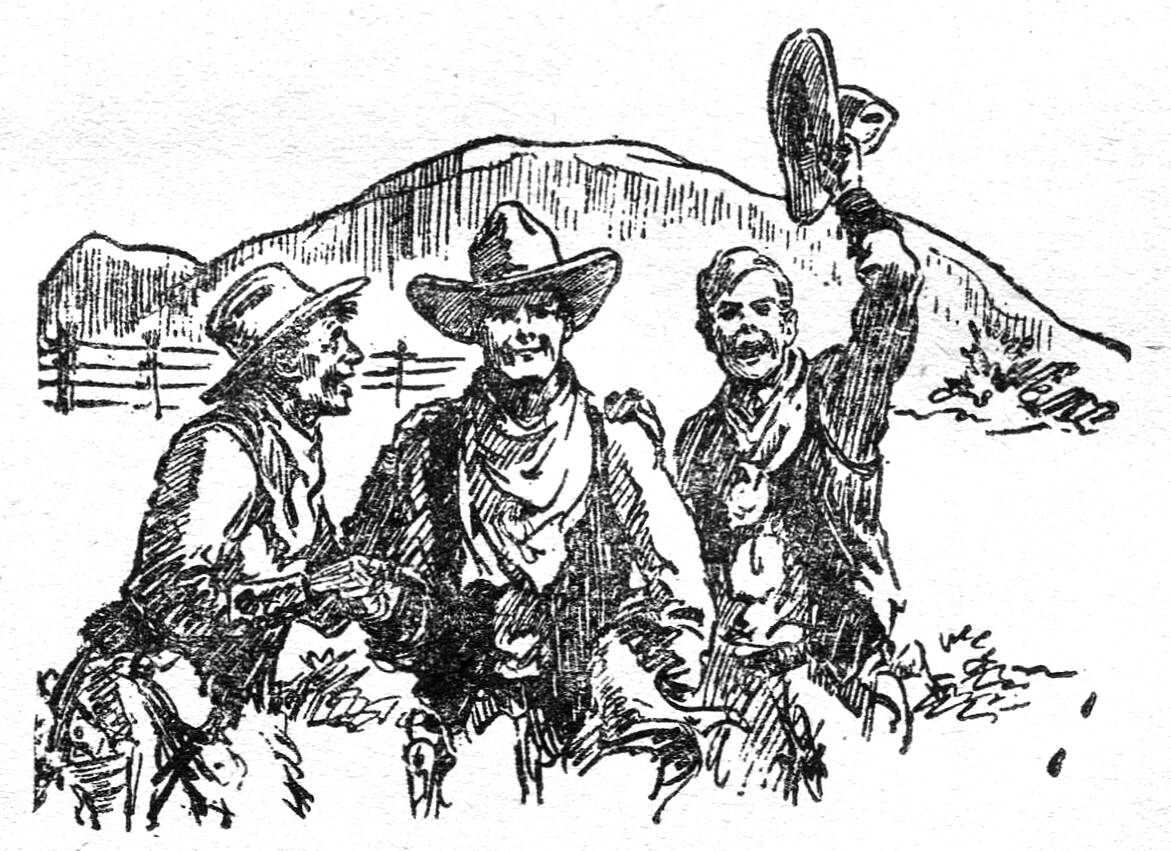
Transcriber’s Note: This story appeared in the January 20, 1925 issue of Adventure magazine.