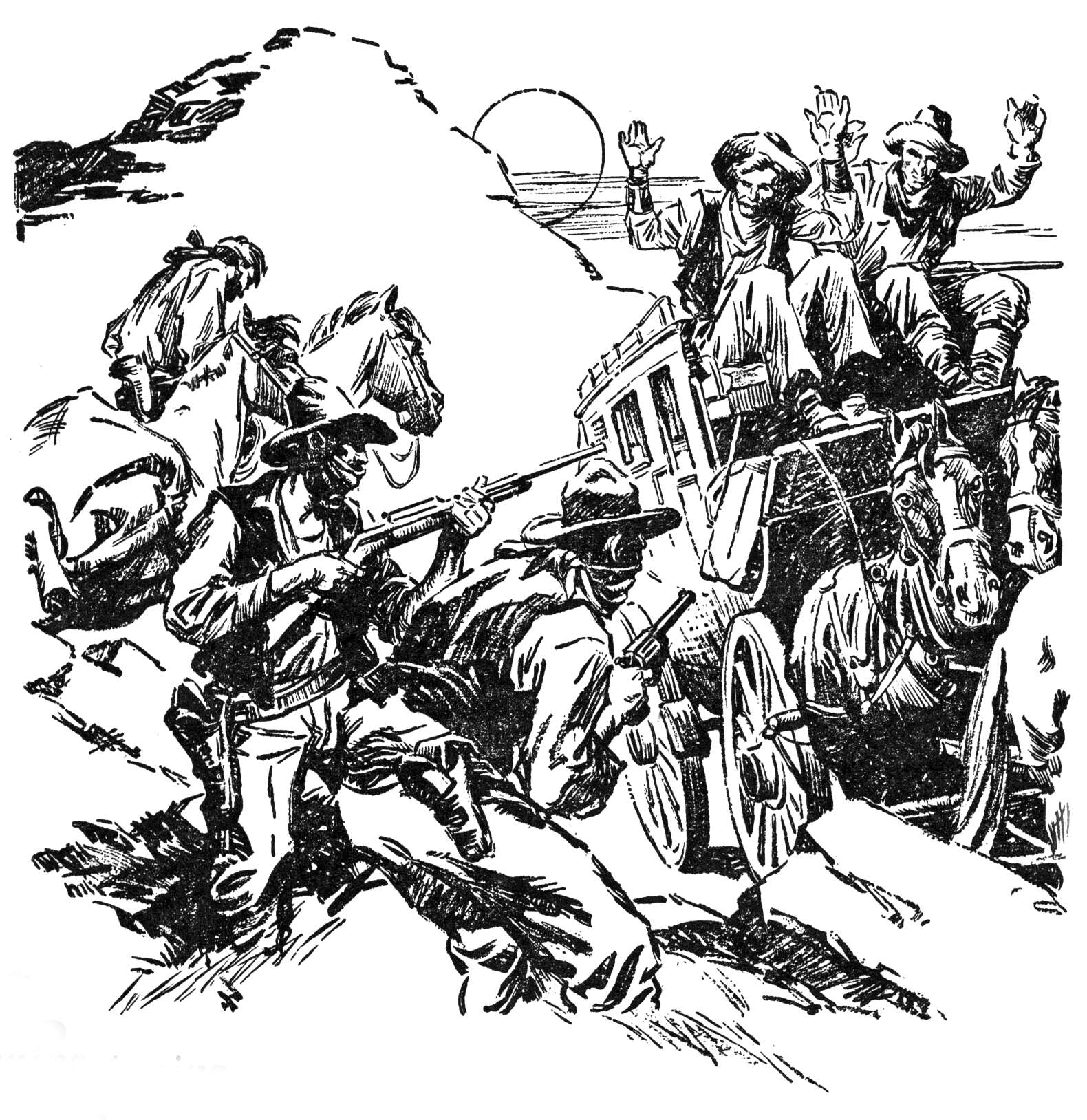
It was a good many years ago, as men figure time. The place, an old, dilapidated shack near the rim of a brushy mesa in the Southwest, near the Painted Desert. It was nearing sundown, and already the intense heat of the day was being supplanted by a chill breeze, as three men rode down through the brush.
One man humped far over the neck of his horse, clinging with both hands to the horn of the saddle, swaying drunkenly, while the other two men rode as close to him as possible. One of the men turned often in his saddle and looked back, as they talked softly.
But the man who humped in his saddle did not talk. His face was chalky white, where it was not concealed by a growth of sandy whiskers, and there was a reddish stain down one side of his cheap cotton shirt. His eyes were glassy and staring straight ahead.
“Is that your shack, Spike?” asked one of the men.
“Where he said it was,” growled the other. “Damn that posse! Do you reckon we shook ’em loose, Steve?”
“I hope so.”
He made a quick grab at Spike’s shoulder in time to prevent the wounded man from falling from his horse.
“He’s a goner,” grunted Steve. “Mebbe it’s just as well, Ed. Hell of a long ways to a doctor in this country.”
Across the fork of the wounded man’s saddle was a canvas sack, the ends of which hung heavily on either side, stretching the canvas tightly. It was the loot from a stage robbery; the clean-up of a mining camp—two hundred pounds of raw gold molded into ingots.
The horses stumbled along wearily, especially the gray horse, which carried the extra burden. The holdup had been successfully accomplished. The single guard tried to make a fight of it, but a bullet smashed his arm. Spike had fired that shot. Trailing the stage, with no knowledge of its treasure, was a sheriff and two deputies; and they arrived just after the gold had been transferred from the strong box to the back of a horse.
Shielded by the stage and the four-horse team, the three robbers made their getaway in a hail of bullets, one of which had smashed through Spike’s body. A deputy’s horse went down, delaying the pursuit; but the saddle was quickly transferred to the back of one of the stage horses, and the posse swept on.
It was a long chase. The sheriff and his men knew the country well, but luck favored the three men ahead, and they finally left the sheriff baffled. But they needed water. Steve and Ed were newcomers, and Spike had only been there a short time. It had been a chance acquaintance. Spike knew of the clean-up; a bottle of mescal settled the deal.
And now they were at Spike’s cabin, where a tiny spring would give them strength and a chance to map out their next move. Somewhere behind them were the sheriff and his two men. They wondered if he knew about the cabin. Spike was too sick to care. They did not know his other name, and he only knew them as Steve and Ed. Perhaps it were better that way.
The men dismounted stiffly and helped Spike down. He was unable to stand alone; they kicked the door open and carried him in. It was dark in there, after the bright light outside. There were two bunks at the rear of the little shack, and as they placed him on one of them, they were greeted by a shrill wail.
Both men sprang back and whirled toward the open door. There was nothing. Steve stepped quickly over to the other bunk.
“My God!” he exploded harshly. “Kids! Babies! Why, this must be the wrong shack!”
He stepped over to Spike and shook him roughly.
“Spike! Wrong shack! There’s babies in here. Can’tcha hear me, Spike?”
“Two of ’em,” whispered Ed. “Little jiggers.”
“All right,” whispered Spike painfully. “They’re all right. Need milk. I—I forgot ’em. Don’t let the law get ’em. I’m a goner, boys. You take the kids. Take my share of the gold and the kids and give ’em to my sister in—in—I can’t remember. Get me some water. It’s only a mile to town from here. They know I live here. Don’t let ’em take the kids. My sister lives in Denver. Her name’s Mrs. Dan Lawton. The money will raise ’em. Don’t tell her where I—”
Spike fainted away.
“I reckon he’s dead,” said Steve slowly. “Only a mile to town, and they know he lives here. I reckon our best move is to hightail out of here as fast as we can, Ed.”
“Shore. But what about them kids?”
“Gawd, I dunno. Denver’s a long ways from here.”
The two men stood side by side, looking at each other in the dim light. Neither of them was over thirty years of age. One was tall, thin, with a serious pair of brown eyes; the other was of medium height, his hair already touched with gray at the temples, thin lipped, square-jawed.
“Them kids don’t mean nothin’ to us,” said Ed, the short one.
“Not a thing, but—” Steve pushed back his sombrero and wiped the sleeve of his shirt across his forehead—“jist suppose they don’t come here? Them kids ain’t done nothin’ wrong.”
“That’s true—” slowly—“but what damn’ right has he to have kids, anyway?”
“They need milk,” said Steve. “Lotsa cows, but few milkers. Dang it, I dunno. Denver, eh? Mrs. Dan Lawton. Can you remember that, Ed?”
“Remember it—shore. But we can’t take them kids, Steve. It ain’t noways possible.”
Steve went over and looked down at them. They were both whimpering. Possibly both of them needed baths; needed more care than Spike had ever been able to give them.
“Got a right to live, I suppose,” grunted Steve, poking at one of the blanket wrapped bundles.
“That’s the idea,” replied Ed. “Got a right to live. It just might be that nobody would come here, and the little devils would starve. But how in hell can me and you ever take care of ’em? They need milk. You can’t feed babies on jerky, you know.”
“I know,” nodded Steve. “Mebbe we can rustle enough milk to keep ’em alive. It’s a funny deal all the way around. Dang it, they can’t arrest us for havin’ babies along. We’ll hit a town somewhere, and mebbe we can pay somebody to take care of ’em until they’re big enough to ship. We’ve got plenty money. If we slip out and leave ’em here—”
“See if we can’t tie ’em up in blankets like the Injuns do. I’ll be danged if I pack one in my arms. Hey! Here’s somethin’!”
It was two cans of condensed milk.
“I’ll betcha they’ll eat tin cow. That’ll fix ’em up for supper. Which one do you claim, Steve?”
“I’ll take the tow-headed one. Looks like a scrapper. C’mon.”
“Is Spike dead?”
“I reckon he is.”
It was considerable of a job to wrap up those two babies, but they finally accomplished the task only to find that there was no way to fasten them to the saddles without danger of injury. It was their plan to lead Spike’s horse, and they were so intent on working out the problem of baby transportation that they did not see several men approaching. Suddenly Steve’s horse nickered softly. The two men saw these mounted men coming down the slope, not over two hundred yards away.
The problem was immediately solved. Both men mounted swiftly, each with a baby in his arms, herded the gold carrying horse around the corner of the shack, whipped it into a gallop with a rope end and went crashing down toward an arroyo.
The posse swung wide of the cabin and began shooting with rifles. A bullet struck in front of the loose horse, which whirled to the right, almost blocking Steve’s animal, and went crashing down an old cattle trail. There was no time to recover it. It was a case of save themselves, if possible, regardless of the fortune.
Ed was in the lead, riding blindly. He struck an old trail down a cañon where a misstep would have sent them a hundred feet in a sheer drop. Death was behind them; so they were taking a long chance. Steve, riding with his right leg lifted to avoid the rocky wall, was almost unseated when the rear end of his mount went down. But after a kicking flurry the animal regained its feet, and its rider looked back to see that a five-foot section of the trail had slipped away, leaving the trail blocked behind them.
They reached the bottom in safety. There they rested their fagged horses before striking the trail which would lead them out the far side of the cañon. Down there in the blue shadows, temporarily safe from the law, they looked back at the far rim of the cañon, wondering at the queer turn of fate.
“Gawd!” said Steve softly, shifting the bundle in his arms. “It looks as though me and you had traded a couple hundred pounds of gold for a couple of milk eaters, Ed.”
Ed sighed, nodding slowly, his lips compressed tightly.
“These kids are a hell of a long ways from Denver. That was shore a close shave, pardner. Let’s get out of this cañon before it’s too dark. We’ll have to make a dry camp, I reckon. But it’s all right for the kids—I saved them two cans of milk.”
“And after that,” said Steve dryly, “we’ll find us a cow.”
“That’s right—a couple cows. How much does a kid eat, Steve? I ain’t never tended one. Have you?”
“Not me. I dunno nothin’ about ’em, except that they squawl when they’re hungry. This’n must be starvin’, judgin’ by his yelp. Tradin’ gold for a couple kids. Well, I reckon we was lucky to get away alive. They’ll get Spike—what’s left of him.”
“Don’t lie, Comanche. They was due here a week ago, and they better be on this stage.”
Pink Lowry, deputy sheriff of Willow Wells, pointed a finger at the body of the stage which had just arrived in front of the stage office, while Comanche Beadle, the attenuated old driver, craned his neck down toward where Pink was pointing, spat violently and straightened up with a visible effort.
“There’s a couple packages in there,” he admitted. “I didn’t see your name, but there’s a package for Dudley D. Evans, and one for Alexander Washin’ton Lowry, which can’t noways be you.”
“Them’s her,” said Pink, “and you keep your damn’ tongue off them two names of mine, Comanche.”
“Oh, shore—” seriously. “Your folks named you after ginerals, didn’t they? How’d they ever miss Coxey? No, I can’t give you them packages; you’ve got to git ’em from the agent. There’s four dollars apiece charges.”
“Well, dig ’em out, will you?”
“I’ll do m’ best, but they’re on the bottom.”
He wound the lines around the brake, climbed slowly down, took a fresh chew and began unlashing the boot.
“Gittin’ new duds, eh?” he grunted. “Suppose you and Evans are goin’ to cut a figger at the SP ranch tonight. New clothes ’n’ everythin’. I jist wonder how much Miss Pelliser’s got to do with all this dudin’ up.”
“You ain’t packed them new suits under all that stuff, have you?” wailed Pink. “Ain’tcha got no sense? My gosh, they’ll be a mess!”
“You can’t hurt cloth, can you? You and Evans didn’t buy no glass suits, didja? There you are! No, that’s Evans’. Here’s yours. No, you don’t. Foller me in, cowboy, and pay your money. That’s how we make a livin’—me and Wells Fargo.”
Pink followed him obediently, and finally paid the eight dollars and received both suits—the crushed packages which bore the name of an eastern tailoring house. Pink was short, chunky, red headed, with decided bowlegs. He was about twenty-five years of age—and in love.
He lost no time in getting down to the sheriff’s office where he found Dud Evans, the slat-like sheriff, in the rear of the office which he and Pink used as living quarters. He was shaving. He was standing before a cracked mirror, clad in a suit of ill fitting red flannel underwear and high-heel boots.
“They come,” said Pink, depositing the packages on the bunk.
“Yea-a-ah?” Dud screwed his face painfully. He was bleeding from many cuts and scratches.
“My gawsh, this razor’s sharp!” he grunted. “I look like I’d been drug over a lot of busted glass.”
“You got my pet razor?” asked Pink, trying to get a glimpse of the instrument.
“Pet! This here thing a pet?”
“That’s my pet, holler ground razor! Dud, you ornery Injun! And I broke my hone last week. Your whiskers would turn a mowin’ machine. I’ll betcha I could write m’ name in the aidge of it right now.”
“Oh, it’s plenty sharp. I whittled off a couple warts jist as slick as a whistle. You got any court plaster, Pink?”
“No, I ain’t!”
Pink yanked savagely at the cord on his package, and finally cut it with his knife. He took off the cover, removed some tissue paper and lifted out a black coat. Dud stopped shaving to look at it. Pink wrinkled his nose thoughtfully as he considered the garment.
“That damn’ thing,” said Dud seriously, “looks like a overcoat with part of the front cut off. A feller could wear a pair of them seatless Injun pants with that coat, and never be an exposure.”
Pink looked at him curiously.
“Funniest damn’ thing I ever seen,” he whispered.
He took out the vest and looked it over critically.
“Dirty cheat!” he snorted. “If that drummer ever shows up here again, I’ll pistol whip him if it’s the last—”
“Ain’t that a funny vest?”
“Funny! My Gawd, it wouldn’t— Look at your own suit, will you?”
“I can’t hurt yours none by jist lookin’ at it, can I?”
Pink sat down on the bunk and began rolling a cigarette with trembling fingers. He was so mad that his red hair stood up in an arch. Dud untied his package and found his suit to be an exact replica of the one on the bunk, except in size.
Dud sat down on a broken back chair and stared at Pink.
“You talked with that drummer,” he said slowly. “All I done was to stand up and be surrounded by a tape measure. What in hell did you tell him?”
“Don’t try to put no deadwood on me—” belligerently. “Me and you both decided that we wanted black suits, didn’t we? Well, he asked me what style we wanted, and I said we wanted somethin’ awful damn’ dressy. He asked me if we wanted dress suits, and I said we shore did.”
“Well—” mournfully—“we done throwed away eighty dollars apiece.”
“Put on your coat, Dud. They might not be so bad.”
Dud slipped into the coat, and Pink circled him slowly. Then:
“Dud, you’re the damndest lookin’ insect I ever seen. From the rear, you look like a black beetle with red laigs. You do, honestly. But from the front you look like a unsuccessful operation. My gosh, what a chance to show off a fancy vest.”
“It’s probably this red underwear.”
“Well, that’s part of it. But it ain’t all, Dud. Mebbe a shirt front would help a lot, but jist as you are now, you look like one of them charts the medicine doctors use to show the heart, lungs, liver and lights, or the bad effect of liquor on the insides of man.”
Dud flung the coat aside and went back to the basin where he dabbled cold water on his bruises, while Pink dug deeper into the suit box. Tucked within the folds of the trousers was a little booklet depicting styles in men’s wearing apparel. On the last page of the pamphlet was a picture of the suits he had ordered.
“Here you are,” he grunted. “Here’s what we got, Dud.”
Dud came over, mopping his face with a towel, and gazed upon the illustration.
“F’r looks,” said the sheriff slowly, “that feller is a dinger.”
“Slicker’n frawg hair. But we ain’t got no white shirts.”
“Nor stand-up collars. Well, what’s the difference? That red and black silk shirt of yours is a damn’ sight prettier than plain white, ain’t it? I’ve got a green silk one. I’ll let you wear my yaller silk tie. What you better do is run up to the store and git some stove polish. We’ve got to run a shine on our boots.”
“You go git the polish. I’ve got to whittle m’ whiskers with a dull razor. Damn’ nice cloth in them suits, Dud.”
“Ought to be at eighty a suit, and half the cloth missin’.”
The town of Willow Wells had never outgrown its infancy. It was slightly over twenty years of age, but looked older because the original false front buildings, facing along the narrow street, had long since lost any vestige of paint they may have had. The signs were barely visible, having been heat and sand scoured many times. The two biggest buildings in the town were the courthouse and the livery stable.
Of saloons there were plenty—the War Paint was the most fashionable. It was not a pretentious structure, although it covered plenty of ground space and, it was said, a multitude of sins. Twenty miles south of Willow Wells was the town of Newton, on the railroad. When Willow Wells was born there was no railroad down there, no town. The railroad brought Newton, and Newton wanted to be the county seat; but the bulk of the votes were in the northern end of the county and Willow Wells retained the honors.
The Willow Wells stage made the round trip daily to Newton, piloted most of the time by Comanche Beadle, who believed himself in partnership with Wells Fargo. Three miles southwest of Willow Wells, on the road to Newton, was the Diamond R ranch, owned by Jim McGowan, a big, handsome man of about forty-eight years, cordially hated by Pink Lowry. In fact, Pink hated the whole Diamond R outfit.
It was not a hate of long standing. Pink had been indifferent to Jim McGowan until Mary Pelliser came back from school and took up her residence at the SP ranch. Pink did not realize that ninety per cent. of the cowboys had fallen violently in love with Mary; he only saw Jim McGowan paying court to her. Jim was handsome and Pink knew it. He realized his own shortcomings, both in face and figure, and he proceeded to hate all of the Diamond R outfit.
Pink was barely past his majority in years, which might excuse him. He was the youngest deputy they had ever had in Willow Wells, and many of the old-timers shook their heads over Dud Evans’ choice as a helper; but Pink was efficient and capable, and Evans knew it.
McGowan had owned the Diamond R for three years, having bought the brand and the ranch from Edward Hart, owner of the Bank of Willow Wells. The Diamond R personnel was, in range vernacular, rather salty. It consisted of Scotty McGowan, a brother of Jim, Buck Haskell, Barney East, Sam Hall and a disreputable Chinese cook named Mulligan. Of course, this was not his name, but it sufficed. Mulligan loved gin and his one-string fiddle, both of which caused him to make weird noises.
The occasion of the two new suits at the sheriff’s office was a party at the SP ranch, two miles northeast of town, given partly in honor of Mary, but more as a celebration of Edward Hart’s wedding anniversary. Steven Pelliser, owner of the SP, was as much of an old-timer as Edward Hart, and Steven Pelliser liked parties. In fact, he never overlooked a chance to hold a regular fiesta at the SP. Edward Hart had been married nineteen years, and the woman he married had done much in a financial way in the old days to put both Hart and Pelliser on their feet.
Between them they owned quite a lot of Willow Valley. East of town, about two miles away, was the HN outfit, connected brand, owned by Uncle Hoddy Noon, also an old-timer in the Valley. Uncle Hoddy was a little old man, typical of the range country, held down to hard and fast rules of conduct by his fleshy wife, Aunt Ida, who believed that the souls of all drinking men were doomed. Uncle Hoddy said he would rather be doomed than dry, and drank in secret and swore he was captain of his own soul—and ate cloves.
Uncle Hoddy’s thirst was aided and abetted by Caliente Smith and Piute Jones, fifty year old cowboys, to whom Aunt Ida had tried to preach religion for years. They worked for Uncle Hoddy, along with Chris Halvorsen and Ed Lane, the latter being Uncle Hoddy’s son-in-law and foreman.
Aunt Ida’s religious talks did little more than amuse Caliente and Piute, but they gave Aunt Ida considerable satisfaction. Her theme was usually temperance, which brought the idea of a little liquor forcibly to the objects of her discourse, and they usually acted accordingly.
They were all at the SP ranch that night. The Simpson brothers with their violin and bull fiddle; Banty Culler with his guitar; Jeff Miller with a banjo. When Steve Pelliser gave a party it was a case of come and get it.
Mary Pelliser never looked more beautiful than when she came down the old stairway to greet her guests that night. Tall, slender, with a wealth of chestnut hair, an oval face, tanned slightly, red cheeks untouched by rouge. She wore a simple white dress, not made by any of the Willow Valley modistes, and at her throat she wore a gorgeous old cameo.
Jim McGowan met her at the foot of the stairs, assuming a sort of proprietorship over her. Steve Pelliser, tall, gaunt, with serious eyes, stood across the room, smiling proudly at her; but a frown of annoyance flashed for a moment when Jim McGowan took her arm.
Edward Hart, the banker, standing near the door, glanced quickly toward Pelliser and their eyes met. Hart was of medium height, his hair as white as snow. He seemed much older than Pelliser, although they were nearly of an age. Hart had the jaw and lips of a fighter. His wife, several years his junior, stood beside him, a robust woman about his height, dressed in black silk.
With much trepidation the assembled cowboys shook hands with Mary. Many of them had known her for years, but now they looked at her as if she were a stranger. The other girls seemed ill at ease for several moments—until Mary left McGowan to join them. The men grouped by themselves in one corner, laughing at jokes, rolling cigarettes.
“There’s somethin’ in the kitchen,” said Hank Blue, one of the SP cowboys, cautiously. “Steve said to not make a rush, ’cause Uncle Hoddy’s out there and if Aunt Ida ever gets a suspicion—”
Eyebrows lifted knowingly, and the men milled around, losing numbers with great regularity. The door between the kitchen and dining room needed oiling. Every entrance or exit was advertised with a whining squeak. Steve Pelliser watched Aunt Ida closely. She was talking with several other women, but he could see her face and he knew she was listening. Once she got to her feet, but one of the women was explaining something to her and she was obliged to sit down.
Jim McGowan came over close to Steve, as if to speak with him, but someone left the door open and they heard Uncle Hoddy’s voice:
“You don’t need to shush me, I’ll tell you that. I’m old enough to be a daddy to any danged one of you. I’m a man among men.”
“That last part is shore true,” said Caliente, “but if Aunt Ida ever hears or smells—”
Someone shut the door, and the last of the discourse was lost to the ears in the living room. Aunt Ida got up slowly, her cheeks very red, and looked around.
“You will excuse me, I’m sure.” Her voice had a metallic ring. Steve caught her at the doorway and put a hand on her arm.
“Don’t blame Uncle Hoddy,” he said. “It’s all my fault, Aunt Ida.”
“Is it? You admit that you led him into temptation, Steve Pelliser?”
“Well, I—I bought the liquor.”
Caliente started to come out of the kitchen, turned right around and went through the back door, fairly carrying Uncle Hoddy with him.
“You know his weakness,” said Aunt Ida severely.
“Yeah, he can’t stand much liquor.”
“Well, I shall stop any further indulgence.”
Aunt Ida flung open the door and swept grandly into the kitchen. The men were massed around a table, where One Hop, the cook, was pouring out the liquor. Aunt Ida’s eyes quickly searched the group. There was Piute Jones, but of Caliente and Uncle Hoddy there was no trace.
Ed Lane coughed apologetically and Aunt Ida shot him a searching glance.
“Does Julia know you are in here, steeping your soul in this devil’s brew?” she asked.
“She ought to know me, after all these years, Aunt Ida,” he said.
“Mm-m-m-m! I’ll bet she don’t.”
“I’ll bet she will,” meaningly.
“Where’s Hoddy and Caliente?”
“I dunno. Anybody know where they are?”
“Hoddy and Caliente,” said Piute owlishly, “have gone out to pail the cows.”
“Piute Jones, you’re drunk!”
“Mad’m,” replied Piute, “that’s a debatable ques’n.”
“You don’t even know what you’re doing.”
“Debatable, mad’m. I know what you’re doin’.”
“What am I doing?”
“Ruinin’ a perf’ly good party for everybody.”
Aunt Ida went out, slamming the door behind her. In the living room she found Uncle Hoddy and Caliente, seated side by side, very erect and as immovable as two statues. They had sneaked in the front way. To her everlasting credit she said nothing to them, but sat down with the women and resumed the conversation.
Steve Pelliser mopped his eyes, while the two men looked him over gravely.
Jim McGowan was greatly amused, but finally moved over closer to Pelliser.
“I want to talk seriously to you, Steve,” he said softly.
“Seriously?”
“It’s serious with me.”
“Oh, yeah. Well, go ahead, Mac.”
“I want to marry your daughter.”
For several moments Steve Pelliser did not speak. His eyes shifted to Mary and he lifted his head, staring at the opposite wall.
“That is serious,” he said slowly. “Too serious, I’m afraid, Mac. You’re old enough to be her father.”
“What has age to do with it?”
“You’re close to fifty, while she’s twenty-one. That’s a big gap.”
“It’s been done before, Pelliser.”
“Yes, I suppose it has—and to the sorrow of both parties, in many cases. Have you spoken to Mary?”
“No. I wanted your permission first. That is, I wanted you to know my intentions.”
Steve looked squarely at McGowan now, and their eyes met.
“What did you mean by that last remark, McGowan?” asked Pelliser.
“Just what I said.” McGowan’s eyes shifted, his jaw squared. “She’s of age.”
“I reckon I understand your meanin’, now. Yes, she’s of age. And if she wants to marry you against my wishes, I’ll have to stand for it, I reckon.”
McGowan’s fists clenched.
“Against your wishes, Pelliser?”
“That’s what I said. I want her to marry happily, and I don’t think she would be happy with you.”
“Thanks. What have you got against me?”
“You.”
Mary was coming toward them, and Pelliser went to meet her.
“I wonder where Pink Lowry and Dud Evans are?” she asked.
“Oh, I wouldn’t worry about them two, honey. Maybe they had to ride on official business. But they’ll be here. Any time Dud or Pink miss a party, it’s mighty serious.”
McGowan walked past them, heading for the kitchen. Uncle Hoddy and Caliente turned their heads wistfully and watched him go. Aunt Ida looked at them and they froze to their chairs.
“Can’t you get Aunt Ida upstairs?” whispered Steve. “Take her somewhere to give them old boys a chance to sneak.”
Mary shook her head slowly.
“Daddy, she wouldn’t move out of here to catch a glimpse of her favorite heaven. What were you and Jim McGowan quarreling over?”
“We weren’t quarreling.”
“No? I thought you were. Is he an awful good friend of yours?”
“Why?”
“I just wondered if I needed to be especially nice to him.”
Her father laughed shortly.
“I never asked you to be especially nice to anybody, did I?”
“No, but I just wondered. I don’t believe I like him very well.”
“Oh! Well, run along and have a good time.”
And just at that moment Pink Lowry and Dud Evans came in. Some of the boys came from the kitchen at the same time, stopping at the doorway to stare at the two officers. And well they might.
They wore the first dress suits ever seen in the Willow Valley.
“My Gawd!” blurted Caliente Smith, pointing at Pink. “Look at the tiger lily in mournin’!”
Pink shot Caliente a glance of deadly hatred, but kept still, while every one stared at them. It was Mary who broke the spell by stepping forward to welcome them. The men crowded in, all talking at once, and in the confusion both Caliente and Uncle Hoddy made their escape to the kitchen.
“I’m so glad you came,” said Mary chokingly.
“Oh, we’d shore come,” grinned Pink. “Try to keep us away.”
Pink was resplendent in the red and black silk shirt, which was not at all subdued, the glaring yellow tie fairly shrieking against it. Dud wore a green silk shirt and a bright red tie, pinned to the bosom of his shirt with an immense bejeweled horseshoe. The tails of Pink’s coat nearly reached the floor. That is, one tail did. The other was hiked up over the butt of a heavy Colt revolver, which Pink wore in one of his hip pockets in lieu of a belt and holster. Dud wore his gun stuck inside the waistband of his trousers, blousing his shirt over the butt.
Both men went around shaking hands, followed by amazed eyes. Pink shook hands violently with Aunt Ida.
“Where’s Uncle Hoddy?” he asked.
She craned her neck past Pink and looked at the empty chairs.
“He’s gone,” she said in a hoarse whisper.
“Yeah?” Pink stared at her. “You don’t mean he—died?”
“If I don’t stop him, he might.” She jumped to her feet and headed for the kitchen.
A look of understanding overspread Pink’s face and he turned to meet Jim McGowan. McGowan was looking him over in an insolent, amused way, and Pink’s ears reddened quickly.
“Well, go ahead and say it,” said Pink coldly.
McGowan laughed shortly.
“Are you trying to be funny, Lowry?”
Pink’s blue eyes narrowed. Trying to be funny! He did not understand.
“This wasn’t no masquerade, you know,” said McGowan.
Possibly a dozen people heard that remark. Pink looked down at his new clothes, at the riot of color on his bosom. Masquerade! He looked up, but McGowan was walking away, grinning. Mary had heard some of it. Pink looked at her. She was not laughing at him. Then he turned and went into the kitchen.
Pink had made up his mind not to touch a drink, but he needed something now. He was not mad; he was hurt. Besides Mary and McGowan, none of the people considered his garb incongruous. They did not understand. Pink realized that neither he nor Dud looked like the man in the little catalogue, but he did not know that their shirts, ties and boots were out of place with dress clothes. He knew now.
Dud was out there drinking with the men, explaining about the new suits.
“They’re the latest thing in Sunday clothes,” he told them. “They call these the ‘show your shirt’ coats. Pretty slick, eh? Well, here’s m’ best regards. Somebody give Pink a glass, will you? Another glass, One Hop. That’s the boy! What’s th’ matter, Pink?”
“Nothin’ the matter with Pink,” chorused several.
“Open and above board,” laughed another.
“You jist missed out, Pink,” laughed Jerry Dole. “Aunt Ida jist saved Uncle Hoddy from temptation. He ain’t had more than a quart. She tried to save Caliente, but the old boy was goin’ down for the last time, and her rope was too short. He’s settin’ on the wood box.”
But Pink was in no laughing mood. He was getting over his hurt, and anger was taking its place.
“I’ll take another,” he said seriously. “That stuff ain’t strong.”
Steve Pelliser had seen it all and wondered what it was about. Then Mary told him what McGowan had said.
“Well, wasn’t them suits all right, honey?” he asked.
“You wouldn’t understand, Daddy. They were all wrong. But what does it matter? Oh, I felt so sorry for Pink. He’s hurt deeply and I’m afraid he’s hurt at me.”
“I don’t think so. Pink’s no fool. Sa-a-ay!” He took her by the shoulders and looked her in the eyes. “You seem to be a heap interested in Pink Lowry’s feelin’s.”
Mary flushed quickly, but her eyes did not draw away when she replied:
“Pink is one of our guests, Daddy. I would insult myself if I said or did anything wrong toward him tonight.”
“Do you consider McGowan’s talk as an insult to you?”
“Don’t you?”
Pelliser sighed deeply.
“I dunno much about such things, Mary.”
“Maybe we better forget it for this time. At least Pink was too much of a gentleman to resent it.”
The orchestra was tuning up in the dining room and Jerry Dole, who called all the Willow Wells dances, was yelling for everybody to take partners for a quadrille. McGowan hurried to find Mary, only to be told that she was engaged for the first dance. McGowan frowned, but said nothing except that he was sorry.
“Two more couple!” yelled Jerry. “Two more couple!”
Mary realized her predicament. No one had asked her for the first dance. She stepped to the door of the dining room, with McGowan standing just behind her.
“One more couple!” yelled Jerry. “Jist one more couple!”
Pink came from the kitchen and Mary motioned for him to take her. He did not understand for several moments, and she walked toward him, motioning at the vacant spot in the set. Then he understood. Jim McGowan also understood. He shut his jaw tightly, turned and walked back to the front of the room, where he rolled a cigarette, thinking blackly.
Finally he went outside, closing the door behind him. Steve Pelliser and Dud Evans were still in the kitchen, while the house resounded with the strains of “Money Musk” and the trampling of heavy feet.
“Did you and Pink stable your horses?” asked Steve.
“Didn’t bother about it, Steve. Tied ’em to the fence.”
“I’ll have one of the boys stable ’em. You won’t go home until late, and there’s no use havin’ ’em stand out there all night. How about one more jolt?”
“Fine.”
Someone called to Dud and he left the kitchen. Steve talked for a few moments with One Hop about the supper and then went outside, where he untied the two horses and took them to the stable.
Mary knew that Pink was hurt. He did not join in the laughter and good-natured joking with the rest. He got all mixed up in the changes, which was unusual with Pink, for he was a good dancer.
“I hope you will have a good time,” she said timidly, when they stopped after the first set.
“I’m havin’ a good time,” he said wearily. “I—I just don’t feel so good.”
“I wouldn’t let McGowan hurt my feelings, Pink.”
“Oh, him!”
The music started again, cutting off further conversation, and after the dance was over he thanked Mary and walked away. He wanted to be alone; he walked through the kitchen and went outside. One Hop was on the back porch, turning the handle of an ice cream freezer, which creaked loudly. It was dark out there.
Pink stepped off the porch and walked slowly down toward the corral. His first impulse was to get on his horse and go home, but he decided that such a move would be unkind to Steve and Mary. He went down to the corral, where he sat down on a pile of old lumber. No one would see him there in the dark, and he could think things over calmly.
He heard the stable door shut with a loud bang. Someone came out on the kitchen porch and talked with One Hop, and he could hear the music of a slow waltz. He wondered who Mary was dancing with this time. Pink loved to waltz, and he had dreamed of waltzing with Mary. He got to his feet and leaned against the corral fence, looking toward the open doorway where the lamplight streamed out on the white-clad cook, bent over the freezer.
Suddenly a gun flashed in the dark. The bullet thudded into a post behind Pink and almost before the echo had been thrown back from the side of the house, Pink had drawn his gun and fired at the flash. It was all done so quickly that the two guns were discharged but a few seconds apart. Men were coming out from the kitchen, crowding on to the porch, looking for the cause of the shots. One Hop jabbered in Chinese and tried to tell them.
They were running down toward the corral before Pink left the fence.
“Down here!” he yelled hoarsely. “Somebody shot at me!”
“Is that you, Pink?” asked the sheriff. “What was it? Who was shooting?”
“I shot once, Dud. Somebody took a shot at me in the dark. Bullet hit the fence behind me. No, I don’t know who it was. They got away, all right.”
“No, they didn’t!” called one of the boys near the stable.
“Get a light; somebody got hurt.”
They moved to the spot, where the sheriff lighted a match, illuminating the features of Jim McGowan. He was flat on his back in the dirt, his right arm outflung, his fingers gripping a heavy Colt revolver. One of the men ran to the stable and secured a lantern.
“He’s dead, boys,” said Dud softly. “My Gawd, what a dead-center shot!”
He removed the gun from McGowan’s fingers and shoved it inside the waistband of his trousers. By that time all the men were down there, and the women were out on the porch, trying to get answers to their questions.
“This is awful,” said Steve Pelliser.
“He shot at me first,” said Pink hoarsely. “I didn’t even know who it was.”
“That’ll do to tell,” said Scotty McGowan.
“Drop all that kinda talk, Scotty,” said the sheriff warningly. “This is no time to make bad breaks. One dead man is enough at a time.”
“I can look out for myself.”
“Damn’ right,” growled Sam Hall.
“The sheriff is right, boys,” said Pelliser quickly. “Cool off first. There was no reason for McGowan to shoot at Pink.”
“No-o-o?” Scotty’s voice was high-pitched. “When a girl—”
“Drop that!” snapped Pelliser quickly.
“Oh, well, I reckon we all know.”
They carried the body up to the house and placed it on the porch. Even Uncle Hoddy and Caliente were sobered now.
Pink stood apart from the rest. He had his six-shooter shoved inside the waistband of his trousers now, and he kept his eyes on Scotty and the rest of the Diamond R outfit. The sheriff had sent a man to town to get the coroner.
Aunt Ida audibly blamed the liquor for all this trouble. It was a wonderful opportunity for a temperance lecture and she was about to avail herself of the big chance when her daughter intervened.
“Ma, don’t be a fool. For goodness’ sake, keep still. Nobody wants or needs your views of the matter.”
“That’s right, Julie,” said Uncle Hoddy, fervently mopping his brow.
“You!” snorted Aunt Ida indignantly.
“Oh, Gawd!” said Caliente piously.
“Won’t you never learn to not use kerosene to put out a fire, Hoddy?”
“Folks,” said Ed Hart gently, “let’s take this easy. Jim McGowan is dead, and all the recriminations in the world won’t bring him back. It’s unfortunate, and we’re all sorry. But it is one of the things that happen. Please think calmly about it.”
“He was my brother,” reminded Scotty grimly.
Scotty was much smaller than his brother, black-haired, swarthy, with a slightly hooked nose and prominent cheekbones. He was less than forty years of age.
“I respect your feelings,” said Hart slowly.
“That’s fine—” sarcastically. He turned to Pink. “I reckon you’ve got more friends around here than I have, Lowry. I’ve never felt very popular around here, and I suppose they’ll excuse you for what you done.”
“I dunno,” replied Pink. “Friendship ain’t got a thing to do with it, Scotty. I dunno why Jim McGowan shot at me in the dark. I didn’t shoot at him—I shot at the flash of his gun, without knowin’ who was behind it.”
“That’s fine. Any jury would believe that, I suppose.”
The women all went upstairs to get their wraps. Uncle Hoddy and Caliente sneaked to the kitchen for another drink. One Hop was humped over in a chair, staring at the floor. One Hop had always liked Uncle Hoddy, and One Hop wanted to talk with somebody. He drew the old cattleman aside.
“You sabe what Pink say?” he asked nervously.
“Shore.”
“He say he no see who shoot?”
“Shore. Pink was over by the corral fence, and we found McGowan between the corral and the stable. In that dark, they couldn’t see each other, Hop.”
“Yessa. Pink not see who he shoot; Pink not go jail, eh?”
“That’s about the size of it.”
“Good. Pink velly nice boy.”
One Hop poured generous drinks and they drank deeply.
“We better git back before Aunt Ida cuts loose agin’,” advised Caliente. “I’ve heard you say you was the captain of your own soul, but you ain’t. As far as that’s concerned, you ain’t even a cabin boy.”
“I know it. I’d admit it to you, but never to anybody else.”
“It would shore be a shame, if everybody else found it out.”
The coroner came—old Doctor Carmichael—white-haired, blunt of speech, but loved by everybody in the Valley. His examination was brief, his questions pointed; and then they loaded the body into one of Steve Pelliser’s rigs and took it back to town.
The party was over almost before it began. Steve Pelliser and Mary stood on the porch and watched their guests drive and ride away. Scotty McGowan was one of the last to leave. He led his horse up to the porch, while his men waited for him.
“This ain’t the end of this deal, Pelliser,” he said ominously. “I know a lot more than you think I do. Good night.” He swung into his saddle and rode away.
“What did he mean, Daddy?” asked Mary, shivering a little in the cold breeze.
“I don’t know.”
“The law can’t touch Pink Lowry, can it?”
“The inquest will decide that, Mary. I don’t think it can.”
He didn’t tell her that Jim McGowan had asked for her hand.
“Jim McGowan asked me to dance the first quadrille with him,” said Mary. “I told him I already had a partner—but I didn’t. He knew I didn’t, because I almost had to drag Pink on to the floor. He hadn’t asked me to dance, and he didn’t understand. I—I just didn’t want to dance with McGowan.”
“I don’t think that would have made any difference. Run along to bed and forget all that. You were not to blame in any way. It—it was just one of those things that happen.”
The body was taken to the coroner’s office, where it was to be held until after the inquest. Pink had nothing to say until he and the sheriff were alone in their living quarters. They took off their coats and vests, sat down and rolled cigarettes.
“What was you doin’ down there by the corral?” asked the sheriff.
Pink studied his fingernails for several moments before he replied.
“Cussin’ this damn’ suit of clothes.”
“What’s wrong with it?”
“I guess we made a pair of fools out of ourselves, Dud. I didn’t think much about it until I saw the expression on Mary’s face. I knew somethin’ was wrong right then. And Jim McGowan—you was out in the kitchen when he made his remarks. He asked me if I was tryin’ to be funny.”
“Tryin’ to be funny?”
“Yeah. I didn’t understand yet. And then he said that this wasn’t no masquerade. He said it loud enough for everybody to hear.”
“McGowan was tryin’ to make fun of your clothes, Pink?”
“Of our clothes.”
“Oh, yeah.”
“Well, I danced the first dance with Mary. I dunno why she picked me. It wasn’t ladies’ choice, but she dragged me on the floor, with McGowan lookin’ on. Oh, he was mad. I wanted to get away from there and as soon as the dance was over I went down by the corral. That’s all there was to it, Dud, except that a gun went off in the dark and the bullet didn’t miss me more than a few inches. I shot right back at the flash, as near as I could judge. You know the rest.”
“He didn’t say nothin’ before he shot at you?”
“Not a word. He shot first.”
“That’s easy to prove, ’cause he couldn’t have shot after you did. Mac wasn’t drunk. In fact, they told me he hadn’t taken a drink out there. Well—” the sheriff yawned widely—“they’ll hold an inquest tomorrow. Better keep an eye on Scotty and the rest of his gang. The law can’t soak you for defendin’ your own life, as far as that’s concerned, but Scotty and Jim was always pretty thick—and I wouldn’t trust Scotty too far.”
“I won’t, Dud. I shore hope that clothes drummer comes back here again.”
“That’s right. Anyway, we can wear the pants, even if they did cost us eighty dollars. Well, there’s no use cryin’ over spilled milk. Might as well fold up in a blanket and take a chance on tomorrow.”
William Allen (Wild Bill) McGill sat in a lawyer’s office, gazing moodily at the stream of traffic on Market Street, San Francisco. The cognomen had been conferred upon him by some of his classmates at Stanford for the same reason that they would call a fat boy “Splinter.” William Allen McGill was most certainly not wild.
He was fairly well built, blond, with wide, inquiring blue eyes and a delicate complexion. His mouth was a trifle stubborn, his chin square. The gum-chewing stenographer over by the other window decided that William Allen was a good looking boy, even if he did act absent minded by not paying any attention to her. She knew him to be the son of old Dr. Andrew McGill, who had died recently. The papers had mentioned the fact that the good doctor had died, leaving little or nothing. He had been one of the old time doctors.
A man came from the private office, nodded to the stenographer, and went out. A buzzer whirred softly.
“Mr. Mahler will see you, Mr. McGill,” said the girl.
“Eh?” The boy turned from the window. “Oh, yes; thank you.”
As he entered the room a pleasant-faced, oldish man smiled at him from across the polished top of a desk.
“Good morning, William,” he said.
“How do you do?” the boy said precisely. “Nice morning, Mr. Mahler.”
“As a matter of fact, it is both foggy and raining.”
“Yes, I believe it is. But no matter. Thank you.”
He sat down on the edge of a chair, rubbing his hands together nervously.
“You handled some of my—er—father’s affairs, Mr. Mahler.”
“Yes, I did, William. Quite a lot of them, as far as they went. As you know, from the amount of your legacy, the good man had little left.”
William Allen nodded violently. His legacy had been a bare thousand dollars—one-fiftieth of what the old doctor was believed to have left. Mortgages covered everything. William’s mother had died ten years ago, when William was little more than ten years of age. Since then he had spent the most of the time in boarding schools, two years in Stanford.
“I didn’t mean about his property,” faltered William. “This, it seems, was a more personal affair.”
“Yes?” The lawyer’s brows lifted slightly. “As a matter of fact, Dr. McGill did not confide any personal matters to me. Strictly business, and I was much surprised at the limited—”
“I’m sorry,” said William, interrupting, “this is something— You see, my father kept a small safe at home, and this morning I accidentally discovered the key. There were a few old papers, some mining stock, which I believe is defunct, and a few old letters. Mr. Mahler, did it ever occur to you that Dr. McGill was not my father?”
The lawyer stared for a moment at William, removed his glasses and polished them carefully.
“Well, I—there has never been anything to cause me to suspect such a thing.”
“Read this, please.”
William handed him two sheets of old writing paper, faded badly, almost ready to fall apart at the creases; evidently paper from a cheap tablet. The lawyer adjusted his glasses and read aloud:
“Dear Andy:
I just got your letter yesterday and I’m glad you and your wife have decided to keep the kid. As I told you up here, I called him Bill. I’ll be damned if I know what the rest of his name is. Why not give him your name, Andy? I’ll send you money to use for him because I kinda feel that I ought to do this much. I’d keep him myself, but I’ve found the woman I want to marry. She’s living at a little place south of here, and I don’t want to answer questions about the kid. You understand what I mean. Your wife seemed to kinda like the kid, and she said she always wanted one. Maybe it all works out right. Anyway, I thank you both. Give her my regards and thanks.
Yours truly,
—ED
“Sounds mighty queer,” muttered the lawyer. He picked up the other paper. It was evidently only half of a letter. He read:
“Dear Andy:
Haven’t heard from you for a long time and I wondered how Bill is getting along. Must be quite a kid by this time. I am doing well here. This place is kinda new, but I’m going to stick and make some money for myself. I guess it don’t pay to knock around. I hope you and your wife are both well and that you are selling lots of pills these days. My wife is a mighty good woman. I guess I needed her to make me settle down and quit being a wild man. I never did tell her about the kid, because it would make me explain a lot of things that I want to forget--”
And there the page ended.
“No postmark or anything,” said the lawyer. “Not even a date.”
“Not a thing,” said William gloomily. “Here is the old mining stock.”
The lawyer looked it over. The date of issue was nearly twenty years ago, capital stock of the Willow Valley Copper Company.
“And here is a letter from a man, asking about it,” said William. “It would seem that Dr. McGill was one of the promoters.”
The lawyer read the letter, nodding slowly.
“Yes,” he agreed, “it would seem so, although the certificates were not signed by him. I just wonder if you could be the Bill referred to.”
“Why not? I am the only child.”
“Yes, that is true. William, I am sorry, but you have made out an airtight case against yourself.”
“Then who am I?”
“Who knows? Who was Ed? Is he alive—and where? He admits that he does not know your name. He says he named you Bill. According to the letter, it would do you no good to find the man named Ed. William, if you will take my well meant advice, you will continue to be William Allen McGill.”
But William shook his head, a stubborn expression on his mouth.
“The name of Bill was given to me by a man I do not know; a man who was ashamed to tell, or afraid to tell, where he got me. The name of Allen is the family name of the only mother I ever knew, and the name of McGill is something I am not entitled to use.”
“Well, what are you going to do about it?”
“I don’t know. I can’t go back to college. Lack of funds would prevent that, even if I wanted to go back. I have less than a thousand dollars to my name. To my name!”
“Names don’t mean so much, William.”
“Perhaps names don’t, but an identity does. I want to know who I am. If the man who gave me to Dr. McGill was afraid and ashamed to tell—what kind of a creature am I?”
“Oh, look at it in a calm way. You are you. After all, what does it matter? You have no past to be ashamed of. Nearly twenty-one, with the world ahead of you. Keep on being William McGill. It’s a good old name. Dr. McGill was a good father to you. Stick to his name and forget the rest.”
“Would you? Wouldn’t you do everything to find out who you were?”
“I suppose I would. But suppose the discovery hurts more than the uncertainty?”
William shut his lips tightly as he got to his feet.
“That won’t matter; I’ll know who I am. Goodby, Mr. Mahler.”
“Are you going away so soon?”
“I think so.”
They shook hands gravely and William walked back to the door, where he paused.
“I’ll let you know where I am.”
“Do that, William—and the best of luck.”
“Thank you.”
William ignored the smile of the pretty stenographer and went down to the misty street. He stood for a while in the protected doorway and looked at the old mining stock certificates. He tucked them back into his pocket, turned up the collar of his coat.
“I guess I better go to the library and find out just where Willow Valley is located,” he told himself. “Twenty years late is rather a poor time to pick up a trail, but I’ve got to have a starting point.”
The inquest over the body of Jim McGowan was held the evening following his death. The courtroom was crowded. The testimony was very brief. Pink took the stand and told the same story he had told following the shooting. That is, he had shot at the flash of the other man’s gun. The sheriff and the coroner had gone out to the SP ranch that day with Pink and had located the bullet which had nearly struck him.
It was deeply imbedded in one of the old posts, shoulder high to a man, and as near as they could judge was of the same caliber as McGowan’s gun—a .45. This was put in evidence. The rest of the testimony consisted of the discovery of the body. There did not seem to be any reasons for McGowan’s attack on Pink. Not a Diamond R man had been impanelled in the jury, which brought in a verdict of justifiable homicide.
Scotty McGowan was mad. He stood up in court and told them he was not satisfied with the verdict.
“Jim was shot down,” he declared. “Self-defense, hell!”
It required several men to silence Scotty, who took his crowd and went outside. Steve Pelliser watched Scotty go out, and the tall, gaunt rancher looked worried. Pink was mad. He wanted to go out and poke Scotty in the nose.
“And start another killin’, eh?” said the sheriff. “One’s enough.”
“It’ll probably come to that anyway, Dud.”
“Then wait for the proper time.”
“Aw, you give me a cramp.”
But Pink obeyed orders. He realized that there was no sense in his starting trouble with all of the Diamond R outfit. Scotty took his men over to the War Paint Saloon, and Steve Pelliser went to a restaurant with Dud and Pink, near the War Paint.
“Scotty is unreasonable,” declared Steve, as they sat together.
“He’s crazy,” said Pink disgustedly. “What does he know about it? He was in the house when the shootin’ took place. He don’t even know as much as I do about it, and I don’t know but danged little. He’ll shoot off his face until I knock his jaw out of kilter. I didn’t have no reason to shoot Jim McGowan, except that he shot at me.”
“Did he follow you down there?” asked the sheriff.
“I suppose he did.”
“It’s shore funny. By golly, it was so dark, I don’t see how he even knew where to shoot. You couldn’t see him, could you, Pink?”
“I could not. All I saw was the flash.”
“Must have shot at you from sixty feet away, too. Queer thing.”
“Yeah, and he didn’t miss me far, I’ll tell you that much.”
Steve Pelliser shook his head thoughtfully.
“I don’t think we’ll ever know,” he said slowly. “McGowan is the only one who could ever tell, and he’s gone.”
“Are they goin’ to bury him here?” asked Pink.
“I dunno. That’s up to Scotty and his outfit.”
“Where did McGowan come from?”
“I don’t think I ever heard,” replied Pelliser.
“I never did,” said the sheriff. “Jim was never a man to talk much.”
They ate their meal, while more cowboys drifted in. Old Caliente Smith came in. He had imbibed a few drinks and was loquacious.
“Scotty’s talkin’ big in the War Paint,” he told them. “You’d almost think he was the one who got shot. If he don’t look out, somebody’ll hit him so hard he won’t even be able to answer Saint Peter’s questions.”
“Don’t pay any attention to him,” advised the sheriff. “How’s Uncle Hoddy today?”
“Oh, he went home with Aunt Ida. She shore rides herd on him. She tells me I’m one of the devil’s mavericks and a bad example for Hoddy. Well, he’s sixty years old, they’ve been married forty years, and she’s been preachin’ temperance to him all them years. His mind is shore clear on the subject—but it never killed his thirst, as far as I can see. Example, hell! He’s led me astray oftener’n I have him.”
“I guess that’s right,” laughed Pelliser, as he and the two officers went out.
They halted in front of the restaurant. Just to the right of them, bordering the sidewalk, was a long hitching-rack used by patrons of the War Paint and the restaurant. Just beyond was the wide front of the saloon, ablaze with yellow lights.
The rack was fairly well filled with horses. Among them was a tall sorrel belonging to Steve Pelliser, a half-broken animal. Steve was telling Dud and Pink about the horse when a rider came from the south and swung in at the rack. It was too dark to distinguish his features. There was a space between Pelliser’s sorrel and another horse, which the newcomer rode in to take.
As he started to dismount, something happened suddenly. Came the flurry of startled horses, a sharp cry, the snapping of a tie rope, dust and confusion. The three men ran to the rack, trying to see what had happened. The man was on the ground with the sorrel kicking viciously over him, the rest of the horses jerking and snorting. Two loose horses milled around behind them.
Quickly they ducked under the top pole of the rack, shoving the sorrel away, while they dragged the man away. More men came and they carried the injured man into the saloon.
“His own saddle turned with him,” said someone.
“Flung him under my sorrel,” panted Pelliser.
They laid him on the floor in the saloon, while a man went running to get the doctor. None of them knew him. He was an oldish man, grizzled of hair, dressed in range clothes. But so far as identification was concerned, even his best friend would have had difficulty in recognizing him. He had been kicked full in the face by a shod hoof, luckily a smooth shoe; otherwise he would have been killed.
“Been hit more than once,” decided the sheriff. “It’s a wonder he’s alive.”
The doctor came and made a quick examination.
“No bones broken,” he decided. “Don’t think there’s any fracture. But he’ll be wearing a different face from now on. Help me take him down to my office. I’ve got an extra bed down there, and this man needs care. Who is he?”
Nobody knew.
“The horse is from Newton,” said a cowboy. “Got the O Box H brand.”
“Fix him up if you can, Doc,” said Pelliser. “I’ll foot the bill. It was my sorrel that done the job, and I feel kinda responsible.”
“We’ll not worry about the pay,” said the doctor.
“I’ll put the horse in the livery stable,” offered the sheriff. “We can probably find out who he was from the O Box H, in case they sold him the horse.”
“Oh, he will probably wake up and tell us,” said the doctor. “Outside of being knocked cold and having his face busted out of shape, I don’t think he’s badly hurt. Of course, it’s too early to tell all about it.”
They took the man down to the doctor’s office, where his cuts and bruises were taken care of; but he was still unconscious when the boys came away. The sheriff searched his clothes, looking for identification, but found nothing except a few dollars and some loose revolver cartridges. Later he found an old Colt revolver half buried in the dust near the rack.
“That feller was sure travelin’ light,” he told Pink, as they went to bed that night. “The horse ain’t much, and the saddle ain’t worth more than ten dollars. He had six dollars and thirty-five cents in his pocket.”
“And the devil only knows what his face will look like when the swellin’ goes down,” said Pink. “That hombre shore got dished plenty. When he started to get down, his saddle slipped and threw him right under that mean sorrel. I’ll betcha he seen so many stars that he won’t look at the sky for the next year.”
“It’s shore tough luck for him. Say, I heard somebody say that Scotty was goin’ to ship Jim’s body to Santa Dolores. Said his wife was buried up there.”
Santa Dolores was about fifty miles northwest of Willow Wells.
“I reckon I ought to feel bad about it, but I can’t,” said Pink. “If Jim was tryin’ to kill me, he got what was comin’ to him; and if he wasn’t, why did he shoot toward me? I never killed a man before, and I ought to feel kinda queer about it, but I can’t.”
“I never killed anybody,” said Dud, as he drew off his boots. “I hope I never have to kill anybody. But if that clothes drummer ever shows up, I’ll shore—”
“That wouldn’t be murder, even if you shot him in the back, Dud. That would be a favor to the world. But I ask for the first chance at him.”
“If he ever comes back we’ll match for first shot. That’s the fair thing to do.”
It was not a very big hay mow, and there was not much hay in it. The sun beat down upon the old pine roof, and within the loft it must have been well over a hundred degrees Fahrenheit, with not a breath of air stirring. Two men were in the stable below, and their voices were plainly audible through the wide cracks of the loft.
Suddenly the hay was agitated, lifted up in one spot, fell away to disclose the head and part of the shoulders of a man. Some of the hay was still balanced on the top of his head, giving him a rakish appearance.
His face was long and serious, with high cheekbones, generous nose and a wide lipped mouth. His gray eyes, still filled with sleep, were mildly curious as he listened to the voices below. Without turning his head, he reached out a long arm, gently touched another hump of hay, and another man sat up. This one was wide eyed in a moment. His face was broad, full of grin wrinkles, the eyes so blue that they appeared black in that dim light. He rubbed his nose violently to keep from sneezing, blinked sleepily and looked inquiringly at the back of the other man.
Then he heard the voices down below.
“Oh, he’s a mamma’s child if you ever seen one, Lee. Talks like a damn’ dictionary.”
“Yeah?” The last voice was harsh. “Well, what’s the game?”
“Here’s the idea. Me and Ed runs into this jigger last night. Got off the stage here by mistake, I reckon. Anyway, he wanted to buy a horse and saddle. Me, I’ve got a bronc I want to git rid of, if the price is right, sabe? It’s an extra I’m usin’. Well, I done sold him this bronc and a saddle for a hundred and fifty dollars.
“Last night my reg’lar bronc got kicked and busted a front leg. I’m here on foot, unless you help me out. This tenderfoot don’t sabe nothin’. Me and Ed will keep out of sight. When this pink faced kid starts to take that horse and saddle from the stable here, you grab him. Tell him you’re the sheriff, sabe? Tell him that this is a stolen horse. He’ll scare awful easy. Give it to him plenty.
“If he wants to buy himself off, take the money. You know how to work it, Lee. He’ll jump at a chance to git away clean, and he’ll grab the next stage out of here, damn’ glad to make a getaway.”
The harsh voiced man laughed with evident amusement.
“Has this tender person got any more money?”
“Listen! He’s got a roll that would choke a horse. No lyin’, he has.”
“What else do you know about him?”
“Not a thing. It’s eight o’clock now, and he’ll be pullin’ out soon. I’ll get Ed and we’ll hide out until you finish with him.”
“Suppose he don’t scare?”
“Aw, hell! Wait’ll you see him.”
“All right. Wait a minute. Where’d you and Ed git that bronc?”
“That’s our business. He’s over there in that last stall—that blue roan with the AHK on his left shoulder. He belongs a long ways from here, so you don’t need to worry.”
“Oh, all right. That’s a good lookin’ gray in there. Who owns him?”
“Belongs to a couple punchers that came here last night. They’re over in the hotel. I dunno who they are. Well, I’ll get Ed and hide out.”
“Hop to it. But if that feller don’t loosen up, what do I get?”
“I’ll give you twenty-five of the money I got from him.”
“All right. I’ll go in the saloon and watch from there. You two keep out of sight.”
Up in the hay mow the thin faced man turned his head slowly and looked at his companion. A grin overspread both faces as they got up cautiously. The thin faced one was well over six feet tall, slender, with large, muscular hands. The other was several inches shorter, powerfully built, broad of shoulder. They dug their hats out of the hay, shook off the few straws that still clung to them and went cautiously over to the square hole in the floor where the top of a ladder projected.
Both men wore overalls tucked into the tops of their high heel boots, faded shirts, nondescript vests, and both wore cartridge belts and holstered guns, which they had evidently not removed before going to sleep in the hay.
“Gits pretty hot around here,” observed the shorter one as they climbed down the ladder.
“Yeah, it does; but we saved the price of a room. That’s worth some discomfort.”
They walked the length of the stable, looking at the horses. The blue roan in the last stall was a good looking animal, and it was a fairly good saddle that hung on a peg behind the stall.
The tall one stepped in beside the lanky gray, which nuzzled at him affectionately, and patted the animal. The other man stepped into the adjoining stall and looked over the chunky, blaze-faced bay. Then they went to the doorway of the stable.
Just ahead of them was the back door of the hotel, an old two-story structure, warped, uninviting. A little way to the left was the back door of the only saloon in the place. Several beer kegs were balanced drunkenly one on top of another and a pile of broken bottles littered the back yard.
Across the road from the front of the two buildings was a store and postoffice combined. There were a few dwelling shacks scattered around, but these three buildings constituted the business section of the settlement of High Grade, a boom town twenty or more years ago, which refused to die out entirely when the mines failed to materialize.
The two cowboys walked around on the right side of the hotel and sat down in the shade. They were not visible from any part of the town. A yellow dog of indeterminate breed came around the corner, looked them over, decided that they were all right and curled up with them. They were evidently on the restaurant side of the hotel, as there was a strong odor of frying bacon and boiling coffee.
A door slammed shut and they heard the creak of boots on the old wooden porch, as a man came around to their side from the front. Then they got their first glimpse of the tenderfoot. He was tender; there was no denying that fact. He wore a stiff brimmed sombrero, which did not fit him well, white silk shirt, riding breeches and laced boots, which had been highly polished. In one hand he carried a suitcase, bulging on both sides. The two punchers looked at him, but he ignored them as he went past. The yellow dog opened one eye, looked at the stranger, closed the eye as if winking at the two cowboys and went back to sleep.
The man went around the corner, heading for the stable. They heard the back door of the saloon slam shut, and the tall one grinned softly as he got to his feet. They edged along the building and peered around the corner. The tenderfoot had already entered the stable, but they arrived in time to see a square-built cowboy, wearing wide chaps and a high crown sombrero, just pass through the door.
“There goes the sheriff,” said the tall one. “C’mon.”
Swiftly they crossed the yard and stopped near the open door. They could hear the two men talking, but their voices were not audible until they came back closer to the door.
“But I tell you,” insisted the tenderfoot, “that I purchased this animal in good faith, Sheriff.”
“That’s for a jury to decide, young feller. You know what they do to a horsethief in this country, don’tcha?”
“Why, I—I—yes, I believe so.”
“Can you prove where you got this horse?”
“From two men.”
“Got a bill of sale?”
“No, I—I didn’t think—”
“That’s where you lose. This horse was stolen, and I’ve been trailin’ the thief for a week. I find you here, claimin’ ownership. There’s nothin’ for me to do except to take you back with me. That there horse was worth a lot of money. You’ll be lucky to git off with twenty years in the pen.”
“But what can I do? My goodness, I—well, I didn’t know. Won’t you believe me when I say I bought the horse from two men?”
“In my business, we never believe a horsethief.”
“Well, what can I do to make it all right? Honestly, I never stole this horse, Sheriff. Why, I never stole anything in my life.”
“That’s for the judge and jury to decide. As I said before, this here horse was a great fav’rite with the man who owned him. He told me the other day he wouldn’t take less’n five hundred dollars for him.”
“Would he—listen, can’t we fix this up? I’d pay what the horse is worth rather than to—”
“And let you go free, eh?”
“Why not? I’d pay for the horse.”
“Yea-a-ah, that might be all right. Yeah, I might be able to fix it up that-away, but I’ve been at quite an expense myself and—”
“Well, I haven’t much more money, but I’d—”
“It’s cost me at least fifty dollars to make this trip, young man.”
“Horse feed must be kinda high around here, ain’t it?”
The pseudo-sheriff jerked around quickly. The tenderfoot had his billfold in his hand, staring at the two cowboys who had entered the stable. The tall one leaned against the partition of a stall, his thumbs hooked over his belt, a grin on his wide lips.
“What’s the idea?” queried the hard faced cowboy who had impersonated the sheriff.
“Are you claimin’ that AHK roan back there?”
The man was stuck. He looked back toward the stall, trying to think what to say, wondering how much they had heard.
“And jist what county are you sheriff of?” asked the tall man.
The tenderfoot looked blankly around. He started to put the billfold in his pocket, but drew it out again.
“Might as well put up your money, pardner,” said the tall one.
“Just what is your business?” asked the cowboy harshly.
“Lookin’ for lost horses,” said the tall one coldly. He shifted his eyes to the tenderfoot. “This man said he was a sheriff, didn’t he? He accused you of stealin’ that blue roan horse, didn’t he?”
“But I bought the horse.”
“Shore you did. Now, here’s what you do. Walk out of here real fast. Go around the hotel, cross the street and set down in front of the postoffice, look up and down the street—but stay there.”
“I—I don’t understand what you mean.”
“That don’t make any difference, sonny—do as you’re told.”
“Oh, all right.”
The tenderfoot walked out and hurried away. The tall man’s right hand slipped from his belt, jerked up quickly, and the pseudo-sheriff was looking down the muzzle of a big six-shooter. The shorter one stepped in quickly and removed the man’s gun from its holster.
“What kind of a damn’ holdup is this?” he wailed, stepping back against the end of the stall.
“Back into the stall,” commanded the tall one. “Yeah—back in there.”
He obeyed, and the shorter puncher stepped in with him, his gun muzzle jammed against the man’s ribs. The tall man walked quickly to the door, peered out and then stepped aside, flattening himself against the wall. A moment later two men came in, chuckling.
“Lee!” one of them called softly.
“He’s busy,” said the tall man behind them, and they turned to see the big gun covering them. “Turn around. Hands shoulder high. Fine! You boys know when you’re whipped.”
He threw their guns over into a manger, and his partner herded his captive out of the stall. The three men scowled at one another, each afraid to speak. The tall man turned to the first captive.
“Which one of these men stole that AHK roan?”
“I don’t know a thing about it.”
“You’re a liar. You knew this horse was stolen, and you knew which one stole it. Either come clean, or I’ll take all of you back with me.”
The other two men gasped. They were a nondescript pair of cowboys. One was anemic, with watery eyes and a pointed nose; the other was colorless, flat-chested, broken nosed and had a deformed ear.
“Well, I don’t know which it was,” said the man, deciding that it was best to protect his own interests.
“Lee didn’t have nothin’ to do with it,” said one of the men. “We bought the horse from a Injun.”
“You knew it was a stolen horse?”
“No. But the Injun sold it cheap.”
“Uh-huh. And you sold it to that tenderfoot for a hundred and fifty. Sold a horse you knew to be stolen.”
“You can’t prove it.” The statement sounded confident.
“That you sold it for that price?”
“No—that we stole it.”
“That’s up to the judge and jury. Anyway, I’m goin’ to take that horse back to its owner. Give me that hundred and fifty for the tenderfoot.”
The man who had it looked at the level gray eyes of the tall man and gave him the money.
“Who owns that sorrel in there?”
“That’s my bronc,” grunted the man who gave up the money.
“Lead him out and put the tenderfoot’s saddle on him.”
“What’s the idea?”
“Atonement, cowboy. You’re payin’ for your sins.”
Still a little mystified, the crooked cowboy did as he was told.
“Better get them guns out of the manger,” said the tall man to his partner. “They might forget their manners. Fine. Now, if you’ll keep the hole in your gun pointed at this trio, I’ll saddle our broncs.”
The tall man saddled their two horses, while the three crooks backed up against the stable wall, watching him gloomily as he led all four horses out of the stable.
“I don’t sabe this,” complained the cowboy whose horse had been saddled.
“Are you takin’ me back with you?”
The tall man looked them over, a humorous twinkle in his eyes.
“That’s to be settled among yourselves. One man goes back, unless you agree that you’re both guilty. We’ll mark off this hombre who tried to play sheriff, ’cause he had nothin’ to do with stealin’ the horse.”
The two horsethieves eyed each other wonderingly.
“Which one?” asked the tall cowboy.
“Well, you took the horse,” said the broken-nosed one, accusing his anemic partner.
“You’re a liar! Don’t try none of that!”
“Who’s a liar, you sheep herdin’ waddy?”
Partnerships were forgotten as they tore into each other. The bartender, the cook, a frowsy waiter, attracted by the uproar, came out to see what was going on. It was a good fight, except that neither man knew much about fighting. They stood toe to toe and slugged wildly, until neither man had more than strength enough to reel around and paw at the other. Finally the anemic one, summoning up all his strength, planted a solid punch on the broken nose’s sagging chin, scored a complete knockout, stumbled over his foe and went flat on his face in the dirt.
The tall cowboy turned to the remaining member of the trio.
“Get on the roan,” he ordered, and the man mounted the barebacked animal without any protest.
The cavalcade moved around past the hotel, while the bartender, cook and waiter wondered what it was all about. The tenderfoot was sitting on the sidewalk in front of the postoffice. He stared dumbly at the riders, and did not move until the tall one told him to mount the extra saddled horse. He managed to get aboard with his heavy valise, and the tall one motioned for them to go on.
“Where the hell do you think you’re takin’ me?” demanded the one who had tried to impersonate a sheriff.
“That all depends on how you act,” said the tall one seriously. “You know it’s against the law to impersonate a sheriff.”
“Aw, I was only jokin’ about that.”
“Was he jokin’ you?” asked the tall man.
“I—I hope he was. You know, he accused me of stealing the horse.”
“I guess he wasn’t jokin’. Didn’t he want you to pay five hundred more for the horse, and pay his expenses?”
“Yes, he did.”
“You’re the star witness in this case, pardner.”
They rode on up the sandy highway, where the sun beat down like a breath from a furnace. The tenderfoot rode awkwardly, trying to hold his suitcase on the horn of the saddle and balance himself at the same time. It was too warm for conversation. The prisoner humped on the barebacked horse, wondering what it was all about.
They were about six miles from town, when the tall one stopped.
“Get off,” he ordered the prisoner, who slid to the ground.
“I reckon the walk back on high heels is your sentence. Get goin’.”
The man gawped at him.
“What’s the idea?”
The tall one drew out a serviceable-looking six-shooter, rested it on the horn of his saddle and said:
“See that rise back there in the road? It’s about two hundred yards from here. Conservatively speakin’, you ought to be over that in thirty seconds, if you hurry. You can take your time from that on, but I shore want to see the last of you within the thirty seconds. I start countin’ right now!”
The cowboy did not stop to argue, but was running as fast as he could toward that hump in the road; and the last they saw of him he was still galloping, hat in hand. The tenderfoot, completely mystified, mopped his perspiring forehead and stared at the tall cowboy, who seemed filled with unholy mirth.
Finally it subsided, and the tall one handed him one hundred and fifty dollars in currency.
“That’s what you paid for a stolen horse, young feller. Mebbe the saddle was stolen, too. We’ll think it was, until somebody proves it wasn’t. Now, you’ve got a plenty good bronc, fair saddle and your money back. I’m no more of a sheriff than that feller was.”
He dismounted, took the hackamore off the blue roan, slapped the animal with his hat and sent it bolting off into the low hills.
“You are not a sheriff?” asked the tenderfoot.
“Not a chance,” grinning.
“And you saved me from those men?”
“Saved your money; they didn’t want you.”
“Well, for goodness’ sake! I don’t know what to say. My name is William Allen McGill.”
“Bill McGill, eh? How are you, Bill? My name’s Hartley. Folks call me Hashknife. My pardner’s name is Stevens—knowned as Sleepy.”
“Well, I’m surely glad to have met you both. But I do not understand why you did all this for me. How you knew what they were doing and—”
“Oh, that’s just our way of havin’ fun. It was fun, Bill. You missed the fight. You see, I sent you over there on the street so that them two cowboys would think you fell for this other feller’s game. Now, don’t feel bad about gettin’ that horse and saddle for nothin’. You earned ’em. What you better get is a war-bag instead of that valise. Tie your stuff behind your saddle, if you intend doin’ any cowboyin’ around here.”
“I really don’t intend doing any cowboyin’, you know.”
“Then what in hell didja buy a horse for?”
“Oh! Well, I wanted to get over to Willow Valley, and they told me I would need a horse.”
“Willow Valley, eh? That’s east of here, I think.”
“Have you ever been over there, Mr. Hartley?”
“No, I haven’t, Mr. McGill.”
William Allen McGill smiled.
“It does sound rather formal,” he said.
“Yeah, it does—in this country, Bill. Are you a drummer?”
“A what?”
“Peddler?” said Sleepy.
“Oh! No, I am not. You see—” William grew confidential—“I am going to Willow Valley— Did you ever hear of the Willow Valley Copper Company?”
“Never did,” replied Hashknife, rolling a cigaret.
“I hope I find it. You see, they might possibly tell me who I am.”
“Uh-hu-u-u-uh,” drawled Hashknife, pausing in the wetting of his cigarette to look at William.
“Do you have to be told?” queried Sleepy.
“Yes.”
“Well, you probably will be, if you don’t get rid of that valise and get you some clothes that fit the country.”
“I suppose that is right. When I left San Francisco I had little idea of what I would find out here. After what happened to me at that town—why, they nearly robbed me of all my money!”
“Not robbed you,” corrected Hashknife, lighting his cigarette. “Scared you out of it. Bill—” Hashknife leaned his elbow on the saddle horn and tilted his hat farther over his eyes—“you’re a innocent pilgrim in a hard land. Keep your money out of sight and don’t believe what cowboys tell you. Your pink complexion makes you fair bait for lotsa folks.”
“You say you’re goin’ to Willow Valley, tryin’ to find out who you are? That’s fine. I dunno anythin’ about Willow Valley, but I sabe Arizona. My advice to you is to stop at the first town you meet and trade your clothes for somethin’ that looks like what we wear. Take off your hat and let the sun scorch you. It’ll hurt a-plenty, but you’ve got to lose that skin. And don’t talk too much until you learn to leave off ing on every word that needs it, and learn to cuss. Sabe what I mean?”
“But I do not intend staying out here.”
“Go your own way, brother,” said Hashknife, dismissing the subject.
“Oh, I didn’t want to hurt your feelings—” quickly—“but don’t you see, I don’t belong out here.”
“Uh-huh.”
“I’ll tell you why I came, if you care to hear it.”
“Is it funny?” asked Sleepy. “This sun is too damn’ hot to set here and listen to anythin’ worse than funny stories.”
“Shoot,” said Hashknife. “We’re listenin’.”
And William Allen McGill told them why he came to Arizona. It was quite a long story, as William told it, going somewhat into details.
“Well,” mused Hashknife, “you’ve shore got a dim trail to foller. The world is full of men named Ed. Twenty years ago, eh? Who knows where Ed is now? That copper stock might lead to somethin’. But it was prob’ly another of them defunct properties, dead for twenty years. You’d be in luck to find a man in Willow Valley who remembers such a thing. Again, it might still be in existence. Who knows?”
“That is exactly what I thought.”
“If I was you,” advised Sleepy, “I’d be content to pack the name of McGill and not dig too deep. You say the old doctor was a good old coot and respected by everybody. What better name would you want? What’s a name, anyway? Pick any one you want; change it when you feel the need. Lotsa good names have been vended and a new one run on in this country.”
But William shook his head.
“One would naturally like to know what kind of stock one comes from.”
“Yea-a-a-ah,” drawled Hashknife, “one would. Well, what’s your idea, Bill? Which way do you go to hit Willow Valley?”
“I don’t know.”
“Well, the next town is Cinnabar. We’ll prob’ly stop there tonight, and you can find out how to get to Willow Valley. It’s only twenty miles.”
“That will suit me fine.”
“Feller,” said Sleepy, “since when did you ever ride a horse?”
“I never rode one before in my life.”
“Check!” grunted Hashknife. “The lad is honest. C’mon.”
It was nearly twenty-four hours after the accident at the War Paint hitch-rack before the injured man became fully conscious. Even then he was unable to talk, because of a cracked jawbone; but the old doctor said he would be all right in a few days.
The sheriff went down to see him, but there was little visible of his face on account of the bandages. The doctor explained his inability to talk; so the sheriff produced a piece of paper and a pencil, which he gave to the man.
“Is there anybody you want to notify?” he asked.
The man thought it over for awhile, and then printed the one word—
“No.”
“What is your name?”
The man studied the sheriff for a few moments, then wrote—
“Smith.”
The sheriff smiled, but said nothing.
“I’ve told him that his features have been practically wrecked,” said the doctor.
The man nodded slowly and considered the interview at an end.
“I’ve got your money at my office,” the sheriff told him. “Ask for it when you want it.”
Smith nodded.
“And don’t worry about the doctor’s bill. Steve Pelliser said he would pay it, ’cause it was his horse that kicked you.”
The man looked keenly at Evans, but did not seem interested.
“The bill won’t bother anybody,” assured the doctor.
Scotty McGowan came for Jim’s body while the sheriff was there and told him he was taking it to Newton, for shipment to Santa Dolores.
“And somebody is goin’ to pay for the killin’ of Jim,” he said.
“I’d drop that if I was you, Scotty.”
“No, you wouldn’t, Evans.”
“Well, I wouldn’t talk about it. I haven’t a thing against you, Scotty. I always respect another man’s feelin’s as much as I can. And I’ll tell you right now, Pink Lowry didn’t murder Jim. He didn’t even know who he shot at. Jim shot first. It’s a cinch he did, because he couldn’t have fired a shot after Pink shot him. And you know we dug Jim’s bullet out of a corral post behind where Pink was standin’.”
Scotty smiled sourly.
“I didn’t threaten any certain person, did I?”
“You didn’t have to. Now, I’ve talked to you as man to man. If any harm comes to Pink through you—Scotty, look out. That’s a warnin’. I doubt if Pink could have killed Jim at that distance in daylight. Jim was the best shot of the two—and he had first chance. My advice to you is to drop it.”
“I’m through talkin’, Evans. How is the injured man?”
“Conscious, but can’t talk. Writes that his name is Smith.”
Scotty grinned.
“Smith? Well, it’s as good as any, I reckon.”
The sheriff went back uptown, dropped in at the bank where he found Steve Pelliser talking with Edward Hart. He told them of his talk with the wounded man, and of Scotty’s intention to ship Jim’s body back to Santa Dolores.
“That’s where Jim’s wife is buried, I reckon,” said the sheriff.
“Must be almost a ghost town,” said Hart thoughtfully. “Never went ahead, after the minin’ boom busted. You never hear anythin’ about it.”
Pelliser walked to the office with the sheriff. He seemed to have aged quite a lot since the killing of Jim McGowan, and the sheriff wondered if Pelliser felt that the trouble had started over Mary.
They sat down in the office, and in a little while Scotty went past with the covered box in the bed of a lumber wagon, resting on some hay. He turned his head and looked toward the office.
“Feels pretty sore about it,” said the sheriff.
Pelliser got up and walked the length of the office.
“Jim McGowan wanted to marry my girl,” he said. “He asked me that night, and I refused him, Dud. He’s too old for Mary—was too old, I mean. He had never said anythin’ to her. He got a little mad about it and said she was of age and he’d do as he pleased; so I told him I’d do everythin’ in my power to stop her from marryin’ him. She didn’t like him.”
“Do you think he got sore at Pink because she danced first with him?”
Pelliser sat down, resting his chin on his hands.
“Dud, as I said before, Jim McGowan is the only man who could tell what happened. The older I get, the more I believe in fate. It can make you or break you. Queer things will happen.”
“That’s shore true. Jist look at that feller down in Doc’s office. He rode in here, lookin’ like himself. Pop! and he’s changed. Doc says he’ll feel all right again, but will look like hell. The man knows it. His eyes lied when he wrote ‘Smith’ on that piece of paper. Mebbe he’s an outlaw—a murderer. Mebbe he’s glad his face is changed.”
“Did Scotty have much to say down there?”
“Mostly threats, Steve. Scotty ought to keep his tongue to himself, or he’ll get in bad trouble. But you can’t reason with him. He seems so positive that Jim was murdered.”
“He does?”
“Shore. Laughs at me when I explain that Pink didn’t murder him.”
Pelliser sighed and got to his feet.
“Ride out to see us, Dud. Tell Pink to come. Mary was afraid he might not feel like comin’ out, after what happened. None of us blame him.”
“I’ll tell him. He went down to Newton to git a suit of clothes.”
Steve Pelliser smiled a little.
“Go ahead and laugh,” said the sheriff. “We didn’t know any better than to wear them suits like we did.”
“Well, I didn’t see anythin’ wrong, except that they was kinda skimpy.”
“That was their main failin’,” laughed the sheriff. “I didn’t care, but it got under Pink’s skin when McGowan laughed at him.”
“Mary was afraid Pink would think she was laughin’ at him; afraid that he might blame her.”
“Oh, hell! If Mary had a trip rope on the sky and Pink saw her jerk it down on his head, he wouldn’t blame her.”
“When you’re young you can feel that way, Dud.”
“Yeah, that’s right. Us old spavs see things different.”
The sheriff was barely thirty-five.
Pink came back from Newton with the new suit. It was as blue as a summer sky and did not fit very well. There are very few alterations in ready-made suits in small cow towns.
“I met Scotty,” he told the sheriff, “and I’ll be darned if he didn’t nod and pass the time of day with me. I thought he was sore at me.”
“I told him to let you alone.”
Pink laughed heartily.
“What’s funny about it?” demanded the sheriff.
“Your influence over Scotty McGowan. Guess again, pardner.”
“Well, I did tell him.”
“Thanks, Dud.”
“You’re welcome. Didja know that Jim McGowan asked Steve to let him marry his daughter?”
“Huh? When didja hear that?”
“Little while ago. I reckon Jim and Steve kinda had a run-in at the party that night. Oh, not a scrap, but just a few words.”
“Oh!” grunted Pink. “No, I didn’t know it.”
“What didja find out about that O Box H horse?”
“He bought it at the livery stable. I talked with the stableman, but wasn’t able to describe this man. Didn’t know his name, either. Said the man didn’t ask for a bill of sale; so he don’t know what his name is. I kinda inquired around, but I didn’t have no luck. How is the man?”
The sheriff explained about the conversation.
“Well, mebbe his name is Smith,” said Pink. “Anyway, it gives him a name. How do you think I’ll look in that blue suit, Dud?”
“Fine—” warmly. “Git yourself a white shirt to wear with it.”
“Why?”
“Hurrah for the pink, white and blue!”
Cinnabar was little more of a town than High Grade. Perhaps there were two or three more buildings, and the saloon
was a little larger, a little dingier. Most of the towns along this road were mere relics of the days when big strikes were being made through that part of the country; but the mines had died out and there was little to support these towns, except scattered cattle ranches.
Hashknife, Sleepy and Bill McGill put up at the only hotel in the place and inquired around as to the best route to Willow Valley.
“There’s an old road runnin’ east from here,” explained the whiskered proprietor of the hotel. “It ain’t very plain no more, and nobody ever uses it, except mebbe a prospector. Never was no great shake of a road, as far as that goes, but it’s marked. You can git into Willer Valley that way, or you can swing plumb around to Newton, thataway. But it’s a long ways.”
As near as the man could estimate, it was somewhere between twenty-five and fifty miles from Cinnabar to Willow Wells, which he explained was the main town in the Valley.
Hashknife and Sleepy talked it over with Bill McGill, who decided that he would attempt the old road. Hashknife managed to talk the proprietor out of an old war-bag, which he turned over to Bill, with instructions to leave his suitcase at the hotel.
“You’d be a nervous wreck, packin’ that valise,” Hashknife explained. “And what’s more, it would make you legal prey for every joker in the State.”
Bill McGill was grateful. He stuck like a leech to Hashknife during the rest of the day and evening. Hashknife had explained to Bill that he and Sleepy were heading northeast into Wyoming to look over some cattle country, with the intention possibly of homesteading some land.
They were up fairly early the next morning, and Bill insisted on paying their room rent and breakfast. Bill left his war-sack in front of the hotel and went to get his horse, while Hashknife and Sleepy sprawled in the shade and smoked an after-breakfast cigarette.
Bill came back in a few minutes, a perplexed expression on his face.
“Am I all turned around here?” he asked Hashknife. “I thought we left the horses in that little stable behind the hotel.”
Hashknife shut one eye and considered Bill quizzically.
“That’s where we left ’em,” said Sleepy.
“I was sure we did, but they are not there now.”
The two cowboys got up quickly and went around to the stable. Their saddles were hanging on their pegs, but there was not a horse in the stable. They went outside and looked around. The hotel proprietor came from the rear door of the hotel and they called him over, explaining that their horses were missing.
“Can you imagine that?” he grunted. “All three gone! First time in weeks, I tell you. Hm-m-m-m. Kinda puts you on foot, eh?”
“It shore does look thataway,” admitted Hashknife. “I don’t suppose, there’s any extra horses around here either.”
“I dunno but we might be able to dig up two or three. Want to buy?”
“I’d rather rent ’em. You see, I expect to git my horse back.”
“Oh, yea-a-ah. Well, I wouldn’t rent nobody a horse.”
He went back to the hotel, leaving them to think it over.
“Our friend came in from High Grade and got even with us,” said Sleepy. “We should have looked out for him, Hashknife.”
Hashknife nodded absently. The loss of that tall gray horse was a serious thing. He had owned Ghost a long time; the best horse he had ever ridden, and he had ridden a lot of horses. He eyed Bill McGill thoughtfully.
“How much money have you got, Bill?”
“Oh, I don’t know. Perhaps a little over five hundred dollars.”
“Uh-huh. Didja ever do any gamblin’?”
“No, I never have gambled. Oh, perhaps small bets on the campus.”
“This is a long shot. C’mon and let’s talk horses with the hotel man.”
They found the bewhiskered proprietor on the front porch, sweeping.
“You spoke about sellin’ us some horses,” said Hashknife.
“Oh, yeah. Well—” thoughtfully—“I’ve got a few good horses.”
“How good?”
“Hundred and fifty dollars apiece.”
Sleepy started to laugh, but looked at Hashknife and stifled the impulse. Horses were worth about twenty-five dollars apiece, average.
“Kinda high, ain’tcha, pardner?” asked Hashknife easily.
“These are good horses.”
“Let’s take a look at ’em.”
The man led the way down to his home stable and corral, where he pointed out six horses in the corral.
“Take your pick, at that price,” he said.
There was not a single horse in the corral worth twenty-five dollars. Sleepy snorted indignantly, but Hashknife looked them over.
“All broke animals?” asked Hashknife.
“Oh, shore.”
After some consideration, Hashknife selected three, while Sleepy wondered if his tall partner had suddenly gone crazy. While the seller put ropes on them, Hashknife borrowed the money from Bill and paid for them.
Hashknife made note of the different brands and asked the man to give them a bill of sale.
“I don’t usually do that,” he growled. “You don’t need any.”
“I do,” said Hashknife. “It’s one of my peculiarities.”
The man finally gave it to him, rather than to lose the sale, and stood around while they saddled the animals. Hashknife had him tell Bill just how to strike that road to Willow Valley, and they rode away from Cinnabar. Sleepy was all primed to tell Hashknife what a dumb fool he was even to think of paying such a price, but Hashknife stopped him. When they were out of sight of the hotel, Hashknife drew up.
“Here’s what you do, Bill,” he explained. “Hit that road, go a mile or so, pull off the road and tie your horse. All you’ve got to do is wait for us there.”
“Are you going with me?”
“I dunno yet. But we’ll see you later. It may be after dark.”
“Sure,” agreed Bill. “Gee, that will be great. Goodby.”
They watched Bill disappear in the direction of the old road and then made themselves comfortable in a little swale off the road.
“That kid is either awful game or awful foolish to let you owe him all that money,” declared Sleepy, as they stretched out.
“That kid is all right, and he won’t lose nothin’, Sleepy. We’re here for the day. Didja bring your deck of cards? Good! A day of rest won’t hurt either of us.”
It was after dark when Hashknife and Sleepy rode back to Cinnabar. They dismounted near the stable, from which their horses had been taken, and found the door locked. Hashknife secured a length of two-by-four and pried loose the staple, letting the door swing open. Cautiously they scratched matches and looked around. Ghost was in the first stall, and in the two rear stalls were Sleepy’s and Bill’s animals, contentedly chewing hay.
They led them outside and tied them to an old fence, with the horses they had ridden.
“Now for the dirty work,” laughed Hashknife, as they headed back for the street. “I reckon I’ve read the signs pretty plain, this far.”
“You shore have,” chuckled Sleepy.
The proprietor of the hotel was sitting on a bench in front of the building, smoking a pipe, when Hashknife and Sleepy found him. He got one look at their faces in the light from his window, and started to his feet.
“Go ahead!” said Hashknife softly. “We’ll talk to you in the house.”
The man went in. He was a poor actor, showing his indignation before any one had accused him of doing wrong. There was a big six-shooter on a little shelf behind the desk, but he was unarmed. Sleepy immediately appropriated the gun, much to the man’s chagrin.
“You owe us four hundred and fifty dollars,” said Hashknife calmly.
“You—I owe you? What for?”
“We brought your horses back. Didn’t like ’em.”
“Oh! You didn’t like ’em, eh? Well, mebbe I’ve got three better—”
“Out in your stable, eh? Oh, yeah, we know all about it. Give me that money right now, or we’re all fixed to treat you like we usually treat horsethieves. I knew you had ’em. Happens to be your business, eh? Steal a guest’s horse and sell him another for ten times what it’s worth. Well, you’re all through. You’ve given me a bill of sale for three stolen horses—enough to send you up for a lot of years. Give me that money, you danged crook!”
The man groaned but produced the money, and Hashknife counted it carefully before pocketing it.
“As I said before,” continued Hashknife, “you’re all through. We’ll be seein’ the sheriff in a short time and give him this bill of sale, along with a story about this last deal. If he don’t run you out or in, we’ll be along in a week or so and do the job up right. As long as we don’t know the morals of this town, you better go and see us pull out.”
The man realized that he was getting off cheaply, so made no objections. Hashknife replaced the staple in the door and they locked the proprietor in his own stable before they rode away to join Bill.
“I’ve never seen such a damn’ country,” declared Sleepy. “Have you got to sleep with your horse to keep him?”
“Looks thataway. I’ve heard of this game bein’ played, but this is the first time I ever had it played on me. You see, the man wasn’t concerned enough about our loss, and was too anxious to sell us horses. When he asked such a price, I could sabe his game. He didn’t seem to have anybody workin’ for him, so I figured he was holdin’ them broncs out in the brush, and wouldn’t bring ’em in before dark.”
“You shore can figure,” said Sleepy. “I was blamin’ that jigger from High Grade.”
“Nope. If it had been him, the hotel man would have been surprised. We better hightail out of here and pick up Bill. He’s probably scared to death by this time, all alone out there in the dark.”
“Are we goin’ over to Willow Wells, Hashknife?”
“Well, why not? We’ve got to see this kid safe, ain’t we? He’s the first person that ever let me walk away with his money, and I’m kinda strong for him. We don’t think he knows much and he probably thinks we’re about the most ignorant people he ever met. Let’s stop and take the ropes off them valuable horses.”
“He’ll probably pick ’em up again.”
“That jigger,” said Hashknife, “is goin’ away from here. He may rent out his horse stealin’ concession on a royalty basis, but I’ll betcha ten to one that he won’t be here longer than it takes to pack up and get out.”
“What’ll we do in Willow Valley?”
“I dunno, pardner. Let’s wait and see what Willow Valley does to us.”
They released the extra horses at the point where they struck the old road to Willow Valley, and from there they kept a sharp outlook for Bill McGill. They did not expect him to go more than a mile or so along the old road, which was little more than a pair of ancient ruts.
But after a couple of miles, during which time they made enough noise to attract Bill’s attention, in case he was along that part of the road, they began to wonder what had become of him.
Hashknife dismounted and examined the road by the light of a match. There was one set of horse tracks heading east along the road.
“He passed here,” Hashknife decided as they rode on. “Probably ain’t got no idea of distance, or wanted to get plumb away from Cinnabar before he tied up.”
They rode along steadily for another hour, stopping at times to look at the tracks.
“That,” said Hashknife, “has got me fightin’ my hat. What’s the idea of that kid runnin’ away from us?”
“Search me,” said Sleepy. “His horse was the only one over that road, back where we started, and the tracks are still goin’ ahead. Do you reckon he kinda got buck fever and was scared to stop? Or mebbe when it got a little dark he was afraid we might have been doublecrossin’ him and wasn’t goin’ to meet him? You never can tell what a feller like him is goin’ to think next.”
“Yeah, that’s true. I suppose the only thing to do is to foller him. If it wasn’t that I had his money, we’d go on back and let him sail his own ship; but I don’t want his money.”
Hashknife examined the tracks again.
“Travelin’ slow,” he said. “We might catch up with him, if he didn’t start until dark; but we don’t know when he started. Well, it don’t matter; we’ll find him tomorrow.”
“He deserves a poke in the nose,” said Sleepy. “If he’d kept out of this country we’d be on our way north.”
“Yeah, that’s true; but what’s the difference? What’s a few days, more or less? And we’ve never seen Willow Valley.”
Uncle Hoddy stood at the bar in the War Paint and tried to get a good view of himself in the back bar mirror. But the image was just a trifle blurred, except when he closed one eye. Uncle Hoddy was drunk, but he could not even admit it to himself. He looked curiously at Hank Blue and Jerry Dole, two of the SP cowboys, who had helped put him in this condition.
Uncle Hoddy was drunk, which in itself was a disgraceful condition; but the worst of the matter was that Aunt Ida was down at the church, where several of the women were conferring on the business of the Ladies’ Aid Society, of which Aunt Ida was an active member.
And Uncle Hoddy might expect her at any time. He had not imbibed such an awful lot, but he remembered that he had forgotten to eat at noon. His empty stomach had given the liquor a good chance to get in its evil work.
“You look,” said Hank thickly, “as though you had sheen a ghos’.”
“I have. Wha’s in that liquor, anyway?”
“Nothin’. You’re drunk, Hoddy.”
“Lizzen,” Hoddy said owlishly. “Hank, ’ll you do me fav’r? Look across street at my buckboard. ’F my wife’s in it, I’m shunk like the Mer’mac.”
“She ain’t there,” declared Hank, who was a little better off than Hoddy, although Hank and Jerry had been drinking long before Hoddy had arrived.
“Good. You’re a nice feller, Hank. What’ll you have?”
“I’m almos’ to capacity. You see, me and Jerry came to town to git some flour. T’day is the day One Hop cooks bread, and he was shy on flour. Tha’s why me and Jerry’s ridin’ a buckboard.”
“Was that t’day?” asked Jerry.
“This mornin’.”
“My, my, my! Hank, we better go home. I’m broke, anyway.”
“Well, let’s have one more,” suggested Hank. “Uncle Hoddy buys the las’ one and then we go home—all of us.”
They drank to each other. Uncle Hoddy blinked foolishly, wiped the back of his right hand across his lips, while he clung to the bar with his other. Hank took another look through the window.
“She’s there,” he announced.
“Eh?” Uncle Hoddy stared at him.
“Aunt Ida’s in your buckboard, Hoddy.”
“My Gawd! And me in thish position. Well—” he tried to shrug his thin shoulders and almost fell down—“I’m jis’ right to abshorb a lecture on my failin’ morals. It’ll hit me and bounce right off. Is she lookin’ thish way?”
“She wasn’t when I looked.”
“Good! Gen’lemen, I am shorry I have but one life to give— Well, tha’s all right. I’ll shay good af’ernoon to you all.”
Uncle Hoddy adjusted the tie he did not have on and went out to the street, where he got his bearings all lined up, then proceeded to miss the buckboard by twenty feet. Aunt Ida did not see him until he passed the rig, and then her backbone stiffened visibly. Hoddy managed to stop at the edge of the wooden sidewalk, where he grinned foolishly at her; foolishly and fearfully. For more years than she would ever admit, she had preached temperance to him to no avail. Two more of her sisters of the Aid were coming out of the store, and the disgrace was almost too much.
She sprang down, untied the team quickly, got back into the buckboard and drove toward home alone; while Uncle Hoddy, shocked beyond words, stood there and watched her drive away. It was the first time she had ever done such a thing. He sat down on the edge of the sidewalk and held his head in his hands.
Hank and Jerry had watched the drama from the safe confines of the War Paint, but now they came over to offer their sympathy.
“I’m shorry, but I’m glad,” said Uncle Hoddy. “Shorry she left me on foot, but glad she didn’t preach. I suppose I’ve got that part comin’.”
“She don’t ’preciate you,” said Jerry, who was a bit wobbly.
“Never did. That is, she never did ’preciate my thirst. I guess the res’ of me is all right.”
“I’ll tell you what we’ll do,” suggested Hank. “She’ll be comin’ back after you, Hoddy. You re’lize that, don’tcha? Well, you won’t be here.”
“Where’ll I be?”
“Out to the SP ranch. Ride out with me and Jerry and the flour.”
“Tha’s good idea. By grab, I’ll learn her to leave me. C’mon.”
It was only after much earnest labor that they managed to get on the buckboard seat. There were three sacks of flour in the back, and two sacks under their feet. The old springs sagged dangerously under the weight, and the half-broken team wanted to run.
Hank managed to curb their desire until they were a mile out of town, when Jerry complained about their snail-like pace, grabbed the lines away from Hank and dropped one of them. The sudden movement behind them was enough to startle the team. Away they went, with Jerry hanging to the one line, and all three men hanging to each other to keep upright. The road was crooked but flat, and the brush grew close to the sides. Jerry did not try to guide them. They were cold-jawed brutes, anyway, and they wanted to run. The road was sandy and the runaways made little sound above the squeal of the dry axles.
The two horses were running as fast as they could, the wheels of the buckboard showering the brush with sand at every curve, when suddenly both animals shied to the right, and three men, with three sacks of flour, went high into the air and came down in a heap.
One sack caught on a mesquite snag, ripped half open, and its contents descended like an avalanche. The team kept right on going. When the cloud of dust and flour blew aside there stood Bill McGill in the middle of the road, in the same position as when the team shied away from him.
Bill had lost his hat, his pants were torn, shirt ripped, and he was carrying one boot in his hand. His face and hands were burned a bright red and his nose looked like a pickled beet. Taken altogether, Bill McGill did not greatly resemble the William Allen McGill of San Francisco.
Hank was the first to recover. He came up like a snowman. His face was white and his collar was full of flour. He blew disgustedly and the blast left a dark streak up his face. Then he sneezed. Bill McGill jerked slightly. Up came Hoddy. He was also white, until he drew a sleeve across his face, leaving part of his features exposed. Then came Jerry. The only reason why his face was not white was that Jerry had landed face down. The three of them gazed at Bill, and Bill gazed at them.
“There’s the devil,” grunted Jerry. “I reckon we all got killed.”
“I’m William Allen McGill,” said Bill, slowly and distinctly.
The three men looked at one another.
“T’ meetcha,” said Jerry, bobbing his head.
“What’re you doin’ out there?” asked Hoddy. “Was it you that scared our team off the road?”
“They went off that way,” said Bill, pointing. “I suppose that is the team to which you refer.”
“Have you scared other teams today?” asked Hank curiously.
“No, sir. I—I just found this road.”
“Was it lost?” asked Jerry.
“I was lost, I suppose.”
“Mm-m-m. Too damn’ bad you didn’t stay lost—until we got past you. Where do you think you’re goin’?”
“I haven’t any idea.”
The three men, nearly sobered by their fall, came out through the brush and looked at Bill.
“In a couple days you’re goin’ to peel off,” said Hank, looking at Bill’s red face and hands. “Where’s your hat?”
“I lost it.”
“Uh-huh. Foot sore?”
“Very. In fact, I am afraid it is one mass of blisters. That is why I am not wearing my boot.”
“I’d judge that’s why. Belong around here?”
Bill shook his head slowly.
“I don’t believe I do.”
“Maverick,” pronounced Jerry.
“McGill,” corrected Bill quickly.
“Well, hell!” snorted Hoddy. “Let’s stop gassin’ and find that team.”
“We’ll find ’em at the ranch-house gate,” said Hank. “Steve will be there and fire me and Jerry. He said he’d tie a can on us if we ever got drunk again durin’ the month.”
“Is this durin’ the month?” asked Jerry.
“It’s the fifteenth.”
“Goodby job. Well, I been meanin’ to move on, anyway. I ain’t wed to no job.”
“I’m still lost,” said Bill helplessly.
Hank got a sudden idea.
“Let’s take him back to the ranch. Mebbe Steve will git to laughin’ and forget to fire us.”
“Shore,” agreed Jerry quickly. “C’mon, redskin. We’ll paint you up with vaseline and you won’t pain yourself so much.”
“I should be very grateful. You see, I have been walking since early last evening. Luckily I found two places where water oozed from the ground, and was able to get a drink. But at one place some cows chased me and I was obliged to seek safety in a tree.”
“Where the hell did you come from?” asked Hank.
“I believe the town was Cinnabar.”
“You walked from Cinnabar?”
“Well, I ran a little, you see.”
“Didn’t you have no horse?”
“Well, I did have. You see, I loaned two men four hundred and fifty dollars to purchase three horses. One of these horses was given to me and I was instructed to wait for them along an old road. It was after dark, when a man came along. I made myself known to him, and he—he knocked me down, robbed me of my remaining money and took my horse. So, I walked.”
The three men looked at one another seriously and then looked at Bill. Bill was not lying and they knew it.
“That’s why I’ve allus wanted to git away from here and into a place like Cinnabar, where there’s opportunities,” said Jerry sadly.
“And so you walked, eh?” mused Hank.
“Yes. I didn’t want to go back. You see, they tried to arrest me for stealing horses in High Grade.”
“Didja?”
“No. I merely purchased a stolen horse.”
“Feller,” grinned Jerry, “you’ve been livin’ a fast pace.”
“But I was innocent.”
“Anybody could look at you and see that. What didja say your name was?”
“Is,” corrected Bill. “My name is—I am known as William Allen McGill.”
“Well, Bill, I’d like you to meet Hank Blue, Uncle Hoddy Noon and Jerry Dole. I’m Dole.”
“I’m certainly pleased to make your acquaintance, gentlemen.”
“Do you drink?” asked Uncle Hoddy.
“Why, I—I never have—not intoxicating liquors.”
Hoddy shook his head sadly.
“Gotta keep him away from my wife. All she needs is a howlin’ example to point out what I might be like if I didn’t drink. Let’s go. I’ll borrow a horse from Steve to ride home.”
They plodded along the hot road, with Bill bringing up the rear. He was hardly able to navigate, but he did not complain. He had been alone so long that his aches and pains were forgotten in the pleasurable knowledge that he was again among human beings.
The team had gone home, and Sid Brayton had unhitched them. The front axle had been badly sprung and several spokes knocked from the wheels, but otherwise the equipage was intact. The harness was broken in a few places, but that could be easily repaired. Steve Pelliser was not at home, but Mary was there.
They walked up to the porch, where she was standing. Mary knew what had happened; knew that Hank and Jerry had got drunk and let the team run away. And it was not difficult for her to imagine that Uncle Hoddy had been drinking with them. They were still covered with flour.
Bill McGill stopped at the bottom step and stared at Mary. He was still carrying one boot in his hand, and most of the sock on that foot was gone.
“Miss Pelliser,” said Hank gravely, “lemme make you used to Bill McGill. He’s somethin’ we found in the road jist after the smash. Bill, this is Miss Pelliser.”
“I am certainly pleased to meet you, Miss Pelliser,” said Bill.
Mary checked a smile. It was easy to see that Bill McGill was not a product of the cattle country. His nose was swelling from sunburn, and there was a suspicion that Bill’s entire face might change contour from the scorching it had received.
“He walked all the way from Cinnabar,” offered Jerry.
“Said he run part of the way,” said Uncle Hoddy seriously. “How are you, Mary?”
“Fine, Uncle Hoddy. How is Aunt Ida?”
“Full of aches.”
“She isn’t sick, is she?”
“Mentally. I took a couple drinks, and she drove home without me.”
Mary smiled with complete understanding; she turned to Bill.
“You better come in and let me dope up your face, Mr. McGill. You are not accustomed to an Arizona sun, I am afraid.”
Bill grinned foolishly.
“I lost my hat last night. But I—I do not wish to bother any one with my troubles.”
“No trouble,” said Mary. “I’ll get some olive oil from One Hop. It will stop the burning very quickly.”
She went back into the house and Bill sank down on the steps. He was about at the end of his endurance.
“I reckon I better borrow a bronc and head for home,” said Uncle Hoddy. “Might as well get it over with. I’ve got jist so much comin’ to me, and the sooner it’s over the better I’ll be feelin’. A man is a fool to drink.”
“Why do you drink?” asked Bill indifferently.
“You and my wife would make a damn’ good team! That question was old when them hills out there was holes in the ground, and no man has ever been wise enough to answer it correctly. And is it any of your business?”
“None,” replied Bill dully.
“Then you won’t team with my wife worth a dang. Gimme a horse, Hank.”
The three of them wandered down to the stable. Mary came out with the olive oil bottle. Bill was really a pitiful sight. His ears were one mass of blisters, and his eyes were beginning to puff badly. Mary looked him over thoughtfully.
“Young man,” she said, as though she were old enough to be his mother, “you are a fit subject for a hospital. Come in the house.”
He stumbled in after her, and she led him to a cool bedroom at the rear of the old ranch-house. Then she called to One Hop, the Chinese cook, who came shuffling in, grinning widely. She handed him the bottle and pointed at Bill.
“As soon as he is undressed you sop this oil all over his burns. Give him plenty. And you better fix up his foot, too. That’s all blistered.”
“Yes’m.” One Hop bobbed his head. “Plenty oil on head. Velly bad. Fix up foot, yes’m.”
“How long since you ate a meal, Mr. McGill?”
“Yesterday morning, Miss Pelliser,” Bill answered weakly.
“I fix meal,” said One Hop. “Fix head and foot, fix meal. Yessa.”
“Oh, I don’t want to be a bother,” said Bill wearily.
“Where do you think you are—in a city?”
“Oh, I beg your pardon. Mighty nice of you.”
“Rats!” said Mary inelegantly. “We even doctor sick calves. You let One Hop fix you up. He’s good at such things. You better eat something and then take a good sleep. No one will bother you here.”
“I don’t suppose I can ever repay you. I don’t know what I would have done if I hadn’t met those men. I’m really going blind.”
“Plenty swell,” grinned One Hop. “All lite tomalla, mebbe.”
Mary walked out and closed the door. She was sitting on the porch when her father came up from the stable, still wearing his chaps and gun. He had been told about the tenderfoot. Mary explained his condition and what she had done with him.
“That’s fine,” said her father. “Poor devil needs attention, I reckon. Well, Hank and Jerry have quit the job.”
“Quit?”
He nodded thoughtfully.
“Yes. The last time they got drunk and smashed up a rig, I told ’em that if they ever done it again I’d fire the pair of ’em. Well, they smashed another rig today—and quit. I wouldn’t have fired ’em, but I suppose it’s just as well.”
“Leaves us rather short-handed, Daddy.”
“Yeah, that’s true; but we’ll get along. They’ve been wantin’ to go up into Wyomin’ for quite awhile. Hank’s got a brother up in the Wind River country.”
“Did you see Uncle Hoddy?”
“No. He got away just ahead of me.” Steve Pelliser laughed. “I’d like to be a mouse in the wall when Hoddy meets Aunt Ida. But she’s to blame for a lot of it. A man don’t like to be preached to all the time. She talks liquor to him so often that he gets thirsty. What’s the name of this young bunch of sunburn you’ve adopted?”
“I never adopted him. His name is McGill—Bill McGill.”
“Yea-a-ah? Bill McGill, eh? Where’s he from?”
“I didn’t ask him.”
“What business is he in?”
“Would it have been polite for me to ask him those questions?”
“No, I reckon not. Bill McGill. Don’t sound like a tenderfoot.”
“Sounds are deceiving—he is.”
“Evidently. Good lookin’?” Steve smiled teasingly.
“Can’t tell until the swelling goes down.”
“M-m-m. One Hop doctorin’ him, I suppose. Prob’ly file up some cowhorn and give it to him for his liver. Well, I’ve got to dig up some money for them rig-bustin’ punchers. Where’s your derelict, Mary?”
“In the back bedroom—and you keep out of there. He couldn’t see you anyway, because his eyes are swelled shut. Let One Hop take care of him.”
“Pshaw, I wasn’t goin’ to bother him. He’s your find, my dear.”
“Don’t be ridiculous.”
“Hm-m-m! I’ll betcha the boy’s got possibilities.”
Hashknife and Sleepy trailed that single horse track almost through to the east side of the range before they happened to discover that there was also a man’s track in the old road. They were on the down slope into Willow Valley when Hashknife dismounted, scratched another match and found the mark of a boot sole in some soft ground. It was not the mark of a cowboy boot.
“He’s prob’ly leadin’ his horse,” suggested Sleepy; and Hashknife agreed that this was probable.
Then they came to the point where the road was no more. It seemed to reach a spot where the old ruts fanned out in every direction, obliterated within a few yards. Here they lost the tracks in the dark, and decided to wait until daylight. Neither of them knew anything about the Valley, and they were very sure that Bill McGill knew no more than they.
“All I want to do is to catch the darn’ fool and give him his money and horse,” said Hashknife. “After that, I’m all through with Bill McGill.”
Daylight revealed no signs of habitation, and they spent several hours trying to trail Bill’s tracks. Once they found them near an old waterhole, where the spoor showed that Bill drank from a trickle of water in a cow track. There were several white faced steers at the hole, and Hashknife wondered how Bill had fared with them. Range cattle are a dangerous proposition to a man on foot, and there was no sign of Bill’s horse near the spring.
Near the spring grew a gnarled old cottonwood, and it was here that Sleepy found Bill’s hat, which he tied to his saddle.
“I’ll betcha them pale faced steers chased Willyum up that tree, and he was so scared when he got down that he forgot his hat.”
Hashknife examined the ground beneath the tree for hoof marks, thinking that Bill might have tied his horse to the tree before he got his drink, but there were only fresh cow tracks.
“Bill’s on foot, I’ll betcha,” he decided. “Horse prob’ly dumped him off.”
“And with all these range stock scattered around here,” said Sleepy, “he’ll have plenty footrace practise before he finds a house.”
They headed east, following down the draws, looking everywhere for Bill; but they did not find any more trace of him. Then they struck the HN ranch just before Uncle Hoddy got home from the SP. Aunt Ida was sitting on the porch of the rambling old ranch-house, hymn book in hand. Caliente and Piute were sitting on the corral fence, and Chris Halvorsen was squatted in the shade of a wagon near the stable.
They all knew that Aunt Ida had come home without Uncle Hoddy, and that meant they were all in for services in case they got near the house. The two strange cowboys rode in at the big gate and up to the porch. Aunt Ida looked them over severely as they removed their hats.
“Howdy, ma’am.” Hashknife smiled. “You ain’t seen a young man limpin’ around here minus a hat, have you?”
Aunt Ida shook her head slowly. She did not understand what he meant.
“We lost one like that,” said Sleepy. “What ranch is this, ma’am?”
“This is the HN.”
“Are you the boss?” asked Hashknife. Aunt Ida shut her lips tightly for a moment or two.
“I am.”
“Uh-huh—I thought you was. Which way is the nearest town?”
She pointed east.
“Take the road out past the stable. It leads directly to Willow Wells.”
“Thank you kindly, ma’am.”
At this particular moment Uncle Hoddy rode past the stable. He was mounted on a scraggly roan. Aunt Ida got to her feet, watching him. He rode in through the wide gate, stopped and looked from the stable to the house. Then he reined his horse toward the house and came up to the two cowboys.
“Howdy?” said Hashknife.
Uncle Hoddy squinted at Hashknife, shifted his eyes quickly to Aunt Ida and replied—
“Not so very good, I guess.”
“Get off that horse and come in here,” ordered Aunt Ida.
The old man sighed deeply, shook one foot loose from his stirrup, started to dismount, but changed his mind.
“Nope,” he said defiantly. “I don’t reckon I will.”
“Won’t you?”
“I won’t! I tell you I’ve been thinkin’ a lot. When a man’s as old as I am, he’s old enough to know what he wants to do. You go right ahead and rant about it if you want to.”
“And right in front of strangers,” wailed Aunt Ida, who felt herself slipping.
“Then you go in the house,” advised Uncle Hoddy. “I never picked this time and place f’r my declaration of independence. You started it.”
He turned to the two cowboys, his face very determined.
“I’ve been temperanced for over thirty years, gents. Every time I get a few drinks I’m lectured to death. Ma’s a Ladies’ Aider. She’s got the worst damn’ case of ingrown religion you ever heard about, and her particular mission on earth is to fight whisky. Know what I mean? Well, the war is over. Hoddy Noon has done turned like a worm. I own this ranch and I do as I please, datin’ from right now. What can I do for you, boys?”
The comedy of the situation choked Hashknife; but the tragedy kept back his smile. Aunt Ida was staring at Hoddy, her lips twitching. It was the war of the rebellion, and she saw her forces scattered. She knew Hoddy Noon to be a very determined man who had let her run roughshod over him all these years, as far as his thirst was concerned.
“Ma,” he said gently, “you go in the house—you’re whipped.”
She turned slowly and went into the house, leaving her hymnal on the railing of the porch. There was no triumph in the old man’s face—only determination.
“We just stopped to inquire the way to Willow Wells,” said Hashknife.
The old rancher pointed past the stable.
“That’s the road out there. Better git down and wait fer meal-time.”
“Thanks,” smiled Hashknife, “but we’ll be travelin’. My name’s Hartley, and my pardner’s name is Stevens.”
“Mine’s Noon,” said the old man. “Hoddy Noon. I own this HN ranch—and I boss it, too.”
“I’ll betcha. Well, we’ll mebbe see you again, Mr. Noon.”
“Shore. Come out any time.”
They left the place and headed for Willow Wells.
“You’ve just watched a tragedy,” said Hashknife.
Sleepy nodded slowly.
“I wanted to laugh, but I couldn’t.”
“The turning of the worm,” smiled Hashknife. “I’ve heard of it, but this was an actual demonstration. They’ll be a lot happier, and he won’t get thirsty near so often.”
They rode to Willow Wells and stabled the three horses. Their main object was to get a big meal and they found it in the little restaurant next door to the War Paint. Filled with food once more, they naturally gravitated to the sheriff’s office, seeking information of Bill McGill.
Pink Lowry was there, but he had not seen the boy. Hashknife explained how they had lost Bill, and Pink was interested. He knew the hotel keeper at Cinnabar.
“He’s out of our jurisdiction,” Pink told Hashknife. “He ought to be put in jail for that job. Hundred and fifty for a bronc! No wonder you suspected him of crooked work. What do you reckon became of your friend?”
“That’s what we’re wonderin’. I’ve got four hundred and fifty dollars of his money.”
“He sure must be a friend.”
“Well, he’s a trustin’ soul, that’s a cinch.”
They were standing in the doorway, when two of the Diamond R cowboys rode in, accompanied by a rider who was a stranger to Pink. Hashknife looked quickly at Sleepy, who was watching the riders as they dismounted at the War Paint. The third man was the pseudo sheriff of High Grade, whom the other two men had designated as Lee.
“That’s Buck Haskell and Barney East of the Diamond R, but I dunno the other feller,” said Pink. Sleepy had recognized him, and his brows lifted with amusement.
Dud Evans, the sheriff, came from the War Paint, and Pink introduced him to Hashknife and Sleepy. Pink explained what had happened to them at Cinnabar, and the sheriff seemed to derive a certain amount of amusement from the story. But he had not seen or heard anything of Bill McGill.
They decided to stay long enough to give Bill a chance to show up and collect his money, and the sheriff assured them that if Bill did not appear within a day or so they would go hunting for him.
It was about an hour later when Hank Blue and Jerry Dole came to town from the SP, on their way out of the Valley. Hank told Pink that he and Jerry had quit their jobs, and Pink told Hashknife about it.
“There’s a chance for you two to grab jobs, Hartley. Pelliser is a fine feller to work for and he’s got a good outfit. Feed fine, and he’s no slave driver. Bosses his own outfit, too. No women, except his daughter, and she’s fine.”
“We could use a couple of jobs,” admitted Hashknife. “Of course, we might not stay more than a few months. We never stay anywhere longer than that.”
“Why not?” asked Pink, not intending to be curious.
“Because when the Lord built this land, He put two sides to every hill, and He constructed us so we could only see one side at a time.”
“I don’t quite sabe your idea,” admitted Pink.
“The other side of the hill. Didn’t you ever wonder what’s on the other side?”
“I never was much of a hand to wonder about things.”
“Then you’ve missed a lot out of life, pardner.”
Pink grinned widely as he looked Hashknife over, wondering what this tall, lean faced cowboy with the level gray eyes had ever discovered on the other side of the hill.
“You never laid up much of a bankroll, didja, Hartley?”
Hashknife jingled a few silver dollars in his pocket.
“Enough for today—who can tell about tomorrow? What is tomorrow? Ain’t it the other side of a hill? There’s lotsa hills in the life of a man, Lowry. Some of ’em are just bumps.”
“Yeah, I suppose that’s true. But don’tcha ever expect to settle down?”
“Who knows what a man may do?”
“I’d want a home.”
“I’d like to have one,” said Sleepy wistfully.
“Be fine,” nodded Hashknife. “We could come back every couple years for a few days rest.”
“If we happened to be in that part of the country,” Sleepy smiled.
“Well, what do you get out of life?” asked Pink. “I don’t see your idea.”
“It’s somethin’ like a little poem a feller up in Wyomin’ wrote. I remember a couple verses, which go like this:
“I reckon I know what you mean.” Pink laughed. “But I’d rather marry and settle down. There’s no money in ramblin’ around.”
“Not a cent,” admitted Hashknife. “If you want money, stick to the job.”
“Didn’t you ever figure what’s to become of you when you git old?”
“Used to. But me and Sleepy will never get old. Somebody will kill both of us before we’re gray.”
“What business are you in, Hartley?”
“Everybody’s.”
Which was very true, in a way. Hashknife Hartley, christened Henry, was born in Montana; on the Milk River, to be exact. His father was an itinerant preacher, blessed with a big family. So big, in fact, that Henry started to work at a tender age, in order to reduce expenses.
Life had given him many hard knocks before he became a tophand. He had drifted into the Southwest, finally working on the big ranch which gave him his nickname. Here he had met Sleepy Dave Stevens, who hailed from Idaho, and together they started out to see the other side of the hill.
Their trails had led from Canada to Mexico. At times they worked for the law and with the law, and on their back trails their name was anathema to those who worked outside the law. Marked men, were these two.
Sleepy did not do much thinking. He laughed his way along, playing the game for the love of it until Hashknife told him that the end of the trail was near. That meant that if fate were kind, they would soon head for another hill.
It was not a remunerative occupation. They had less money now than they had that first day they rode away together. Their needs were few, and they did not want to be thanked for what they did. Fate had thrown them into Willow Valley, but there was no work for them to do, no mystery to be solved.
It was late in the afternoon when Steve Pelliser came to Willow Wells. Dud Evans ran into him in a store, and during their conversation Dud told him that he had heard about Hank and Jerry quitting their jobs.
“Leaves you short handed, don’t it?” asked the sheriff.
“Sure does—but I’ll get along. Good men are scarce around here.”
“There’s a couple of strange cowboys in town. I dunno anythin’ about ’em, but they’ll prob’ly be lookin’ for a job.”
“Strangers, eh? I dunno, Dud; I’m kinda particular.”
“Well, you might talk to ’em. They seem all right. Got mixed up with some sort of a dude over at Cinnabar and lost track of him. Feller named McGill, or somethin’ like that.”
“Good Lord, he’s out at my place! Mary and One Hop have him in bed out there, doctorin’ him for sunburn and blisters. Hank and Jerry and Uncle Hoddy found him between here and the ranch. Mebbe we better tell these boys where he is.”
They found Hashknife, Sleepy and Pink at the War Paint, playing pool. The sheriff introduced Pelliser to the two cowboys and told them about Bill McGill.
“Well, that’s great,” laughed Hashknife. “I’m shore glad he fell into good hands.”
“Is he one of your outfit?” asked Steve.
“No, he ain’t part of any outfit—he’s a lone wolf,” said Hashknife. “He loaned me four hundred and fifty dollars, and I want to give it back to him. I’ve also got a horse that belongs to him.”
“He loaned you four hundred and fifty dollars, and you’re huntin’ for him to give it back?”
“Shore—and I want to give him his horse.”
“Are you two boys lookin’ for jobs?”
Hashknife grinned slowly, examining the tip of his cue carefully.
“Well,” he said finally, “we might work a while, Mr. Pelliser. Just at present our finances ain’t a burden to us. When do we start?”
“You’re already started.” Pelliser grinned. “Get your horses and go out to the ranch with me.”
“All right—shore.”
“And just what else do you know about this sunburned McGill?”
“Not enough to talk about it. He’ll prob’ly tell you as soon as his fire dies down. Queer sort of a jigger, Bill is. William Allen McGill, if I remember rightly, and he talks like he had swallowed a dictionary. But you’ll like Bill. Wait’ll we shoot out this game and we’ll be with you as thick as horseflies in May. Your shot, Pink.”
“He said his name was Smith, that he needed a job, so I gave him one.” Thus Scotty McGowan summarized his reasons for hiring the man who had been almost kicked to death that night at the War Paint hitch-rack.
It was a week after the arrival of Hashknife and Sleepy. Smith’s face had healed up well, but twisted from the deep cuts, which gave him a perpetual leering expression. The old doctor was glad to get rid of him, and would receive no recompense from Steve Pelliser. Smith did not even thank the doctor, which was very ungrateful on his part; but the doctor’s only comment was that the man had soured on the world and was not entirely responsible. Scotty McGowan could use another man at the Diamond R, so Smith got the job.
Hashknife and Sleepy liked their places at the SP ranch, and those of the ranch liked them. It did not take Steve Pelliser long to discover that he had two men who were not only cowpunchers but men who knew cattle. Thursday Adams, who was past fifty and had lived all those fifty years in the range country, said of Hashknife and Sleepy:
“I dunno where they came from, Steve, but somebody is shy a couple good hands. Sid Brayton told Hashknife that there wasn’t a puncher in the State that could stay six jumps on that roan Bucket o’ Blood bronc; and this mornin’ at daylight I seen Hashknife sneak out with nothin’ on but his undershirt, overalls and boots.
“I wondered where he was goin’, so I peeked out the winder. Pretty soon I sees him comin’ out with that man-killin’ roan all saddled. And you know what a job it is to saddle that brute, Steve. Well, he cramps that roan almost double, slips into the saddle and gives the roan his head.
“Did they go high? I’d tell a man! He bucked that animal plumb down to the willers and back ag’in, fannin’ his ears. Then he yanked off the saddle and came back to the bunkhouse. I asked him what in hell he was a-tryin’ to do, and he said that all along he had suspected Sid of stretchin’ the truth. Can you ee-magine that? Takin’ a chance alone? Man, I wouldn’t fork that Bucket o’ Blood with a dozen men to ride herd for me—and he sneaked out to do it all alone, jist to prove that there was one man in the State that could ride him.”
“That’s takin’ fool chances,” said Steve.
“Not when you can ride like that. But they won’t be here long. ’Cause why? ’Cause Hashknife is always askin’ me, ‘What’s on the other side of that hill over there? What’s over that hill? There’s that ridge of blue hills north of here, Thursday—what’s beyond them?
“Sleepy asks questions, too. Derndest fellers I ever seen, Steve. You never know whether they’re serious or not. And there’s that Bill McGill! What’re we goin’ to do with him? He’s all healed up, but he jist sets out there on the porch with Mary.”
Steve smiled and shook his head.
“I dunno, Thursday; don’t even know why he’s here in Willow Valley. He’s up there now, gassin’ with Mary and Aunt Ida.”
“Aunt Ida’s wastin’ her breath on that maverick—he don’t drink.”
“That’s nothin’ against him.”
“Against him—no! But it ain’t natcheral. And if he don’t quit callin’ me Mister Thursday I’m goin’ to run him down with a neck yoke. He asked me if I was named after one of the days of the week. I told him I was one of a set of twins in a big family. I was born a minute of twelve, and they called me Thursday the Twelfth. My brother was born a minute after twelve, and they called him Friday the Thirteenth.
“He asked me if Friday had bad luck, and I said he did—he lost his voice answerin’ damn’ fool questions. Did it stop him? Huh! He asked me why we didn’t run numbers on the cows instead of brands. Said it would be much easier to keep track of them noo-meeri’kly. Know what he meant?”
Steve laughed.
“Don’t pay any attention to him. He’s harmless.”
“Harmless, but irritatin’.” Thursday went away shaking his head.
Bill McGill had suffered exceedingly, was blind for two days, but came out of it all right. The sun had poisoned him, but now his features were back to normal, his face peeling off like an onion, as Sleepy expressed it, and he was able to wear his boots again.
Aunt Ida had come visiting Mary, but with her ever present inclination to plant seeds of temperance, she was glad for having Bill where she might sound her warning.
“Really,” protested Bill, “never having indulged, I do not know anything about the stuff. I am not what you might term a fertile field, Aunt Ida. I may get drunk, or I may not get drunk. You say that the cowboys drink too much, that they are ruining their health. Well—” Bill hooked his clasped hands around one knee and leaned back in his chair—“I would like to have seen them before they began drinking. Of all the healthy animals I have ever seen, they are the finest.”
“And yet,” she said severely, “you say you are not a fertile field.”
“No.” Bill laughed. “Perhaps I do not understand your point of view. Why, you even claim that a thirst for liquor is hereditary.”
“Of course it is. Did your father drink?”
Bill’s smile vanished quickly. He unclasped his fingers and rubbed his forehead thoughtfully.
“That is a question I can’t answer—because I never knew my father.”
“He died before you were born?”
“Who knows?” He turned and looked at Mary. “Will you believe me when I say I do not know who my mother and father were? I have the name of McGill, but it isn’t mine. As far as I can learn, I was never legally adopted by Dr. McGill, whose name I bear. That is why I am over here—to find out what I can about myself.”
“Well, goodness gracious!” exclaimed Aunt Ida. “What a calamity!”
“Are you joking?” asked Mary.
“Joking? I wish I were.”
“But how—why look for information in the Valley, Bill?”
“Oh, I suppose it is a wild goose chase. I am more convinced of it all the time. Aunt Ida, you have lived here a long time, haven’t you?”
“Almost thirty years.”
“Did you ever hear of the Willow Valley Copper Company?”
“Willow Valley Copper Company? No, I don’t believe I have. It has been many years since the old mining boom. Hoddy might remember. He was in the thick of it. Oh, yes, he was. And all he ever got out of it was a broken leg. Rode his horse into a prospect hole.”
“Drunk?” asked Bill innocently.
“Not admittedly, Mr. McGill.”
Aunt Ida arose, picked up her crochet work and went into the house.
“Did I hurt her feelings?” asked Bill. “I wouldn’t do it intentionally, you know.”
Mary sighed deeply as she shook her head.
“I don’t think so. She has quarreled with Uncle Hoddy for thirty years over his thirst, but she resents any one else hinting that he drinks. They are very fond of each other. Uncle Hoddy says he’s cured her of nagging and preaching and that the cure has quenched his thirst.”
“A double cure.” Bill smiled. Then, seriously, “Did any one ever tell you that you are pretty, Mary Pelliser?”
Mary flushed quickly, but replied—
“The men of Willow Valley are not nearsighted, you know.”
“You mean—they haven’t?”
“Don’t be foolish.”
“Is it foolish to tell a girl she is pretty? You are pretty.”
“The sunburn has affected your eyes,” said Mary, getting to her feet.
“Don’t go in.”
Mary stopped in the doorway.
“You might ask Dad about that copper mine. He has been around here a long time, and he might know something about it.”
“Thanks, I will— May I call you Mary?”
“That’s my name.”
“I’m not sure about mine, you know.”
“Oh, I didn’t mean that.”
“It’s all right—I don’t mind.”
Steve Pelliser had walked up to the porch without either of them seeing him.
“Don’t quarrel.” He laughed and they turned quickly.
Mary made a face at him and went into the house, while Bill walked to the edge of the steps.
“Mr. Pelliser,” he said gravely, “I want to ask you a question.”
“And I can answer it right now,” said Steve seriously, “and the answer is no!”
“Oh!” said Bill blankly. “I’m sorry I—you talked with Aunt Ida?”
“What the hell has she got to do with it?”
“She said she didn’t remember.”
Steve stared at him.
“She didn’t remember what?”
“The Willow Valley Copper Company.”
“Yea-a-ah? Say, what are you talkin’ about?”
“Why, I wanted to ask you if you ever remembered a mining company by that name.”
“Good gosh! I thought you wanted to marry my daughter!”
“No, I—well, you see, I—” floundered Bill.
“Uh-huh.”
Steve pushed back his sombrero, his eyes thoughtful.
“Willow Valley Copper, eh? What about it?”
They sat down together, while Bill explained why he was there and what he wanted to find out. Steve humped on the steps, resting his chin on his hands, while Bill explained about the letters and of his trials and tribulations before he finally reached the SP ranch.
“There were so many of them companies,” said Steve. “That was a long, long time ago, young man, and lots of them corporations didn’t last long. In fact, none of ’em ever lasted more than a year. There wasn’t any copper to amount to anythin’, and they died a natural death.”
“I suppose I am twenty years too late.”
“Just about. But what’s the difference? You’re a young man, and you’re educated. This is the wrong country for you, anyway.”
“Wrong?”
“Well, your education wouldn’t do you much good here, unless you go into a bank, or somethin’ like that. You belong in a city.”
“I suppose that’s true, but I haven’t any desire to return.”
Steve shrugged his shoulders indifferently and got to his feet.
“You’re your own boss, young man, but I think you’re wastin’ time in tryin’ to run down shadows of twenty years ago.”
“Shadows are what they are, I suppose.”
“That’s all, Bill. I can’t help you. I doubt if there’s anybody in the Valley who can help you. It has been so long since the old mining days, and there’s none of the old minin’ men left. No, I think they’re shadows.”
“Perhaps. Have you any objections to me staying here awhile? I shall expect to pay my board and room rent, of course.”
“Well, I dunno. I’m not runnin’ a hotel, you know. Why don’tcha go down to town and live at the hotel?”
“I’d rather not, if you can put up with me.”
Steve shook his head.
“I can’t do it, Bill. I couldn’t take money for your board and room.”
“Give me a job.”
“A job? What doin’?”
“What have you that I could do?”
“Not a thing in the world. You can’t ride.”
“Might learn.”
“I’m not runnin’ a school for riders, and you’d be a long time learnin’. Better go back to a city.”
“No, I don’t want to go back. I wonder if I might get a position in the bank at Willow Wells?”
Steve’s eyes narrowed and he gnawed the corner of his lip thoughtfully. A ghost of a smile flitted across his face, as he said—
“I’ll speak to Mr. Hart about it, Bill.”
“Thank you, Mr. Pelliser.”
Steve nodded and walked down to the corral, where he leaned idly against the fence.
“It’s a funny old world,” he told himself. “Bill McGill. Two old fools of fate. Mebbe I’m wrong, but McGill was the name, I’m sure. And I wonder what Ed will say? Willow Valley Copper Company, your ghost is still walkin’ the hills. And unless I’m mistaken the danged young fool is stuck on Mary. The best thing for all concerned is to git him safely out of this country, before he becomes a nuisance.”
Nick Lee, the man who had impersonated the sheriff at High Grade, was an old friend of Scotty McGowan; and Lee was around the Valley several days before he happened to see Hashknife Hartley. It was quite a shock to his nerves when he found that Hashknife and Sleepy were working at the Pelliser ranch. Lee had never told Scotty what happened in High Grade, but after seeing Hashknife he decided to tell him all about it.
He told him how Ed Reese and Jack Erb, the two cowboys, had conceived the idea of taking the money away from the tenderfoot and of the disastrous results when these two traveling cowboys had taken a hand in the matter. He described how they had taken him out of town, made him get off and break all existing records in getting out of sight.
“You should have seen Jack and Eddie when I got back. This tall waddy got them into a fight and they was a mess. They got drunk that evenin’, and I pulled out. I kinda had a hunch that I might git even with these two jiggers, so I went to Cinnabar. You know old Matt Daley, who runs the hotel there, don’tcha?”
“Well, them two punchers and the tenderfoot stayed there. Old Matt’s as crooked as a snake in a cactus patch, and I find out that he’s pulled the stolen horse game on ’em, ’cause he’s got some broncs he wants to git rid of. Figures he can sell ’em three at a tall price. I keeps out of sight, and old Matt sure sold ’em. Got a hundred and fifty apiece for a twenty dollar animal. Matt tells me that they’ve pulled out, but I’m not so sure.
“Anyway I waited until almost dark, and then I headed for here over that old road from Cinnabar.”
“Well, they ain’t got nothin’ on you, except that you played a game,” said Scotty.
“Yeah, that’s true. But here’s another queer one, Scotty. I ain’t more than a mile or so from Cinnabar, when I runs into that tenderfoot ag’in. He don’t rec’nize me in the dark, and I figure he thinks I’m one of them other two. Anyway, I stick him up for what he’s got and took his bronc.”
“Oh! Did he know who you was, Lee?”
“No. But he’s out at the Pelliser ranch, and I’m here. It wouldn’t sprain anybody’s brain to figure who got his money and bronc.”
“Aw, forget it. They can’t prove nothin’. But who in hell are these two strange punchers?”
“Search me. But I’ll tell you one thing, they’re forked and salty. Don’t forget that, Scotty. They shore tell you where to head in.”
“Well, they ain’t after you, so forget it.”
In the meantime Bill McGill was loath to leave the Pelliser ranch. He had no place to go.
“Kinda helpless,” said Hashknife to Steve Pelliser, a day or so after Bill had unburdened himself to Steve.
“Yeah —— helpless,” agreed Steve. “Wanted me to board and room him, but I can’t do that. He ain’t no earthly good around here. Don’t even know which side of a horse to get on to. I told Mary I was goin’ to ship him away from here.”
Steve paused reflectively.
“I caught him recitin’ poetry to her yesterday.”
“Did he recite it well?” Hashknife smiled.
“That part of it didn’t interest me a damn’ bit.”
“She’s a pretty girl, and he’s a good lookin’ youngster.”
“And that,” said Steve slowly, “is jist why Bill McGill has got to git away from here.”
Hashknife grinned and went away. He did not appreciate Steve’s viewpoint in the matter at all. Hashknife had heard all about the killing of Jim McGowan and had even been shown the hole in the corral post where McGowan’s bullet had bored into the wood. Thursday Adams’ idea was that the two men had fought over Mary Pelliser.
“O’ course,” warned Thursday, “that’s jist my idea—but it’s reasonable. Pink’s story about all that shootin’ in the dark is bunk. McGowan wanted to marry this girl, I tell you, and when he seen Pink Lowry beatin’ his time, he runs into Pink down there by the stable and they had words. It was jist a case of McGowan missin’, Pink hittin’. Oh, it was self-defense, but why make a mystery over it?”
“Lowry seems like a nice feller.”
“Nicest you ever seen. He was past here yesterday and he talked to me. Never went near the house, ’cause Bill was there. He asked me about Bill, and I told him he better shine up his shirt or dance at somebody else’s weddin’. He acted like I’d stepped on his corns. He don’t come out to see her. Can’t expect her to go and see him, can he?”
“Did she like Lowry?” asked Hashknife, rather amused at Thursday.
“I reckon she did—better than she did McGowan.”
Hashknife and Sleepy were going to town that evening, and Bill asked to go along. He had never been at Willow Wells and he needed some new clothes. His war-bag was somewhere along the old road out of Cinnabar. He had been wearing a pair of Steve’s socks, which he wished to replace.
Thursday Adams went along with them, and they left Thursday, with Bill, at the store. Hashknife and Sleepy met Dud Evans, and the three of them went to the War Paint, where they found Scotty McGowan and Buck Haskell. Scotty had been drinking and was in a belligerent mood, while Buck greatly desired to sing. Scotty gazed moodily upon Hashknife and Sleepy, decided that they might resent any familiarity on his part, and let them alone. The three men were at the bar when Nick Lee came in with Sam Hall, an undersized cowboy from the McGowan ranch. They stopped to watch a poker game, and when Nick Lee glanced around, he saw Hashknife looking at him. Lee tried to appear nonchalant, but he swallowed heavily and looked away.
“Outside your own county, ain’tcha, Sheriff?” said Hashknife.
Lee affected extreme deafness.
“Feller talkin’ to you, Lee,” said Sam Hall.
“Oh!” grunted Lee.
“Called you sheriff.”
“Huh?”
Lee looked at Hashknife, who was grinning. Lee grinned, too, because it looked like an easy way out.
“Didja resign?” asked Hashknife.
“He asked you if you resigned,” said Sam, as if acting as interpreter.
Hashknife turned to Dud Evans.
“That’s a man you ought to know. He’s the sheriff at High Grade. You sheriffs ought to know each other.”
“That’s right,” grinned Evans. “What didja say the name was?”
Lee was cornered, looking for a way out. Scotty was close enough to hear what was being said. He seemed to enjoy it.
“Tell’m to go to hell, Lee,” he advised.
“You better keep your horns out of this, Scotty,” advised Dud.
Sleepy had moved slowly around until he was within reach of Scotty, who realized he was getting in bad. He shrugged his shoulders and turned around. For several moments he seemed undecided what to do, but finally headed for the front door; and with him went Nick Lee, thankful to get away. Sam Hall laughed loudly, as if with complete enjoyment. “I’ll buy a drink,” he offered. “Them two jiggers are supposed to be plumb saline—mucho salinas, as they say. I never did see that Lee feller until he came here; but Scotty says he is mucho malo hombre. What’ll you have, gents?”
“Who is he, anyway?” asked the sheriff as they accepted the drink.
“Jist a waddy from over in the Cinnabar country; old friend of Scotty McGowan. Scotty sent for him, I reckon. Here’s how.”
Hall paid for the drink and walked out. Hashknife and Sleepy went over to the pool table, racked up the balls and began playing, while Dud perched on the back of a chair and offered advice on the shots. They were arguing when Thursday Adams came in, hat in hand, a wide grin on his face.
“You shore missed a sight!” he blurted. “Golly, it was good! Me and Bill are over there in the store where you left us, when in comes Scotty McGowan and another jigger—a stranger to me. You know, they don’t light up that store very good, and this stranger almost ran into Bill. I don’t know yet what it’s all about.
“Them two met right there beside the counter, and they looks at each other for long enough to count ten. This here stranger says, ‘Well, if here ain’t little Red Ridin’ Hood.’ Jist like that. And Bill draws back his right fist, bats this stranger plumb in the nose and knocks him half the length of the store. And then Bill walks right over him and goes out through the doorway.
“Well, none of us gets much explanation. Scotty swears he don’t know what it’s all about, and this stranger is losin’ so much red ink that he ain’t explainin’ anythin’. I can’t find Bill—and there you are.”
Hashknife placed his cue on the table top and sat down in a chair to laugh.
“Bill,” said Sleepy chokingly, “is gettin’ civilized.”
They went out and tried to find the boy. His horse was still tied to the hitch-rack, but Bill was not in evidence.
“Do you reckon he got scared and pulled out on foot?” asked Evans.
“I can’t believe that,” replied Hashknife. “I don’t reckon Bill ever hit a man before, and it might react kinda funny on him. He might think that this feller would kill him on sight, and he’ll keep out of his way. We’ll have to wait until he gits over his scare.”
“Is he packin’ a gun?”
“Not in sight.”
“Well, I dunno,” said Thursday. “He asked me if I knowed where Mr. Hart, the banker, lived, and I told him. He didn’t say why he wanted to know.”
“Maybe he went out to Hart’s house,” suggested the sheriff.
“Well, we’ll wait and see if he shows up,” said Hashknife.
They went to the store, but Scotty and Nick Lee had left there. The storekeeper said that the stranger was angry about the blow.
“I think his nose was busted. Anyway, it looked as though it was. I’ve got the bundle of stuff the tenderfoot bought. I reckon he forgot it.”
“I’ll give it to him,” said Sleepy, taking the package.
They were standing on the sidewalk in front of the store, when a man came running across the street. It was the blacksmith.
“Is the sheriff there?” he panted. “Oh, hello, Evans! Say, you better get up to the Hart house right quick—I’ll get the doctor.”
And without any further information, he ran down the street.
“That’s funny,” said Evans. “Hart home, eh? C’mon.”
Edward Hart lived in a neat frame house, located about three city blocks from the main street. The nearest house was the one occupied by Jeff Miller, the blacksmith, about a hundred feet away.
Not knowing what had happened, the four men ran all the way to the Hart home, where they found Mrs. Miller at the gate. The front door was open, the light shining out on the little vine-covered porch.
“Somebody shot Mr. Hart,” she said hoarsely. “Mrs. Hart’s in there with him. Did Jeff go for the doctor?”
“Yes,” said Evans shortly. “Who shot Hart?”
“Nobody knows. Mrs. Hart was over at our house, when we heard a shot. Jimmy, that’s my oldest boy, says there were two shots, but I only heard one. We came out on our porch, but there wasn’t anythin’ wrong as far as we could see. But Mrs. Hart said she’d go on home. Pretty soon I heard her scream for help, and me and Jeff came runnin’ over.”
The sheriff and Hashknife went into the house, while Sleepy and Thursday sat down on the porch. After a few moments Hashknife came back to the door.
“Hit pretty hard,” he said.
The doctor was coming, and they could hear the excited voice of the blacksmith as he tried to explain. There was a soft groan from the shrubbery beside the porch, and Sleepy got quickly to his feet. The bushes quivered considerably. Hashknife stepped to the edge of the porch as a man raised up to a sitting position.
It was Bill McGill, a trickle of blood over his left temple, a vacant expression in his eyes. Then he got to his feet. Clenched in his right hand was a heavy Colt.
“For God’s sake, Bill!” cried Sleepy.
Evans stepped out on the porch, staring at Bill, as Hashknife jumped down and removed the gun from the boy’s hand. The doctor came hurrying down the little sandy walk, brushed past them without a word and entered the house. Hashknife seated Bill on the steps and wiped the blood off his face.
“What happened, Bill?” he asked.
“What was he doin’ with that gun?” queried the sheriff, taking it from Hashknife and examining it. “One chamber empty,” he said. “I guess this is the gun. Smells as though it had just been fired.”
Bill was beginning to recover. He wiped his face, stared at the handkerchief and put it into his pocket.
“What happened?” asked Hashknife.
Bill looked at him dazedly.
“I hurt my head, I guess.”
The sheriff went back into the house, where the doctor was working over his patient. Hashknife went in and looked around. They had the wounded man on a couch. Mrs. Hart was sitting in a rocking chair, her face in her hands. The sheriff rested one hand against the wall, watching the doctor.
“Badly hurt, Doc?” he asked.
“Bad enough. Who shot him?”
“We ain’t got that far—yet.”
Hashknife examined the room. One window, a front one, was wide open, the shade up, a pair of lace curtains playing back and forth in the breeze. The sheriff tried to question Mrs. Hart, but she knew nothing. She had found her husband on the floor. There had been no one with him when she went over to see Mrs. Miller.
Hashknife and the sheriff went back to the porch. Bill was still hazy about what had happened. He did not seem able to tell why he should be lying out there in the bushes with a six-shooter in his hand.
“I hate to do it,” said the sheriff, “but I’m afraid I’ve got to lock this boy up—until he knows somethin’.
Hashknife nodded slowly.
“It looks thataway, Evans. Queer deal all the way around. He’s been hit on the head.”
“Been hit twice,” corrected Sleepy. “I examined him.”
“Remember bein’ hit, Bill?” asked Thursday.
“I know I have a fearful headache.”
Evans drew Hashknife aside.
“I think I better lock him up. Folks around here are mighty fond of Hart, and you never can tell, you know.”
“That’s true. I’ll go with you.”
Bill was a little wobbly on his legs and a trifle vague about things, but went willingly. They locked him in a cell after bandaging his head, which had swollen badly on one side, and helped him to bed. The doctor had put Hart to bed by the time they got back to the house.
“We’ve got to wait and see what happens,” he told them. “It’s a bad hurt, boys.”
“Got a fightin’ chance?” asked the sheriff.
“Just about. The bullet is still in there. Struck a rib, I think. I’ll try and take it out tomorrow, when I can get enough light to work by. I’ll be here all night.”
The three cowboys rode back to the Pelliser ranch. It was past midnight, so they did not awaken any one to tell them.
“I suppose you’re satisfied, Hashknife,” said Sleepy, as he sat on the edge of his bunk, drawing off his boots.
“Satisfied over what?”
“Somethin’ to work on.”
“Oh!”
“I was just wonderin’ if that feller that Bill hit had anythin’ to do with it.”
“Hart didn’t hit him.”
“I know that. But mebbe somebody shot at Bill and hit Hart.”
“Doin’ a little thinkin’ yourself, ain’tcha?” Hashknife said, smiling.
“A little. I kinda like Bill McGill.”
“Yea-a-a-ah. Bill’s all right—the danged fool.”
“But who hit him on the head twice?”
“Keep thinkin’—you might get it. That’s how I got my start.”
The shooting of Edward Hart rather upset Willow Valley. He was universally liked and respected; so much so, in fact, that men came a long way to get the details and find out what was being done to punish the man who shot him. There was little change in his condition. The doctor forbade any one’s going in to see him; accordingly the cattlemen congregated, drank too much liquor and wanted to know more about the tenderfoot who was in jail.
Bill McGill was willing to talk and did talk, but the prosecutor did not believe him. It was not a consistent story. Bill told it to Hashknife and Sleepy.
“After I had trouble with that man in the store, I decided to go and see Mr. Hart at his home. Thursday told me where he lived. I found Mr. Hart at home, and he asked me to come in. I told him what I wanted, and he said there was no opening at the present time.
“We sat down to talk a few minutes, and he said he wanted a drink. I noticed this big revolver on the table, near where I was sitting. Mr. Hart left the door open when he went to the kitchen, and I was looking at him as he came back in. I remember that he turned his head and looked back toward the kitchen, and just at that moment I heard the report of a gun.
“It was like a clap of thunder and frightened me for—well, anyway, it was considerable of a shock. I saw Mr. Hart falling forward. I don’t remember taking that gun, but I suppose I did. I remember running to the front door, throwing it open, and my toe caught on a rug. I was falling when something struck me on the head. I dimly remember hearing another shot, and then—then I don’t know what happened.”
Bill told his story haltingly, as if afraid of a misstatement, and he kept his eyes on the floor as he talked.
“I guess I was still dazed when I was put in jail.”
“Remember firin’ a shot from that gun?” asked Hashknife.
“I do not,” Bill answered crisply. “In fact, I have never shot a gun in my life.”
“I believe you,” said Hashknife, “but the rest of ’em don’t, Bill.”
“My heavens! They don’t think I killed Mr. Hart?”
“I’m afraid they do. You see, they don’t know you like we do.”
“Does Mr. Pelliser and—Mary?”
“They didn’t say. It was quite a shock to Pelliser, you know. Bill, I’m shore afraid they’ll keep you here quite awhile.”
“But I am innocent of any wrong, Hashknife.”
“I know. There’s no earthly reason for you to kill him. You didn’t even meet him until last night. But a jury of these Willow Valley cowmen would hang you higher than a kite, evidence or no evidence. Hart was mighty well liked around here. The thing to do is not to prove your innocence, but to prove somebody else guilty.”
“Could that be done?”
“That question shows lack of practise in thinkin’, Bill.”
They left Bill and went over to the War Paint, which was crowded. Nick Lee was there, back to the bar, while the rest of the Diamond R outfit were scattered around the room. The man who called himself Smith, whose injuries were not entirely healed, was at the bar with Lee.
Lee was talking rather loudly, with but few listeners.
“Well, they caught him in the act, didn’t they? What the hell good is the law if that’s all they do? Found him out there with a gun in his hand, and one shot fired. They’ll use up a lot of taxpayer’s money and then turn him loose. The law is pretty damn’ loose, I’d say.”
“And lenient,” said Hashknife.
Lee twisted his head quickly, his jaw sagging a little.
“Otherwise some folks I know would be breakin’ rocks,” added Hashknife.
Some of the men laughed. Even if they did agree with Lee, they did not approve of his soap-box actions.
Lee shrugged his shoulders and tried to appear indifferent.
“Are you through talkin’?” asked Hashknife.
Lee looked at him defiantly for a few moments, but shifted his gaze. He did not like the level stare of those gray eyes.
“Well, I’ve said what I wanted to,” he growled.
“I haven’t. You stand there and kick about the law being slow to hang a man whose sole guilt is in having been on the spot of crime. The tenderfoot kid never killed anybody. He hasn’t a crooked thought in his danged head. And you kick because they don’t hang him quick. Your name’s Lee, ain’t it? That’s what them two horsethieves called you. Want me to tell this crowd what kind of a hairpin you are, Lee? No? Then keep your mouth shut about the laxity of the law.”
Lee turned slowly around and motioned for the bartender to serve them. The scar faced man studied Hashknife intently, but said nothing.
“How are you comin’ along, Smith?” asked Hashknife pleasantly.
“All right, thank you.”
“That’s fine.”
As they passed toward the rear of the room, Scotty McGowan accosted Hashknife.
“I’d like to talk with you a minute. My name’s McGowan, Hartley.”
“I knew you by sight, McGowan.”
“Good. You know that Hart was a friend of mine, and I kinda want to git your opinion of this tenderfoot they’ve got jailed for the shootin’. What you jist told Lee kinda struck me as good sense. You don’t believe the kid shot him, eh?”
Hashknife shook his head.
“I don’t. Why would he?”
“That’s what I’m drivin’ at. Who is this kid they call McGill? Where did he come from and what’s he doin’ here?”
Hashknife explained as much as he knew of Bill’s personal affairs, and Scotty listened attentively.
“Well, that shore don’t show any reason why he should shoot Hart,” admitted Scotty, after Hashknife had finished.
“Did Hart ever have any trouble with anybody around here?” asked Hashknife. “Ever put anybody out of business through the bank?”
“I don’t believe he did. Never heard of anythin’ like that. I’m glad you told me what you did, Hartley. Lotsa folks don’t sabe anythin’ about this kid, and they might try takin’ him out of jail some night.”
“That would shore be a pity.”
“Yeah, it would. What kind of a chance do you think Hart stands?”
“The doctor won’t even make a statement.”
“Uh-huh. If he recovers, mebbe he can tell who shot him.”
“I hope so, but I doubt it. My opinion is that Hart was shot while his head was turned, and that he never seen the man who shot him. The kid told me that Hart was lookin’ toward the kitchen when the shot was fired.”
“There was only the kid and Hart in the room.”
“But the window was open.”
“Oh, yeah. Well, it shore is a mix-up. Thanks for tellin’ me about it.”
“You’re welcome, McGowan.”
Mary and her father came to town early that morning, and Pink let them in to talk with Bill. Pink was sour about Mary’s coming down to the jail but secretly glad that Bill McGill was away from the Pelliser ranch. After the interview Mary met Pink in the office.
“You haven’t been out to see us for a long time,” she said.
“I was past there,” admitted Pink, “but you had company.”
“Why, Pink, we haven’t had any company for ages.”
“Oh!”
“Why, you didn’t stay away on account of Bill McGill, did you?”
“Well—” Pink rubbed an ear violently—“well, he—he’s company.”
“No such a thing—he was a patient.”
“Oh, that’s how it was.”
“He wouldn’t have bitten you.”
“No-o-o,” admitted Pink, “but I don’t like to horn in. Say, I’ve got a dinger of a new mouth harp. Sent away for it.”
“Bring it out with you.”
“Yeah, I shore will.”
“You haven’t been out since the party, you know.”
“I know.” Pink grinned slowly, bashfully. “My clothes wasn’t—”
“Forget the clothes.”
“Well, I was to blame for bustin’ up that party, Mary. I’ve tried to puzzle out why Jim McGowan ever took that shot at me. I didn’t like Jim, but I’m shore sorry it had to be thataway. It wasn’t like him. I always thought he was too practical to shoot at a man in the dark.”
“Didn’t he say anything before he shot?”
“I swear I don’t know. The wind was blowin’ toward him from me, and the music was kinda loud, you know. I did hear the stable door slam just a few moments before the shot was fired. I tell you the truth, I was so sore about what McGowan said to me in the house, that I wouldn’t have heard anythin’.”
Mary nodded slowly.
“I heard what was said.”
“It wasn’t bad enough to start a battle over.”
“I know. Oh, I’m sorry about what I did, Pink. McGowan asked me to dance with him, and I told him I was engaged when I wasn’t. That was why I grabbed you and made you dance that first quadrille with me. McGowan knew I lied.”
“Well,” Pink said slowly, “it’s all over now. What do you think of them new cowboys you’ve got out there?”
“I don’t know so much about them, but Dad likes them fine. Hashknife says such serious things, and Sleepy laughs at everything and everybody.”
“What do you think of Bill McGill’s story?”
“I think he is telling the truth, don’t you?”
“Well—” Pink grinned—“I believe it more now than I did awhile ago.”
“What caused the change in your beliefs?”
“Findin’ out that he wasn’t company at your house.”
Mary laughed and went on up the street, while Pink did a shuffle on the office floor. He wanted to go in and hug Bill McGill, but was afraid Bill might not take kindly to such a procedure.
The following day Edward Hart regained consciousness. The sheriff happened to be there at the time. Hart’s memory seemed all right, and he wanted to talk; so the doctor merely warned him against it.
“Did you see the man who shot you?” asked the sheriff, eager to find out what Hart knew.
“The stranger,” he whispered, “was the only person in the room. I can’t swear he shot me. My gun was there on the table.”
“You don’t know where the shot came from?”
Hart shook his head weakly.
“It was pretty close.”
The doctor forbade any further questioning, and the sheriff went back to the office to talk with Bill about what the banker had said.
“But I didn’t,” protested Bill. “I’ve told the truth, Sheriff.”
Bill McGill’s reasons for being in Willow Valley had been broadcast by word of mouth, but no one seemed interested; people wanted to know his reasons for shooting Edward Hart.
And that night the banker died. Pink rode out early the next morning, bearing the news to Steve Pelliser and the rest of the SP outfit.
“He was conscious for awhile yesterday evenin’,” explained Pink. “He seemed to think that Bill shot him. He said he wasn’t sure.”
It was quite a blow to Steve, although he said nothing. Mary went to town with her father, but the rest of the boys went ahead with their work. That afternoon after they returned Steve told Hashknife that the doctor had taken the bullet from Hart’s body, that it was a .45.
“Same as the gun Bill had,” said Hashknife.
“The kid is up against a hard deal,” declared Steve. “They’ll cinch him as sure as fate. Ed didn’t have an enemy in this Valley. I hate to say it, but I’m afraid Bill did the job. No, I’m not bitter, Hartley. Ed was my best friend, but I’m not bitter against the kid. Why he did it, God knows. I’d believe him innocent as quick as a flash, if there was a chance in the world.”
“They’ll hold him for murder, you think?”
“Sure as fate. Judge Lindsay won’t be here until tomorrow, so they’ll have to hold his preliminary when he comes.”
“I still don’t believe the kid killed him, Steve.”
“I wish you were right.”
“Do you?” Hashknife looked at him quizzically.
“I certainly do.”
“All right, pardner. You fire me off this job I’ve got, and I’ll see if I can’t scare up a murderer.”
Steve stared at him for several moments.
“I don’t sabe your idea.”
“Well, I can’t do much if I keep workin’ every day. You fire me.”
“You mean to work on this case? Are you a detective, Hartley?”
“No-o-o, I’m not—not a reg’lar one.”
“What do you know?”
“Nothin’—yet.”
“Well, I won’t fire you. But if you think there’s a chance to save that kid, I’ll pay your salary and let you do as you please.”
“Why are you so anxious to save the kid?”
Steve hunched back against the corral fence, his eyes somber as he looked off across the hills.
“I’d hate to see an innocent man hanged,” he said slowly. “The kid is nothin’ to me. Go ahead and work on the case, Hartley. I’ll pay the bill.”
“You’re a square shooter.”
“Mm-m-m. I’ve been hit hard today and I feel kinda limp. You see, me and Hart have been friends for years, and I’ll miss him a lot.”
“You don’t remember anythin’ about that Willow Valley Copper Company, do you, Steve?”
“What the kid was searchin’ for? No. I never mixed up with the minin’ game to any extent.”
“Did Hart?”
Hashknife wondered why Steve gave him such a searching look.
“I guess not.” Steve turned away. “He never said anythin’ about it.”
“Was Hart in the cattle business?”
“Punched cows for awhile years ago. He married money. Oh, not a barrel of it, but enough to set up the bank at Willow Wells. Hart was educated in the East, but he came West, dropped his education and learned to ride the range. A lot of men have done that. The bank has made money.”
“You say Hart had no enemies?”
“Not one—that I know anything about.”
“Uh-huh. Do you know if he held any mortgages against ranches in the Valley? Any notes or anythin’ that would cause a man to wish for his death?”
Steve’s eyes narrowed thoughtfully, but he finally shook his head.
“I don’t know of any.”
“Somebody had a reason to kill him, you know. Only crazy men kill without reason, and you ain’t got no crazy men around here. At least—” Hashknife smiled—“not crazy enough to do a thing like that.”
“No, I guess not.”
“Well, it looks like a blank wall,” admitted Hashknife, “but I’ll see if there ain’t a crack in the wall somewhere. Don’t tell anybody I’m doin’ anythin’, ’cause I don’t want a bullet in the back.”
“You seem convinced that the kid didn’t do it.”
“I’m hopin’ he didn’t; there’s nothin’ sure.”
“I wish you luck.”
Hashknife did not tell Sleepy of his new arrangement with Pelliser. He knew Sleepy would go ahead with his own job, asking no questions. Sleepy had perfect faith in Hashknife. After supper that evening Hashknife rode to Willow Wells. He found Evans and Lowry at the sheriff’s office, and the three of them went in for a short talk with Bill, whose preliminary hearing was set for two o’clock the following afternoon.
Bill was a bit downhearted, but felt that the judge would release him as soon as he heard his story. The boys cheered him up as much as they could. They left Pink at the office and went over to the War Paint. The place was almost deserted, but they managed to get Miller, the blacksmith, and Frank Davis, book-keeper in the bank, to play sluff with them, while the bartender sat on the back of a chair, watching the game.
They played for a couple of hours, then Davis went home. He was in charge of the bank until the directors decided on what to do. Hashknife was tired of cards, and when the bartender took Davis’ place and suggested a small poker game, Hashknife drew out, lighted a cigarette and walked out of the place.
He crossed the street and went into a store, where he made a few purchases. Several men were there, and the conversation was all about the murder of Edward Hart. Hashknife leaned on a counter and listened to the different opinions regarding Bill McGill.
No one seemed to have any idea why Bill should shoot Hart, but they were of the general opinion that Willow Wells would have a murder trial.
“Judge Lindsay will shore soak him plenty,” decided one of the men. “He’s death on murderers.”
Hashknife smiled to himself. Death on murderers!
“And I’d like to see you pick a jury in this county that wouldn’t hang that feller.”
“You couldn’t do it.”
Hashknife wandered back to the door. He could understand them. They were of the types of human beings who believe any man in jail is guilty; their reasoning is that he would not be in jail if he was not guilty.
Hashknife went outside and stood on the edge of the sidewalk. It was rather dark, and the street was lighted only by two or three windows. There seemed to be a lot of horses around the sheriff’s office; men and horses. Hashknife’s heart gave a quick jump. He knew what it meant.
Swiftly he ran across the street to the War Paint, where he yelled at the sheriff—
“They’re takin’ Bill out of the jail, Evans!”
The sheriff kicked back his chair and came running, followed by all the others. The men were mounting now—were riding down the street in a compact mass. The sheriff ran from the saloon to the office, where the door stood wide open. The rear half of the office was the jail.
Pink Lowry was stretched on a cot, blood dripping from a cut on the side of his head. The sheriff ran quickly down to Bill’s cell, where the door sagged open. The cell was empty.
The sheriff ran back and found Hashknife examining Pink’s head.
“They swatted him over the head,” said Hashknife. “Get me some water.”
“They’ve got Bill!” exclaimed the sheriff. “My God, what next? They’ll lynch him before we can stop ’em, Hashknife.”
Hashknife got up quickly and turned to the bartender.
“Get some water and bathe that cut. Miller, you run for the doctor and bring him here. Evans, have you got a couple rifles? Oh, yeah.”
Hashknife strode across the room and took down a Winchester, around which was wound a belt full of ammunition.
“Take a rifle and get your horse. Mine’s at the hitch-rack. We may not be able to do anythin’ for the kid, but we’ll try. Where’s the nearest big tree south of here?”
But the sheriff did not wait to figure out details; he was on the way to his stable. Hashknife ran up the street and mounted his horse. Evans did not take time to bridle his mount, but rode with a hackamore. He met Hashknife in front of the office, and they raced their horses down the street and over the road which led southward to Newton.
There were trees along the road, but no sign of the lynchers; so the two men pounded along to the Diamond R ranch, which was in darkness. They circled the ranch-house close enough to see that no horses were concealed behind the buildings and then came back to the road. Both horses were heaving from the long run.
“They’ve got away,” said the sheriff dismally. “Started south and turned north, I’ll betcha. Threw us off the trail. Well, it’s too late to help him now.”
Hashknife was obliged to agree. The lynchers would not delay matters.
“I only hope Pink was able to identify some of ’em,” said the sheriff, as they headed back toward town.
“What satisfaction in that?” asked Hashknife wearily. “Kick up an awful mess here in the Valley. There were at least a dozen men in that gang.”
“Oh, I suppose. Men are awful fools sometimes, Hashknife.”
“Men,” said Hashknife slowly, “are awful fools most of the time—especially when they’re in a bunch. The sheep instinct, I reckon.”
They came back to the office and dismounted. The blacksmith and the doctor were with Pink, who was sitting on the bunk, his head bandaged, smoking a cigarette. His eyes were bloodshot and he looked miserable.
“Didja find ’em?” asked Miller anxiously.
“They slipped us,” replied the sheriff. “We went as far as the Diamond R, but didn’t find a soul. What do you know, Pink?”
“I know I got hit,” Pink said sourly.
“Didja see any of that gang?”
“I didn’t see nothin’ but stars. Doc took two stitches in my scalp.” Pink grinned painfully over his cigarette. “I was settin’ in here readin’ when I heard somebody outside. It wasn’t exactly a knock—it was more like somebody brushed against the door. I got right up and opened it, stuck my head out—and somebody dropped a match in the barrel of skyrockets.”
“Didn’t you even see that bunch of horses?”
“Nope.”
“Somebody petted him on the head with a rifle barrel,” said the blacksmith.
The sheriff returned the two rifles to the wall and slumped into a chair.
“I’ll be going back,” said the doctor. “Dress that head again tomorrow.”
“Thanks, Doc,” said Pink, as the doctor walked out.
“They unlocked the cell with your key,” said the sheriff.
“Took it out of my pocket.”
“It was still in the lock.”
“Do you suppose they hung Bill?”
Evans looked at his deputy pityingly.
“I s’pose they did,” said Pink sadly.
“And you don’t need to look at me that-away, Dud. I’ve been through enough tonight.”
“It shore didn’t reach your brains.”
“If I had any brains to begin with, I wouldn’t be a deputy sheriff.”
“There’s no use quarrelin’,” said Hashknife. “It’s all over by this time. We’ll just have to wait until somebody locates the scene, and then cut Bill off the limb. I reckon I’ll go home.”
“And I’m goin’ to bed,” decided Pink. “I’ve been through somethin’.”
“Yeah, and you’ll go through more, if you don’t stop wailin’,” said the sheriff.
“Anybody’d think you was hurt.”
“Look at my head!”
“I’ve been lookin’ at it for years—wonderin’ at the handiwork of Nature. She shore plays jokes on the human race.”
“Yea-a-ah? I’ll match my brains against yours any old time, Mr. Evans.”
“You would, eh? Huh! And if the winner had some calf liver, he could scramble the whole works and not have enough for a hummin’ bird’s breakfast.”
They were still glaring belligerently at each other when Hashknife softly closed the door and went out to his horse. They were not going to fight. Their nerves were overwrought, and this was merely an outlet for their feelings.
Hashknife mounted his horse and rode back to the ranch. He had always detested mob law, and now he was more against it than ever. They had not given the boy a chance, and Hashknife believed him innocent. He hated to bear the news to Mary and her father, hated even to think about it himself. No one would be punished for the deed. The cattlemen were always a clannish crew and the sheriff could do nothing.
He went in at the big gate and started for the stable, but Mary called to him from the front porch and he rode up to her.
“You’re up pretty late, ain’t you?” he asked, as he dismounted.
“I couldn’t sleep,” she replied. “Dad went to town to sit up with the body. Mrs. Hart sent word that she’d like to have him. What is new in town?”
Hashknife sat down on the porch, while the gray horse nuzzled at him in the dark.
“Mighty bad news, Mary. The lynch lawyers took Bill out of the jail tonight.”
“Lynch lawyers?”
“Men who take the law in their own hands.”
“You mean—oh, Hashknife, they didn’t!”
“I reckon they did. Knocked Pink Lowry cold. We tried to find ’em, but they faded out with him. Gee, it’s a tough way to cash in your last chip.”
“But—but—”
Words failed her. She was crying now.
“I feel bad about it myself,” Hashknife said slowly. “I liked the danged fool, and I don’t believe he shot Hart. But what’s the use—now? Even if we knew who was guilty, it wouldn’t bring Bill back.”
“Oh, who would have done such a thing? Isn’t there a punishment for a deed like that?”
“Yes’m—it’s against the law. Lots o’ things against the law, you know.”
“It’s just the same as murder.”
“The law misses badly in some cases, Mary. I’ve known cases where a man was as guilty as hell, and yet the law let him loose. And then it’s time for lynch lawyers—not before the suspect has even been heard. Poor Bill never had a chance. Oh, it’s murder all right.”
“What will Dad say?”
“He’s prob’ly heard about it by this time.”
“Are you sure they’d hang him?”
“Sure? Mary, they knocked out Pink Lowry to get him. What else would they want him for?”
“I guess there’s no hope.”
They sat there together, thinking it over. Far away a cow bawled dismally, a cricket chirped beside the porch. The rim of the moon was just showing over the hills, and a lonesome coyote protested.
Someone was coming through the big gate. It was a man on foot, and he came slowly toward the porch. The light was behind him and his size was exaggerated, his shadow almost reaching the house from the gate.
“Who’s this?” murmured Hashknife.
The man came on until he was not over twenty feet away, where he stopped. Hashknife cleared his throat softly.
“Lovely evening, isn’t it?” said the man.
“My God!” exclaimed Hashknife. “Bill McGill!”
“Oh, it’s Hashknife. I wondered where you were.”
Mary did not speak. The shock was almost too much for her nerves. Bill came over to the porch.
“I believe I have another blister,” he said. “Hello, Mary. I didn’t expect to find you up at this hour.”
“They—they didn’t hang you?” she whispered.
“I don’t understand.”
“Listen to me, Bill,” said Hashknife severely. “What did those men do to you?”
“Those men? Oh, do you mean the man who let me out of the jail?”
“There were at least a dozen of them, Bill.”
“Possibly. I saw but one. He unlocked the cell door, pointed toward the back door and said, ‘Get to hell out of here.’ Rather a difficult order to fulfill, of course, but I went as far as I could. After I got out, I had no idea of what to do; so I walked out here.”
“What did this one man look like?”
“I haven’t any idea because he wore a covering on his face. I thought it rather queer at the time, but I was pleased to get out, you see.”
“Did he carry a light?”
“None at all; but there was light enough shining down the corridor from the sheriff’s office for me to see him rather plainly.”
Hashknife stood up and leaned against the porch. He could not understand what it was all about. Why should these men let Bill loose? It was rather a ridiculous thing to do, he thought.
“Did you come around to the main street?” he asked, thinking that Bill might have seen the crowd around the front of the office.
“No, I did not.”
“What did you think, when this man let you out?”
“Oh, I was quite pleased with him.”
“Mm-m-m. Bill, you’re a queer jigger. But what’s to be done now? They’ll put you back in jail and try you for murder.”
“I should hate to go back there again.”
“I should think you would.”
“Can’t we hide him?” asked Mary.
Hashknife had been revolving the thing over in his mind. Could it be possible that some man had released Bill, knowing that the lynchers were coming? It was a bare possibility. And next time Bill would be there when they came.
“Where on earth could we hide him?” said Hashknife.
“Oh, I know!” Mary’s voice was eager. “Over there against the hill is an old dugout. It was my playhouse when I was a little girl. There is a lot of brush around the doorway and nobody ever goes there. We could get some blankets for him, and One Hop would—One Hop will do anything I tell him.”
“By golly, it’s a chance!” exclaimed Hashknife. “But just remember, we’ll all go to jail if he’s discovered.”
“Rather a foolish move on your part, then,” said Bill.
“I’m not afraid,” said Mary. “I’ll get the blankets right now.”
She went into the house, and Hashknife turned to Bill. “Pardner, you’ve got to play the game with us. If you go back to that jail, your neck will be disjointed inside of a week. If you hide in this dugout, by golly, you stay there durin’ the daylight. One peep out of you, and we all go to jail, sabe?”
“I understand, Hashknife—and thanks. Mighty good of you both.”
“You play the game, Bill McGill.”
Mary came out with several blankets and a pillow. She carried a few candles and led the way to the dugout, which was on the slope behind the stable. A jutting rock and some brush concealed the old doorway from the ranch-house. It was about fifteen feet deep by ten feet wide, dirt floor and no furnishings of any kind.
Mary made up a bed for Bill. It looked fairly hard, but Bill was grateful and promised to keep well hidden. Hashknife and Mary raided the kitchen for enough food to keep him one day, and they brought him a bucket of water too.
“I’ll let One Hop in on it tomorrow,” said Mary. “He’ll keep a secret and he’ll see that you don’t starve.”
They shook hands with the boy and went back to the house.
“This has been a big night,” Hashknife laughed. “I hate to keep Evans in ignorance and let him ride the hocks off his bronc, lookin’ for the corpse of Bill McGill; but it won’t hurt him.”
“Pink wasn’t hurt much, was he?”
“Couple of stitches. Well, you better go to bed, Miss Lawbreaker.”
Mary laughed and held out her hand.
“Good night, pardner.”
The door closed softly behind her, and Hashknife faded out toward the stable, leading his tall gray horse.
Both Evans and Lowry were gone when Hashknife rode to Willow Wells early the following morning. The blacksmith told Hashknife that Steve Pelliser had gone along with them and that they were hunting for Bill McGill’s body. The whole town was talking about it, speculating, wondering who was in the mob. Nick Lee and Sam Hall rode in about ten o’clock, and Hashknife wondered whether they had not come to get the latest information.
Lee avoided Hashknife, and a little later they rode away. It was early in the afternoon when the sheriff came back, and with him were Steve Pelliser, weary eyed from lack of sleep, Pink Lowry and Scotty McGowan. They had overtaken Scotty on the road to town.
“Never found a damn’ thing,” Evans told Hashknife. “Goin’ to get some food and then head north.”
Hashknife rode with them, and after a wide circle, they left Pelliser at his ranch. Scotty stayed in town.
“I’ve examined trees until I’ll see ’em in my sleep,” declared Pink, as they rode back to town.
Evans was weary and thoughtful. He had expected to have little difficulty in locating the corpse. Hashknife seemed without any ideas at all. Scotty was sitting in front of the office as they rode in, but Hashknife tied his horse in front of the War Paint.
Pink took the two fagged horses to the stable, while Evans talked it over with Scotty.
“What makes you so damn’ sure that McGill was lynched?” queried Scotty.
“What would a mob take him out for, if not to lynch him?”
“Suppose it was a bunch of his friends?”
“Rats! Where’d he get a dozen friends?”
“How do you know there was a dozen?”
“Saw ’em ridin’ away.”
“Yeah? Are you shore Bill McGill was with ’em?”
“What do you mean?”
“Just suppose, for sake of an argument, that Bill’s friends knowed he was goin’ to get lynched.”
“You mean they’d take him out ahead— Where didja get that idea?”
“Thinkin’ about it.”
The sheriff squinted at Scotty. Evans was no fool, and he realized that Scotty did not arrive at that conclusion from merely thinking things over. Then—
“What friends has he got around here?”
“Well, there’s Hartley and Stevens.”
“Hartley was with me.”
“Where was Stevens?”
“Out at the Pelliser ranch. Anyway, it wouldn’t be hard to find out if he was. Nope, I think you’re wrong, Scotty. Neither of them boys turned him loose. Somebody lynched him last night and hid the body.”
“Have it your own way.”
“Where were you last night?”
Scotty smiled slowly.
“No, you don’t, Evans. You can’t put the deadwood on me. I was home with my gang, and they’ll swear to it.”
“They would,” said Evans shortly.
Scotty stood up and brushed the tobacco crumbs off his shirt.
“Go ahead and hunt for a body,” he said. “It’ll give the kid plenty time to make a clean getaway.”
Scotty headed for the War Paint, and Evans went to have a talk with the prosecuting attorney. Down in his heart he was not sorry that Bill McGill was not there to have his hearing. In any other place, with no more evidence against him than they had, Bill would have stood a good chance of never coming to trial; but not in Willow Valley.
Scotty met Hashknife in the War Paint, and Scotty insisted on buying a drink.
“How do you feel about this Bill McGill?” he asked Hashknife. “Do you think they lynched him and hid the body?”
“That seems to be the sheriff’s opinion.”
“What’s yours?”
“Me?” Hashknife smiled widely. “I haven’t any.”
“Did you see them take Bill away last night?”
“It was too dark for that. If I could have seen Bill McGill I might have spotted some of the men who took him out of jail. That would have been rather unfortunate, you know.”
“Why?”
“Because there’s quite a severe penalty for lynchers, you know.”
“I see. Well, I’m lookin’ at it from the outside. You’re a friend of the kid, and your views would favor him, of course. It’s nothin’ to me. Hart was a friend of mine, but I ain’t the rabid kind that demands an eye for an eye and a tooth for a tooth. Just what the kid had against him, nobody will ever know, unless the kid confesses.”
“And if he’s dead, he can’t talk.”
“No, that’s the truth. The sheriff believes he is. Matter of opinion, of course, but if I was in his place, I’d kinda look for a live Bill McGill.”
Hashknife toyed with his empty glass thoughtfully.
“Jist what makes you think Bill is alive, McGowan?”
“Just a hunch.”
“Mm-m-m.”
“Do you have hunches?”
“You’d be surprised to know some I’ve had. Well, let’s have another. I’ll take a see-gar, if they ain’t too dry.”
“Hadn’t ought to be,” said the bartender. “We got ’em for Christmas.”
Hashknife was satisfied that Scotty and at least some of his gang were in that lynching party. But as long as they did not accomplish their purpose, the law could not touch them. After Scotty rode away, Hashknife went over to the Bank of Willow Wells, where he found Frank Davis in charge of things.
Davis greeted him pleasantly and they talked about the disappearance of Bill McGill. Davis was a man of about thirty-five years of age, prematurely gray, well educated, trustworthy. He had been connected with the bank about four years and there had been a close friendship between Hart and himself.
“I’m tryin’ to help the law out a little on this Hart case,” he told Davis, “but we’re up against a blank wall. I don’t believe for a minute that Bill McGill shot Hart. It isn’t reasonable. I want a little inside information, if you’ll give it to me.”
“I’ll do my best, Hartley. Of course, there are things—”
“I understand that. Can you tell me if there’s anybody in this Valley who owes or did owe Hart a lot of money on a mortgage or a note?”
Davis gave the question considerable thought. He did not like to divulge anything confidential. He did not know Hashknife, and he was not sure Hashknife was connected in any way with the sheriff’s office.
Hashknife appreciated his hesitancy.
“Mebbe I better bring the sheriff up to get the answer,” he said.
“No, I guess it’s all right, Hartley. The Diamond R is mortgaged with this bank for ten thousand. That is the largest mortgage we hold at the present time. It expires soon.”
“Was it taken out by Jim McGowan?”
“Yes. McGowan purchased the property from Mr. Hart, who took a mortgage for that amount with the Wells bank.”
“Would the bank renew the mortgage?”
“That is up to the directors. I believe Mr. Hart would, if he were alive.”
“Did any one owe Mr. Hart any large amount on a note?”
“I don’t believe they did.”
“Mr. Davis, did you ever suspect that Mr. Hart was afraid of anybody?”
The cashier shook his head slowly.
“I am afraid I can’t help you there. Perhaps Mr. Pelliser would know. He and Mr. Hart were very close friends.”
Hashknife thanked him and went out. The cashier’s information was worth nothing. He found Pink down at the sheriff’s office. His head was still very sore, but he was in fairly good spirits.
“Dud and the prosecutin’ attorney have gone to Newton to wire out some descriptions of Bill McGill,” he said. “I guess they’ve got a hunch that somebody jist wanted to let Bill out, instead of hangin’ him. The county is offerin’ a thousand dollars reward for Bill.”
Hashknife smiled over his cigaret.
“Got an idea that Bill’s friends let him out?”
“Looks thataway to them.”
“Where would he get any friends?”
“I dunno. You and Sleepy—”
“I was here in town with the sheriff, and Sleepy was at the ranch.”
“That’s what I was goin’ to say, when you went off half-cocked. Why would a dozen men ride up here, pop me on the head and take him out unless they wanted to hang him? My idea is that they’re holdin’ him somewhere until the reward gits big enough, and then they’ll cash him in like a stack of blue chips in a poker game. I may be wrong, but I’m as much right as they are.”
“You shore are.” Hashknife grinned.
“One man’s guess is as good as another on a thing like that. I wish you’d tell me about that shootin’ at the Pelliser ranch. I’ve only heard parts of it.”
Pink went into details of the story, even telling about the dress suits. He admitted that he was hurt by what McGowan had said that night, and he told about Mary’s not wanting to dance with the older man.
“Then you didn’t know you shot at McGowan?” asked Hashknife.
“You couldn’t see your hand before your face, I tell you. There was only one light spot in the whole danged world, and that was the open kitchen door, and the lamplight shinin’ out on One Hop, who was makin’ ice cream. I didn’t even hear McGowan. Of course, the wind was blowing away from me and the orchestra was whoopin’ her up pretty strong.
“I guess I was lookin’ toward McGowan. I must have, to see the flash of his gun. The bullet plunked the post behind me, and I shot right back before I stopped to think about anythin’. The flash of my own gun kinda blinded me; kinda scared me too, ’cause—well, I dunno jist why I shot. Mebbe I was jist in the humor to shoot.
“I heard One Hop yellin’, and folks commenced to pile out of the house, runnin’ down toward us. Then they found Mac. He was hit dead-center.”
“How did he know where you were? You didn’t have anythin’ white on?”
“Not a thing.”
“Queer thing, wasn’t it?”
“Danged queer. If he knew where I was standin’, he must have had eyes like an owl. And you wouldn’t hardly think he’d try to kill me just because Mary didn’t want to dance with him, would you?”
“I wouldn’t think so. Was McGowan in love with Mary?”
Pink hunched his knees up around his chin, smoking thoughtfully.
“Yeah, he was. That same night he asked Steve Pelliser about it. He told Steve he was aimin’ to marry her, and I reckon Steve kinda threw a monkey wrench into Mac’s machinery. Anyway, they had a verbal run-in, so I’m told, and Steve told him to keep away from her.”
“What was Steve’s objection to McGowan?”
“I dunno. Mebbe it was ’cause McGowan was too old for her. He was as old as Steve, you know.”
“I see. And Mac thought you had the inside track on him, eh?”
“That’s the only way I can figure it. They dug that bullet out of the corral post, and it was the same size as Mac’s gun shoots.”
“How did Scotty act about it?”
“Oh, he was sore as a boil. Swore that Jim had been murdered. Me and him almost made some more smoke. But I reckon he’s over it now. There’s a dance in Newton tonight, and I wish I was goin’.”
“Why don’tcha go?”
“Well, I ain’t made no plans to go. Been so danged much goin’ on. I reckon I’m better off right here, with all these stitches in my head. They have some rough times down there, and I might lose all my sewin’. Kinda ravel out, you know.”
Hashknife saw the sheriff after he came back from Newton, and was told that notices had been wired to head off Bill McGill.
“Finally made up your mind he didn’t get hung, eh?” asked Hashknife.
“No, I ain’t. But I’ve got to play the game safe. This kind o’ thing worries me. If I catch him again, I’ll shore guard him close. Things like this make a sheriff look bad. Had your supper yet? No? Let’s eat.”
While they were eating, the sheriff told Hashknife he had met the Diamond R outfit heading for the dance at Newton.
“Pink tells me that their dances are a little rough.”
“Rough? And then some! I keep me and my hired man away from there on dance night. Lot of the boys come up from the south and they shore cut loose. Oh, there ain’t much gunplay—not much. But they resent havin’ an officer around. I was thataway when I was younger; so I hadn’t ought to begrudge the boys a little leeway.”
“You know,” the sheriff went on, “I always feel kinda like the old-timers—that the wilder the colt the better the horse.”
It was just growing dark when old Piute Jones and Caliente Smith rode in from the HN ranch. The two old boys wore their Sunday clothes. Caliente displayed a rusty black suit, with the trousers tucked into boots; Piute was in an ancient cutaway coat and a pair of tight fitting gray pants. He wore an old green Ascot tie and no vest. On his big feet were a pair of congress gaiters, the elastic sides of which had long since lost their elasticity, gaping wide at the ankles.
“We have come jist for fun,” announced Piute. “Long time we no have fun, eh? The rest of the outfit has gone to Newton to the dance. Aunt Ida went ’cause the Methody church is givin’ a oyster supper. Anythin’ the church does will draw her from far and wide. Hoddy hankered to come with us, but he had about as much show as a snowball in hell.
“Chris Halvorsen, he’s young enough to dance and enj’y it, and Mrs. Lane elected fer her and Ed to trip the light fantasmry. Me and Caliente, we’ve long since wore out our welcome on the dance floor. Yessir, we’ve lost our swing.”
“I ain’t,” denied Caliente. “I’m as young as I used to was, and don’t you forget it, you bald headed old badger. I jist come to keep you from drinkin’ up all the liquor in Willer Wells and makin’ a fool out of yourself. Yes, you would, Piute; you’re irresponsible.”
“Well, you don’t need to be responsible for me. I c’n worry along by m’self. Go on to Newton and dance, you—you damn’ infant.”
Caliente wore the conventional belt and holstered gun, but Piute tucked a huge Colt inside the waistband of his trousers, the weight of which kept him busy pulling them up.
They took a few big jolts of whisky and Piute essayed a clog dance, which nearly proved disastrous when his ankle turned in his ill fitting shoes.
“Drunk already,” said Caliente disgustedly. “Ain’t got the capacity of a hummin’ bird.”
“You think so, do you? Huh! I c’n drink you flat on your old spinal col’m, I’ll tell you that. No snake eater from the Modoc lava beds can ever make me wobble. I’m a wild wolf from Snake River, that’s me.”
“You never saw no Snake River, Piute. You was borned and raised in the Kern River hills, and you never saw more’n two people together at once till after you was of age. Iggerant? My gawsh, you’re iggerant! You never had no learnin’. Wild Wolf from Snake River! Where’s Snake River?”
“Colorady, you Digger Injun!”
“What part?”
“Part? Splits the State in two parts.”
“Oh! Well, what if it does—you wasn’t never on it.”
“Well, I ain’t iggerant, I’ll tell you that.”
“Let’s have another drink.”
“All right. But I’ve had as much learnin’ as you.”
“Is that so? How much is six times seven?”
“Eighty-nine!”
“Yea-a-a-a-ah! You heard me ask Chris that same question.”
“Well, I got the right answer, didn’t I?”
“Not out of your own head, you didn’t. Here’s blood pizen to you.”
“Same to you and many of ’em.”
Hashknife and the sheriff enjoyed the repartee of the two old-timers, but refused to join them at the bar. It was doubtful whether either could recognize his own name in letters ten feet tall. They were a pair of hard-headed old bull whackers, ready to fight at the drop of a hat, sarcastic, argumentive; but either of them would have given away his last dollar to a friend.
“That,” said Piute, slamming his glass down on the bar, “is the worst liquor I’ve had since one day in New York. Me and Cash Rawlins was ridin’ down Main Street—”
“Ex-cuse me,” drawled Caliente, “but was that the day you bought them rubber ankle things you wear on your hoofs?”
“It was not, dang you! These come from Washin’ton, D. C. These are congress gaiters. Me and Cash was a-ridin’ down Main Street, and Cash says to me—”
“Why don’tcha tie a string around your ankles, Piute. Some day a rattle snake is goin’ to climb in with you. Haw-haw-haw-haw! New York! Do you know where New York is?”
“I know where it was the time I was there.”
“Well, they’ve moved it from over on the Kern River.”
Piute’s eyes opened in sarcastic amazement.
“The hell they did!”
“Sho-o-o-ore! The day after you was there. They said we better move this place before that danged liar comes back ag’in. What’ll you have?”
“I’ll take some more whisky, if the barkeep will strain it. The dang stuff is full of tobacco leaves.”
“Leaves!” snorted the bartender.
“That’s feathers off the Old Crow.”
“Yea-a-a-ah? Tryin’ to make a piller out of me, eh? No, you don’t. I’ll drink gin.”
“I’d jist as soon drink kerosene,” declared Caliente. “That stuff ain’t made for human consumption.”
“What surprises me is that you ain’t been drinkin’ it all your life, then, Caliente. You ain’t human. You don’t need to look at that label, ’cause letters don’t mean nothin’ but marks to you. Ah-h-h-h-h-h! Hm-m-m! Well, it didn’t have no feathers in it. Now, what do we shing?”
Hashknife and the sheriff went back to the office.
“They’ll both get paralyzed, have a fight, and go to sleep on the floor,” said the sheriff. “Salt of the earth, both of ’em, but I don’t want to be around when they get to singin’. They’ll have a good cry, want to fight a duel and pass out. They’ve been doin’ it for years and they’ll keep on doin’ it until they die. Why not? It’s all they git out of life.”
“That’s true; why not?”
They found Pink asleep on a cot, snoring loudly, lying flat on his back, his mouth wide open. The sheriff grinned, stepped in close to the cot, drew his gun and fired a shot through the rough board floor. It made a terrific noise in that small room.
The snore was cut short, but Pink did not open his eyes. He grinned slowly and whispered—
“Shoot ’em again—they ain’t got no friends,” and resumed snoring.
“My alert deputy,” said Evans dryly as they sat down.
Hashknife wanted the sheriff’s version of the shooting at the Pelliser ranch and steered the conversation around to it. The sheriff knew very little about it. His idea was that McGowan had seen Pink.
“I know it was dark, but he must have seen him, Hartley.”
They spent about an hour discussing the shooting of Edward Hart, in which they tried to find some lead to work on. It was a blank wall, no matter what theory they brought up. When Hashknife looked at his watch it was eleven o’clock.
“I reckon it’s about time for me to go to bed.”
He got to his feet and yawned widely.
“Goin’ back to the ranch?”
“I reckon so. I dunno though; might get a bed at the hotel.”
From the street came a shrill cowboy yell, the splintering of boards, the report of two guns spaced about five seconds apart. They ran to the door and stepped out on the sidewalk. A man was running from the War Paint, a riderless horse came down past them, turned around and stopped when it stepped on the reins.
“That’s Piute’s horse,” said the sheriff. “Got drunk and fell off, I suppose.”
“Somebody come here!” yelled a voice. It was the bartender, out in the street, his white shirt and apron visible at that distance.
Hashknife and the sheriff ran up the street and found the bartender and Caliente. Caliente was staggering, gun in hand, trying to break away from the bartender.
“He shot me, I tell you!” he choked.
“Lemme go, will you? I’ve been his bes’ friend, and he shot me.”
“Who shot you?” asked the sheriff.
“Piute Jones! Lemme go, will you?”
“He got hit all right,” said the bartender. “Look at the blood on his sleeve.”
“By golly, I believe he did!”
“Course I got shot! Don’t I know when I get shot? Been shot hunners of times—hunners and hunners of times. Lemme go, dang you!”
“Hold still.”
“Bring him over to the light,” said the sheriff.
They led the protesting Caliente over to the saloon. The bullet had furrowed his left arm just below the elbow. It was rather a nasty wound, but not serious.
“Now, what happened?” demanded the sheriff.
“Look at that and ask me?”
“Aw, they got to quarrelin’ like a pair of old fools,” said the bartender. “And then—”
“I never quarreled like any old fool!”
“Shut up! You wanted to fight.”
“That ain’t quarrelin’, is it? Ain’tcha goin’ to stop me from bleedin’ to death? How much blood am I supposed to lose in thish argument? Why don’tcha go and apperhend m’ murderer? Is thish a debate?”
The bartender waved his arms helplessly.
“If you’ll choke him off, I’ll tell you about it.”
“Choke me! Go ahead. I’m bleedin’ t’ death, and you want to choke me. Fine lotta cit’zens we’ve got. Murderers runnin’ loose, me bleedin’ to death—and you want to tell ’m a story. Oh, go ahead, don’t mind me. I’m no use to anybody. Dammit, I’m bleedin’ t’ death!”
Caliente’s voice ended in a despairing wail.
“Where’s Piute?” asked Hashknife.
“Yeah!” snorted Caliente. “Now you’re talkin’ sense. Go ahead. I’m willin’ to bleed to death to hear one shensible thing shed.”
“They got to quarrelin’ in here and decided to shoot each other,” said the bartender. “I told ’em to get out and they got mad at me. I got down behind the bar, and one of ’em threw the bar bottle through the back-bar. Look at it—all busted up! Then they went outside together, and I don’t know what happened. I found Caliente on foot, walkin’ in a circle, lookin’ for somebody to shoot.”
“I wasn’t lookin’ for anybody to shoot—I wanted to kill Piute.”
“And Piute shot you?” asked Hashknife.
“Ain’t I bleedin’ to death? Ain’t I? He didn’t bite me, did he? Looks t’ me like a bullet wound. I may be wrong, but I’ve lost forty gallons of blood already, and no relief in sight. Might as well make my will, I reckon.”
“Why did Piute shoot you?” asked the sheriff.
“Jist damn’ mean, tha’s all.”
“Shot you off your horse?”
“I wasn’t on no damn’ horse, but he was. I got on once, but I got on so far that I went off the other side. Piute rode his horse on the sidewalk in front of the bank, and then he shot me down—the dirty polecat!”
“Did you shoot back at him?”
“I shore did.”
“Mebbe you killed him.”
“That’d be almos’ too good to be true. Jus’ one more thing before I shrink to rest; how bad does a man have to be hurt before he gits a doctor? I’d crave to know, that’s what I’d crave.”
“Set down there in a chair and let the bartender put a towel around your arm,” said the sheriff. “We’ll see if we can find Piute.”
“Tell ’m,” said Caliente weakly, “that I bled t’ death, listenin’ to a lot of damn’ fools talkin’ about the weather. C’mon with your towel, barten’er. You’re too late, but it’s nice of you, anyway.”
Hashknife and the sheriff crossed the street and went over to the sidewalk in front of the bank, where they found Piute. He was sitting in the street, with his elbows over the edge of the sidewalk. Hashknife lighted a match, and Piute blinked up at them.
“Twinkl’, twinkl’, li’l star,” he whispered.
“Are you hurt, Piute?” asked the sheriff.
“There’s shome precincts to be heard from yet. I ain’t sure, but I think my horsh dumped me here. How’s all your folks?”
“Mine are fine,” grunted the sheriff. “Can you walk?”
“Why not—I’ve still got legs.”
They helped him to his feet, and between them they led him over to the saloon, where they found Caliente, one arm bound up in a towel, fast asleep with his head resting on a card table. Piute looked him over owlishly.
“Passed out, eh?” he grunted. “Ain’t got the capacity of a hummin’ bird.”
“Why did you shoot him?” asked the sheriff.
“Why?” Piute rocked on his heels, but grasped the table in time. “Why didn’t I shoot him, you mean? He shot at me, tha’s what he done. Af’r my bronc dumped me, my gun got caught in m’ pants and I couldn’t shoot.”
The sheriff managed to unhitch the gun, and looked it over curiously.
It had not been fired. He showed it to Hashknife, and they looked at each other foolishly.
“Caliente’s a danged—danged back-biter,” declared Piute.
“You say Caliente shot at you?” queried the sheriff.
“It’s too bad he didn’t hit me,” complained Piute. “Then I’d have shome proof. I shuppose, if he shot me through the heart, you’d be sayin’, ‘Poor old Piute—his horsh mus’ have kicked him!’”
The sheriff had Caliente’s gun, and an examination showed two empty cartridges in the cylinder. The sheriff grinned.
“Two shots fired, and Caliente shot both of ’em. All this fuss about nothin’. Piute, you better take Caliente home.”
“That danged murderer? Me take him home? Misser Evans, you git funnier every day. You lemme have him and I’ll lynch him.”
“Caliente must have shot himself,” said the bartender.
“Sure,” chuckled Piute. “He’s jist that handy with gun.”
Hashknife shook his head doubtingly.
“There’s no powder burn on him.”
“Well, I heard glass smashin’,” declared the bartender. “He must have busted somebody’s window.”
“Mus’ been awf’l big winder,” said Piute sleepily, stretching out in a chair. “Mus’ have been for him to hit it.”
Piute Jones’ head slumped forward, and his snores blended with those of Caliente.
Hashknife and the sheriff crossed the street, lighted matches and examined the bank windows. One of Caliente’s bullets had hit a big window, almost dead center, knocking out about three square inches of glass and sending cracks radiating in every direction...
“That’ll cost Caliente plenty money,” said the sheriff. “Danged old fool.”
“Well, if the excitement is all over, I think I’ll get me a bed,” laughed Hashknife.
He walked up to the hotel, changed his mind and went back to the ranch. He wanted to see how Bill McGill was getting along.
It was shortly after daylight the next morning at the SP ranch. The sun was still below the horizon, but the eastern sky was bathed in a warm glow. Smoke was drifting lazily from the kitchen stove pipe, as One Hop prepared breakfast. Perhaps One Hop was cooking a little earlier than usual, as it would be an hour before the breakfast call would come clanging from his gong, a segment of an old circular saw suspended on a wire.
Hashknife was awake. He got softly out of his bunk, looked at his watch and quietly dressed, without waking any of the others. He wanted a chance to talk with Bill McGill before the rest of the crew were around. Mary was in the kitchen, watching One Hop boil eggs and make toast.
The old Chinese, in the secret, grinned at her as he prepared a meal for the man in the dugout. Mary was just a little impatient—afraid someone might see her going to the hiding place.
“Clowboy not wake yet,” One Hop assured her. “Steve sleep plenty ha’d. You no be flaid. I make plenty fo’ all day. Eight eggs plenty, eh?”
“Plenty.” Mary smiled.
She took the food, wrapped it in a towel and tucked it under her arm. Praying that no one would see her, she started for the stable. If she reached there safely, the rest would be simple, because the remainder of her way would be out of line with any window in either the ranch-house or bunkhouse.
She stepped around the corner of the stable—and ran face to face with Pink Lowry. It was such a shock that she almost dropped her bundle. In fact, she did loosen it to such an extent that an egg rolled out and fell to the ground. Pink glanced at the egg, which did not break, stooped to pick it up and found it quite warm.
Neither of them had spoken. But Hashknife had seen Pink just a few moments before Mary reached the corner and had rushed out to try to save the day. He saw Pink pick up the egg. His laugh broke the spell and they turned.
“I didn’t mean for you to bring my breakfast out to me, Mary,” he said. “I just meant that I didn’t want to wake anybody up in the house. But it’s all right—and thanks.”
He took the bundle from Mary, and the eggs began to fall—one, two, three, four, five—
“Here’s your other one,” said Pink foolishly, as Hashknife began picking them up.
Mary leaned against the stable, breathing hard, her eyes on Pink, wondering if he believed that all those eggs were for Hashknife’s breakfast. Hashknife had all of them that had dropped in his two hands, when the other two fell out of the bundle.
“Jist like a magician I seen once,” said Pink seriously. “Mebbe if you unroll that towel a pigeon will fly out.”
“Yeah,” grunted Hashknife, retrieving the other eggs.
“You shore have an appetite,” said Pink.
“Pretty good, Pink. How comes you out here so early?”
“Oh!” grunted Pink. “I plumb forgot what I came for. Somebody robbed the bank last night and Evans sent me out—”
“The bank in Willow Wells?”
“Yeah. Mrs. Davis was huntin’ for her husband, ’cause he didn’t come home. He didn’t seem to be in the bank, and every other place was closed. It was about three o’clock this mornin’ when she woke us up; she was kinda scared. She said he went to the bank last night to fix up some papers—”
“Where and how didja find him?”
“Evans kicked out the rest of that busted winder and we found Davis under a counter, all tied up and gagged. The safe was open and all the money gone. Davis couldn’t talk for quite awhile, on account of that gag crampin’ his jaws. He only seen one man, who met him on the street, made him open the bank and open the safe. Davis says he heard two shots when the man went out the front door, and Evans says that’s when Caliente—”
“So that was it, eh? Never mind the breakfast, Mary. Wait’ll I get my horse and I’ll be with you, Pink.”
Hashknife went into the stable, leaving Pink and Mary together.
“I certainly was surprised to see you,” she said, laughing nervously.
“I guess you was. The tall feller thinks kinda fast, don’t he?”
“Thinks fast? Why, what makes you think he does?”
“That bunch of grub.”
“Oh, you mean his breakfast?”
“I’d like to see him eat it all.”
“Oh, he really does have a good appetite.”
“Eight hard boiled eggs! Mary, were you takin’ food to—Bill McGill?”
Mary’s face paled a little, and Pink knew he was right. He took a deep breath, walked almost to the stable door, then came back.
“It’s all right,” he said softly. “What I don’t know won’t hurt me, Mary.”
She blinked quickly and looked away.
“That’s nice of you, Pink.”
“It doesn’t matter, you know. I’ll keep my mouth shut.”
“I won’t forget it.”
Hashknife was leading his saddled gray from the stable, and Pink walked to the far side of the building, where he had left his horse. Hashknife grinned at Mary, but received no answering smile.
“He knows!” she whispered. “He guessed it, Hashknife.”
Hashknife’s jaw set tightly for a moment and his eyes narrowed.
“But he says he won’t tell,” she whispered.
“Good. Get the grub to him as quick as you can.”
Pink rode up to them and Hashknife mounted. Pink did not look at Mary as they rode away, but Hashknife turned and waved at her.
“She’s wavin’ at us,” said Hashknife.
“She ain’t wavin’ at me,” replied Pink doggedly.
“Any special kind of a wave you’d recognize with the back of your head?”
“Oh, go to hell!”
Hashknife chuckled, reached across and slapped Pink on the shoulder. But the deputy was in a black mood; he jerked away angrily.
“Aw, cheer up.” Hashknife grinned. “A man must eat.”
“Yea-a-ah!” Pink turned and scowled at Hashknife. “You—you or somebody else around this ranch popped me over the head and brought that damn’ fool tenderfoot out here, eh? That’s fine! And I’m sucker enough to tell her that I’d keep my mouth shut.”
“Do you think a lot of her, Pink?”
“Aw, what’s the use talkin’ about it? I know when I’m sunk.”
“If I told you that Bill McGill don’t mean anythin’ to her?”
“Go ahead and lie about it. I told her I’d keep my mouth shut, and I’ll do it. That lets me out. Let’s drop the matter.”
“Oh, all right.”
They found the sheriff at the bank with Davis, whose lips were still sore from the rough gag. It was still too early for the town to have learned the news.
“How much did he get?” asked Hashknife.
“Approximately twelve thousand dollars.”
“Pretty good haul, eh? What did he look like?”
“Medium height, masked, and talked hoarsely, as if suffering from a bad cold. I had left the bank and was starting home when this man met me. He shoved a gun in my face. He merely said, ‘Davis, walk back ahead of me and open the bank. If you make a crooked move I’ll kill you.’
“What could I do? There was nobody on the street, but I could hear voices over at the War Paint. We went back and I unlocked the door. He made me stand near the entrance, while he tied my hands behind my back with a long rope. Then he closed the door, which locks with a spring, and made me go ahead of him to the safe. Then he tied my feet and made me lie down. He had not spoken since he met me, except to warn me.
“He asked me for the combination of the safe. I refused to give it to him and he said, ‘Oh, all right. I’ve got a few sticks of dynamite all set to touch off, and if you don’t give me that combination, I’ll blow you and this damn’ bank out through the window.’
“He showed me the dynamite, but I couldn’t be sure, because it was too dark in the bank. He was busy at something for a few moments and I asked him what he was doing. He replied that he was fixing the dynamite.
“Well, I gave him the combination, and he worked it by the light of matches, after he had gagged me and tied me up tightly. He rolled me under the counter before he opened the safe, and I didn’t see him again. But I heard him leave the safe and stand at the front door.
“That was when a great commotion started out there. I heard the door slam shut, just after the first shot was fired, and then I heard the window break. I thought someone had discovered him, but when no one came here, I didn’t know what to think.”
“There was two sticks of dynamite on the floor,” said the sheriff.
“I guess he meant business,” sighed Davis.
“Men who bust banks usually do,” remarked Hashknife as he looked around the floor.
“I’ve looked everythin’ over carefully,” said Evans. “All I found was the two sticks of dynamite.”
Hashknife looked them over. They were of the usual percentage of nitroglycerin used in mining.
“Said he’d blow the bank out through the window, eh?” Hashknife smiled. “Had a sense of humor, evidently. Where’d he get the gag?”
“It was an old dust cloth,” said Davis, working his jaws painfully. “And it wasn’t very clean.”
They left Davis alone in the bank and went down to the office.
“I thought you might have an idea,” said the sheriff. “That’s why I sent Pink out for you right away. It was the bank robber who shot old Caliente. Prob’ly thought they were after him.”
“That’s the answer. Did Caliente and Piute go home last night?”
“I don’t think so. Their horses were still at the rack this mornin’, and I put ’em in the stable. Them two old badgers prob’ly went to the hotel after we left.”
As far as Hashknife could see there was nothing to be done. The man had left no clue.
“There’s a lot of blind cañons around here,” said Hashknife.
“What do you mean?”
“I mean, you run up against blank walls all the time. Two men dead and a bank robbed, and I’ll defy you to pick up a trail on any of ’em.”
“Jim McGowan was killed in self-defense.”
“That’s what they say.”
“Don’t you believe it, Hartley? You don’t think Pink shot him outright, do you?”
“McGowan’s gun had an empty shell, didn’t it?”
“Shore did.”
“Uh-huh. Well, somebody’s twelve thousand to the good this mornin’. Will that cripple the bank?”
“Oh, no, I don’t think so; but it’ll shore make a dent. That’s a lot of money. Didja know there’s a thousand dollars reward for Bill McGill?”
“I heard there was.”
“Some folks seem to think that the SP outfit know where he is.”
Hashknife smiled slowly.
“I dunno, Evans; I never asked the outfit.”
“A thousand dollars is a nice piece of money.”
“Shore. And Bill McGill’s a nice boy—wherever he is.”
The sheriff shrugged his shoulders. He could not understand Hashknife. Steve had told Evans that Hashknife was working on the case, but Evans did not understand what it was all about. He was perfectly willing to have assistance, but he did not see what a mere cowboy could do.
Caliente and Piute came down to breakfast at noon. They were still grumbling at each other. The bartender
had taken Caliente down to the doctor’s office, or rather his home, before putting them to bed at the hotel, and Caliente was favoring his arm that morning.
Hashknife made it a point to meet them, and the three of them went to the restaurant together, where Hashknife told them what had happened at the bank and how Caliente got shot. They were amazed.
“We thought you fired both shots,” said Hashknife. “You had two empty shells in your gun.”
“I allus keep the hammer on a empty shell, young feller.”
“That accounts for it.”
“But who robbed the bank?” asked Piute, gulping down some water.
“Nobody knows.”
They ordered their breakfast, the eating of which seemed to put them in better humor.
“You’ve been around here a long time, ain’t you, Caliente?” asked Hashknife.
“He’s the oldest inhabitant,” declared Piute, wolfing hotcakes.
“No such a damn’ thing! I’ve been in Arizony a long time.”
“Punchin’ cows all the time?”
“Not all the time. I’ve driv’ stage, mined a little.”
“That was before my time,” grinned Piute. “All I believe is what I’ve seen.”
“Who cares what you believe? I had me plenty copper claims in the old days, but they never panned out. Gimme that syrup, Piute. Yeah, that’s it—the pitcher with all the flies on the outside.”
“How long ago was that?” asked Hashknife.
“Twenty-odd year ago. I used to drive the stage from Cinnabar to Santa Dolores.”
“Not very damn’ long,” said Piute, reaching for the syrup. “They got on to him and fired him off the job.”
“No such a danged thing. I quit. Got held up and the guard was shot in the arm. He reached for his gun. The owners of the stage acted as if I should have took a chance, so I got mad and quit. Gimme the syrup.”
“I’d believe that if I’d seen it,” said Piute.
“Well, I ain’t goin’ to prove nothin’ to you. Jim McGowan was the sheriff of Santa Dolores at that time. He didn’t know me, ’cause I was quite a new man there at that time. But if he was alive, I could make him remember me. Him and his deputy took one of my stage horses. You see, them three stage robbers downed the sheriff’s horse and they needed rollin’ stock.”
“How much money did they git off your imagination stage?” asked Piute.
“Forty-five thousand.”
“Haw-haw-haw-haw-haw! Forty-five thousand what? Not dollars?”
“Danged close to two hundred pounds of raw gold.”
Piute shook his head at Hashknife.
“You can’t do a thing with him when he’s thataway. Humor him and wait until he’s back to normal.”
Hashknife smiled, as the two old men glared at each other.
“Did they recover the gold?” asked Hashknife.
“They never did. Two men got away. The sheriff got one of ’em. The posse shot him, I reckon. I dunno much about it, ’cause I quit my job.”
“Tell us some more of your adventures, Diamond Dick,” begged Piute. “I’ve read that one before.”
“Read? You couldn’t read nothin’.”
“That was a lot of money to get away with,” observed Hashknife.
“Lot of story to git away with, too.” Piute laughed.
“Gospel truth, you—you sidewinder.”
“McGowan used to be the sheriff at Santa Dolores, eh?”
“Y’betcha. Served out his term. I heard his wife died up there. That’s why Scotty took his body up there, I reckon. Next time I seen Jim McGowan, he was runnin’ a big gamblin’ house in Apache City. That was about three years later. He shore was doin’ great, but I reckon he got to rollin’ ’em a little too high ’cause he went out of business, and I never seen him again until he bought out the Diamond R ranch.”
“You spoke about the minin’ around here,” said Hashknife. “Did you ever hear of the Willow Valley Copper Company?”
Caliente thought deeply, and Piute grinned maliciously.
“Pardner, you’re leavin’ yourself wide open for some awful lyin’.”
“I don’t remember it,” said Caliente. “Nossir, I don’t.”
“Well, I’m shore surprised,” said Piute. “He remembers the Battle o’ Waterloo perfectly.”
Caliente ignored Piute.
“There was a lot of minin’ goin’ on, and a lot of companies formed; but I don’t remember that one. I owned the Copper Girl, the Copper Kid and the Sweetheart mines, and I had half interest in several others. But they never paid nothin’. Nobody made anythin’ until they made that big gold strike out east of Cinnabar. That played out in a year or so. It was the gold from them mines that I was haulin’ when I was held up. It was worth eighteen dollars per ounce and I had close to two hundred pounds.”
“If reports are true,” said Piute dryly, “I reckon me and you better hightail it for home. We’ll prob’ly git a lecture from Aunt Ida, as it is. Uncle Hoddy kinda knocked her ears down awhile back. Declared himself as bein’ a free man. Since then she’s laid off him, but piled it plenty on me and Caliente. He deserves it, I suppose—the drunken idiot.”
Hashknife went down to the stable with them and watched them ride away, still arguing. The old men were prone to exaggeration, and Hashknife wondered how much of that holdup story was true. Probably none of it, he decided. Nearly all the old-timers had at least one wild story to tell, but usually they figured as the heroes of the tales. Caliente had merely quit the job because the owners doubted his bravery.
He asked Evans if he knew that Jim McGowan had been sheriff at Santa Dolores, but Evans had never heard anything about it. He had never heard of McGowan until he bought the Diamond R, nor had he ever heard McGowan say anything about ever having been a sheriff.
Mary told her father about the robbery, and he came to town, anxious to learn the details. He told Hashknife that he was a director in the bank. Uncle Hoddy was another of the directors, and Davis had already sent a man out to notify him. Aunt Ida came in with him. Caliente and Piute had told him about the robbery, and he was ready to leave when he had official word from Davis.
They all met at the bank, in company with the sheriff, to talk things over. It was nearly noon when Sleepy and Thursday rode in. They found Hashknife and Pink at the sheriff’s office. Thursday wanted to talk with the sheriff.
“I’m his shadder,” said Pink. “What do you want?”
“I’ll tell you what I want—I want somebody’s scalp. Me and Sleepy found a SP cow this mornin’ sucklin’ a Diamond R calf. And that Diamond R ain’t twenty-four hours old. They might at least wait until a calf gits through suckin’, before they oreano him.”
Pink looked serious. Things like that had been done before, and only in rare cases was it discovered. An oreano is a motherless, unbranded calf, legitimate prey of the first man to run on his brand. But this calf had not yet left its mother.
“And we’ve got the mother and daughter in an old corral, ready to give plenty evidence,” said Sleepy.
“That,” said Pink, “looks mighty bad for Scotty McGowan.”
“I’ll tell you it does,” agreed Thursday. “Awful bad. He’ll have a lot of tall explainin’ to do to Steve Pelliser.”
Pink stepped to the door, looked out and came back quickly.
“There’s Scotty and that scar faced Smith,” he said, picking up his belt and gun, which he had laid aside. “Mebbe we better wait for Dud and Steve.”
“Good scheme,” agreed Hashknife.
A few minutes later Steve, Uncle Hoddy and the sheriff came down to the office, talking earnestly. Thursday told Steve what they had discovered. Steve was mad.
“That’s goin’ too far,” he said angrily.
“Scotty and that scar faced Smith are over at the War Paint,” said Pink.
“Let me handle this,” suggested the sheriff. “No use makin’ trouble out loud. I’ll bring Scotty over here.”
“Go ahead,” grunted Steve shortly. In a few minutes Evans came back with Scotty, and they walked into the office. Scotty looked sharply at the other men, but said nothing.
“Here’s what I wanted you for,” said the sheriff. “Stevens and Thursday say they found a SP cow this mornin’, sucklin’ a Diamond R calf.”
Scotty’s eyes narrowed, but he did not flinch.
“Plenty nerve,” thought Hashknife.
“And the Diamond R calf ain’t more than twenty-four hours old,” said Thursday.
Scotty smiled a little, but his eyes were hard.
“Yeah,” he said slowly.
“Well?” queried Steve angrily. “What about it, McGowan?”
Scotty looked at Steve for several moments. Then—
“I’d like to talk privately with you, Pelliser.”
“Talk privately, eh?”
“If you don’t mind—yeah.”
“All right, I’ll listen to you.”
They walked out, crossed the street and stopped near the blacksmith shop. It was too far away for any one to hear what was being said or to see the expressions on their faces. They were there for at least five minutes, after which they walked together up to the War Paint.
The suspense was too much for Thursday. He went over to the saloon, where he met Steve on the porch. They talked for a few moments, after which Steve went to the hitch-rack, mounted his horse and rode homeward. Thursday watched him ride away, scratched his head thoughtfully and came slowly back to the office.
“You can ask me all the questions you care to,” he said, “but I’ll be darned if I can answer ’em. Steve jist said, ‘It’s all settled, so we’ll drop the matter, Thursday.’”
“Can you imagine that? Droppin’ a case of plain rustlin’! What’s the matter with folks, anyway?”
The sheriff shook his head. He had troubles of his own. Hashknife lighted a fresh cigarette and smoked thoughtfully.
“Well,” said Sleepy, “if he don’t care—I don’t. They ain’t my calves.”
“That’s the best way to look at it,” said Hashknife.
Sleepy and Thursday went back to the ranch, and the sheriff went to the War Paint with Hashknife, where they found Scotty in a poker game. He grinned at them rather triumphantly. Smith was at the bar, having a drink alone. Hashknife studied him at a distance, wondering what he really looked like before the horse kicked him in the face.
There were livid, bare patches in his bristling gray hair, where the doctor had sewed his scalp together. He was possibly past fifty years of age, hard as nails. His fists were gnarled, calloused, and the leer on his twisted face was not good to see. His eyes were a slate blue, and he was evidently letting his beard grow to cover some of his scars.
He wore an old, homemade cartridge belt, sagging heavily from the pull of a big Colt. The holster was held down by a leather string which circled his right leg.
“Ties his holster down,” observed Hashknife to himself. “Mebbe his belt fits loose, and the gun bobs when the horse gallops, or mebbe he’s lookin’ for a quick pull and wants to be sure it comes loose.”
They were still in the saloon when Hashknife decided to go back to the ranch. He realized that he was accomplishing nothing. Why did Pelliser make some sort of deal with Scotty McGowan? What kind of deal could two men make in a case of this kind? McGowan had not denied his guilt in the matter. It looked to Hashknife as if Scotty had something on Steve Pelliser. It was not like Steve to overlook a plain case of stealing, but it seemed that he had.
Hashknife stabled his horse and went around to the bunkhouse. Mary was on the back porch, talking with One Hop. When she saw Hashknife she came down to him.
“Everythin’ all right?” he asked.
“You mean with Bill? Yes, he’s all right. Dad seems all broken up over the bank robbery. He actually looks ten years older. I have never known anything to affect him so much. I suppose it’s partly on account of Ed Hart’s death. So many things happening, you know.”
Hashknife nodded slowly, wondering if it was the bank robbery that affected him. Mary said there was no one at the ranch except her father and the Chinese cook; so Hashknife decided to have a talk with Bill McGill. Mary said her father was asleep in the front room and she would go back to talk with him in case he awakened.
Bill was overjoyed to see Hashknife and asked for the latest news. He seemed amused over the fact that they were offering a reward for him. It never seemed to strike Bill that he was in a dangerous position. The bank robbery meant nothing to him. During their talk Bill showed Hashknife the two letters he was carrying. These interested Hashknife, and he studied over them quite awhile.
“If I could only find someone who remembers that Willow Valley Copper Company,” said Bill. “But I don’t suppose there is any hope.”
“I reckon not. I’ve talked with old-timers. It wasn’t much of a company, I guess. Anyway, twenty years is a long time.”
Hashknife was groping in the dark for something to work on. In all his life he had never worked on a case that offered so little in the way of leads.
“Mary told me how she nearly got caught this morning,” said Bill.
“She did get caught. Pink Lowry knows you’re here on this ranch.”
“Does he? Does Mary know this?”
“Shore.”
“Well,” Bill said wearily, “I suppose I’ll be back in jail again.”
“You stick right here, Bill. If Pink gives you away, he breaks his word with Mary. And I don’t think he’d do that.”
“He likes Mary, doesn’t he?”
“I don’t reckon there’s any use denyin’ that.”
“I don’t blame him. I do too, Hashknife.”
“I don’t think anybody would blame either of you. See you later.”
Hashknife took care of his gray horse before going back to the house. One Hop was sitting on the back porch, smoking a long pipe. He grinned, and Hashknife sat down with him and rolled a cigarette.
“You been here a long time?” asked Hashknife.
“Yessa, long time. Long time ago I come Alizona. I be heah on SP fo’ seven-eight yea’ next July. I long time cook.”
“Go back to China some day, eh?”
“Get old man, mebbe I go. Alizona plitty good.”
They smoked quietly for several minutes. Inside the house they could hear Mary and her father talking.
“You remember the night Jim McGowan got shot out there, One Hop?” asked Hashknife.
“Yessa.” One Hop bobbed his head quickly.
“You were lookin’ down that way when the shots were fired?”
“Mm-m-m,” One Hop murmured thoughtfully. “I no see.”
“It was very dark, but you saw the flashes of the guns.”
“Mm-m-m. How you know? You not hea’.”
“I know a few things, One Hop. You saw three flashes.”
The old Chinese let the smoke drift from his wide nostrils in a thin stream, his eyes half closed. Finally he shook his head.
“I hea’ two shot.”
“You saw three flashes.”
Slowly the Chinese knocked the ashes from his pipe and got to his feet.
“I bake bleed today,” he said. “Must go watch.”
He shuffled into the house. Hashknife smiled over his cigarette. It had been pure guesswork on his part, but he was satisfied that he was right. The Chinese had admitted nothing, denied nothing.
That night he and Sleepy talked over things, and Sleepy was inclined to be a little disgusted over the tame ending of their oreano affair.
“We turned that cow and calf loose,” he said. “Thursday wanted to vent the Diamond R and run on the SP, but I said I wouldn’t have anythin’ to do with it. If Steve Pelliser don’t want the calf, I’m danged sure I’m not goin’ to force it on him.”
Hashknife smiled, but agreed with Sleepy.
“Sid and Thursday are both wonderin’ how it is that the boss will let you spend your time off the job,” said Sleepy. “I told ’em you was helpin’ the sheriff. That’s the only thing I could tell ’em.”
“It’s all right. But danged little help he’s gettin’ from me. Sleepy, this is a tough layout. I’m beginnin’ to cuss Bill McGill for leadin’ us into this place.”
“I wonder where poor old Bill is.”
“Poor Bill’s all right. He’s in that old dugout behind the stable, livin’ on the fat of the land and hardboiled eggs.”
“Well, holy henhawks! How’d he get there?”
Hashknife explained all about it. Sleepy was greatly amused when he heard how Mary had run into Pink with the armload of food.
“Pink’s no fool,” grinned Hashknife. “He knew. But he’s stuck on Mary and promised not to tell. He figures that Bill has got the edge on him, and it shore has taken all the sunshine out of Pink’s future. He almost bit me this mornin’.”
“What do you think about that robbery?”
“I can’t even think, pardner. They’ve got me runnin’ around in circles—like a pup tryin’ to lay down. They’re offerin’ a thousand dollars for Bill, you know.”
“Yeah, I know—and lettin’ calf rustlers go free. Hell of a country.”
The following morning Steve and Hashknife rode to town, and Sid Brayton went along in the buckboard to bring some needed groceries. Steve told Sleepy and Thursday to ride to Spotted Horse Springs and see if the water supply was in good shape. The spring needed digging out every season, so they took a shovel and a pick along.
Mary asked to go along. She had not been riding for several weeks. The boys saddled her sorrel, and the three of them rode away together. They took a lunch along to eat at the springs, and Sleepy chuckled when he saw the boiled eggs. Mary did not know that Hashknife had told him about the other boiled eggs, and wondered why he was so amused.
It was about three miles to the springs, and the two boys spent an hour getting the hole into good shape again. Sleepy went out into some weeds to wipe his muddy boots, and got struck in the ankle by a sleepy-eyed rattler, which failed to sound any warning. But the stout boot resisted the fangs, and Sleepy kicked the reptile out on some open ground, where he proceeded to kill it with a shovel.
“It’s shore funny it didn’t rattle,” said Thursday.
“Nothin’ funny about it,” drawled Sleepy. “I was standin’ on his alarm clock.”
They wanted to skin it and present Mary with the trophy, but she did not want it.
“They don’t always rattle,” said Sleepy. “They’re a lot like folks—shoot first and buzz afterwards. Lucky thing I had on boots—I might have had a sore ankle and the snake would probably have died.”
Mary did not seem as happy as usual, and Thursday asked her if she felt well.
“Oh, I feel all right—I was thinking about Dad. He walked the floor most of the night. I can’t imagine what’s the matter with him, unless it’s the robbery of the bank and the murder of Mr. Hart. He didn’t eat any supper or breakfast.”
“He’s all right—jist upset,” assured Thursday. “Mebbe that calf—”
“What calf?” asked Mary quickly.
“Oh, I was jist thinkin’ out loud. Queer what things will come into your mind. Well, I reckon we might as well start back. Let’s go around and take a look at that little waterhole at the old nester’s place. It don’t run much water, but it helps a lot to clean it out once in awhile.”
They mounted their horses and rode eastward from the Spotted Horse Spring. They were much higher than the ranch buildings of the SP, and they could see, far down the hazy valley, yellow and blue hills. Wild bees buzzed among the sage flowers, and humming birds, like streaks of gold, darted from flower to flower.
One of them—gold, with a scarlet throat—investigated Mary at close range, became suddenly frightened and buzzed past Sleepy’s ear like a bullet. He ducked quickly and his hand snapped back to his holster.
“Danged things scare me,” he admitted, laughing.
“Beautiful things.” Mary smiled.
“If they ever hit you, you’ll think so.” Thursday grinned. “One hit me. I was pickin’ some wild strawberries one day, kinda behind some bushes, and I lifted up right in front of a hummin’ bird. Zowie! He hit me right between the eyes and I went flat. Woke up with both eyes swelled shut.”
“Kill the bird?” asked Sleepy.
“I dunno. He wasn’t big enough to stumble over, and I couldn’t see.”
Thursday led the way across a mesa, and down through an old wash-out, where a cloudburst of some remote age had torn a deep swale. They swung back to the left along a narrow mesa and then went down the hill above what was known as the old nester place. Breaking through a screen of mesquite, they came out on an open slope, possibly a hundred and fifty yards above the old pole corral.
“What the hell!” snapped Thursday, jerking back his horse.
There were cattle in the corral. A man was running along the fence, crouched low. He picked up a rifle at the corner, turned and ran down the other side of the fence.
One man was in the corral, scurrying back among the cattle. There came the thud of a bullet and Mary’s horse went down in a heap, throwing her down the slope on her hands and knees, while from down at the corral came the rattling report of a rifle. Sleepy was down, running to Mary, who was dazed. He picked her up in his arms and went stumbling after his horse, which had gone back through the mesquite.
Another bullet screamed off the dirt near him, and some gravel hit him in the ear. Thursday had spurred his horse around, buck-jumping the animal toward the heavy cover, while more bullets crashed through the mesquite. Sleepy reached the brush, staggered ahead a dozen feet and dropped flat.
Mary was unhurt, except for a skinned knee, but she was frightened. Thursday came running to them and dropped down on his hands and knees.
“Are you hurt, Mary?” he asked anxiously.
“Skinned one knee,” she replied, panting a little. “I’m all right.”
“Catch my horse,” said Sleepy. “We’ve got to duck out of here. We ain’t got a chance against rifles, and they may try to head us off. Mary can ride my bronc, and we’ll double up.”
“Is my horse dead?” asked Mary.
“Neck broke square off. Hurry up, Thursday.”
Sleepy’s horse only went a short way, and in a few minutes they were mounted and riding toward the ranch at top speed. There was no chance for conversation. Thursday took the shortest way back to the house, but his horse was floundering badly from the double weight before they arrived.
“Didja recognize any of ’em?” asked Sleepy, as they dismounted.
“Not one,” replied Thursday.
Mary said she had not, either. Her knee was stiff and she limped badly.
“Well, they think we did,” decided Sleepy. “Saddle another horse and get us a couple of rifles.”
“The rifles are all in the house,” said Mary, and went with Sleepy to get them.
Sleepy selected a pair of .30-30 Winchesters, and was outside with them when Sid Brayton drove in with the buckboard and load of groceries.
Sleepy told him what had happened, and Sid unhitched quickly, calling to One Hop to unload the buckboard. Sleepy
got another rifle and met them at the stable. It was not over ten minutes from the time they arrived until the three men were riding away from the ranch.
They swung out about a quarter of a mile apart, with Sleepy keeping to the route they had followed back. They rode swiftly, keeping an eye on the tops of the ridges. They saw no one. Sleepy came out on the open ridge where Mary’s horse had been killed, but found the corral empty and the branding fire extinguished.
He waited there until he saw Brayton riding in from the north side, and went down to meet him. In a few minutes Thursday came riding in from the south, carrying his rifle in the crook of his left arm. They dismounted and looked around the burned-out fire. There were plenty of boot tracks and cigarette butts. There was also an old can half full of axle grease.
Near the fire was an old log, on which several hot irons had been tested.
“What do you make of this?” queried Thursday, pointing at a rather queer burn on the log, which appeared to be fresh.
Sleepy did not know what it was, and neither did Brayton.
“I can danged soon tell you what it is,” said Thursday. “It’s the vent iron of the Diamond R. They use a six pointed star, cut out of a flat piece of iron, big enough to cover most any brand.”
Sleepy nodded slowly. It was the iron used to vent another brand when an outfit bought branded cattle and wanted to run their own mark on the animal. The vent brand was registered the same as a regular brand, but was supposed only to be used legally.
“That don’t mean nothin’,” said Brayton. “You can’t prove that mark was burned today, and you can’t prove it was used on our cows.”
“Look for a six pointed star vent on the left shoulder.”
“Yeah, and the HN outfit brand on the left shoulder, too.”
“That’s the worst of it. But them jaspers was stealin’ cows. You’ve got to admit that, Sid.”
“You’re danged right they was. Golly, it’s lucky they didn’t hit Mary.”
“Didn’t miss her far,” said Sleepy grimly. “Broke her bronc’s neck near the shoulder, and the animal was facin’ them. A few inches higher—”
“You looked at the animal?”
“Before I came down here. We better collect her saddle and bridle on the way back. There’s no use huntin’ for them jiggers. They faded out of here mighty quick after we left, and they probably scattered the cattle. How many men did you see, Thursday?”
“I’m sure of three. Mebbe there was more. I dunno.”
They took the rig off the dead horse and rode back to the ranch, where they found Steve. Mary had told him all about it, and he was anxious to get more news. He looked a little pale, but his jaw bulged angrily when they told him about the vent mark on the log.
“Of course, you can’t put the deadwood on anybody through that,” said Thursday.
“No, you can’t. Well, I dunno.” Steve’s eyes narrowed as he looked off across the hills. “I reckon we’ll call it a day. If they’d hurt Mary—”
Sleepy explained how close she came to being shot. Steve sighed and went back to the house. Thursday shrugged his shoulders dismally at the lack of fight in Steve Pelliser.
“The killin’ of Ed Hart has shore handcuffed Steve,” he declared. “He ain’t been the same man since. He jist don’t seem to care what happens. If we got killed protectin’ his danged cows, he prob’ly wouldn’t give us a decent burial.”
“Prob’ly not,” agreed Sleepy.
In the meantime, Hashknife rode out to the Diamond R ranch. He was curious to know how Scotty had squared that calf deal with Steve, but he was not going to be foolish enough to ask him. There was always a chance that Scotty might say something that would give him a lead. Hashknife had never been there before. It was on the main road to Newton, one of the old type ranch-houses, part adobe, part weathered lumber. The stables and outhouses were all one story affairs. The Diamond R was one of the oldest cattle outfits in the country. The first owners had set out a big grove of cottonwoods, which nearly concealed the old place.
Scotty and Smith were home, and Scotty’s greeting was none too friendly. Hashknife had the feeling that Scotty was suspicious of him. Smith was braiding a quirt, seated on a box in the shade of the stable, while Scotty humped on his heels beside him, watching the operation. Neither of them got up when Hashknife rode in and dismounted.
“What’s new?” asked Scotty curiously.
“Not a thing,” replied Hashknife. “I got tired of listenin’ to folks talk about bank robbers, so I went for a ride.”
“I reckon it made plenty talk.” Scotty smiled.
“And that’s all,” growled Smith. “That’s about all the law does these days.”
“That’s true,” agreed Hashknife. “But what can the law do? When a criminal don’t leave any tracks, how can you find him?”
“If I robbed a bank I’d prob’ly leave my photograph on the floor,” said Scotty, flipping pebbles at a lizard. “They’d get me before I got a mile away.”
“I dunno about me.” Hashknife grinned. “It looks like a safe way to get some money. Still, I’m not smart enough to leave without losin’ a hat or my gun, or somethin’ with my name on it.”
The conversation shifted to the killing of Edward Hart.
“You knew him pretty well, didn’t you?” asked Hashknife.
“Ever since I’ve been in the Valley. He was all right.”
“What become of the kid that killed him?” queried Smith.
Hashknife smiled.
“The county is bettin’ you a thousand dollars against nothin’ that you can’t find him.”
“Funny deal,” said Scotty soberly. “Didja ever find out anythin’ about the dozen men that turned him loose?”
Hashknife shook his head.
“They didn’t leave any tracks.”
“And the kid faded out, eh? I don’t blame him—he was guilty as hell.”
“That’s a matter of opinion.”
“It’s shore my opinion, Hartley.”
“I don’t think there’s any question of a jury convictin’ him.”
“Not a bit.”
“A cow jury—” Smith grinned crookedly—“ain’t nothin’ to monkey with.”
“I’ve seen ’em do strange things.”
“Well, a jury won’t never try that kid,” declared Scotty. “In the first place, our sheriff’s office is damned inefficient.”
“Did you ever work in a sheriff’s office?” asked Hashknife.
“I never did. Why?”
“Oh, nothin’. I knew your brother used to be a sheriff, and thought mebbe you worked with him.”
Scotty was silent for several moments, scowling at the ground. Then:
“No, I never worked with him at that time. Who told you he was sheriff?”
“I think it was Caliente Jones. He merely mentioned the fact while he was tellin’ a story of his experiences as a stage driver. Santa Dolores, wasn’t it?”
“Yeah—Santa Dolores. He’s buried there, Hartley. You didn’t know him, didja?”
“No; that was before I came here.”
“Uh-huh.”
Smith went into the stable to get more leather.
“Queer sort of a hombre,” said Scotty. “Good worker, but kinda queer. I suppose that kickin’ didn’t help him much. He gets bad headaches—bad enough to put him in bed. I kinda feel sorry for him.”
“Nice of you to give him a job.”
“Oh, he’s able to work for his money. Don’t smoke nor drink much. Likes to set and work on ropes and things like that. He looks bad, but he ain’t.”
Smith came out and resumed his seat on the box.
“The killin’ of Hart kinda hurt Steve Pelliser,” said Hashknife.
Scotty nodded thoughtfully.
“They were good friends. Steve’s all right. Me and him get along fine.”
The talk shifted and they spoke about cattle, with no mention of calves. And as Hashknife did not want to broach the subject, he rode back to town no wiser than when he came. He talked for awhile with Pink, who was still a little sour over his promise to Mary.
“Every cloud has a silver linin’,” said Hashknife. “Sometimes you got to put the silver on for yourself. If you wasn’t as dumb as an oyster and as sore headed as a bee-stung bear, you’d go out to see her.”
“She don’t want to see me.”
“Well, she might.”
“Yea-a-aah?” Pink brightened visibly. “Well, I—what the hell do you know about it anyway?”
“I’m just tellin’ you, tha’s all.”
“Thank you—kindly.”
“You’re welcome.”
Hashknife went on out to the ranch, where Sleepy and Thursday told him about their run-in with the rustlers.
“Too bad you didn’t wait and see what they looked like,” said Hashknife.
“Yeah!” snorted Sleepy. “And us with two puny six-guns and a shovel and a pick, against rifles. And with a girl. You’d have stayed and peeked, eh?”
“No.” Hashknife grinned. “I’d have come home as fast as I could. Mebbe I wouldn’t have waited for a horse, ’cause when they’re shootin’ at me, I’m not botherin’ about anythin’ but myself.”
After supper Hashknife talked with Steve about it. Mary was hobbling around with a bandaged knee, and Steve watched her with gloomy eyes. Steve had little to say to Hashknife, not even making a guess as to who had fired the shots.
“That brand mark on the log don’t prove anythin’,” he said.
“And,” said Hashknife, “if you did find a vented brand on the left shoulder, you couldn’t tell whether it was your cow or a HN cow, or some other cow that the Diamond R had shipped in here.”
“That’s right, Hashknife, you couldn’t. It’s a mistake for two outfits to brand on the same spot, but both brands have been registered for years, and neither of us have ever thought of making a change. Uncle Hoddy’s outfit was originally located below where Newton is now, but he came up here fifteen years ago.”
“Sleepy says that bullet only needed a few inches elevation to have hit Mary.”
Steve shook his head wearily.
“That’s somethin’ I don’t even want to think about.”
“You think a lot of Mary.”
“Think a lot of her? Hartley, I’m not a man to make a fuss over anybody, but if anythin’ ever happened to her—”
“I know how you feel. Mary is a wonderful girl.”
“Well, I don’t care much for anythin’ else. I sent her away to school, and I was scared she’d get some tall notions—but she didn’t. You can’t change Mary.”
“If I was twenty years younger—” Hashknife smiled.
“I wouldn’t put anythin’ in your way, Hashknife. I wonder why you never got married.”
“Well, I never stopped long enough in one place.”
“You don’t believe in love at first sight?”
“Shore. But not marriage, Steve.”
“I reckon that’s a good way to look at it. I think Mary is kinda sweet on Pink Lowry. Pink’s a nice kid. But he don’t come out to see her. He’s fought shy of here ever since Jim McGowan was killed. Nobody blames him.”
“He’s jealous of Bill McGill.”
“Ho-o-o! Of Bill McGill, eh? Well, Bill’s gone, and there’s nothin’ to stop him.”
“Would you have considered Bill as a son-in-law?”
“Not in a million years! Why—well, I wouldn’t, that’s all. I—I want her to marry her own kind of people.”
“That’s right. Well, I reckon I’ll hit the hay.”
“Do you know anythin’ new?”
“Nothin’ worth talkin’ about. I think I’ll go out and read some brands tomorrow. Mebbe I can find some six pointed stars.”
Steve nodded slowly.
But Hashknife did not find any vented brands the next day. He and Sleepy rode all day across the range, looking over bunches of cattle, but not a single one bore a vented brand.
“It looks as though you broke up the party,” decided Hashknife. “It was probably their first move at ventin’ brands, and you ruined it.”
“That’s about it. But will they quit at that?”
“Not likely.”
They got back to the ranch at supper time and talked it over with Steve, who seemed relieved to think that his cattle were untouched. Steve had been to town that day, giving Mary a good opportunity to see Bill. One Hop kept him plentifully supplied with food, and Mary kept him in books; but she said that Bill was getting restless.
“He thinks he ought to get out of the country,” Mary told Hashknife. “I’ve explained that there’s no way for him to get out. Some officer would pick him up, sure. But—oh, I don’t know. He gets bull headed at times. You might have a talk with him.”
“I don’t know what to do with him. I’ve worn my brain to a whisper tryin’ to figure out some way to clear him, but nothin’ works out. If he leaves here, he’s a goner. There’s a thousand reward, which is an inducement to anybody. Anyway, I’ll try to talk sense to him. Saw Pink yesterday.”
“How is he?” the girl asked him quickly.
“All right physically, but all wrong mentally. Lookin’ through blue glasses.”
Mary laughed and shook her head.
“I don’t understand him. The only time he’s been out here since the night of the party was when he caught me with all those boiled eggs.”
“He thinks enough of you to keep still about Bill McGill.”
“In other words, he thinks more of my opinion of him than he does of that thousand dollar reward.”
“Yeah, I reckon it would take several thousands to tempt him.”
“Is he—is he sore about Bill being here?”
“Sore about you takin’ care of Bill.”
“That’s foolish.”
“Mebbe. Of course, if Pink was hidin’ a lady in a dugout, packin’ her an armload of boiled eggs at daylight, and you knew it—”
Mary flushed quickly, but her sense of humor was keen enough to see the point.
“That’s true, Hashknife. Perhaps I have misjudged him.”
“He’s misjudged himself, too—and Bill McGill and you. But I had a talk with him, and mebbe he sees the light now. He’s not ignorant, you know.”
“What in the world did you tell him?”
“Oh, I didn’t lie.” Hashknife grinned. “I reckon I’ll have to make a little medicine talk to Bill McGill. He’s educated, but jist fool enough to tie a rope around his own neck. And if he got out and was caught, he’d probably tell where he’s been. I’ll speak a lot of words to him for him, and I’ll also speak a few words to him for me and you. Hangin’ don’t mean much to him, because he’s never been hung, and don’t know how painful it might be. Yeah, I’ll talk to Bill, plenty.”
And Hashknife did talk to Bill. He sat down in the dugout with him and told Bill in detail just what might happen to him if he got bull headed and left his hiding place. When Hashknife was finished, Bill had an idea that the dugout was not the worst place in the world, after all. “But,” said Bill, after making many promises, “I do not see why you are so anxious to preserve my life. What am I to you?”
“It’s like this. When a prominent citizen comes to a city, they generally hold a meetin’ and hand him the key to the place. Well, the city is Willow Wells, I’m the prominent citizen—and you’re the key.”
“The key to what?”
“Who knows? You set here and wait developments.”
The next couple of days were devoid of interest, as far as Hashknife was concerned.
The sheriff was no farther along on the robbery case, and of course he had no knowledge of Bill McGill’s whereabouts. He felt that Hashknife knew something about Bill McGill, but he also had a feeling that it would be a waste of time to try to find the boy. Hashknife was somewhat of an enigma to the sheriff. In fact, Hashknife was discussed whenever a group of men met around Willow Wells.
But Hashknife did not care, as long as they let him alone. He was on his way back to the ranch from town, when he was imbued with a certain hunch. At the ranch he tied his slicker on the back of his saddle, selected a rifle and scabbard and told Mary, who was the only one on the place except One Hop, that he was going away for a couple of days.
He told her to tell Sleepy that everything was fine and that he would be back when he got back. Mary did not ask him where he was going, but she watched him ride away across the hills, heading westward.
Sleepy was a little puzzled and perhaps a little angry. He wanted to be with Hashknife. Mary told him that Hashknife had taken a rifle; and that admitted the possibility of trouble, because the tall cowboy seldom rode with a rifle on his saddle. Steve had nothing to say about it. He and the rest of the boys had been riding in the hills to the north, but found few cattle. This was rather unusual, as that was their favorite range at this time of the year, and the water supply was still good. They had taken particular pains to look for vented brands, but found none.
“I tell you, Steve’s sick,” Thursday declared, after supper that night. “He don’t eat hardly anythin’, and he ain’t got a grin in his system. If I was him I’d see a doctor. No use sufferin’.”
“Indigestion,” diagnosed Sid Brayton, who had not the slightest idea what indigestion might be.
“How does that affect you?”
“Somethin’ like si-atti-ky.”
“That’s him all over.”
“If I ever get sick,” said Sleepy, grinning, “you jiggers keep away from me. You know too much about diseases.”
“Well,” said Sid, “I can shore cure a upset stummick.”
“How?”
“Stand you on your head and tip her back to normal. Aw, go ahead and laugh.”
Someone rode up to the front of the bunkhouse, and they went out to find Pink Lowry, dressed in his blue suit and a red shirt.
“My Gawd!” blurted Thursday. “We ain’t done nothin’—honest!”
Pink grinned widely. He dismounted, and Sid sang mournfully:
“You came jist in time.” Sleepy grinned. “We been wantin’ a fourth man to make up a poker game. C’mon right in, Officer.”
“Wait ’ll I do.” Pink laughed. “Will one of you hired men put away my horse?”
“Ee-magine that!” blurted Thursday.
“I don’t want to git the shine off my boots,” said Pink.
“Take ’em off. You ain’t got no socks on t’ spoil. Mebbe you’d like to have one of us go up to the house and announce that you’ve arrived.”
“You start up that way and I’ll shoot you.” Pink grinned. “I reckon I’ll tie m’ steed to the corral fence.”
“Yeah, and let him eat a hole in it, eh? That’s all your bronc ever gets—post oats. I’ve seen that buzzard head eat himself plumb through a corral fence. I’ll put him in the barn, if you don’t think he’ll git scared of some oats and choke himself to death.”
“Put a halter on him. He can’t choke himself with a halter.”
“Halter’d prob’ly scare him,” grumbled Thursday, as he led the animal away.
“My idea of a good time,” said Sid thoughtfully, “would be for all of us to go up to the house and spend the evenin’.”
“Wait till Thursday gets back,” said Sleepy. “Mebbe Mary will play on the organ for us.”
“If you do,” replied Pink ominously, “they’ll be datin’ time from the Pelliser ranch massacre. Good evenin’, gentlemen.”
Pink went striding toward the house, expecting that the three cowboys would do just as Sid suggested; and they probably would have, except that Sleepy pointed out that it would really be a mean trick. Sleepy had been in love and he knew a few things about it.
Mary and her father greeted Pink warmly, and he forgot all his misery. There was plenty of food for conversation, and when talk lagged Mary played the organ for them. Steve retired early.
“Steve ain’t lookin’ good,” declared Pink. “What’s wrong with him?”
Mary shook her head.
“I don’t know, Pink. He says he feels all right, but he won’t eat and he don’t sleep well.”
“Stummick gone wrong, I reckon.”
They went out and sat on the porch in the moonlight. It was warm out there, and they could hear Sid Brayton strumming on his guitar down in the bunkhouse. Crickets chirped softly, and in one of the trees a mocking bird seemed to be trying to imitate the higher notes of the mandolin.
“I dunno,” said Pink thoughtfully. “It’s always been so peaceful in the Valley, and now—”
“Something has gone wrong.”
“Looks thataway. Me and Dud have been wonderin’ a lot about Hashknife. Steve told Dud that Hashknife was workin’ on this Hart case. He didn’t say why he was workin’ on it, nor anythin’. He don’t seem to be doin’ anythin’, as far as we can see, except to kinda set around. He ain’t a detective, is he?”
“I don’t know a thing about him,” said Mary. “Dad gave Sleepy and Hashknife jobs. He told me that Hashknife had an idea that Bill McGill didn’t shoot Mr. Hart, and that he wanted Dad to discharge him, so he could investigate. Dad wouldn’t fire him. He likes Hashknife—we all like him—so Dad told him to keep the job and do as he pleased.”
“I reckon I was kinda sore about Bill McGill,” confessed Pink.
“When I met you with the eggs?” laughed Mary.
“Mm-m-m. Well, before that, Mary. Of course, that’s the first idea I had that Bill was out here.”
“Hashknife is a quick thinker.”
“Quick—y’betcha. And I’ll bet he’d be a hard hombre in a fight. Looks long and thin and kinda quiet, but he’s got the squarest eyes I ever did see. They look through you. Oh, I’m for him, even if he did frame up to have me popped on the head in order to get Bill out of jail.”
“But he didn’t do that, Pink. I could swear he didn’t. I tell you he was sick about it, before Bill showed up. He thought they had lynched him.”
“Mebbe I’m wrong. But I wasn’t holdin’ it against him. I couldn’t believe Bill killed Hart.”
“They’d have hung him.”
“Sure thing. I dunno what all them men were doin’ there. Dud saw ’em. That is, he saw a bunch of men ridin’ away from in front of the office that night. That’s the queer part of it all. I never saw anybody, and Bill wasn’t there to tell what he saw.”
“He saw one masked man.”
“Just one, eh? Well, I’m not goin’ to worry about it. I’m goin’ to keep on drawin’ my hundred and ten a month, and one of these days I’ll have enough to buy me a few cows.”
“That’s fine,” said Mary. “Dad says you ought to succeed.”
“Any man that’ll wear a dress suit and a striped shirt ought to.”
“I wonder if you’ll ever forget that?”
“Not until after I meet the suit drummer that sold it to me. He’s got a lot of misery comin’. How do you like this suit?”
“Fine. But I like you better in the clothes you wear every day, Pink.”
Mary was very frank. Pink slowly rolled a cigarette.
“Well, I wish I’d have known that,” he said slowly. “I could have saved the price of a couple good cows.”
“Did you buy that suit on my account?”
“Yea-a-ah—and the dress suit, too. Don’t forget the dress suit.”
Mary laughed softly, and Pink chuckled over his cigarette.
Suddenly they both looked up, at the sound of a peculiar noise. It was like a sudden cry stopped almost before it began—one sharp note.
“What do you reckon that was?” asked Pink.
“I haven’t any idea. What did it sound like to you?”
“I don’t know that either.”
Sid was still strumming his guitar, and they could hear their voices raised in a heated argument of some kind.
“I guess it was the boys,” said Mary.
“Probably was.”
They talked for a few minutes longer, and Pink decided to go home. He said he did not want to wear out his welcome. They shook hands solemnly, said good night, and Pink went to the stable without saying anything to the boys in the bunkhouse. He was in fine spirits, whistling softly to himself.
The stable door was half open, and as he stepped in something struck him over the head and his consciousness went out in a shower of stars. He felt himself falling through space for miles and miles, floating among the clouds. They seemed heavy enough for him to walk on, like huge beds of rubber-like mist, and he was doing well until he fell through a hole and came back to earth with a dull thud.
For several moments he sat there in the dark, staring at the square hole, which was the door, with the moonlight streaming through. He wondered if that was the hole in the clouds through which he had fallen. By degrees he realized that it was a door and that he was sitting in a stable. His head was throbbing, and after an investigation he decided that someone had grafted a goose egg on the side of his skull.
He got drunkenly to his feet and groped his way to the door. It was quiet out there. He leaned against the wall and tried to puzzle out just what had happened to him. There was no question that someone had hit him. He looked inside, but no beams had fallen. His horse was there in the stall, where Thursday had left it.
He walked halfway to the bunkhouse, intending to tell the boys what had happened to him, but a sudden idea smote him and he went back to his horse, mounted and rode away.
“That’s a hell of a way to do,” he told his horse bitterly. “Here I keep away from her all this time, givin’ that danged tenderfoot the inside track on it, and when I do come out for a little visit he up and hits me over the head for it. I’d like to bet forty dollars that he did kill Ed Hart. That jigger is mean enough to kill anybody.”
There was little of the grandeur of the early mining days left to Santa Dolores. The town had possibly fifty inhabitants, who eked out a living from the cattlemen and an occasional mining venture. It was on the same railroad as Newton, but it had become only a flag station, without even a dot on the map to show its existence. Many of the buildings had fallen down, and the inhabitants did not think it worth their time to remove the débris. Santa Dolores was in a fair way to become another of the ghost towns, although the inhabitants swore by the place and wished for another mining boom.
It was close to midnight when Hashknife came to Santa Dolores. He had taken the road over to Cinnabar and followed the old stage road from there to Santa Dolores. It was a distance of about forty-five miles from Willow Wells, but over a road which would be impassable for vehicles. Hashknife did not go to Cinnabar. He wondered if the horsethief was still running the hotel there, and decided to find out on his way back.
He stabled his tired horse and got a bed at a rickety hotel, where the old man in charge showed him to bed with a lantern.
“You won’t find no bed bugs,” he was assured solemnly. “Even a bed bug must eat once in a while, and our guests are few and far between.”
“That’s some consolation,” agreed Hashknife. “Have you lived here long?”
“About as long as there is. Yessir, I’m one of the oldest.” This was said proudly.
“Is this the county seat?”
“Used to be. Yessir, this was shore a good town in them days. We held the honor of bein’ the county seat until about ten year ago, when the court house burned down. They moved the county seat up to Piñon City, then, where she is now.”
“Court house burned, eh?”
“Y’betcha. Destroyed everythin’ connected with it.”
This did not sound so good to Hashknife. He wanted to get at some of the old records.
“Remember Jim McGowan?”
“Jim McGowan? Lemme see. Jim McGowan. Did he tend bar here?”
“I heard he was the sheriff.”
“Jim McGowan? Lemme see. Well, mebbe he was. Come to think of it, there was a McGowan sheriff. Yessir, there was. I ’member him now. Jim McGowan. Ain’t it funny how you’ll forget things like that? Do you know him?”
“He was killed over near Willow Wells a while back.”
“The deuce he was! Ain’t that too bad? I knowed him so well, too. I’m shore sorry about it. Great feller, Jim was. Us old-timers do pass away. I come near gittin’ me some harp lessons last winter. Damn’ house fell in on me. I jumped up and down on the floor to see if she was stout. Floor was all right, but the damn’ roof jumped down on me. They dug me out and said, ‘Abner, you’re dead.’ Fooled ’em. They all said, ‘Well, it’s jist like Abner—he will play jokes, even on the undertaker.’ I allus was knowed as a great joker. Well, I hope you sleep well. But if you feel like jumpin’ up and down to test the floor—remember what I told you.”
Hashknife assured him that he did not feel at all like jumping up and down on the floor. It was far from a good bed, but he was tired and slept until nine o’clock. The proprietor cooked him some breakfast and talked incessantly. He had forgotten Jim McGowan, and it needed quite a lot of prompting on Hashknife’s part to enable him to remember.
But Hashknife soon found that the man’s memory was hazy on most things that happened in the past; so he went out to look over the town. Near the depot was a sizable loading corral and there was evidence that it had been used as a shipping point.
Hashknife circulated around the old town, trying to find someone who knew clearly of the things that happened in the heyday of Santa Dolores. He had little luck, until he found two old men playing seven-up for matches in the livery stable where he kept his horse.
They were a pair of ancients, there was no doubt of that. Hashknife sat down with them. They filled their pipes.
“I imagine you’ve lived here a long time,” said Hashknife.
“If you mean me,” said one, “you’re all wrong. I’m a seafarin’ man from Gloucester. Hennery Cable’s my name. Come from a long line of ancestors—mighty long. The first Cables built—”
“He’s off like a stick of dinnymite!” exploded the other old man disgustedly. “I’ve heard that so many times. Seafarin’!”
“I am so, John Byrd! You know danged well I’ve been around the Horn twice in windjammers. I c’n prove it.”
“Twice! And you started from—where was it?”
“New Bedford.”
“Uh-huh. Last time you came overland, eh?”
“I did not! All the trippin’ I ever done was before the mast.”
“Then you’re back in New Bedford, ain’t cha?”
“I’m right here, you old moth-eaten badger.”
“Yeah, and you’ve been here fifteen year. I don’t believe you ever seen the ocean, except in a pitcher. Seafarin’!”
The seafaring man glared angrily, helped himself to a fresh chew of tobacco and looked Hashknife over.
“You ain’t droppin’ anchor in this harbor, be you?”
Hashknife laughed and shook his head.
“Don’t. If you ever spoke a word, they’d make you out a liar. They think the Horn is somethin’ that grew on a cow. I’m jist about through with this place.”
“You’d think he jist come here,” jeered the other. “Fifteen years, or I’m a cow’s uncle. And the lies he’s told about spearin’ whales, and wrecks. Huh! Wouldn’t know a whale if he met him on the road. There’s three damn’ liars in Arizony, and Hennery Cable’s all three of ’em.”
“Well,” said Henry Cable disconsolately, “that’s the worst of a sailor comin’ out here. You can’t prove seamanship in no danged desert.”
“I’ve been here twenty-five years, and I’m proud of it,” said Byrd.
“A feller like you don’t need much to make him proud.”
The argument might have been interminable, but Hashknife asked Byrd if he remembered when Jim McGowan was sheriff of that county.
“Jim McGowan? Shore do. Why, he was buried here a short time ago, and I went to his buryin’.”
“That’s right, he was. Remember him pretty well, eh?”
“Pretty much. I was in and out of here at that time. Minin’, mostly.”
“Ever know Caliente Smith?”
“Knowed lotsa Smiths, but I don’t jist remember that one.”
“Drove stage between here and Cinnabar.”
“Yeah? Prob’ly. Long time ago, that was.”
“Do you remember a big holdup, in which a lot of raw gold was stolen?”
The old man filled his pipe carefully, tamped the tobacco down with a gnarled finger, and frowned thoughtfully.
“I jist do remember that,” he said. “It was on a stage between here and Cinnabar. But I ain’t so very clear on the details. Lemme see. Yeah, I was freightin’ at that time, but I ’member the holdup. They shore got plenty dinero, them fellers.”
“More than one man?”
“Yeah, there was. Lemme see. Yeah, they shot one feller all up, but the rest of ’em got away with the gold. I ain’t recollected that incident f’r years.”
“Did this one man die?”
“I ain’t shore about that. You see, one man more or less in them days didn’t make no difference.”
“And the gold mines played out, eh?”
“Oh, shore. Nobody left there now.”
“I think there was a guard shot at that holdup,” said Hashknife, trying to refresh the old man’s memory. “The sheriff’s horse was killed, so he took one of the stage horses to ride.”
“Yessir, that’s a fact. Buck Bowen was the guard. Crippled for life, he was. The bullet took him in the elbow. I kinda remember, now. That feller’s name was Neilson—Nelson—Neilan? No, it was Neal—well, somethin’ like that. He was tried right here in Santa Dolores.”
“Then he didn’t die, eh?”
“Mebbe he did. I ’member there was a trial, but I wasn’t here.”
“How long ago was that?”
“Oh, I reckon about twenty year ago.”
“Did you ever hear of the Willow Valley Copper Company?”
“Nope. Don’t remember it, anyway.”
“Did you ever know a Dr. McGill?”
“Dr. McGill? Can’t place him. Was he doctorin’ around here?”
“I don’t suppose he was.”
Hashknife thanked them for the information and went back to the hotel, where he talked with the old landlord again. He remembered Jim McGowan readily, and they talked about Jim’s being buried in Santa Dolores.
“I was to his buryin’,” declared the old man. “I c’n see it jist as plain as though it was yesterday.”
“How long ago was it?” asked Hashknife curiously.
“Twenty-two year ago last winter.”
Hashknife gave up. There did not seem to be any one in Santa Dolores whose memory was clear on events of twenty years ago; so he decided to ride back that evening to Cinnabar. But this time he was going to be more careful with his horse.
The mellow notes of One Hop’s gong echoed from the hills as the three men in the SP bunkhouse drew on their boots that morning. They had been trying to frame up something to tell Mary about Pink Lowry. None of them knew what time Pink left the ranch.
“Mebbe we better lay off Pink,” said Thursday. “Steve ain’t in no joshin’ frame of mind, you know, and if we’ve got anythin’ funny to pull off, we better wait until Steve ain’t there.”
Thursday stamped into his boots and went outside, where he headed for the stable. It was religion with Thursday to see that his horse was all right before eating breakfast. Sleepy and Sid finished dressing and went up to the back porch, where they performed their morning ablutions at the old wash basins, splattering water all over each other and quarreling over the towel.
Mary came out through the kitchen and they grinned at her.
“Didn’t expect you up before noon today,” said Sid, seriously.
“Why not?”
“Oh, I dunno. Me, I’d sleep half the day, if I set up all night.”
“I wasn’t up all night.”
“No? Didn’t I see Pink ridin’ away from here jist at daybreak?”
“You did not, Sid.”
“Well, it shore looked like him. I called Sleepy to the winder, and I said, ‘There goes young Lochinvar.’ Didn’t I, Sleepy?”
“Somethin’ like that,” mumbled Sleepy, his face in the towel. Neither of them had been up at daylight, and Mary knew it.
Thursday was coming up from the stable, half running in his haste.
“Is Steve in the house?” he asked.
“Eating breakfast,” said Mary.
“Well, that’s danged funny! My saddle’s missin’.”
“Your saddle?” grunted Sid. “What’s th’ joke, Thursday?”
“No joke about it—it’s gone.”
“You prob’ly left it somewhere.”
“I hung it up last night, I tell you. I’m not jokin’, Sid.”
“Huh! I suppose somebody packed it away on their back, eh?”
“I’ll betcha they didn’t. Sleepy’s horse is gone, too.”
Sleepy dropped the towel and started for the stable, with Sid and Thursday following. Mary went in and told Steve, who came out at once. There was no question that Sleepy’s horse and Thursday’s saddle were missing.
“It was shore there when I stabled Pink’s horse,” said Thursday.
“You don’t suppose Pink played a joke on us, do you?” asked Sid.
“That kind of stuff is no joke,” said Steve seriously as they went back to the house. “I’ll give you another horse, Sleepy, and if that saddle don’t show up, I’ll buy another one for Thursday.”
“That ain’t the point—but thanks just the same,” said Sleepy. “I’d like to get my fingers on that gent.”
“Me too,” grunted Thursday. “I jist had that saddle well broke in.”
“It ought to be,” said Sid. “You’ve had it five years.”
Sleepy had a suspicion that Pink Lowry might know something about the missing horse and saddle, so after breakfast he and Thursday went to town, while Steve and Sid rode east to see how the waterholes were on that side of the range.
One Hop fixed up a nice breakfast for Bill McGill, and Mary took it over to the dugout. He was usually watching for her, but this morning he was not in evidence. She called to him as she went through the open door, but no voice answered her.
Bill McGill was gone!
Mary went outside and looked around, but there was no sign of the boy. She went slowly back to the kitchen. She was satisfied that Bill had broken faith with her—and Hashknife.
“Wha’samalla?” queried One Hop, noting the returned breakfast.
“He’s gone.”
“He go way all time now?”
“I guess so, Hop. They’ll probably catch him and hang him.”
“I guess so. Not much blains, eh?”
“That must be it.”
Pink Lowry had a triumphant expression in his eyes when Thursday told him about the missing horse and saddle. On account of the bump on his head, Pink was wearing his sombrero at a rakish angle. While Thursday and the sheriff talked about the stolen outfit, Pink went on a hunt for Sleepy, found him in the War Paint and took him aside.
“See that?” Pink removed his hat and pointed to the bump.
“Somebody hit you?” asked Sleepy.
“Bill McGill.”
“Aw—”
“I tell you he did. And I’ll betcha four bits it was him that stole your horse. The danged pup laid for me and busted my head. He shore put me to sleep.”
“I can’t believe that Bill would hit anybody.”
“You see that bump, don’tcha?”
“Them ain’t Bill’s initials on it.”
“Well, who else would hit me?”
“I’m no mind reader. Ain’t you got no enemy, except Bill McGill?”
“None that would lay for me with a club.”
Sleepy decided that Pink was all wrong about Bill McGill. He and Thursday rode back to the ranch a little later.
“I don’t like this here saddle a-tall,” declared Thursday.
“I don’t like this horse,” grinned Sleepy, “but he’s got four legs.”
“That’s prob’ly the last we’ll ever see of our horse and saddle. The sheriff can’t do anythin’.”
“You didn’t expect he’d make a house to house canvass of the county, didja?”
It was nearly dinner time when they got back. Sleepy found Mary alone on the front porch and told her what Pink said about being hit over the head.
“And he thinks Bill McGill hit him,” laughed Sleepy. “Prob’ly walked into a post in the dark. And he offered to bet that Bill took my horse and Thursday’s saddle.”
Mary did not smile, and Sleepy noticed how serious she was.
“There might be some truth in it,” she said slowly.
“What do you mean? Ain’t Bill—”
“He’s gone, Sleepy.”
“Well, the danged horsethief! After all you’ve done—”
“That part is all right. If only he won’t get caught.”
“He sure won’t—if I get my hands on him first.”
“Don’t tell Thursday anything about it.”
“I shore won’t. Well, well! Bill McGill! You never can tell which way a dill pickle is goin’ to squirt.”
It was about nine o’clock that night when Hashknife rode to Cinnabar and dismounted at a vacant hitch-rack near a small saloon. Hashknife had decided not to stay all night in the town, if the same man was in charge of the hotel.
But there was a new proprietor. This one was stooped, rather gray, with a hard face and cruel mouth. Hashknife inquired about the former proprietor, and the man said that Matt Daley had left the country.
“I bought him out. Want a room?”
Hashknife nodded, and the man showed him a room on the second floor, after which Hashknife stabled his own horse. He knew he was taking a chance again, but was sure the new man did not suspect him of being the one responsible for Matt Daley’s flight. Hashknife inspected the rest of the main street, but saw no one he knew. In fact, there was hardly any one around the town that evening.
He went up to his room, undressed and went to bed; but the building had absorbed so much heat during the day that it was like a furnace, even with the window open. The partitions were thin, the door warped so badly that he could hear any sound from any part of the house.
A man came in and talked with the proprietor for awhile and was shown a room across the hall near the stairway. Hashknife could not distinguish any voices. Finally the proprietor went down the stairs, his boots creaking an accompaniment to the groans of the stairs.
Hashknife kicked all the covers off and rolled a cigarette. From far off came the bawling of a cow, answered by several more in chorus. He rubbed the fire from his cigarette against the floor and tried to go to sleep.
He was just on the borderland of slumber when he heard more voices downstairs, laughing and talking. He was wide awake now, as their voices came clearly.
“Hello, Sims, you old son of a gun! Since when didja start runnin’ a hotel?”
“Where’s old Matt?”
“He left here. Howdy, boys. What brings you over here?”
“None of your business. Have you seen Ed and Jack around here today?”
“Ain’t seen ’em for a week.”
“They was to meet us here tonight.”
Hashknife sat up, listening closely. Ed and Jack were the names of the two cowboys who had tried to bilk Bill McGill in High Grade.
“How’re you fixed for somethin’ to eat, Sims?”
“Reckon I can fix you up a snack. Stayin’ with me tonight?”
“Damn’ right. Got stable room for three good horses?”
“Shore—plenty room. Go right ahead, and I’ll cook some steaks. How do you like ’em?”
“Plenty dead,” laughed a voice. “Git us some bottle beer, will you?”
“Got plenty, but it ain’t awful cold.”
“All right.”
“Match you to see who puts up the broncs.”
“All right.”
The question was finally settled and one man went out, grumbling at his bad luck. There were more cows bawling. Hashknife sat up and rolled another cigarette. There were voices downstairs, but Hashknife could not make out what was being said. From the kitchen came the rattling of pans.
“Hello, waddies!” The voice evidently came from the front doorway.
“Hello, Jack! How are you, Eddie? Been lookin’ for you.”
“Hello, Sam. How’s tricks?”
That was Eddie and Jack, the two crooks from High Grade, decided Hashknife. He recognized the whining voice of Eddie. There was a murmur, and then came the voice of the man who had gone out to put up the horses:
“Where’s Sims? Hey, Sims, c’mere.”
“He’s fryin’ steaks, you bat-eared—”
“Damn the steaks! C’mere, Sims.”
Sims came.
“Who owns that sorrel in the stable, Sims?”
“Oh, that one? Belongs to a feller who came here a while ago. He’s upstairs asleep.”
The man dropped his voice, and there was a rumble of low pitched conversation. Then:
“You’re allus seein’ boogers. Them fellers are in Willer Wells.”
“Don’t I know the brand?”
“Sh-h-h! Don’t yell. What room’s he in, Sims?”
“First one to the left of the stairs. What’s all this about?”
“Never mind. You cook them steaks.”
Hashknife was dressing swiftly now. He went to the open window and looked out. He could see the stable in the moonlight. Sliding over the sill, he stretched out to his full length and dropped. He struck yielding sand, fell to his knees, got up quickly and went toward the stable.
Stopping at the door, he looked toward the hotel, but no one was coming. He stepped inside and scratched a match. In the first stall was Sleepy’s sorrel. It was quite a shock to Hashknife to see that horse in Cinnabar, but he quickly untied it, got his gray and led both outside. Off behind the stable, possibly a hundred yards away, was a dense clump of mesquite, and as quickly as possible he tied the two horses behind this cover.
He had not waited to get the saddles. Accordingly, he went back and got them. He noticed that it was not Sleepy’s rig, and wondered if he had taken somebody else’s by mistake. He felt better now. If it came to a case of getting away fast, he would not have to enter the stable.
He circled around to the right side of the hotel and found a flight of stairs on the outside, leading to the second floor. He went up cautiously and found the door unlocked. Taking off his boots, he went slowly down the hallway to the door of his room, which he had locked from the inside.
There seemed to be considerable commotion below, so he sneaked over to the head of the stairs. There was the odor of cooking steaks and boiling coffee.
“Where’d you git that horse? That’s what we want to know.”
“I do not know.”
Hashknife almost gasped aloud. It was the voice of Bill McGill.
“Don’t be so damn’ ignorant, tenderfoot. Remember me, don’tcha?”
“Yes, I believe I do.”
“Well, you’re worth a thousand dollars in Willer Wells, and we’re shore goin’ to collect. Where have you been all this time?”
“That is my business, sir.”
“Don’t git sassy or I’ll bust your nose. I owe you that much.”
“Aw, let him alone.”
“Don’t make so much noise—” it was Sims’ voice. “I’ve got another sleeper upstairs.”
“Well, why didn’t you say so?” The voice was angry. “Who is he?”
“I never seen him before.”
“What does he look like, Sims?”
They were talking cautiously now.
“Tall, skinny jasper, ridin’ a gray horse.”
“My Gawd!” blurted one of them.
“Sims, you danged fool! Why didn’t you tell us?”
“I was busy cookin’ steaks and I didn’t think—”
There came a volley of whispers, and a man went out, evidently heading for the stable.
“Damn the steaks!” said one man, loud enough for Hashknife to hear. “My appetite has been ruined.”
The man came back, running, and panted softly—
“The sorrel is gone, and so is the gray, if the gray ever was there.”
“Heard us and got out.”
“See if he’s in his room.”
Hashknife stepped cautiously into Bill McGill’s room, which was in darkness, and several men went down the hall to his room, where they knocked boldly.
“Jumped out the winder,” grunted one. “Gimme a little help.” Hashknife heard them throw their weight against the flimsy lock, which broke. After a few moments they came back out, cursing Sims.
“Well, we’ve got that tenderfoot,” said one.
“Yeah, if that’s any satisfaction. I’m shore scared to go back now.”
“Aw, he didn’t see any of us.”
“How do you know?”
They went down the stairs, and Hashknife sneaked back to his own room. He wanted to decide what to do next. It was true that he had not seen any of the men, and he wondered why one of them should say he would be afraid to go back. Was it any crime to come to Cinnabar, he wondered.
It was several minutes before he heard anything more, and then the men were coming back up the stairs. He slid half out of the window, ready to jump again if any of them came to his door; but they did not. He could hear them plainly, now.
“He won’t get loose. When I tie ’em, they stay tied. Let’s eat.”
They tramped down the stairs again, and Hashknife went back to the hall. The door of Bill’s room was open. Hashknife moved cautiously and he found the boy tightly bound, lying on the bed. Hashknife pawed him over until he found Bill’s head, and whispered softly:
“Keep your mouth shut, Bill. This is Hashknife.”
“Good evening,” said Bill weakly.
“Not so very good, but danged interestin’,” whispered Hashknife, as he unfastened the ropes and helped the boy to his feet.
He cautioned Bill against making any noise, and they went out to the back door and down the steps. They did not stop until they were out to the horses. Bill sat down on the ground, while Hashknife squatted on his heels.
“Go ahead and talk about it,” encouraged Hashknife. “What are you doin’ over here, and where didja get Sleepy’s horse?”
“I really don’t understand it all myself. I’ve really been muddled. I think it was last night when something struck me.”
“An idea?”
“Not at all. I had been standing outside the dugout door, looking at the moonlight, when I saw a man over near the stable. He seemed to be acting rather queerly. He seemed to be trying to see without being seen. I distinctly saw him sneak up and peer through the window of the bunkhouse, where I could hear someone playing a string instrument.
“The man went from there almost to the house, but at that moment someone came out on the front porch, and the man came back to the stable. He seemed to be carrying a gun—a rifle, perhaps. Then one of the boys came from the bunkhouse and went to the stable. I rather lost track of this other man, as he had disappeared in the shadow.
“I came out a little farther, but could not see him; so I sat down on the ground for awhile. The other man went back from the stable and entered the bunkhouse. Finally I got up, turned to go back into the dugout, and the man was right behind me, his face in the shadow. He asked me who I was and I—I—”
“You said William Allen McGill.”
“Oh, no. I said Bill McGill. And he struck me with something. If it were light enough I would let you look at my head. I’m afraid the swelling will never go down.
“The next thing I knew, I found myself tied to a saddle. Really, I was so sick I could hardly hold up my head, but I could not fall off because of the ropes. It seemed as though I rode for hours and hours before we stopped. It was still dark, but the man had a cloth over his face. He untied me and let me off the horse. I sank right down on the ground and I never was so grateful for anything in my life.
“He said to me, ‘It will soon be daylight. You get on your horse and follow this road and don’t never come back here again.’ He called me names that will not bear repeating, but I was too sick to resent them. I did not get on my horse at daylight. I tied the animal to a bush, stretched out and stayed there nearly all day.
“It was almost night when I finally mounted the horse again, and within an hour I was here. I remembered the place, but I was too miserable, hungry and worried to care what place it was. The man gave me some canned beans, bread and coffee. Then I went to bed. I suppose you know the rest.”
“Did you recognize any of the men who roped you in there?”
“Just one—the man who arrested me in High Grade.”
“Nick Lee of the Diamond R, eh?”
“Yes. They were going to take me back to Willow Wells and get the reward.”
“What are they doin’ over here?”
“I asked Mr. Lee that identical question, and he slapped me across the mouth. Some day I shall—”
“Better let it out on shares, Bill. Lee’s a salty gent.”
Hashknife untied the horses and they both mounted. As far as they could see, everything was serene at the hotel; but Hashknife knew the gang would be rather excited to find that their captive was not where they left him. They traveled north out of town for a short distance, and then cut across to the east to strike the old road to Willow Wells, but found their way blocked by a barbed wire fence. Investigating as well as he could in the dark, by riding along the fence, Hashknife decided that the wire enclosed about twenty acres of land, and that there was an opening on the east side, guarded only by three long poles.
Cows bawled softly. Hashknife could make out several dark shapes. Leaving Bill outside the bars, Hashknife rode in and moved among the cattle. The light was very bad, but the cowboy estimated that there were at least a hundred head within that enclosure. He slowly herded some of them into a corner, where he leaned as close as possible and scratched a match.
A wild-eyed steer moved back, not over five feet away, and by the light of the match Hashknife plainly saw a six pointed star vent brand on its left shoulder and a Diamond R on its left hip. Both brands were fresh. Hashknife knew now what it was all about. The Diamond R was stealing cattle in Willow Valley and bringing them over to Cinnabar to Ed Reese and Jack Erb for disposal. This would give the Diamond R boys a chance to get back to their ranch before morning.
Hashknife rode back to the bars, pondering deeply. There were at least three of the Diamond R—Ed Reese, Jack Erb, and the man Sims, who owned the hotel. Sims would naturally side with his friends. Hashknife knew that Bill McGill would be of no assistance to him, and he did not feel like tackling five men single-handed. By this time they would have discovered the loss of their thousand dollars’ worth of prisoner and be on guard.
“We’re goin’ back to the Pelliser ranch,” he told Bill. “I don’t like fightin’ with cattle rustlers in the dark, so we’ll hightail it for home. We’ll get back there about four o’clock in the mornin’, if we can keep on that old road in the dark. If them clouds break away and give us some moonlight, we’ll make it earlier. C’mon.”
“I shall be pleased to get back,” said Bill. “I don’t know what Mary thinks of me, going away without even saying goodby. But really, I had nothing to say about the matter. I hope she will understand.”
“Leave it to Mary. She’s got a lot of sabe for a girl.”
“I don’t know what that word means, but she is wonderful.”
“Means the same thing. You give that bronc his head and he’ll stick to the trail. All you have to do is set there and ride.”
“And that,” said Bill painfully, “is quite enough to keep me out of mischief.”
Pink Lowry came out that evening. Perhaps he came to gloat over what Bill McGill had done to his erstwhile friends. Pink had forgiven Bill the wallop over the head. He was willing to forgive Bill anything, as long as he stayed out of Willow Valley.
Mary was a little sad over the whole affair, but tried to hide it. She and Sleepy had discussed Bill, and Sleepy greatly desired Bill’s scalp for stealing his horse. He also desired Bill’s scalp for betraying Mary’s friendship. As far as Pink’s sore head was concerned—Sleepy had no interest in Pink Lowry.
“Dad says he will give you another horse,” Mary told him.
“Yeah, I know all about that. It’s shore square of him, but I like that sorrel bronc. I hate to be stolen from by a tenderfoot.”
Pink and Mary talked about Bill after her father went to bed. Steve was just a trifle curious as to why Pink came out there two nights in succession, and had stopped at the head of the stairs. He liked Pink, and he was not going to interfere with any love making, but he stopped long enough to hear Pink say:
“Well, my head is pretty sore, Mary, but what makes me more sore than the busted head is the fact that he throwed you down.”
“You have to make allowances for Bill,” said Mary. “He’s not like the men out here. He doesn’t think the way we do. My opinion is that Bill got so frightened he had to leave, and he didn’t stop to consider the ethics of the case at all. He likes Sleepy, and I’m sure there was nothing malicious about his taking Sleepy’s horse. Hashknife had a long talk with Bill, and he frightened Bill.”
“That’s all right,” grinned Pink, “but there was somethin’ malicious about the way he slapped me over the head in the stable.”
“Another case of fright. You surprised him when he was taking the horse.”
“Well, he shore surprised me.”
Steve went to his room, where he sat down to puzzle it out. Now he knew Mary, Pink, Hashknife and Sleepy had been hiding Bill McGill somewhere on the ranch. Bill had struck Pink over the head, taken Sleepy’s horse and Thursday’s saddle. Thursday probably did not know anything about it. That is, he had no hand in the affair. But why were they hiding Bill? There was a thousand dollar reward for Bill, and Pink Lowry, the deputy sheriff, was helping to shield him. He wondered what it was all about.
He smoked in his room until he heard Pink leave, and then went down the stairs to meet Mary. She seemed greatly surprised to see him. He did not beat around the bush at all, but came right to the point. Mary turned a little white, but was rather defiant.
“He—he came out here that night,” she said. “Hashknife was with me, and we—he knew they’d hang Bill. We hid him in the dugout, where he has been ever since. Hashknife—”
“Hashknife was at the bottom of it, eh?”
“Do you want to see Bill McGill hanged, Dad?”
Steve’s face was very grim, but he shook his head negatively. Then—
“You ain’t stuck on Bill McGill, are you, Mary?”
“Not a bit of it.”
“He’s stuck on you.”
“What makes you say that?”
“Oh, couldn’t I see it? When he looks at you he looks like a bogged calf. I’m not blind. So he’s gone, eh? Stole a horse and a saddle, did he? Hm-m-m. Well, I’ll gladly replace the horse and saddle, if he’ll never come back.”
“But, Dad, they’ll catch and hang him.”
“He’s nothing to you, is he?”
“Well, I don’t want to see him hanged. Hashknife says—”
“Oh, dang Hashknife! Where is he?”
“You know as much as I do.”
“I suppose I do. When he shows up I’m goin’ to fire him. There’s been nothin’ but trouble around here since he came. I’ll fire Sleepy and him and hire a couple of ignorant cowboys.”
“Don’t do that.”
“I’m goin’ to, just the same. You go to bed, Mary.”
It was about four o’clock in the morning when Hashknife and Bill reached the ranch. Bill went back to his dugout, and Hashknife, rather than disturb the boys in the bunkhouse, climbed up into the hay loft and went to sleep. And it was Thursday who discovered the return of Sleepy’s sorrel. He went whooping around to the bunkhouse and yelled the news. Steve was on the back porch; he came down to the stable.
“That’s my sorrel all right,” declared Sleepy. “And there’s Hashknife’s gray!”
“That’s right,” snorted Sid Brayton. “But where on earth did that saddle come from?”
“Who wants to know?” grunted Hashknife, peering down through the hayhole in the stable ceiling.
“C’mon down here and talk about it,” laughed Sleepy; and Hashknife came down to them.
He looked keenly at Steve, wishing him far away from there just at that time.
“Hyah, boys,” he said. “How’s everythin’ around here?”
“Where in the world didja find my horse and that saddle?”
“Oh, yea-a-ah.” Hashknife rubbed his nose and looked at the saddle. It was well made, nicely stamped, and had only been broken in.
“My saddle’s missin’,” said Thursday, “and that shore ain’t mine.”
“It shore ain’t,” agreed Sid heartily. “Yours was an old kack, while this’n’s a reg’lar hull.”
“I’d like to talk with you alone, Hartley,” said Steve.
“Oh, shore.” Hashknife nodded and they walked around to the corral.
“Where did you find Sleepy’s horse?” asked Steve.
“Cinnabar.”
“Found Bill McGill, too, eh?”
Hashknife simulated surprise.
“I found the sorrel and a saddle. It was too dark, and I was in too much of a hurry to examine the saddle.”
“Yeah? What were you doin’ in Cinnabar?”
“Comin’ back through there from Santa Dolores.”
“Santa Dolores, eh?” Steve picked at a splinter on the fence. “What’s the idea of goin’ to Santa Dolores?”
“Didja ever do any trailin’ with hounds, Steve?”
“No, I never did.”
“Well, if you ever do, and you lose the trail, try back. I’m tryin’ a long ways back to pick up a cold trail. And I want to tell you somethin’ more; there was at least three Diamond R punchers at Cinnabar, and inside a twenty-acre wire fenced patch there was at least a hundred steers wearin’ a six-pointed star vent on their left shoulders.”
Steve’s face went black and he walked several yards away from Hashknife, his hands clenched. Coming back, he leaned against the fence, his eyes half closed.
“A hundred head, eh? How could they get away with a deal like that?”
“Bunch ’em at this side of the hills, take ’em through in less than a day, turn ’em over to men on that side and get back here before mornin’.”
“Did you see any of those men?”
“Nope. I only heard their voices and somethin’ of what they said.”
“But you didn’t see any of ’em?”
“I did not.”
“Can you swear they were SP cattle and that the Diamond R took them across the old road to Cinnabar?”
“I can swear to the vented brands, that’s all. The old road is cut up by tracks, all headin’ west.”
“Have you told any one else about this?”
“Not a soul.”
“Don’t. I’ll handle it in my own way. Better come up and eat breakfast.”
Sleepy was curious to know what had happened to Hashknife, and after breakfast the tall puncher told him all about it.
“You tell Mary that Bill is in the dug-out again,” said Hashknife. “I’m afraid to because I’ve got a hunch that Steve suspects it. He’s watchin’ me pretty close.”
“But what about them stolen cows? Don’t we salivate the Diamond R?”
Hashknife told him what Steve had ordered.
“Well, I’ll keep it under my hat, of course,” agreed Sleepy. “But jist the same, I don’t sabe the deal, especially that them Diamond R cow thieves know you were at Cinnabar. They’ll try to get you, pardner.”
“Yeah, that’s a bad feature. Still, there’s nothin’ to be done. We don’t know whether them were SP cows or HN cows. They both brand on the left shoulder, you know.”
“Don’tcha think Hoddy Noon ought to know about it?”
“Let Steve tell him.”
“Oh, all right. I’m sick of this stuff, anyway.”
“I’m gettin’ kinda sick myself, Sleepy.”
For the next couple of days Hashknife waited to see what Steve was going to do, and as far as he was able to determine, Pelliser did nothing. Steve had not been to town, nor had he sent any word to Hoddy Noon about the vented cattle. Hashknife was disgusted over the affair. He broke his word with Steve and went out to the HN ranch, where he told Uncle Hoddy the whole story.
“And Steve won’t do anythin’?” queried Hoddy indignantly. “That’s a fine way to do. By golly, I’ll do somethin’. I’ll keep cases on that Diamond R outfit and if I find an animal with a vented left shoulder brand, I’ll shore inoculate some of them jaspers against dyin’ of old age.”
“I broke my word with Steve to let you know, Noon.”
“That ain’t breakin’ no word, Hartley. What’s wrong with Steve? Don’t never come over here any more, nor nothin’. I meet him in town, and he ain’t like he used to be. He ain’t drinkin’, is he? No? Mebbe he ain’t drinkin’ enough. Well, I won’t tell him what you said, but I’m much obliged.”
Hashknife felt that he had done his duty, and he did not think Hoddy would tell Steve; but he did not consider the fact that Hoddy might get drunk—which Hoddy did. He came to town that afternoon with Caliente and Piute. They rode in from the range, so that Aunt Ida would not suspect them of being in town, and inside of an hour they were as drunk as the proverbial boiled owls.
Hashknife was with Pink at the office and did not even know they were in town until Dud Evans wandered in and said that Hoddy and Steve were having a great argument over something.
“Uncle Hoddy’s shore drunk and vociferous,” laughed Evans.
Hashknife had a feeling that all was not well, and a little later he met Steve in front of a general merchandise store. Steve was angry and he showed it in every line of his face.
“You’re fired,” he told Hashknife coldly. “Get your stuff and your pardner off the ranch. Here’s what I owe the both of you. You went out and told Hoddy Noon, didn’t you? That’s fine. You promised to keep your mouth shut, which you didn’t. And I want you to understand that I know all about that Bill McGill deal. You kept him hidden in a dugout on my place. If the truth were known, you took that sorrel horse, sneaked Bill out of the country and then came back. Now, I’m all through with you.”
“It’s a wonder to me that you didn’t turn detective.” Hashknife grinned. “You shore figure things out. But gettin’ fired is all right. I don’t want to work for a man who don’t care who steals his cows.”
“That part of it is my business, Hartley.”
“Well, every man to his own trade.”
“What do you mean by that?”
“I mean just what I said. Any man who will let another man steal from him and not make any effort to stop it, is as bad as the thief. And when you keep the information from Noon, who might own part of those misbranded steers, you shore are as bad as the thief! Think that over, Pelliser!”
Hashknife turned on his heel and went across the street to the hitch-rack, where he mounted his horse and started back to the ranch. He was a little over a mile from town, riding loosely in his saddle, thinking deeply, when a sudden shock seemed to strike his tall gray horse. The animal went down in a jerking heap, while from somewhere came the rattling echo of a rifle shot.
Hashknife barely escaped being pinned by the falling horse, which was only down for a moment. It struggled back to its feet and Hashknife saw the red mark on its neck where the bullet had creased just above the neck bone. Hashknife was a little dazed by the fall, lying on his side, gun in hand. Someone was coming through the brush. Hashknife tried to swing the gun around, but his arm seemed paralyzed. He had struck his elbow in the fall, and his whole arm seemed asleep. Quickly he rolled over on his face, both hands beneath his chest.
He heard footsteps in the dusty road; then he was gripped roughly as his would-be assassins tried to turn him over. Hashknife came to life suddenly.
He grasped the man’s feet in both hands and fairly yanked him off the ground. It was done so quickly that the gunman did not have a chance to save himself. In a flurry of dust both men were on their feet, locked together. Hashknife towered above his antagonist as they grappled for holds. Things were happening in split seconds of time.
Suddenly the man went limp in Hashknife’s arms, and another shot echoed through the hills. Hashknife dropped to his knees and eased his attacker to the ground. They were well below the tops of the brush. Hashknife picked up his gun, took one look at the man’s face and darted into the cover.
It was Jack Erb, the broken nosed cowboy from High Grade and Cinnabar. Hashknife worked his way farther into the brush, waiting for Erb’s companion to appear. Hashknife grinned grimly to himself, realizing that Erb had been hit by a bullet intended for himself.
“Find the man who thinks he’s a crack shot,” said Hashknife to himself, “and that will prob’ly be this feller’s pardner.”
Hashknife spent a long time trying to get a line on the shooter, but could not locate him. He found Ghost down in a brushy swale, got on him and headed for the ranch, taking a long detour. The gray horse was not seriously injured. The bullet had seared across his neck, shocking him badly for a few moments, but drawing little blood.
“That jigger shoots low,” observed Hashknife. “Shot low on me when I was on the horse, and shot low when me and Broken Nose was wrestlin’. He better get his sights raised.”
Pink Lowry had heard about Hashknife’s bringing back the stolen horse, and Pink was afraid Bill McGill had returned; so he elected to ride out to the ranch with Steve and find out what was what.
And it was they who found Ed Reese, with the two horses, trying to load Jack Erb on one of them. Erb was not dead, but he was so near it that Ed thought he had passed out. Reese was a good liar, and convincing.
“Me and Jack jist come over from Cinnabar,” he said, whining a little. “We just hit the road out there a little ways, when ker-blooie! Somebody shot Jack off his horse. I ducked in the brush and waited a long time for the dirty bush-whacker to show up, but he didn’t come. I knowed Jack needed a doctor, so I started to town.”
Steve and Pink examined Jack, who was unconscious. He had been hit in the right shoulder and the bullet had broken him up quite a bit.
“Looks like he’s been hit by a .30-30,” said Steve.
“Sounded like one,” admitted Ed. “Poor Jack, he never done nothin’ to anybody, either.”
“Take that out and bury it,” said Pink. “He’s as crooked as a snake in a cactus patch, and you know it, Reese.”
“Aw, he’s all right, Lowry. Give a dog a bad name, you know.”
“He earned his. But that don’t matter—he needs a doctor. Can you take him in alone?”
“If you’ll help me tie him on. It ain’t far.”
“Better go to town and get a buggy,” said Steve.
“Takes too long. Jist help me lace him on and I’ll take him in.”
They helped him pack the wounded man, and Reese was profuse in his thanks. But as soon as they left him, he grew bitter in his remarks to his unconscious partner.
“You ain’t only crooked, but you’re a danged fool, Ed. Runnin’ in thataway! Why didn’t you stay back? Didn’t you see the horse fall? And why didn’t you shoot him again? I’m disgusted with you. He knows who you are, and he’ll be on my trail. I’ll turn you over to a doctor and then I’ll fade out. If you die, it’ll be a mystery who bushwhacked you—and if you live, that crane legged jasper will prob’ly shoot your topknot off for tryin’ to bush him. It don’t take no fortune teller to guess that you’ve got misery ahead of you!”
Sleepy was not at the ranch, but Hashknife told Mary about being fired, and he told her the reason. She admitted that her father knew about Bill McGill.
“I’m frightened to death that he’ll investigate the dugout,” she said. “I don’t know of any other place to hide him.”
Hashknife smiled at her.
“Mary, he won’t look there. He’d never suspect that we’d be fools enough to bring him back and hide him there. He’s sure I took Bill and that horse in order to get Bill out of the country.”
“Didn’t you?”
“I did not, Mary—and Bill don’t know who did. Somebody hit him over the head and took him away.”
“I’ll bet that was the cry we heard. Oh, I must remind Pink of that. We were on the porch that night, and it startled both of us.”
“I was in Santa Dolores that night, and can prove it,” said Hashknife.
“What will you do now?”
“I don’t know. As soon as Sleepy comes in, we’ll get out together. I’m sorry it broke the way it did, but I felt duty bound to tell Noon.”
“I’m glad you did, and I’m going to tell Dad.”
“I wouldn’t. No use stirrin’ things up.”
“But what in the world will I do with Bill McGill?”
Hashknife grinned softly.
“I reckon we’ve got a white elephant on our hands, lady. I’ll have to do a little thinkin’.”
Hashknife was down at the stable when Steve and Pink rode in. Steve stabled his horse, while Pink told Hashknife about meeting Reese and his wounded partner.
“Oh, them two punchers from over Cinnabar way. Well, well! Bushwhacked, you say?”
“That’s what Reese says. No warnin’ at all.”
They talked about it for several minutes before Steve came out. His expression was rather serious as he said to Hashknife—
“What happened to your gray horse, Hartley?”
“Happened? Nothin’ that I know of, Steve.”
“He’s been creased with a bullet, it seems.”
“Yeah, I noticed that. I reckon he rolled over a snag or somethin’.”
“Probably,” Steve said dryly, and Pink followed him to the house.
It was suppertime when Sleepy came back to the ranch. He was glad he had been fired and he told Steve so.
“Stay until after supper,” begged Mary. “I want a chance to talk with you about Bill McGill.”
They agreed, and while they were eating supper Buck Haskell, of the Diamond R, rode in and asked to see Steve Pelliser. Hashknife would have given a lot to hear what passed between them, because Steve went straight to the stable, saddled his horse and rode away toward town with Haskell without finishing his supper.
None of the boys at the supper table said anything about it, but they thought deeply. Mary came out to the table and sat down with them, but did not eat.
She was worried about her father, and after supper she called Hashknife out to the front porch.
“Buck Haskell brought Dad a note,” she whispered, “and I’ve got the note!”
“How did you get it?”
“The right hand pocket of Dad’s coat hadn’t any bottom. He burned it out with some matches. I was to mend it today, but I forgot. He put the note in that pocket and it fell out. Do you want to read it?”
“Have you read it, Mary?”
“Not yet.”
“Uh-huh. I think you ought to. And if you want to tell me what’s in it, why, all right.”
Mary frowned over the note for a moment, then laughed with relief as she handed it to Hashknife.
“I guess it isn’t so bad,” she said. Hashknife read it.
Steve
Noon had me arrested and jailed. You come down here and prove you sold me a hundred head of stock and that I had a right to vent brand them.
—S. McGOWAN
Hashknife laughed, but there was no humor in his gray eyes as he handed the note back to Mary. He knew, or was fairly positive, that Steve had not sold any cattle to Scotty McGowan lately. But Mary accepted the explanation.
Pink came out to them, and their chance to talk about Bill McGill was lost because Mary did not want to tell Pink that Bill was back. Hashknife and Sleepy saddled their horses, while Thursday and Sid complained bitterly over their discharge.
“Well, I’ll tell you one thing,” declared Thursday. “If things don’t change pretty danged soon, I’m goin’ to quit my job. I’ll betcha that Diamond R outfit are stealin’ us blind. Whatcha s’pose Haskell wanted Steve for? I don’t sabe Steve no more. Used to be a fighter, but his guts has all turned to fiddle strings. You boys ain’t leavin’ the country, are you?”
“Not for a day or two,” said Hashknife. “We’ll come back and tell you goodby.”
“That’s fine.”
They rode up to the house and shook hands with Mary and Pink. Hashknife promised Mary that they would come out again before leaving the Valley.
“I’ll see you in town,” said Pink as they rode away.
On the way to town Hashknife told Sleepy about being bushwhacked, and the perhaps fatal results to the broken nosed cowboy from High Grade.
“They both laid for me, and the skinny one slammed a .30-30 into his pardner. I shore heard it hit—and if that guy ain’t dead, he’s as tough as he looks. Them two jiggers came over here to put me out of the game ’cause they know I fooled ’em at Cinnabar. But I’ll bet you ten to one that the skinny one won’t be in Willow Wells when we get there. If he is, I’ll shore bend him all out of shape.”
They stabled their horses and went over to the sheriff’s office, which was empty, and sat down to enjoy a smoke. It was possibly thirty minutes later when the sheriff came in. He sat down at his desk, leaned back against the wall and looked at the two cowboys.
“Well,” he said disgustedly, “what’s new this time?”
“I dunno,” grinned Hashknife. “What’s on your mind, Dud?”
“You heard about Jack Erb stoppin’ a bullet, didn’t you?”
Hashknife nodded and blew smoke rings at the ceiling.
“And then Ed Lane and Caliente Smith dragged Scotty McGowan in here and charged him with misbrandin’ HN cows. I made ’em get a warrant, and then I put Scotty in jail. Scotty sends a note to Steve Pelliser, and Steve comes down here to swear that Scotty bought a hundred head of SP cattle and had a right to vent the brand. Ed and Caliente can’t prove that it was a HN instead of a SP, so the judge squirshed the warrant and turned Scotty loose.”
“Was Scotty mad?” asked Hashknife, trying to poke a finger through one of his smoke rings.
“Mad? I’ll tell you he was mad. So was Ed and Caliente.”
“How’s Jack Erb?”
“One chance in a thousand, the doctor says.”
“And where’s Ed Reese?”
“I think he pulled his freight.”
“I knew he would. Come over to the stable and look at my horse.”
They went over, and Hashknife showed Evans the crease on the neck of the animal. And when they went back to the office the tall cowboy told Evans what had happened to Jack Erb and why Ed Reese left Willow Wells.
“Well, the dirty murderers!” blurted the sheriff. “Why pick on you?”
Hashknife explained about the cattle at Cinnabar, but did not mention Bill McGill. The sheriff thought it over for awhile.
“But Steve says he sold the Diamond R a hundred head. If that’s true, they were merely movin’ ’em out of the country.”
“Shore. And them two crooked jaspers shot at me because they had a right to receive them honestly owned cows, eh? Think again, Evans. I heard one man say he’d be scared to ever come back here again.”
“But you don’t think Steve Pelliser would lie about sellin’ them cows.”
Hashknife dropped his cigarette on the floor and ground it out with his heel.
“I’m not claimin’ that anybody is a liar,” he said slowly. “If Steve is willin’ to swear he sold ’em, that’s his business.”
“We’ll have to take his word for it, Hartley.”
“Shore. Dud, I’d like to send a telegram to Newton in the mornin’ and sign your name to it. The stage driver can send it from Newton for me.”
“I dunno about signin’ my name. Write it out and let me see it.”
Hashknife took a blank sheet of paper and wrote a telegram to the warden of the penitentiary.
SEEKING INFORMATION ON MAN NAMED NEILAN NOLAN NELSON OR NEAL WHO WAS CONVICTED OF ROBBERY AT SANTA DOLORES TWENTY YEARS AGO HAVE YOU ANY RECORD
The sheriff studied the telegram for awhile.
“What’s the idea?”
“A lot depends on the answer, Dud. Will you sign it?”
“I guess so. Who was this man, anyway?”
“That’s what I want to know.”
“Gimme that pencil. That’s shore goin’ back a long ways. Are you sure he was sent to the penitentiary?”
“Haven’t any idea, and I can’t find out. If he was, they’d know it.”
“Will you tell me what the thing is all about when you get your answer?”
“Yeah, if it’s worth tellin’.”
“Good enough. I’ll ship this out on the mornin’ stage. Steve tells me he fired you boys today, but he didn’t say what for.”
Hashknife laughed softly.
“We ate too much, I reckon.”
“That’s as good a reason as any other. Well, I think I’ll go down and see how Erb is gettin’ along. I should have throwed Ed Reese in jail when I had a chance, the danged murderer.”
After Ed Reese delivered the wounded Erb to the doctor at Willow Wells, he headed straight for the Diamond R. Reese was frightened. He had fallen down on the job.
Scotty was not at the ranch for the simple reason that about that time he was being held in Willow Wells, while Buck Haskell carried the note to Steve Pelliser. Sam Hall, Barney East and Nick Lee were there, and Scarface Smith rode in shortly after Reese arrived.
“Yeah, I raised hell,” said Reese disgustedly. “Me and Jack laid for that long legged Hartley—him in one place and me in another so one of us would shore get a crack at him. I reckon my first bullet creased his bronc, and Jack, like a crazy fool, thought I’d dropped my man and went in to see. From where I am I can’t see what happened, but I reckon the tall feller foxed Jack. Anyway they came up together, and I shot too low.”
“Didja kill Jack?” asked Sam.
“Well, he got a .30-30 through his body, and if that ain’t enough to kill a man he’s shore tough. I packed him to town, swore we’d been bushwhacked and then headed for here.”
“Did they believe you, Ed?”
“Damned if I know. But I know I’m headin’ out of here as fast as a bronc can carry me. That lanky gent is plumb bad luck, and the sooner I get rid of him the better I’ll be satisfied.”
“Where are you goin’?” asked Smith curiously.
“I’m headin’ for Cinnabar.”
“Hell, they ain’t got nothin’ on you,” said Hall. “Hartley didn’t see you, did he?”
“Mebbe not.”
“Wait here until Scotty gets back. It’s a cinch that Hartley won’t come out here. At least, he better not.”
“I think I’ll go to town and see what I can hear,” said East. “Want to ride in, Smith?”
“Yeah, I’ll go with you, Barney.”
It was dark when they reached town, and they found Scotty in the War Paint with Buck Haskell. Both men were half drunk, and Scotty was in a bragging mood. It was not often that Scotty got drunk—drunk enough to be mean—but he was in that condition now. He told Smith and East of his arrest, punctuating his remarks with hot oaths against the HN outfit. Then he invited every one in the place to drink with him.
They were drinking when Hashknife and Sleepy came in with the sheriff. Scotty wiped the back of his hand across his mouth and considered the three men belligerently, but they paid no attention to him.
“Hello, you weepin’ willers,” he grunted. “I’m runnin’ this place tonight, and don’t-cha forget it.”
“Cool off, Scotty,” advised the sheriff.
“Who’ll cool me off if I don’t, Evans?”
The sheriff shrugged his shoulders and followed Hashknife and Sleepy back to the pool table, where Sleepy began racking up the balls for a game. Scotty felt hurt at being ignored. He tilted his hat over one eye and came back to the table. Hashknife was chalking his cue, watching Scotty from the corner of his eye.
Scotty halted almost against the table, a sneering grin on his face. Suddenly he reached out, snatched up a ball with his right hand and drew back as if to crash it down among the other balls. But at the same moment Hashknife’s cue, rapier-like, flicked over Scotty’s left shoulder, the point catching under his right elbow, and the ball shot straight into the air. Hashknife, with a savage wrench, whirled Scotty around and dropped him flat on his back, his right shoulder almost dislocated.
The crash stunned Scotty for several moments, before he got to his feet, his face twisted with pain.
“Any time you want to get in a game of this kind, get yourself a cue,” said Hashknife coldly.
The rest of the Diamond R men made no move to assist Scotty; they looked on soberly while their boss rubbed his shoulder. Once Scotty’s right hand moved back toward his gun, but the pain in his arm was too much for his nerve.
Sleepy picked up the ball and proceeded to rack the lot again, while Scotty moved away to the end of the bar.
“I’ve seen a lot of things,” said East slowly, “but I never seen anythin’ like that before. Jist poled him right off his feet.”
“Shut up!” snarled Scotty. “This ain’t finished; not by a damn’ sight!”
Hashknife laid down his cue and walked over to Scotty, who looked at him rather anxiously.
“Shoulder hurt you?” asked Hashknife.
“What’s that to you?”
“Just want to know. I’ve never killed a cripple yet, and I don’t want to start on you. You ain’t drunk now. The liquor has all run out of you; so I wouldn’t be throwin’ lead through a drunken man. Now, you’re either able to finish your war talk, or go back home and wait until you are.”
“You can’t run me out.” Scotty shoved out his jaw angrily. “You damn’ imitation of a cow detective!”
Hashknife laughed shortly.
“I wondered what you thought of me. So it was you who hired Ed Reese and Jack Erb to bushwhack me, eh?”
Scotty’s face went black.
“That’s a lie!”
“It’s the truth, but I can’t prove it.”
“You bet you can’t. And I’ll make you swaller them words.”
“Go ahead.”
“Boys, that’s enough,” said the sheriff. “Let’s drop it. You’re both hot under the collar. Scotty, you better go home.”
“You can’t run me out of town, Evans.”
“All right. You get your bronc and pull out right now, or I’ll stick you in jail over night for disturbin’ the peace.”
Scotty sneered at Evans. No one had ever been jailed in that town for disturbing the peace.
“I’m not foolin’,” warned Evans. “Take your choice.”
“All right, I’ll go home. But you ain’t heard the last of this—neither of you. C’mon, boys.”
They filed out of the place and a few moments later the men in the War Paint heard the noise of their departure.
“That’ll mean trouble,” said the sheriff sadly.
“Barkin’ dogs,” grinned Hashknife, as he lined up his shot.
“I hope it ain’t nothin’ worse.”
The sheriff watched the game for awhile, yawned widely and told them good night. Hashknife and Sleepy played another game, bought a drink for the bartender and themselves and headed back for the hotel. They were in the middle of the street when they saw three riders coming toward them. It was light enough for them to recognize Thursday and Sid. The third man was Bill McGill. Hashknife snorted aloud.
“Hello,” said Thursday. “Look what we caught. Willyum McGill, at our services. Caught the son of a gun peekin’ in the ranch-house winder. Can you imagine that? Can you? Me and Sid will split that thousand two ways.”
For several moments Hashknife did not know what to say. Then—
“What did he have to say for himself?”
“Not a word. This jigger ain’t opened his mouth. Mebbe he’s gone dumb.”
“He won’t tell where he came from, what he wants, nor nothin’. We’ll take him to the sheriff and then join you.”
“Listen to me, Thursday,” said Hashknife seriously. “Bill has been on the ranch ever since he got out of jail. Mary has been feedin’ him, and he’s been livin’ in that dugout behind the stable. She’ll be all broke up if she knows he’s been taken. In the first place—”
“Why in hell didn’t somebody tell us?” asked Thursday.
“You can’t spread that kinda knowledge around.”
“You say Mary’s takin’ care of this feller?” asked Sid.
“Ever since he got out of jail. Why, even Pink knows about it, and he ain’t tellin’.”
“Well, for gosh sake! There goes our winter stake, Thursday.”
“Looks thataway. Great gosh! Well, back he goes. I wouldn’t hurt Mary.”
“Not a chance,” agreed Sid heartily. “Let’s git off the street before somebody sees him.”
“Bill,” said Thursday, “can you find your way back to your hole in the hill?”
“I have no doubt of it,” replied Bill.
“There!” snorted Thursday. “He ain’t dumb. That’s the first word he’s spoken since we caught him. All right, Bill, you go home. Leave the bronc in the stable. Don’t worry about the saddle. We’ll take care of that.”
And without another word Bill McGill swung his horse around and went back up the street.
“My Gawd!” breathed Thursday. “If I ever want to share a secret, I’ll do it with Bill McGill. Let’s go and git a drink.”
In the meantime Pink left the SP ranch, knowing nothing of what had happened. He had spent the evening with Mary and he was in good spirits. The moon was bright and he sang to the wide world as he galloped along. Suddenly he turned a curve in the road, and almost ran into a rider. He jerked back on his reins in time to avoid a collision. The other horse stopped short.
“Who are you?” grunted Pink.
“William Allen McGill.”
“Christmas daisies! Bill McGill!”
Pink was off his horse and up to Bill, poking him with the barrel of his six-shooter.
“So it’s you, is it? Why, you danged pin headed— Keep your hands up! Now keep ’em up, or I’ll bore you plenty. Stole a SP horse and saddle, eh? Don’t move, Willyum, or I’ll be obliged to bore holes in your carcass.”
Quickly Pink shook out his lariat, and while poor Bill reached for the moonlit sky the deputy sheriff roped him to the saddle. Bill said nothing. In fact, he had nothing to say about it. That was the second time in one evening that he had felt the muzzle of a six shooter.
“That’ll hold you,” grunted Pink. “Mebbe next time you won’t hit me over the head—you amateur horsethief.”
Pink mounted, picked up the reins of Bill’s horse and headed for town.
“I think you are making a mistake,” said Bill timidly.
“Well, if I do, we’ll be even; you’ve already made yours.”
Hashknife, Sleepy, Thursday and Sid were in the shadow near the hitch-rack when Pink rode in with his captive; they recognized both men by the light from the War Paint windows.
“Good gosh, Pink caught him!” snorted Hashknife. “C’mon.”
They ran across the street, keeping out of the light from the saloon windows. Pink dismounted at the short rack in front of the office, tied both horses carefully and went to the office door. As far as he noticed, the street was deserted. He opened the door and stepped inside the room.
He scratched a match and lighted the lamp, while Evans lifted up from his cot, blinking at the light.
“Why don’tcha stay out all night?” grunted the sheriff. “By golly, your girl shore costs me lots of sleep.”
“Thasso?” Pink grinned at him. “Does, eh? Come out here and see what I’ve got for you.”
“What have you got?” asked Evans.
“Git up and take a look.”
Evans grumbled, grunted, but finally got out of bed, while Pink grinned in anticipation of the sheriff’s surprise, as he walked over to the door. But the door was stuck. He could tug it open about an inch, but it would not come any farther.
“What’s the matter with this danged door, Dud?”
“Stuck?”
“You open it.”
Dud tried, but with no better success. Pink frowned. Something was holding it from the other side. He turned, ran through the door that led to the corridor, let himself out through the back door and circled the building. Bill McGill and his horse were gone, and Pink’s own lariat rope had been looped around the door-knob and tied off tightly to the hitch-rack.
Pink swore bitterly as he unfastened the rope and opened the door. Dud looked him over, squinted at the rope, then grinned.
“Did somebody play a joke on you, Romeo?”
“It may look like a joke to you, but it don’t to me. I had Bill McGill!”
“Yea-a-ah? Bill McGill? Where’d you capture him?”
“On the road between here and the SP ranch, ridin’ a SP horse and saddle.”
“Pink—” severely—“you ain’t been smoking marihuana weed, have you?”
“I tell you I had him.”
“Well, you ain’t got him now. You’re like a lot of fishermen I’ve knowed. Better come to bed and sleep it off, Pink. That’s what love does to you.”
“Aw, hell! Why do you suppose anybody fastened me in the office for?”
“For safe keepin’, I reckon. You jist ooze insanity.”
“You ain’t got a lick of sense, Dud.”
“I know it. Every time I look at you I realize it. If I had any, I’d hire me a girl-proof deputy. C’mon to bed and forget your hallucinations.”
Comanche Beadle swung the stage team through the gate at the Diamond R on his southern trip the next morning, and drew up near the kitchen door of the ranch-house. He had some stuff to deliver. Scotty looked him over sourly, and Comanche grinned to himself. He had heard about Scotty’s turning a flip over a billiard cue. Scotty’s eyes were bloodshot, but he was perfectly sober.
“Hello, Mulligan!” yelled Comanche to the Chinese cook, who came shuffling out, skillet in hand.
“H’lo,” replied Mulligan.
“Got some stuff for you, you flat faced heathen.”
Comanche unroped some boxes from the boot and put them on the steps.
“Hyah, Comanche,” grunted Scotty.
“Howdy,” Comanche grunted back at him. Comanche was a tough old bull whacker. He grinned at Scotty, spat copiously and said, “They tell me you’re gittin’ good at pool, Scotty.”
“They do, eh?” Scotty said coldly.
“Yea-a-ah. They say you shore believe in signs.”
“What kinda signs?”
Comanche grinned widely.
“There’s a sign in the War Paint which says for pool players to keep both feet on the floor. They tell me you—”
“I’ll make somebody laugh out of the other side of their mouth,” gritted Scotty angrily.
“They ain’t laughin—they’re marvelin’.”
“Thasso?”
“Uh-huh.”
Comanche bit off another generous chew.
“You lived in Santa Dolores a long time ago, didn’t you, Scotty?”
“What if I did?”
“’Member a feller named—uh—” Comanche consulted a sheet of paper for a moment—“a feller named Neilan, Nolan, Nelson or Neal, who used to be up that-away about twenty years ago?”
Scotty shut one eye and squinted closely at Comanche.
“What’s the idea?”
“I jist thought mebbe you’d know him.”
“What about him?”
“Sheriff’s sendin’ a wire to the penitentiary, askin’ for information about this feller. I jist thought mebbe you knowed somethin’ about him.”
Scotty hitched up his overalls and walked over to look at the boxes. Comanche climbed back on his seat, picked up the lines and sat there, looking at Scotty.
“You didn’t say,” reminded the old driver.
“Didn’t say what?”
“Whether you knew him.”
“Knew who?”
“Feller named Neilan, Nolan, Nelson or Neal.”
Scotty’s face turned red, puffed angrily and he seemed about to turn the vials of his wrath on old Comanche. Then he took a deep breath.
“Comanche, if there was a taxidermist around here, I’d shoot you and have you stuffed. I don’t know any Neilan, Nolan, Nelson or Neal. Git to hell away from here before I haul you off that stage and rub your nose in the dirt.”
“You and what other six cowpunchers? Rub my nose in the dirt! I’m sixty years old, but I can whip you on a sheepskin. Gittin’ mad jist because I wondered—”
“Wondered, eh? Can’tcha drive and wonder at the same time, or can’t you do two things at once?”
“Giddap!” snorted Comanche. “I never seen a pool player yet that—” The rest was lost in the rattle of the heavy stage as he turned swiftly to the right, and headed back for the main road.
Scotty stood there, scowling after Comanche, his jaw set belligerently.
“Neilan, Nolan, Nelson or Neal, eh? That’s damn’ funny.”
“You no feel good t’day?” queried Mulligan.
Scotty gave the Chinese a blistering look and walked around to the front porch, where he sat down on the steps and tore up several cigarette papers before he succeeded in rolling one.
A few minutes later Buck Haskell rode in from Willow Wells and got off his horse at the porch.
“Jack Erb is still alive,” he said. “Unconscious yet. As far as I can find out, everybody believes Jack was bushed. If Hartley knows Reese done the shootin’, he ain’t tellin’ nobody.”
Scotty spat dryly.
“That’s the hell of it! Hartley don’t tell all he knows. That hombre is dangerous, Buck. Look out for him.”
“I’m not worryin’ about him. Here’s a funny deal, and I got it straight. Pink Lowry captured Bill McGill between town and the SP ranch last night. He took the tenderfoot to jail, roped to the saddle, tied the horse in front of the office and went in to tell Evans. And somebody blocked the door on him, took McGill away and nobody knows where he went nor who got him.”
“Bill McGill, eh? Well, I’ll be danged! So that blamed tenderfoot is still around here.”
“Must be. And Pelliser fired Hartley and Stevens yesterday.”
Scotty laughed with evident amusement.
“They’re stayin’ at the hotel,” offered Buck. “I wonder why Pelliser fired ’em.”
“I dunno. They told old man Noon that he was stealin’ his cows.”
“They did, eh?”
“Yeah. Well, if they ain’t got no job, mebbe they won’t stay long. If they do stay, it won’t be long before me and that Hartley person locks horns.”
“Don’t never tackle him with your fists.”
“Not me.”
“Lee says he’ll get him.”
“Yea-a-a-ah, he will! Lee’s as yaller as a sunflower. Reese said he’d get him, too. And Reese is hightailin’ it for Cinnabar, lookin’ behind himself at every straight piece of road. He’s scared, if you ask me.”
“I guess he is. How’s your shoulder?”
“Pretty sore. He thinks he pulled a slick one on me, and I’ll admit it was; but it don’t end there. It’s a wonder he didn’t unjoint me.”
Buck laughed shortly.
“Any man who can think that fast—well, I hope him and his pardner pull out of the Valley pretty soon.”
“They will—or they won’t never leave here,” declared Scotty. “They ain’t got me scared.”
“Oh, I’m not scared, but I don’t want no truck with ’em if it can be avoided.”
Buck took his horse down to the stable, and Scotty sat down again. He had told Buck that he was not afraid, but there was a worried expression in his eyes.
“Neilan, Nolan, Nelson or Neal,” he said softly. “I wish I knowed what it was all about. A telegram to the penitentiary, eh? Mebbe I better try and get Evans to talk.”
He nodded slowly to himself, but suddenly his jaw sagged.
“Hartley was over at Santa Dolores, I’ll bet! That’s how he happens to be in Cinnabar. Damn’ him, what’s he up to, anyway?”
Scotty got to his feet, staring off across the hills.
“That’s it,” he muttered. “Hartley! Tryin’ to spoil my deal, eh? Yeah, he will—not! I’ll stop him if it’s the last thing I do.”
Buck and Smith, the scar faced cowboy, were coming up from the stable, heading for the bunkhouse. Scotty called to Smith, who came over to the porch.
“How good a detective are you, Smith?” he asked.
Smith grinned and shook his head.
“Not very good, I don’t reckon.”
“Prob’ly not. But here’s what I want you to do. Go to town and kinda mix around with the folks. If you can git in with Hartley and Stevens, that’ll be fine. Or even with the sheriff. Steer the talk around to Cinnabar and Santa Dolores. Mebbe they’ll ask you some questions.”
Smith scratched his stubbly hair and looked at Scotty.
“How could I answer their questions, Scotty? You’ve got to know—”
“Lie about it. Tell ’em—lemme see. Tell ’em you had a brother out in this country a long time ago, up around Santa Dolores. See the idea? Tell ’em you’d like to git some track of him.”
“But I never—”
“Aw, lie, you damn’ fool!”
“What’s the joke, Scotty?”
Scotty shook his head.
“Mebbe it’s a joke, and mebbe it ain’t. Go ahead and lie to ’em. They’ll talk, and you tell me what they talked about.”
Smith nodded slowly.
“All right, I’ll do it. I reckon I can rig me up a brother. I never had any, you see.”
“Git yourself one to use. But find out all you can. And see what else you can find out about Bill McGill. He’s back in the Valley again.”
Smith laughed softly and shook his head.
“That feller is a wonder.”
“He’s a locoed tenderfoot, that’s what he is. Did Buck tell you?”
“About the deputy sheriff losin’ him? Yeah. Funny, wasn’t it?”
“Lots o’ funny things happenin’.”
Smith saddled his horse and rode to Willow Wells. The first bit of information he received was in the War Paint Saloon, where he went to get a drink. The bartender had the story from Hashknife, and he gave it to Smith for what it was worth.
“That feller Jack Erb was conscious for a little while, and I’ve heard that he told quite a few things to the sheriff. The doctor says he can’t live, you know.”
“Told about what?” asked Smith.
“I dunno. Kinda queer about him bein’ bushwhacked, wasn’t it? Mebbe he had somethin’ to tell, eh?”
“Mebbe.” Smith was quite positive that this would interest Scotty. It might also interest other people, he thought.
The town was quiet and there was no sign of Hashknife and Sleepy. Smith got into a small poker game to while away the time. The stage was due to pass the Diamond R ranch at about suppertime, and Scotty happened to be out at the road with a letter for Comanche when the stage came along.
“Kinda dusty, ain’t it?” grunted Comanche as he reached down for the envelope.
“It is dusty, Comanche. Didja get the information you wanted?”
“What about?”
“That feller named Neilan, Nolan—”
“Oh, no,” grinned Comanche. “Fact is, I never asked anybody else. Got a telegram for the sheriff, but the damn’ thing’s sealed. Mebbe that’s the information. Well, see you later. Giddap, broncs!”
And Comanche wheeled away in a cloud of dust, springs creaking. Scotty walked back to the house, buckled on his chaps and headed for the stable.
“Goin’ to town?” asked Buck Haskell.
“Right now, Buck.”
“We’re all goin’ in after supper. This is Sat’day night and I’d like to draw a few dollars.”
“See you in town, Buck.”
“All right. We’ll be in about seven o’clock.”
Buck went on to the house, where the boys were washing up for supper.
“He’ll meet us in town,” explained Buck.
“Must be in a awful rush to go before supper,” said Lee.
“All on aidge,” said Barney East, his face muffled in a towel. “Since old man Noon had him arrested for rustlin’, Scotty has been keyed up—and that billiard cue business didn’t calm him down a bit. I’ve jist got a hunch that there’ll be powder smoke in the old town tonight.”
“I hope not,” grunted Buck. “I got a cactus spine in my right foot and I can’t run very fast.”
“Powder smoke or no powder smoke, I’m goin’ to play some poker,” declared Barney. “I’ve got some easy money comin’, and I’m goin’ to make me a bankroll or go busted right.”
Smith did not see Hashknife or the sheriff until the stage rolled in; it stopped for a moment at the sheriff’s office to deliver the telegram, then went on to the stage station. The sheriff opened the telegram, read it and handed it to Hashknife. It was from the State penitentiary, signed by the warden.
NEAL SERVED FULL SENTENCE BELIEVED RINGLEADER IN ATTEMPT TO DELIVER TWENTY MEN TEN YEARS AGO WAS BAD PRISONER NO FURTHER INFORMATION.
—TAYLOR
Hashknife swore softly and handed the telegram back to the sheriff.
“My mistake was in not askin’ how long a sentence Neal got. But this might be enough.”
Smith came up to them, sauntering along, and Hashknife pocketed the telegram.
“How are you this evenin’, Smith?” asked the sheriff.
“Pretty good; how are you? Any news about Jack Erb?”
“Not since this afternoon,” said Hashknife. “He was conscious for a few minutes—long enough to talk a little.”
“And he shore talked,” said the sheriff, backing up Hashknife’s lie.
Smith smiled to himself, wondering what Erb had said. Not for a moment did he suspect that Hashknife had circulated this information for an especial purpose. Even the sheriff did not know what it was for.
“Was either of you men ever up around Santa Dolores years ago?” asked Smith seriously.
“I never was,” said the sheriff. Hashknife’s gray eyes twinkled a little.
“Why I asked you was because I had a brother out in this country a long time ago, and I kinda lost track of him. He wrote me letters from Santa Dolores, and I kinda thought somebody might remember him.”
“Named Smith?” asked Hashknife.
Smith snorted softly.
“Naturally. First name Henry.”
“You might ask Caliente Smith,” suggested Hashknife. “He was up in that part of the country a long time ago and he might remember a Smith, bein’ as that’s his name, too.”
“I might ask him. Thanks for the suggestion.”
Smith went back up the street and Hashknife looked after him, a curious expression in his eyes. He turned to the sheriff.
“That was kinda funny, wasn’t it? Comin’ right after that telegram?”
“Yeah, it was.”
They walked up the street and met Comanche, who had turned his team over to the stable. Comanche evidently saw nothing wrong in having read the telegram entrusted to his care.
“Didja git an answer to your telegram?” he asked. “The one I sent out for you this mornin’? Quick work, eh? Send her out and git an answer inside of a couple hours. I stopped at the Diamond R on my way down, and I happened to remember that the McGowans used to be up around Santa Dolores. I asked Scotty if he remembered anybody by them names, but I guess he didn’t.”
“You showed him my telegram?”
“Didn’t show it to him—no.”
“Read it to him?”
“No, I jist asked him about a feller of that name. He didn’t know any.”
Hashknife sighed deeply and shook his head as they walked on.
“That’s a lesson,” he said to the sheriff.
“Always seal your telegrams.”
“That’s right. But there’s no harm done, is there?”
“I reckon not. Mebbe it’s best that way. Let’s go and eat.”
“All right. I’ll lock up the office. Pink’s gone out to the Pelliser ranch again, I reckon. Love must be a awful thing, Hartley.”
“No question about it. It shore ruins a good officer.”
“Then it won’t hurt Pink; he ain’t a good one.”
By the time Scotty reached town Smith was back in a poker game, which had built up considerably. It being Saturday night, the cowboys would all be in, especially if they were able to draw some of their wages. Scotty came to the War Paint and hung around until he was able to attract Smith’s attention. Smith shook his head at Scotty, indicating that he had no information. He had forgotten that Erb was said to have talked. Anyway, that was common knowledge, and Scotty might already have heard about it. Scotty had a drink and went to the restaurant, where he found Hashknife and Evans.
Ignoring them, Scotty sat down at a table as far removed as possible, and ordered a meal. Thursday and Sid Brayton came in, yelped gleefully and sat down with Evans and Hashknife.
“Didn’t wait for supper,” they said. “Wanted some ham and aigs. Hey! Sing Lee! Two order soup and two order ham and aigs, straight up.”
Scotty scowled at them as they talked softly, wondering what they were discussing. With Hashknife and Sleepy fired from the outfit, and with Sid and Thursday in town, it meant that Mary and Steve were alone at the ranch.
Scotty was still eating when they left the restaurant and went to the War Paint, where they found Sleepy playing pool with Chris Halvorsen. Chris was too easy for Sleepy, who asked Hashknife to play a game with him; but Hashknife shook his head shortly and Sleepy knew his lanky partner had something on his mind.
The rest of the Diamond R outfit showed up, but paid no attention to Hashknife. They wanted liquor and cards—not trouble. The sheriff sat down to watch another poker game, and in a few minutes Scotty came in. He gave the men some money and they went straight to the bar.
Hashknife saw the bartender talking to Barney East, and the Diamond R cowboys seemed deeply interested. They turned and spoke to Scotty, who listened to what Barney told him. Hashknife had no way of knowing what was said, but he felt sure the bartender had told Barney that Jack Erb had talked. Scotty nodded shortly and they went back to their drinks. Hashknife watched Scotty closely now. He stood there under the hanging lamp, with tobacco smoke wreathing around his face, his eyes half closed. He caught Smith’s eye and the scarfaced man cashed in his few chips and drew out of the game. Hashknife had never practised lip reading, but he watched the two men closely as Scotty asked Smith a question. And Smith’s answer was very plain.
“Yeah, I knew about it.”
Hashknife caught it easily—as also he caught Scotty’s reply.
“You fool, why didn’t you tell me?”
Smith shrugged his shoulders. Scotty was whispering swiftly, too swiftly for Hashknife to catch any of it. Scotty was vehement. His eyes swept the room and his lips said—
“They’re all here now.”
Smith glanced around, and Hashknife saw his eyes pick out Thursday and Sid Brayton. He nodded quickly. Scotty said something more, but Smith did not reply. Scotty turned quickly and left the saloon without saying anything to his men. Smith glanced around sharply, went slowly to the doorway, where he stood for several moments, idly looking around. Then he slipped outside and headed for the hitch-rack.
Hashknife touched Sleepy on the arm and they went outside, not appearing to be in a hurry. Once out of the lights, Hashknife ran swiftly toward the livery stable, with Sleepy at his heels. The stablekeeper gawked at them as they saddled quickly, mounted almost on the run and fairly shot through the wide front doors.
“I reckon,” said the stablekeeper thoughtfully, “I ought to run and tell the sheriff that them two gents has either killed somebody or robbed the bank—but I won’t. It’s none of my business, and I like ’em both.”
Pink ate supper at the Pelliser ranch that evening. He wanted to talk with Mary about Bill McGill, but Steve stayed close to them, and it did not seem that he was going to get a chance. Thursday Adams and Sid Brayton drew a little money from Steve and went to town before supper. Pink had hoped Steve Pelliser would decide to visit town that evening, but the rancher seemed content to stay home. Steve had changed much in a short time. He did not smile any more, and the lines of his face had deepened. Mary was worried.
“Funny about Uncle Hoddy havin’ Scotty McGowan arrested for misbrandin’ cattle,” observed Pink as they ate supper. “That’s the trouble when two outfits brand the same spot. It ended all right, but Uncle Hoddy ain’t satisfied. Too much chance for the Diamond R to slip that six pointed star on some HN beef. I don’t blame him.”
Steve remained silent, his eyes troubled.
“And the bushwhackin’ of Jack Erb,” continued Pink. “Queer thing, if you didn’t know Jack Erb. He’s crooked. Mebbe that ain’t the right thing to say about a dyin’ man—yeah, the doctor says he can’t live—but I know Jack’s got a bad rep. Somebody slammed him with a hot bullet, that’s a cinch.”
“I’ll betcha Ed Reese knowed who done the shootin’, but he pulled his freight pretty quick. I told Dud he was a fool to let Ed get away, ’cause it was a ten to one bet that Ed knowed who fired the shot. I had kind of a hunch that Jack had tangled with Hashknife Hartley, but Hashknife don’t pack a .30-30. Hashknife had a run-in with them over in High Grade before he came here—helpin’ out Bill McGill over there.”
“There has been a lot of trouble around here lately,” said Mary softly. “Willow Valley has always been so peaceful.”
“Well, it ain’t peaceful no more. Hashknife and Scotty almost smoked up the War Paint last night. Scotty got drunk and tried to bust up a pool game, but Hashknife upset him with a billiard cue. I dunno just how it was done, but I reckon it was kinda slick. Hurt Scotty’s right shoulder. Scotty shot off his face a little, and then Hashknife shore called him plenty. Them two are goin’ to throw lead one of these days.”
“I’ll bet on Hashknife,” said Mary.
“All depends on the breaks. They’ve both got plenty nerve.”
“What are they quarrelin’ over?” asked Steve, showing a little interest.
“I dunno. Somethin’ has made Scotty dislike Hashknife. Mebbe he’s scared of Hashknife. He knows that Hashknife told Hoddy Noon about the misbranded cattle. Or—” Pink corrected himself quickly—“the cattle he thought was misbranded.”
“What is your personal opinion of Hashknife?” asked Steve.
“He’s got me guessin’,” laughed Pink. “I don’t sabe him. Dud was tellin’ me about a telegram Hashknife sent to the penitentiary, askin’ for information about a man who robbed somebody in Santa Dolores twenty years ago. Feller named Nolan, or somethin’ like that.”
“He was at Santa Dolores,” said Mary. “He told me he had been there.”
“What does he want that information for?” queried Steve.
“I dunno. Queer, ain’t it?”
They got up from the table and went into the front room. Pink was wishing that Steve would decide to make himself scarce, because he wanted to ask Mary if she knew Bill McGill was back again. Steve filled his pipe and smoked moodily, taking no part in the conversation. Finally Steve arose and went up the stairs to his own room.
“I wanted to tell you somethin’,” said Pink cautiously, “and I didn’t want your Dad to hear it. Bill McGill is back again.”
“How do you know?” asked Mary quickly.
“I found him between here and Willow Wells last night.”
Mary knew it, but she did not tell Pink.
“I knew you folks was through with him, so I tied him to the horse and took him back to town. But—” Pink smiled sourly—“somebody swiped him from me. Dud thinks I’m crazy when I insist I had him.”
“Why, who took him?”
“I dunno, but I’ve got a hunch that Hashknife had a hand in it. Where he took Bill McGill, I’ve no idea. I ain’t sure he took him, of course.”
“It is all very mysterious,” said Mary, masking a smile.
“I should say it is. If I ever get my hands on—”
The scrape of footsteps sounded on the front porch and the door rattled under heavy knocking.
Mary stepped over and opened the door. It was Scotty McGowan, panting just a little, his face drawn and serious. He stepped inside, paying no attention to Mary or Pink.
“I want to see Steve,” he said harshly.
“He’s upstairs,” said Mary. “I’ll call him if you—”
“I’ll go up to see him,” growled Scotty, and started for the stairs; but Steve had heard him and was coming down. Scotty stopped at the bottom of the steps. Pink got to his feet, wondering what was wrong with Scotty.
Steve came down, looking curiously at Scotty.
“What’s wrong?” asked Steve.
“I can’t tell you here.”
Scotty looked at Pink but did not speak. He turned to Steve.
“Better go outside, I reckon.”
The door was wide open and as they turned, Smith, the man with the scarred face, was in the doorway, hunched forward, a leer on his crooked lips.
“What do you want?” growled Scotty, his hand dropping back toward the butt of his gun.
Perhaps Scotty had no intention of drawing a gun. He and Smith had never had any trouble. Again, Scotty might have been startled to see Smith, whom he had left in Willow Wells.
At any rate, as Scotty’s hand swung back, Smith’s right hand shot forward with a big black Colt. The room shuddered from the explosion of the .45 cartridge. Scotty jerked half around, clawed at the empty air and went down in a heap as Smith sprang forward, the gun cocked again.
It swayed toward Pink, whose hands went up, jerked back to Steve and steadied.
The leer was gone from Smith’s face now. In its place was the drawn mask of hate, the half-closed eyes of a snake.
“Pray, you damn’ thief!” said Smith. “Pray quick, if you know a prayer!”
Smith came a little closer, his knuckles white on the grip of that big gun, his teeth bared in a snarl.
“Pray!” he whispered tensely. “Say it quick, you lyin’ thief!”
“Smith!”
The word snapped and Smith whirled like a trapped wolf, shooting as he whirled. Two reports sounded as one as Hashknife’s gun flicked flame through the smoke of Smith’s first shot.
Smith tried to lift the gun, but it seemed to weigh a ton. His arm sagged down, the gun fell from his fingers and he went to his knees, sprawling, still reaching for it.
Pink still had his hands up. Mary was swaying, her eyes shut, when Hashknife caught her by the shoulder.
“For God’s sake get this girl out of here, Pink!” he snapped.
Pink jerked back to realization. There did not seem anything incongruous in ordering a deputy sheriff to leave the scene of a shooting. Pink took Mary by the arm and they both stumbled out through the kitchen.
“My God!” breathed Steve, relaxing a little.
Hashknife knelt down and turned Smith over. He was conscious and seemed to know he was at the end of things.
“Fell down on the job, didn’t I?” he said jerkily.
“You did, Neal,” said Hashknife.
The scar faced man smiled thinly.
“Knew me, eh?”
“Guessed you, Neal.”
“But why did you want to kill me?” asked Steve wonderingly.
“Why? Damn’ you, you and Hart stole all that money! You never made good your promise, you dirty thief. You kept the kids, too. Oh, I heard from Denver. You never sent a penny. I tried to break jail and get you both, but they stopped us and I served all my time. I killed Hart and robbed his bank, and I was goin’ to get you.”
Steve’s face was white, drawn.
“You—you are Spike?”
“What’s left of him—yes.”
“You—you didn’t die that—”
“Damn’ you, of course I didn’t die. They gave me twenty years, and you got the gold.”
“We didn’t, Spike. No, no! We never got the gold. We never had a cent to send to Denver; never had money enough to send the kids, so we kept ’em. Mary—she’s one. She don’t know it. Ed sent the other to—”
“I know,” interrupted Neal. “They—Scotty led the lynchers that night, but I was ahead of ’em and turned him loose. I—I came out here to kill you, and found him in the dugout; so I stole a horse and took him out of the Valley—but the fool came back. You say you—never got the gold?”
“Not a cent of it.”
Neal closed his eyes and they thought he was gone. Steve was trembling, his lips twitching, as he looked down at Neal, who opened his eyes.
“It’s all right, Steve,” he said painfully. “Clears everythin’. Sorry about Hart. The money is in straw-tick in my bunk. The kids—wasn’t mine. Their father was killed in a blast—mother died when girl was born. I—I promised to take care of ’em—stole to do it. They’re good stock—mavericks, both of ’em. Jim McGowan was sheriff—he knew. Scotty knew. I—I talked about you—when I was sick before the trial. Scotty didn’t know me. They’re stealin’ your cattle because they know you don’t dare kick.”
Neal stopped for breath, his eyelids growing heavy.
“Sorry,” he panted. “Lived a tough life, but it’s all right. Mavericks, both of ’em, but good blood. Jist mav—”
Hashknife got slowly to his feet and put a hand on Steve’s shoulder. They were looking at each other when a voice broke the stillness.
“What was the shooting all about this evening?”
It was Bill McGill. He was standing in the doorway, his eyes wide as he looked through the smoke at the two men on the floor. Steve stared at him, wonderingly. Sleepy stepped over and looked at Scotty, shook his head sadly and leaned against the wall, rolling a cigarette. Pink and Mary came back, coughing a little in the smoke.
“I—I couldn’t keep her out any longer,” said Pink.
“It’s too bad you wasn’t here,” said Hashknife. “Smith confessed to the killin’ of Ed Hart and the robbery of the bank.”
“He did? Can you imagine that? What was the matter with him? Why did he want to kill Steve?”
“Loco,” said Hashknife softly. “I reckon that kickin’ he got at the War Paint hitch-rack that night busted somethin’ in his head. He kinda blamed Steve ’cause Steve owned the horse, I reckon. Anyway, it’s all cleared up. I dunno why he killed Scotty, unless it was ’cause Scotty tried to pull a gun.”
“Can you imagine that?” breathed Pink. “And Bill McGill is free?”
“Free as the air. It was a verbal confession, but there was three of us to hear it. He even told where he hid the money.”
“You say I—that there is no charge against me?” queried Bill McGill.
Hashknife shook his head quickly.
“You’re free, Bill.”
“Thank you kindly. I’m really all fed up on dugouts and having guns thrust in my ribs. Still, it was experience. I suppose there is no reason for my staying longer?”
“Bill,” said Steve, his voice trembling a little, “would you like to stay in this country and learn the cattle business?”
“I—er—well, I don’t know. I suppose a man must learn something.”
“The bank has a mortgage on the Diamond R,” said Steve. “I think I can buy it out—the mortgage. There are no McGowans left. Perhaps I can buy the ranch at a reasonable figure; and if you want a job, Bill—”
“Thanks, Mr. Pelliser. But no one has told me what the shooting was all about, don’t you see?”
“Bill,” replied Hashknife softly, “when you’re in Arizona, don’t ask questions.”
“And I think,” said Steve slowly, “that we’ll have a marriage here at the ranch in a short time.”
He looked at Mary and Pink, who looked at each other foolishly.
“That’s gug—great!” blurted Pink. “I—I think I better go and get the sheriff now.”
“Take it easy,” smiled Hashknife. “I’ll send him out.”
He and Sleepy headed for the front door, and Steve followed them outside, where they mounted their horses.
“Hashknife,” he said softly, “I don’t know what to say. Man, you’ve—”
“That’s all right, Steve. Everythin’ is cleared up.”
“Cleared up? Man, the weight of the world is off my shoulders. If I get that Diamond R ranch, won’t you run it for me? I need you both.”
“I’d like to, Steve, but it ain’t in us to stay still very long. We’ve both been wonderin’ what’s on the other side of the hill. Take care of Bill McGill. He’s all right—jist ignorant from ingrown education. See you later.”
They rode away, knee to knee, heading down the moonlit road over which they had ridden so furiously.
“Funny case, Sleepy,” said Hashknife. “Had me whipped for a long time. I went to work on the theory that Pink didn’t kill McGowan. I studied it a long time, and this is how I figured it out. McGowan wanted to marry Mary Pelliser. Steve kicked. They were down near the stable that night when McGowan told Steve he knew he was one of the men who helped Spike Neal rob that stage. It meant that Steve was in McGowan’s power. Steve shot McGowan. They shot together, Steve’s body maskin’ the flash of his own gun from Pink, who was in line with ’em.
“Pink’s shot never hit anythin’. The Chinaman saw three flashes. He didn’t admit it, but I knew danged well he saw ’em. Pelliser loves Mary, and he’d fight to keep her from knowin’ that she wasn’t his daughter. As soon as I worked out that theory—of course, I didn’t know what McGowan had on Pelliser—I went to work on the killin’ of Hart. Bill McGill was out of the question. He fell down and accidentally fired that shot.
“I knew that one man turned Bill loose ahead of the lynchers, and my job was to puzzle out who that one man might be. It was somebody who knew of the proposed lynchin’, and I figured Scotty was in on that deal. Then came the bank robbery. One masked man. The letter Bill McGill had was signed Ed. That was the name of Hart, who was murdered.
“Caliente Smith told me about the stage robbery near Santa Dolores, in which one man was shot and the rest got away. Then came the deal of the misbranded calf, the misbranded cows, and Steve Pelliser provin’ an alibi for Scotty McGowan.
“You see, the murder of Hart looked like a grudge proposition. He didn’t have any enemies in the Valley. Hart and Pelliser had been pardners for years. They fitted in nice. I didn’t know where the two kids came in, but it seems that Neal intrusted them to Hart and Pelliser. I had to have a man who hated both Steve and Ed Hart. Smith was the only stranger, so I kinda looked him over. Nobody would recognize him with that face. He came here to kill both men, but that kickin’ kinda delayed the deal.
“The telegram made me more sure that Smith was Neal. I circulated the report that Jack Erb had told a few things, and watched to see how Scotty took the news. Well, he headed straight for Pelliser—to demand protection in case Erb told too many things. He figured that only Steve and Mary were at the ranch, and it was a good time to talk with Steve. And when Smith, or Neal, followed him real quick, I figured that there would be somethin’ doin’ at the Pelliser ranch.”
“And Smith was jist a locoed nut, who shot Scotty McGowan, ’cause Scotty reached for a gun; and then tried to kill Steve, ’cause Steve’s horse kicked him that night,” said Sleepy.
“That’s right. Fact is stranger than fiction, don’tcha think?”
“It shore is in this case. Man, that was a snappy finish.”
They rode into the town and found the sheriff at his office. He had been looking for them. In a few words Hashknife told him what had happened at the Pelliser ranch, and Evans almost fell out of his chair.
“Smith confessed to the murder of Hart and robbin’ the bank before he died? Can you beat that? And he killed Scotty McGowan? My golly, that’s shore a shock. Say! I better get the coroner and pile out there as fast as I can. Will you tell Scotty’s gang?”
“Shore. You can go right ahead, Dud.”
The sheriff ran for the stable while Hashknife and Sleepy crossed the street to the War Paint, where everything was in full swing. Buck Haskell was at the bar, talking with Barney East, as Hashknife came up to him.
Buck looked him over suspiciously, but Hashknife’s slow smile was reassuring. He said softly:
“Haskell, get your other two men and meet me outside. I’ve got some news that might interest you all.”
“What do you mean?” asked Haskell tensely, while Barney shifted his right arm a little.
“Just a little news you might like to know ahead of time.”
Buck looked straight at Hashknife, but the level gray eyes never shifted.
“Get ’em, Barney,” said Buck softly.
Sam Hall was playing twenty-one and Nick Lee was watching the whirring roulette; but they followed Barney East, suspiciously, wonderingly, and the six men walked a short distance away from the front door.
“Scarface Smith killed Scotty McGowan at the Pelliser ranch less than an hour ago,” said Hashknife. “The sheriff and coroner are headin’ that way right now. Smith talked a little before he died. I’m tellin’ you this for what it’s worth and before too many folks know about it. It’s none of my business, but if I was you, boys, I’d see that Willow Wells was a long, long ways behind me by this time tomorrow night.”
The four men said nothing for several moments. Finally Buck Haskell spoke softly:
“Is this on the square, Hartley? Did Smith kill Scotty?”
“They’re both dead, Haskell.”
“That’s a square deal on your part,” said Barney East. “I’m not lookin’ for anybody to prove anythin’ to me. Thank you.”
“Same here,” nodded Lee. “I’ve been here too long, anyway.”
Silently they turned, went to the hitch-rack, mounted their horses and rode down the street.
“Undesirable citizens,” said Hashknife. “We couldn’t pin anythin’ on ’em; so I decided to scare ’em out of the country.”
They crossed the street, heading for the sheriff’s office, where their horses were tied; but a single-rig, with one man in it, drew up in front of a general merchandise store and they crossed over to see who it was. The man was rather short, stout, with a Semitic cast of countenance; he wore a derby hat.
“Good evening, gentlemen,” he said. “My, that is a dusty trip. I came from Newton. Stine is my name. I represent Nathan and Stine, makers of first class men’s clothing. I come ever so often to here because my headquarters are in Phoenix. I make clothes to your order cheaper—”
“Oh, yes,” said Hashknife pleasantly. “You’ve been here before?”
“Certainly. Last time I sold suits to the sheriff and his deputy.”
“Oh, yea-a-ah. Here’s a tip, Mr. Stine. The deputy is goin’ to get married in a few days and I know danged well—say, he’s been wantin’ to see you ever since he got his last suit.”
“Fine! He spoke about my goods, eh? Can’t I see you boys tomorrow?”
“All depends on where you are,” grinned Hashknife.
They went on to the little hitch-rack, where they climbed on their horses and rode back to the hotel to pay their bill and get their war-bags. As they came from the hotel they met Stine.
“I’ve got some nice fast colors in new weaves,” he said hopefully.
“You’ll need ’em, when you meet that deputy,” said Hashknife. “The faster the better.”
Five minutes later the lights of Willow Wells had faded out as they headed westward, riding knee to knee through the fragrant sage. The moon shone down, silvering the points of the distant ranges.
“I wonder what we’ll find over there,” said Sleepy.
“More hills, I suppose.”
“That’s great.”
And so they passed from the Valley as quietly as they had come. Their work was completed and they were going over the hill, leaving Willow Wells to work out its own salvation, and to wonder what became of them.
As Pink said, two weeks later—
“Dud, you can stand up with me and Mary, but don’t kid yourself—the best man pulled out of here that night.”
The sheriff nodded slowly.
“Queer feller, that Hashknife Hartley. Never told much. I’m still wonderin’ about that telegram and what a man named Neal had to do with it. Why did every one of the Diamond R punchers disappear? Why did a bunch of men take Bill McGill out of jail and not lynch him? When you come right down to it, I don’t know much.”
“That’s what I’ve been tryin’ to tell you ever since I’ve knowed you, Dud. I’m with you, as far as that goes. But where ignorance is bliss, why git all het up. The only thing that worries me now—will Stine git that new suit to me in time? I swore I’d kill him if he ever came back to this town, but I felt so happy over the way things broke, I almost hugged him. Me and Mary are goin’ to run the Diamond R, and you’ll have to hire a new deputy.”
“Yeah, and you told Bill McGill to apply for the job! That maverick!”
“What didja tell him, Dud?”
“What did I tell him?” snorted the sheriff. “I told him he didn’t have brains enough to come in out of the rain. And he said there was very little rain in this part of Arizona, and as far as being ignorant was concerned, did Mr. Lowry have any brains?”
“And then what did you say?” asked Pink, grinning.
“Well, I said a deputy had to be able to smoke cigarettes and cuss a little, and the son of a gun pulled out the makin’s and—who learned that maverick to cuss?”
Pink threw back his head and laughed heartily.
“And then what, Dud?”
“I gave him the job.”