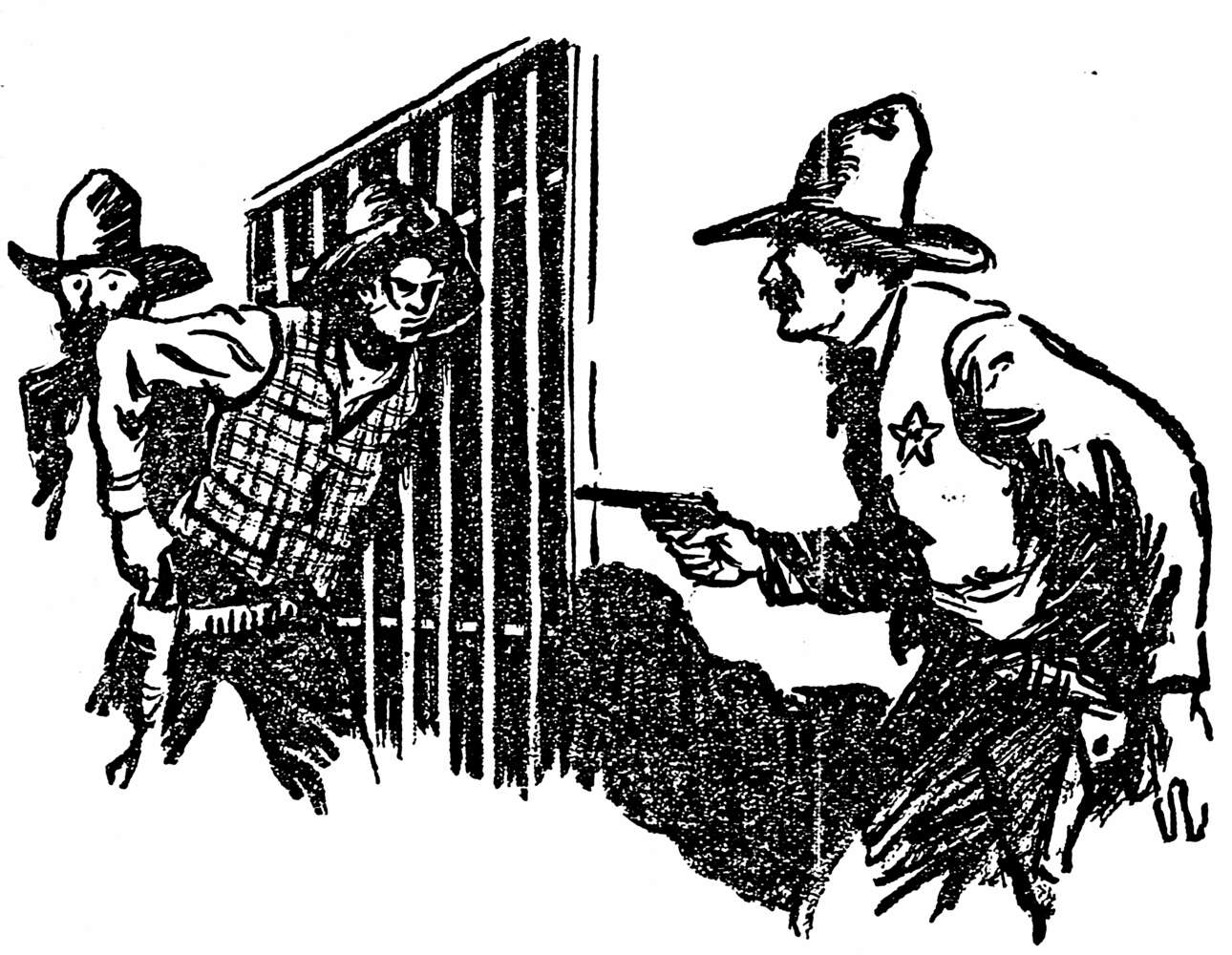
It was very hot when the sheriff sucked meditatively at his pipe in the county jail and listened abstractedly to the buzzing of the mob outside. It was dark, of course. Mobs do not often form in daylight—not mobs who propose to lynch one not especially reputable citizen for the murder of another still less reputable one. The jail was dark and more than a little malodorous. A darky in one of the rear cells whimpered a little in entirely unreasoning terror. A moth blundered heavily about the yellow-flamed lamp.
The only other sound was the sucking, bubbling sound of the sheriff’s pipe. He rapped it out and rammed out the stem with a broom straw. There was a knock on the thick outer door.
“Huh?” said the sheriff heavily.
“Has he come to, yet?”
“Not yet,” said the sheriff.
He refilled the pipe with care, and struck a match. He had to shift a heavy, blued steel revolver on his desk to get at the matches. He rearranged the matches and the revolver and the box of shells—already opened, so that all three articles would be equally convenient. He leaned back in his chair and smoked and sweated. He left the window of the office down, though. His forehead was creased in an irritated frown.
The buzzing of the mob outside the jail kept up. The pounding and thumping of a secondhand car came down the road, growing louder as it came nearer until it stopped with a squealing of brakes. There were voices, new voices and loud ones.
“... What in hell difference does that make? ... Might’s well go on an’ get through with it ... Ain’t no diff’rence whether he’s come to or not....”
The buzzing rose louder. The sheriff mopped his face and looked speculatively at the blued steel gun. He wished it weren’t undignified to fan himself. Any jury on earth ’ud convict Sam Blake an’ send him to the electric chair. Just cost the county a lot o’ money convicting him an’ the State a lot more electrocuting him. An’ with election comin’ on, an’ a lot o’ folks thinkin’ about votin’ Republican again, an’ all—— It was mighty foolish to try to keep ’em from gettin’ Sam.
A banging on the door again. The sheriff hitched himself upright.
“He ain’t come to, yet,” he said irritably. “I ain’t lyin’. I ain’t goin’ to let you-all have him, but I’m tellin’ the truth when I say he ain’t come to, yet.”
There was no direct reply, but voices growling to one another in the heat outside. Then someone was repeating savagely, over and over: “Want him to know what’s happenin’ to him—want him to know what’s happenin’ to him——”
The buzzing of the mob absorbed the sound. The sheriff continued to smoke and frown.
A little murmur, different from the buzzing of the mob. A voice protesting. The sheriff grunted. Preacher Bayles outside, arguing with the mob, trying to persuade them not to lynch Sam Blake. His voice was cool and persuasive. But another voice answered him.
“Hit was the hand o’ Gawd gave Sam Blake away! Hit was the hand o’ Gawd!”
The sheriff lifted his eyebrows. One may be a good church member, but the business of enforcing the law among ten thousand people, white and colored, leads to certain skepticisms.
“First time,” grunted the sheriff drily to himself, “I ever knew the Lord to knock a man cold so much longer’n was necessary.”
A car cranked up and went sputtering away. To get more people, maybe. If you had half a county mixed up in a lynching, you couldn’t do much about it. Somebody said you couldn’t indict a nation. Well, you couldn’t hang a county, either. Or half of it. Especially for lynching a cold-blooded murderer.
The killing had happened down in Bethel. And the sheriff, just by luck, had happened to be there, or Sam Blake would have been dead before now, unconscious or not. It was a clear case. Open and shut. Absolute, positive, hanging evidence.
The sheriff went over it in his mind. Something of stubbornness made him want to justify himself for what he was going to do. Get killed, pretty certainly. Kill some other people, quite likely. And over a murderer that a jury would send to the electric chair as soon as they left the jury box.
Nothing special about the killing itself, of course. Kittinger went into Bethel store to get his mail. He got it, growled at the storekeeper and went out. He stopped on the store porch to fill his pipe, leaning against a pile of newly arrived packing-cases that filled up three-fourths of the porch. And as he tamped down the tobacco with a horny thumb, from somewhere an incisive, spiteful crack resounded. Kittinger shuddered suddenly and moved his head to look astonishedly down at his breast. And then, quite abruptly, he pitched clumsily forward down the rough plank steps into the road. Then he was still.
The sheriff had been down in Bethel serving a summons and complaint. He’d heard the shot as a thin, muted, distant pop! They’d sent a man racing after him, and he got to the spot within five minutes of the killing. Kittinger’s body was still warm, still flaccid. His face still wore that expression of blank astonishment that would never be wiped off it. Never. The sheriff had been peculiarly shocked by the fact that a dead man’s hand should slip from his own and drop with a sickening, loose-jointed thud in the soft dust.
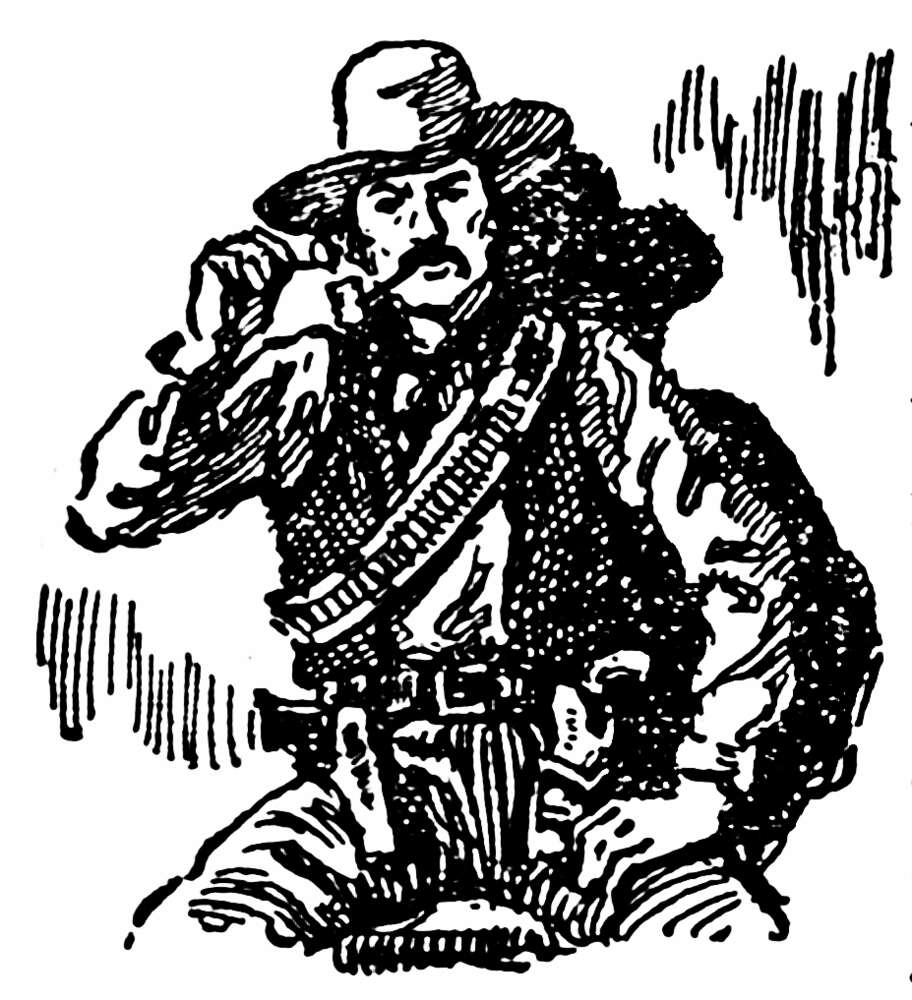
And they’d found Sam Blake in the disused blacksmith shop just across the road from Bethel store. With a gun lying beside him, and his toe caught on a discarded metal wagon tire half buried in the earthen floor. He’d fired his shot and turned to run away, and he’d stumbled over that unimportant obstacle. His head had hit a mass of brickwork as he fell. There was a great welt on his forehead where he’d struck.
“Open an’ shut,” growled the sheriff, sucking at his pipe.
Two more cars rolled up to the jail outside. The sheriff pricked up his ears. Sam Blake was still unconscious in the cell to which the sheriff had rushed him. He was the murderer, all right. Even his motives were clear. He’d wanted to marry Lucy Sears, and her father was making her marry Kittinger because Kittinger had more money. He’d have been lynched before now if he’d come to. But it is one thing to drag a scared and babbling man out of a smashed-open jail and hang him to a telegraph pole, riddling his body with bullets to make sure. It is an entirely different thing to haul a limp and unconscious figure, totally unresisting, out to the same fate. No mob is especially honorable, but that last is beneath even a mob.
Words rose above the murmur of the crowd on the courthouse green. Preacher Bayles was still arguing, trying to convince men that the law should take its course. The sheriff would take a hand in the discussion presently, but his argument would be the blued steel revolver lying handily on his desk, with the open box of cartridges beside it. It was horribly hot to think of fighting.
“The hand o’ Gawd——”
That was Pete Brown, the nephew of the dead man. He had been the only one to see Kittinger die. He’d seen the killing from his barbershop, fifty yards away, and he’d been the first man to reach the body. When the sheriff got to the spot where the dead man lay in the dust, Pete Brown was still babbling.
“I was lookin’ at him on the porch of the store, an’ he was fillin’ his pipe, an’ I heard the shot, an’ he looked down at his chest an’ looked surprised, an’ then he just slumped over an’ went tumblin’ down the steps——”
The whole scene came back with the vividness of tragedy. The sheriff felt the hot breeze on his sweating face; felt the curiously liquid feel of soft dust beneath his feet; saw the small, scared crowd parting for him and then seemed to see the still limp figure with the dark spot on its shirt-front, grayed with the dust of the road. There was no dignity in a death like that. One was merely a huddled heap in the dust before a mountainous pile of packing-cases.
“He was fillin’ his pipe, an’ I heard the shot, an’ he looked down at his chest——”
Something of the sick disgust he had felt returned to the sheriff as he sat smoking his foul old pipe in the sooty jail office.
He’d bent down over Kittinger in the roadway, and it had been shocking to find his wrist still warm, still flexible, still limp. He’d stood up.
“Who shot him?”
Nobody knew, but Pete Brown shivered and pointed to the gray and scabrous walls of the abandoned blacksmith shop across the road. The packing-cases on the store porch made it inevitable. Kittinger could only have been shot from directly across the road.
The sheriff waddled over to the place. Five minutes, at least, since the shooting. No man would be fool enough to stay where he had hidden to kill another, and the sheriff knew too much about the practical part of man-hunting to think seriously of tracks, of clues, of betraying signs left by a hastily fleeing murderer.
It had been almost with incredulity that he saw a man lying on the sun-speckled dirt floor of the abandoned shed. Sam Blake, sprawled out, tripped up by a forgotten piece of scrap iron in the act of flight. His head had hit the corner of a brickwork forge. He was unconscious then, as he had been ever since, but his rifle lay where it had fallen from his hands, with a freshly discharged shell on the floor just a little way off. Hanging evidence. Open and shut. Absolutely positive proof of his guilt. With just enough of the supernatural about his discovery to justify that talk of the hand of God that was being circulated among the members of the mob outside. And enough of the supernatural, too, to weigh powerfully with a jury.
“Hurried fool,” grunted the sheriff to himself in the dismal lamplit gloom of the jail. “What d’ I want to p’tect him for? Waitin’ theah till ol’ Kittinger come out, an’ drillin’ him, an’ then turnin’ to run before anybody came lookin’. He’d ha’ got away if he hadn’t tripped on that wagon tire an’ cracked his head on the forge.”
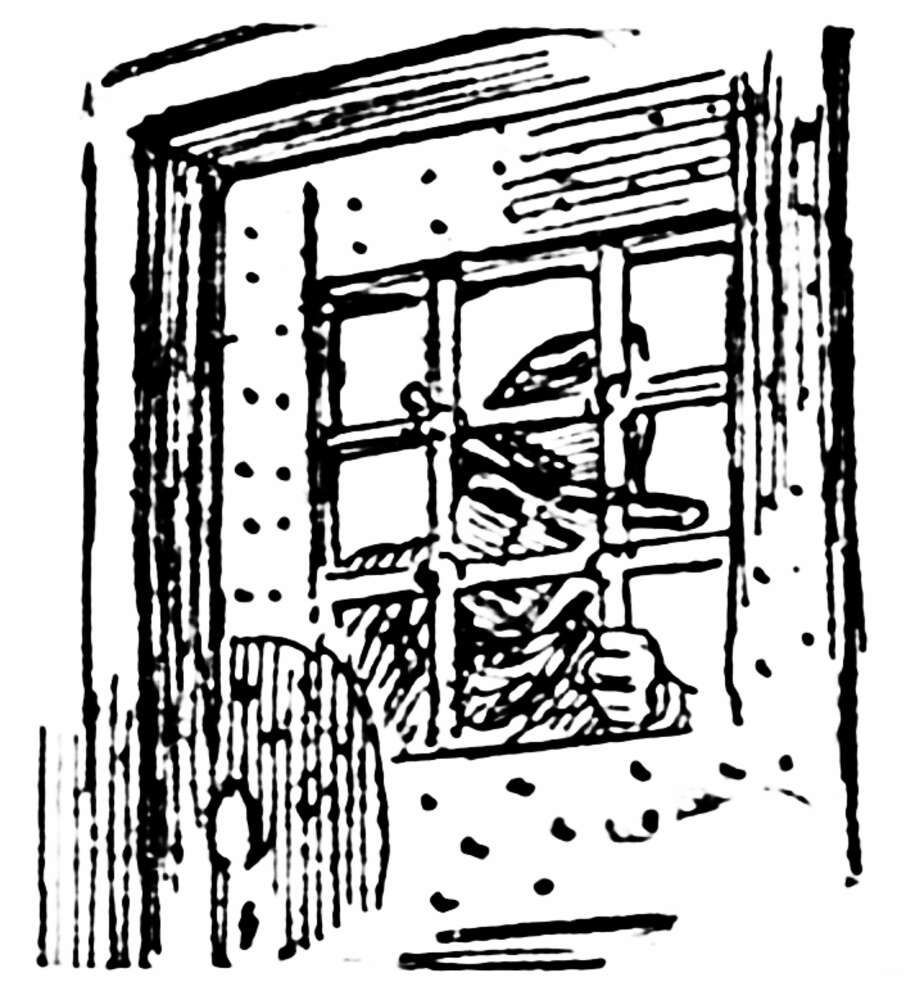
He stood up uneasily. He saw heads moving outside of the barred window. His pose, the revolver, the lamp, had not been arranged at random. Even the martyrdom of a closed window on a hot night had its purpose. The members of the mob could see him there with the gun and cartridges ready. But they could not talk to him. Moral effect. It is always daunting to see a man with a gun ready, when you cannot reason with him.
The sheriff waddled back into the jail proper. He unlocked a cell and went over to the cot against the wall. The fumes of strictly local moonshine arose to his nostrils. Sam Blake had nerved himself up to his bushwhacking by copious doses of corn whisky, it seemed. Still out. No—he was stirring.
“Pete, y’ g’dam fool, gimme ’nother——”
He relaxed. Snores, vast and stertorous, sounded monstrously loud in the tiny cell. The sheriff grunted.
“So drunk he don’t know what he’s done.”
He went out of the cell again. That fool darky was still whimpering in the stifling darkness. The mob was still waiting grimly. Cousins and neighbors and friends of Kittinger, waiting for Sam Blake to recover consciousness so he’d know he was being lynched. Getting impatient, too, and getting more numerous all the time. All his kinsfolk gathered. All of them suspicious of the law and the Democratic Party. Election coming on, and a proved murderer in the jail, and the sheriff needing re-election.
He growled stubbornly to himself.
“There ain’t a pris’ner got away from me yet, an’ they ain’t goin’ to take one now.” He sat down at his desk again, scowling.
A cloud of smoke came irritably from his lips. Perspiration streamed down his face. It was hot. The mob was buzzing more angrily, now. The sheriff knew what was needed, of course. Something to puzzle the men outside. Something to focus their attention somewhere else. A storm. A house on fire. Anything would do. He heard them puffing and grunting at something heavy. It wouldn’t do to look out of the window. His job was sitting here where all men could see him, with a revolver on the desk before him, making of himself a threat.
But it would be hard to kill men in defense of a murderer as low-down as Sam Blake. Lying there in ambush, waiting until a man stood still as a fair target——
The squeak of a wheel, outside. The sheriff grunted to himself, tucking his handkerchief inside his collar. Half of a log cart. They’d swing a ten-foot section of log to it and grab the shaft. Rush it against the jail door. It would break in. Then they’d come in and it would be time for the sheriff to start shooting.
“Gawd!” growled the sheriff disgustedly, “shootin’ them damn fools so’s a blasted murderer can be ’lec-trocuted instead o’ hung! That’s all it ’mounts to.”
It hurt. He didn’t like lynchings. Never had believed in them. Never would. But Sam Blake was the coldest-blooded murderer in the history of the county. And Kittinger’s kinfolk had a right to see that he died. If they’d shot Sam dead there in the blacksmith shop, with his empty gun beside him, nothing would have been done about it. Talk, maybe, but everybody’d have said it served him right. And there wasn’t much difference between that and coming and getting him out of jail.
“Huh!” snapped the sheriff to himself. “Am I gettin’ scared?”
Pounding on the door again. Something definite, final, something resolved in this pounding.
“Sheriff! Open up! We ain’t goin’ to wait all night!”
The sheriff reached over to his desk and picked up the blued steel revolver. He squinted at the shells in the cylinder. He was hot and angry and stubborn and irritated.
“Listen heah t’ me!” he snapped. “I ain’t aimin’ to kill you folks, but I’m goin’ to do it if yuh try breakin’ in that door! If Sam Blake comes to an’ confesses, maybe it’ll be another matter. But I ain’t goin’ to let anybody take an unconscious man outer my jail an’ hang him. If he confesses, a’right. But if he don’t——”
A momentary silence, while the sheriff raged in sudden shame. He deliberately cocked his revolver. Moral effect. The click would carry through the door. Murmurs.
“... Want him t’ know what happens, anyways.... The bloody louse’ll confess all right. The hand o’ Gawd’s on him.... Doc’ll bring him to.... Pete, you take yore car an’ get the doc....”
Men went back. More murmurings. Grim satisfaction outside. Somebody cranked up a car. The sheriff swore bitterly.
“Losin’ my nerve, maybe,” he growled. Then with a harsh disgust: “They forgot I got a telephone.”
He sat down at his desk again. He replaced the revolver within easy reach. He knew Sam Blake was guilty. Empty shell on the floor of the blacksmith shop. Empty gun almost in Sam Blake’s hands. The sheriff looked over at the killer’s rifle on a table by the wall in his office.
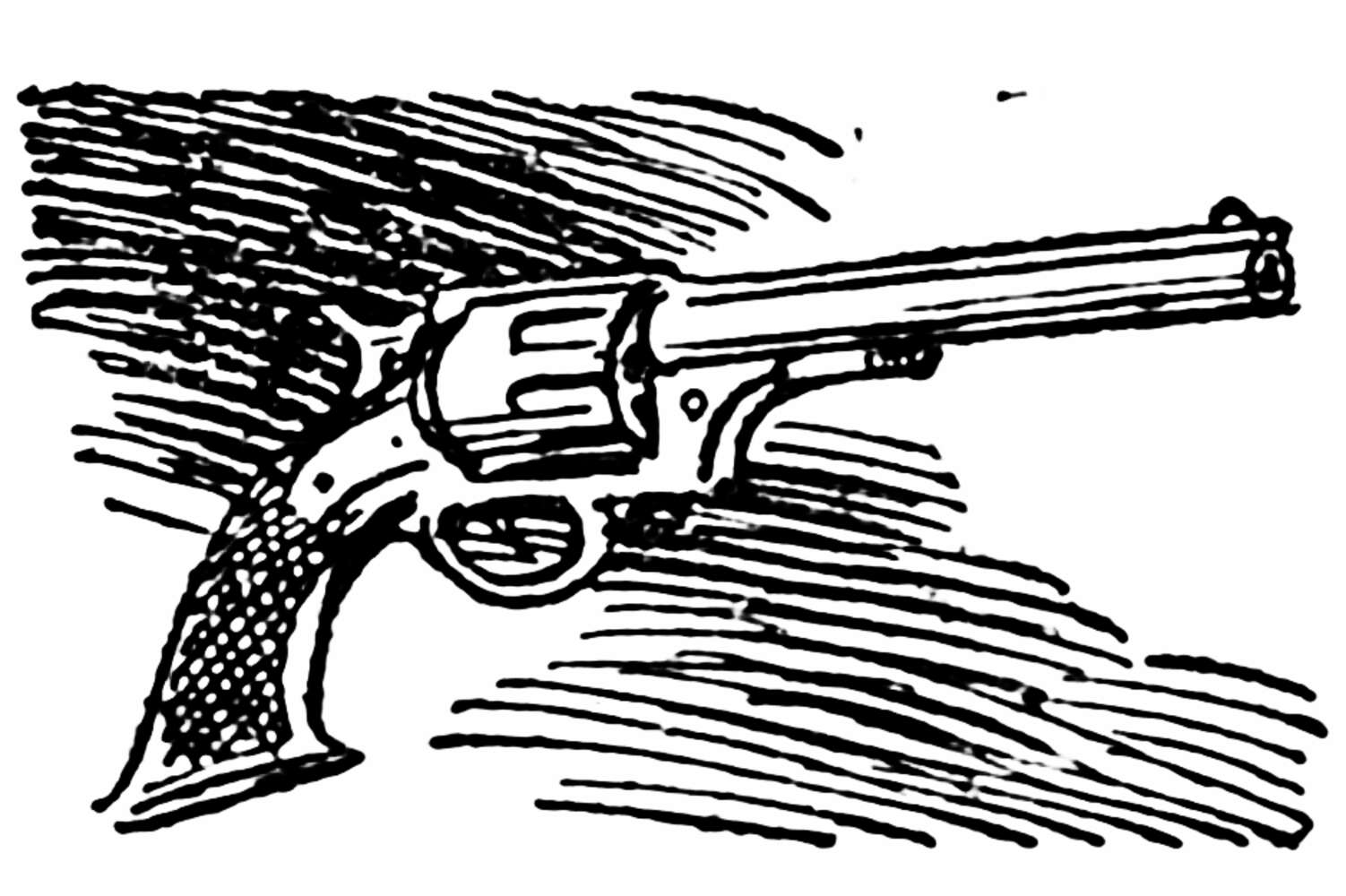
And then, quite suddenly, the sheriff swore a tremendous oath. He’d seen—— He thrust himself out of his chair and to the rifle with one movement. He picked it up. He snapped open the bolt.
An empty, discharged shell flicked out of it and went spinning to the floor.
The sheriff stared at it for seconds. His pudgy figure was stiff. The stem of his pipe snapped between his teeth.
“Hand o’ Gawd,” said the sheriff grimly to himself.
He picked up the empty shell. He went back to his desk and rummaged in the drawer. A little cardboard box. Another empty shell. A brass shell—the one that had killed Kittinger.
The sheriff set them up, side by side. He’d looked at Sam Blake’s gun. He’d looked in the barrel for fouling, for proof—which he hadn’t needed—that it had been recently fired. His handkerchief had fouled in the bore. Sam Blake’s gun had been fired. The sheriff hadn’t looked in the breech, however. Hadn’t there been the empty shell on the dirt floor? What need to look in the breech?
But—a rifle shoots one shell at a time! The killing of Kittinger had been done with one shot. And now he knew there had been two empty shells at the scene of the murder! One snapped out of a rifle after being fired, one left in. Two empty shells in the deserted blacksmith shop—and only one shot had been heard and only one bullet had been found.
The sheriff mopped off his face. Stubbornness suddenly intensified in his rather pudgy figure. This was funny stuff. Nobody was goin’ to take Sam Blake out o’ the jail tonight! Funny stuff. Wheah’d that extra shell come from? Wheah’d the bullet from it go? Why wasn’t the other shot heard? Sam Blake must ha’ killed Kittinger, but—why the other extra shell? The hand of Gawd?
“Ef Gawd’s han’ is in it,” grunted the sheriff stubbornly, “an’ Him havin’ thunderbolts handy, theah wasn’t any need to waste a thutty-thutty shell.”
He stared at the two bits of brass in the yellow lamplight. Sweat poured down his face, but he forgot it. The mob outside the jail was merely murmuring now. It was waiting. Doc Paulson had been sent for. He would come. He would be passed into the jail. He would bring Sam Blake back to consciousness. Maybe Sam would confess. Maybe he wouldn’t, when the mob would take him. The mob was waiting in a patient deadliness for what it was going to do.
“Time,” said the sheriff, sweating in an agony of impatience. “I got to have time to think hit out. Ef Gawd would send a thunderstorm, or set a house on fire, or somethin’ to get these folks thinkin’ about somethin’ else——”
Two brass shells where there should be only one! Small, insignificant things for a man’s life to rest upon. The sheriff had been wavering. Hard to think of killing men so that a proved murderer could be electrocuted instead of hung. Mighty hard. But something was wrong. Kittinger had been killed with one shot. The sheriff had heard it. And here were two empty shells—one from Sam Blake’s gun, and the other—— Where did the other come from?
The sheriff had to guess, and guess quickly. Doc Paulson would be back soon. When he was passed in, some members of the mob would force themselves in too, unless the sheriff started shooting. And when the mob once got in the jail, Sam Blake would go out with it. Confessing or not confessing, praying to Gawd or screaming he hadn’t done it. When Doc Paulson came something was going to happen. Sam Blake was going to get lynched. And there was something wrong—— Two shells, instead of one——
“I got to think. A thunderbolt, or a house on fire—even a haystack, Lord!” said the sheriff helplessly. “Somethin’ t’ gain me time! Somethin’s wrong!” He beat his forehead with a pudgy fist. “Wheah’s the hand o’ Gawd?” he demanded despairingly. “Ef Sam Blake ain’t guilty, why don’t the hand o’ Gawd show up?”
Rumblings. A car coming. The sheriff’s hand closed convulsively.
“I’m goin’ to get killed,” growled the sheriff defiantly, “an’ I’m goin’ to kill some other folks too, an’ Sam Blake’s goin’ to get lynched. This heah looks wrong t’ me. Ef he’s guilty an’ innocent folks get killed, it ain’t my fault!”
He gripped the blued steel revolver, full of defiance of some supreme power on which he had thrown all responsibility.
The car came nearer. Then the sheriff realized that it couldn’t be Doc Paulson. Too soon for him to get here.
“More folks for the party,” said the sheriff, setting his teeth. “What happens from now on ain’t my fault. It’s up to the hand o’ Gawd.”
The telephone rang.
The sheriff took down the receiver. It was his deputy talking, half a dozen miles away—asking fearfully if the sheriff wanted him to come in to the jail.
“No,” replied the sheriff savagely. “It ain’t up to me, what happens.” He was in a mood to clutch at straws. “But looka heah! You git to Doc Paulson’s. Quick! Theah’s a carload of Bethel folks hustlin’ theah to wake up the doc an’ bring him heah. They want him to bring Sam Blake to, so’s they can make him confess to the killin’ an’ lynch him. You git Doc Paulson outer his house if yuh have to drag him out in his nightgown. He’s to leave word he’ll be back ’most any minute. An’ then you keep him off somewheres. I’m playin’ for time. Keep him outer his house until the Bethel crowd leaves. When they come back, I’m goin’ to have to start shootin’. Understan’?”
The deputy, relieved at so tame an assignment, agreed volubly. The sheriff hung up the receiver and wiped the sweat off his face. He’d been asking God to bring on a thunderstorm or a fire, something to unsettle the lynching mob outside. God hadn’t done it. And the sheriff was still playing for time, hoping rather desperately for a miracle.
It mightn’t need a miracle, at that. Two small crowds are only one-fourth as deadly as one large one. While the mob was divided its menace was lessened. And mobs have no patience. Never. Part of the mob would not attack, because it would be waiting for the rest to return. And the rest of it might wait a long time for Doc Paulson to come back to his house. It might. But of course——
“I’m holdin’ on,” said the sheriff grimly. “It’s up to the Lord to build me a backfire.”
If he could hold off the lynching until morning, he could get help from the city and rush Sam to a safe jail. But the sheriff felt weak and shaky. He was dealing in mob psychology, which was not exactly one of his strong points, and he knew it.
“But there’s somethin’ wrong,” he said stubbornly. “They ain’t goin’ to hang Sam Blake t’night.”
He sat and stared at the two small cartridge shells without seeing them. He was listening—to the low voiced, savage murmuring of the mob—to the infinitely faint rustling of wind in the topmost branches of the trees on the courthouse green—to the whimperings of the darky back in the jail and the stertorous snorings of Sam Blake, too drunk to know what he’d done.
Time passed very slowly. Twice the mob grew restless, as its increasing murmuring testified. Each time it quieted down. But it was in a deadly mood when, all of half an hour later, a car came roaring down the road from Doc Paulson’s. The sheriff was drenched in sweat, but at the sound he rose and dried his hands grimly and picked up the big revolver. He was going to bluff, or he was going to shoot. He was going to keep Sam Blake from being lynched, or he was going to be killed. And he renounced all blame from the beginning.
He unlocked and flung open the jail door and stood in the opening, staring stubbornly out at the soft, velvety blackness. Headlights drew nearer and played upon the surging figures of the mob, moving toward the car. It stopped.
Voices rose; snarling, babbling voices.
“Doc was theah.... Dep’ty sheriff got theah while he was dressin’.... Talked to the doc.... He wouldn’t come. Him an’ the deputy said we’d have t’ drag him. The deputy pulled a gun.... Hell! It ain’t that important....”
The sheriff felt sick all over. The deputy had gotten there too late. Hadn’t understood, maybe. He’d just understood the sheriff didn’t want the doc to come. It was a bonehead play. If he’d come on with the doctor, the two of ’em might have kept the mob out of the jail while the doc lied and said Sam was dying.
The sheriff licked his lips and lifted the muzzle of his gun as the mob surged toward the jail.
“You-all lookin’ for the Pearly Gates?” he snapped. He was raging; wrathful with a supreme power which gave no help to a sorely tried peace officer in time of need. One last straw presented itself. “I’ll let two of you men come in heah,” he snapped again, “just so’s yuh can see I ain’t lyin’ about him bein’ in no shape to know whether he done it or not. Just two, so’s yuh can see. An’ if more’n that try to come I start killin’ somebody!”
His gun sent a sudden long streak of yellow flame out into the darkness. A man had run on ahead and was moving toward the jail door from the side. The sheriff’s voice cut through the echoes of the explosion as other guns came out in answer to his.
“I wasn’t aimin’ to hit, then,” he snarled, “but I’m tellin’ yuh! Two men, no more, can come in this heah jail!”
He was crouched down, deadly and desperate and despairing of help from above. He was going to be killed. He was quite sure of it. But his tired brain was clinging desperately to one last shred of hope. If they picked two men who would listen to him, he could show them the two shells. He could reason with two men, when he couldn’t with a mob.
The mob was milling aimlessly and angrily. The sheriff’s shout, alone, would have been useless. The shot, alone, would have been worse than useless. Together, they halted a mob not quite up to the pitch of facing hot lead for the sake of a killing it lusted for.
And then two men came forward. One was Pete Brown. The other was Lucy Sears’ father, raging because he had wanted his daughter to marry Kittinger.
“We’re heah,” said Sears harshly.
Pete Brown’s eyes were bright when the sheriff let them in the jail, and brighter when he barred the door behind them. He was fingering a gun in his belt.
“You try shootin’ him, Pete,” said the sheriff, “an’ I blow yuh to bits! A lynchin’ is a lynchin’, but one man killin’ another is murder, an’ yuh know it.”
Pete snarled at him. The sheriff was very weary, and very sick at heart. He took hold of Sears’ arm.
“Listen heah, Mistuh Sears——” began the sheriff desperately.
But Sears wasn’t listening. He was looking savagely after Pete Brown. And Pete Brown had gone on, and was staring into a cell—then he turned, with the smoky lamplight disclosing his teeth. Pete Brown looked remarkably unhandsome, just then.
“Y’ damned liar!” he snarled at the sheriff. “I seen him! He was sittin’ up! He flopped down an’ he’s pretendin’ to be passed out now. Shammin’!”
And suddenly the sheriff saw everything. Everything. Pete Brown was lying! He said he saw Sam Blake, but he didn’t, because the cell into which he was looking was empty. Sam Blake was in another cell entirely. And that little lie, of Pete Brown’s contriving, made two little brass shells mean——?
Pete Brown was shouting:
“Come in, folks! He’s up an’ about, only shammin’!”
And the sheriff’s voice cut like steel.
“The hand o’ Gawd’s come down at las’! Pete, yuh remembered t’ shoot off Sam Blake’s gun, but yuh forgot to eject the shell!”
Pete whirled. The sheriff’s big revolver was bearing unwaveringly upon his body, and the sheriff’s eyes were glowing.
“That cell’s empty,” said the sheriff, very calmly. “Yuh didn’t see anybody in theah, because it’s empty. But I’m willin’ to believe yuh did see yore uncle when he was killed. Only—whah were you when yuh saw him?”
He went hurtling forward as Pete Brown gasped and jerked something out of his belt. There was a terrific explosion in the iron and concrete interior of the jail. Then there were thrashing bodies, fighting madly between the rows of rusty bars. The bearded Sears stared, stupefied.
And suddenly the sheriff heaved upward, with blood flowing from a cut on his forehead. Keys jangled. A cell door clanked open and clanged shut again. There were thunderous, pounding blows upon the jail door. The sheriff shot through it, deliberately high. The blows stopped. He shot through it again, lower down.
“I just arrested Pete Brown,” said the sheriff, in a voice that cut through the thick wooden door. “I ’rested him for the murder of his uncle. Pete got Sam Blake drunk las’ night an’ shot off his gun somewheres, but the damn fool forgot to fling out the shell a’terward! An’ this mornin’, sometime before the killing, Pete banged Sam over the head—Sam bein’ still dead drunk—an’ dragged him into the blacksmith shop. Then Pete shot his uncle himself an’ run, leavin’ Sam to take the blame. But there was empty shells in the blacksmith shop, one where Pete’d flung out the shell he killed his uncle with, an’ the one he’d left in Sam Blake’s gun. Pete run along the back of the houses to his barbershop an’ run out, sayin’ he saw his uncle die. But, listen t’ me, you folks out theah! The porch of the store wheah Kittinger was killed is full o’ packin’-boxes. Pete couldn’t ha’ seen a damn thing from his barbershop! The only place he could ha’ seen Kittinger die is from the place the murderer killed him!”
A pause. One second. Two. Three—— Then Sears, beside him in the jail, gasped, “By Gawd! Hit’s so!”
He turned, his face working with rage. The sheriff’s gun came up.
“Git out o’ my jail!” said the sheriff grimly. “No matter who’s the murderer, theah ain’t goin’ to be no lynchin’ tonight! An’ me thinkin’—me thinkin——” The sheriff swallowed suddenly and went to the jail door, unbarred it, and stepped out. “Git to hell outer heah!” he snarled at the still dazed mob. “Git goin’! The lynchin’s off, if I have t’ kill every rannigan in the county!”
He was ready to kill, then. Quite ready to kill in defense of his new prisoner, who would have no option but to confess his crime and the lust for Kittinger’s money that had prompted it. Entirely ready to kill, now, for the sake of the law alone.
Men are queer things. And so are mobs. Anything that distracts the attention of a mob—a storm, a house on fire, the discovery that it was about to lynch an innocent man—— Did not such things show the hand of God?
A quarter of an hour later the sheriff went back into the jail from the now deserted courthouse green. He was trembling. He raised the window and a cool breeze came in and fanned his forehead.
“The hand o’ Gawd——” The sheriff felt suddenly guilty, as if he should apologize to someone or something for his previous skepticism and for his hesitation. But an innate stubbornness came to his rescue. “Dawggone it, hit wasn’t my fault! Anybody’d ha’ got mad!”